Cycling Through Jekyll and St. Simons Islands: A Historical Journey


May 4, 2026

Exploring the Historical Layers of Jekyll and St. Simons Islands in Georgia: A Cyclist’s Journey with Road Scholar. History is woven into nearly every stop and story on these remarkable islands, from grand clubs and pivotal events to deeply meaningful landmarks.

We cycled for a few hours each day, spending the rest of the time visiting historical and other unique sites across the two barrier islands.

Among the many stops we made on Jekyll Island, the most fascinating story for me involved the Jekyll Island Club and its founders. The original owner of the Island, Eugene du Bignon, a Frenchman, sold it to New York investors looking for a wintering place for hunting and recreation in 1886. Fifty shares were sold to industry elites in New York, including the Morgans, the Rockefellers, the Vanderbilts, and other titans of industry. Joseph Pulitzer was one of the original owners as well. He built his fortune publishing the St. Louis Dispatch-Post and later the New York World. A hotel was built, and some shareholders also built “their cottages,” which measured up to 10,000 square feet. The cottages had no kichens, all the people ate at the Club.
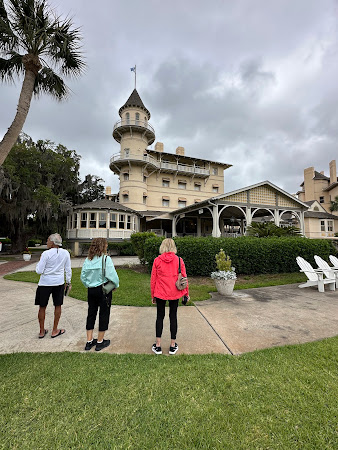

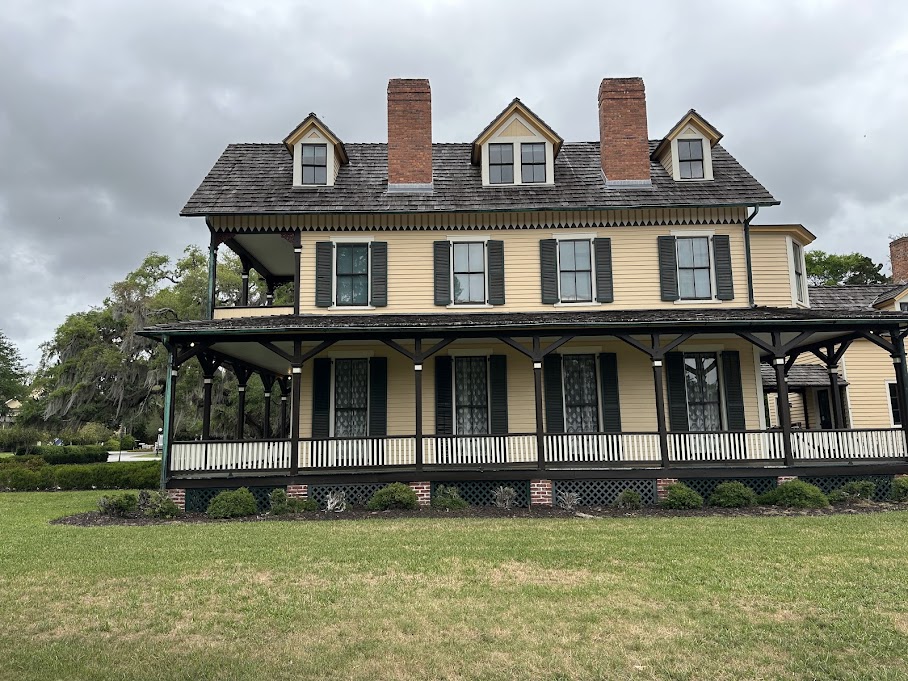
The Jekyll Island Clubhouse and the dining room. Below are two cottages.
Among the Club’s many noteworthy events was a 1910 gathering of American financial leaders, who drafted legislation that would later serve as the foundation for the Federal Reserve system.

The depression impacted the industrialist owners of Jekyll Island and their use of the Club diminished. Also, travel opportunities expanded in the 1940s, and the original owners’ descendants lost interest in Jekyll Island and the Club. After the Club closed in 1942, the Island was expropriated by the State of Georgia in 1947 for $647,000, designated a historic landmark, and turned into a State Park managed by a Governor-appointed Commission.

The architecture of the Clubhouse is in the Queen Anne style, with a typical four-story turret, wraparound porches, and complex rooflines. The interior is in the Gilded Age style, with luxurious furnishings that made me think about how the ultrarich lived in the late 1800s and early 1900s. Thwae Clubhouse is a magnificent building in my opinion and is open as a luxury hotel today.

Turning to another chapter of the island’s history, the story of the Wanderer stood out. This luxury schooner, built in 1856, was converted into a slave ship two years later. Businessmen brought over more than 400 slaves from the Congo in 1858 to Jekyll Island and sold the slaves in the South, that was against federal law since 1808 in the United States. The businessmen were indicted but not convicted, and the ship was seized by the Union Navy and later sunk by Cuba. The Wanderer Memory Trail on Jekyll Island relates the story of the slaves brought over from Africa. I found the exhibits along the trail fascinating, espemcially the musical instruments and the foods the black people brought over from Africa. Walking along the trail and listening to the audio stories gave me a bad feeling.

On St. Simons Island, two key points of interest drew my attention. First was Harrington House, which was once a one-room schoolhouse for black children in grades 1 to 7. Inside the building were pictures and artifacts related to the schoolhouse’s operation, as well as information about the students who attended. After the Brown v. Board of Education decision in 1954 (the desegregation legislation), the school closed, and the students were transferred to the wider public school system in Brunswick. The school docent was from the local community and had vast knowledge of the school’s history and explained that the island’s black population has decreased due to gentrification, falling from over 80 percent to just 1 to 2 percent of the current 13,000 residents.

The island’s past also comes alive at Fort Frederika, built in 1736 by James Oglethorpe. Now a National Monument, the fort was at the heart of 18th-century debates between Spanish and British governments over lands south of Savannah. Oglethorpe asked the King for a land grant to establish a colony, to serve as a defense against the Spanish. Like civil war sites, the Fort Frederika National Monument is a grassy field today with remnants of buildings and ramparts.

Oglethorpe was a visionary, and in 1736, he laid out a town, a utopian kind of village with streets forming a grid pattern, giving each resident a 50-by-100-foot piece of land on which to build a house and a fifty-acre site for agricultural uses. And he brought over from England indebted people in prison as colonists.
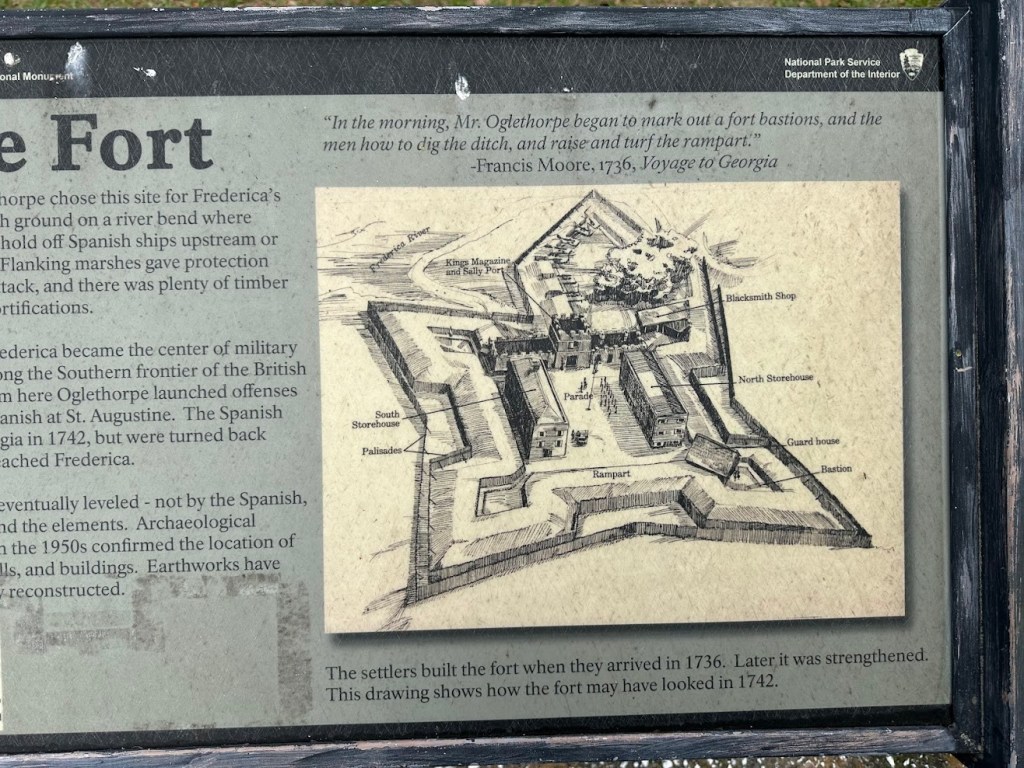
Fort Frederika.

I learned that the houses were built with “tabby”, a material made of crushed seashells, mixed with sand and water, the combination of which resembles concrete.

Before concluding my journey, I visited another unique destination: the Georgia Sea Turtle Center on Jekyll Island. It is a hospital for sick turtles as well as an educational and research center. I learned that turtles lay hundreds of eggs a few times a year, but only after reaching 30 years of age; after that, they lay eggs every second year up until they die, which might be at 100 years of age. But only one egg will grow into a full turtle out of 3,000 eggs!

The expert also explained that after the eggs hatch, the baby turtles are guided by moonlight to find their way into the water. She advised us not to use flashlights at night when watching the move of the turtles because that may confuse them and lead them away from the water.
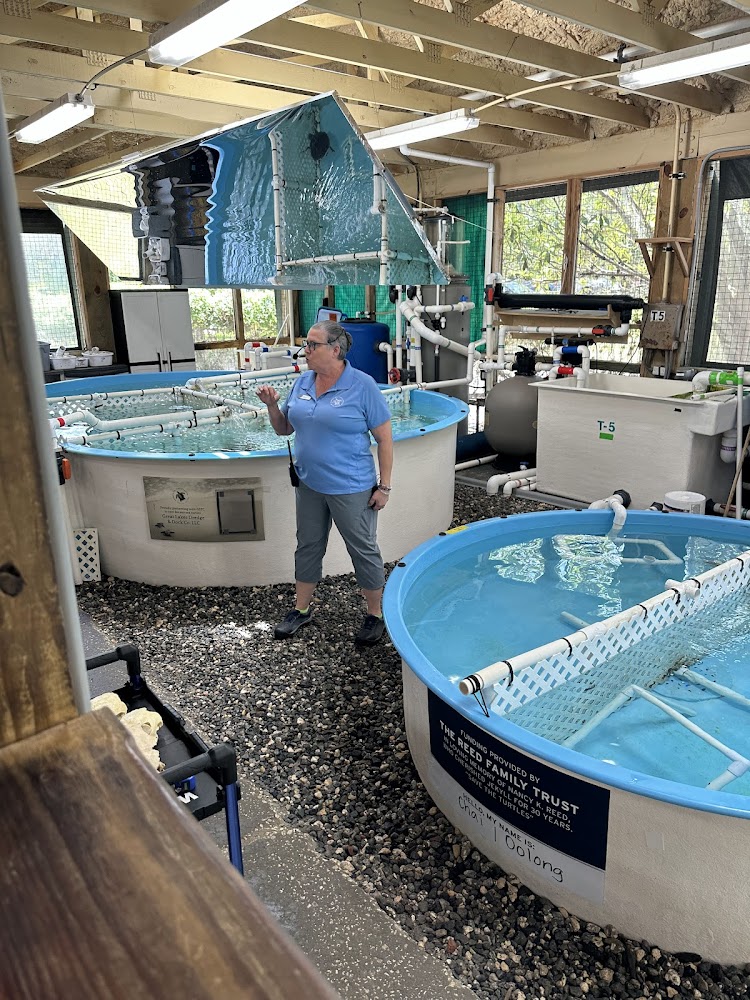
Tanks with recuperating turtles.

In addition to listening to an expert on turtles describing their lives, we observed technicians examining a turtle in a lab, behind a window. Next to the exhibition space on turtles was an industrial warehouse, filled with huge tanks housing recuperating turtles. Interestingly, there was only one turtle in each tank. Apparently, turtles are solitary animals, and if more than one is in a tank, they attack each other. Most of the turtles in the tanks came from Cape Cod; the cold water at the Cape caused hypothermia in turtles and were brought to this hospital for recuperation.

Visiting the two barrier islands offered a unique window into American history—from colonial times, through the Civil War and Gilded Age, to the civil rights period. The experience reminded me how these islands encapsulate the evolving story of the region, illustrating why their preservation and interpretation matter so much today.

Book Club Insights: Discussing Albright’s Take on Fascism


April 19, 2026

We thought our book club would have a great discussion of Albright’s book on fascism. And we did. Our group’s politics is mostly in the middle of the spectrum, from right to left. But we have someone on the far left, I would think about him as a tree hugger, with social views, and he is a vegetarian. A strong believer in climate change, who cycles everywhere when he can. At the same time, he has a Tesla and another car. And then we have someone on the right, who questions climate change and has been a supporter of Trump. I am not sure if he is still supporting him, although he followed the line justifying the Iran war by saying that for decades no President has had the balls to tackle Iran’s nuclear arsenal. I looked forward to our discussion.

Let’s not forget: our group starts with lunch, the quality of which has been improving with each meal, as if we are competing for better lunches. This time, we started with vegetable soup, with maple syrup as the key flavoring. Although I do not favor sweet soups, this soup was excellent and the cook was proud of his creation. Following the soup were sandwiches with any filling you wished for. With chips as well. And, oh, the desert was a cake, six inches in diameter and equally tall. It was a lemon cake that we cut into eight pieces; there were eight of us. We do not consume any alcoholic beverages yet, but I think it could come soon. Coffee was made, and we moved to the living room to continue our book discussion which had already started over lunch.

I asked, “What is fascism?” One club member explained that according to Albright, it is a form of autocracy, although not all autocrats are fascists. I took some time to digest this idea. In Albright’s view, autocrats try to dominate the judiciary, the press, universities, and are willing to use force and violence to enforce their rules. The examples Albright related in her book were Mussolini, Hitler, Erdogan, and others, and I was wondering whether perhaps Orban was an autocrat but not a fascist, since he did not use violence, to the extent that I am familiar with his story.

It did not take long before the discussion veered over to the present time and whether Trump is a fascist. Albright does talk about Trump’s first administration which exhibited characteristics of fascism but never called him a fascist. And it also did not take long to talk about the Iran war, triggering a flashpoint between our club members, between the far left and far right members. Tempers flared, and I interrupted the conversation by raising the question of how one country can interfere in another’s affairs; on what basis would such behavior be acceptable? I thought that measures to create temporary peace for a few years would be acceptable, providing time for further negotiations, and who knows what may happen in the next few years that may ameliorate current issues. I was called a “prag,” and I asked, “What?” Again, I was called a “prag,” which I suddenly realized was a term for a pragmatist, never heard that before. OK. I could live with that.

The book is written in an easy style, with anecdotes from Albright’s career that make it interesting to read (she was Secretary of State under President Bill Clinton). I found the book very relevant and entertaining, as it related to recent events I remember well from reading the papers and listening to the news. But I was surprised that Albright did not discuss Mao and Stalin, perhaps she did not consider them fascists, although both acted like autocrats, and used their power to intimidate their people, and used violence to enforce their governing philosophy. Mao and Stalin adhered to communist philosophy and nationalized assets while Mussolini and Hitler left private enterprise carry on.

The economic descriptions of countries she mentioned lacked numbers. I would have preferred to see numbers on economic growth, unemployment, industry trends, and similar matters to ground her broad characterizations, such as that Germany had a poor economy that helped Hitler gain traction. But I realize that she was a historian or political scientist, not an economist, and the book was not a research exercise.

Having read some more scientific books on climate change and cryptocurrency in our book club recently, this book was a nice change, offering a clear, plain-English account of recent history I could relate to. And we spent as much time on the book discussion as we did eating; I suspect some members joined to socialize.  However we all would probably agree that the club encourages us to read books.

The First Question Writing a Memoir: What Emotions Arise When Sharing Your Life Story


April 5, 2026

The first question when you write a memoir: What emotions arise when you think about sharing your life story?

That is a loaded question. For anyone writing a memoir, it may be the first consideration: are you prepared to reveal your personal history and inner thoughts to others? Which aspects of your life would you share, with whom, and would sharing bring you happiness or sorrow?

That raises a followup question: would I, or should I, experience emotion when sharing my story? By emotion, I mean feelings of pride or shame, excitement or boredom when discussing myself. I might downplay or amplify achievements. I could even conceal parts of my story, perhaps out of shyness or avoid recalling painful memories. When prompted, I think I would be happy to share but I would not initiate such discussions unless the setting was appropriate.

Another consideration: what is my life story? Is it focused on my career, chronological list of positions held? Or does it center on pivotal moments that shaped my life? Or would my story be marked by how I navigated adversity, or by how I capitalized on—or missed—opportunities?

Then, the audience matters. Am I sharing my story with people of my generation, who have similar accomplishments and backgrounds, such as fellow immigrants? Would I discuss it with someone experiencing homelessness when I have financial stability? Would I share it with children, and for what purpose?

For example, I would share my adventures and challenging experiences with those who have faced similar situations, but I might feel uneasy sharing with people whose lives have been sheltered. They might not relate to or value my experiences.

Issues of comparability can also lead to uncomfortable situations. We have seven grandchildren. People without grandchildren have said we’re lucky and well-off for that reason. I agree. But I am sensitive to such situations, and I do not want to cause discomfort, so I avoid the topic unless asked. People adapt their life stories to their listeners.

Another example, do you want to describe your children’s success, even if the other person had misfortune with theirs? There have been instances when such situations could have led to negative comparisons between my experience and theirs. I try to avoid those situations.

In conclusion: Would I share my story with someone? Yes. I have nothing to hide and would be glad to talk if someone is interested. However, I’ve noticed people are rarely curious about others’ experiences; even travel stories are met with polite acknowledgment unless the listener traveled the same routes.

I would prefer sharing my experiences with those who have backgrounds similar to mine, so we can genuinely connect over common ground.

If I were to share my life story, I would begin with my childhood in Hungary under the Communist regime, describing what that experience was like. A major turning point came when I walked to Vienna, where I was temporarily placed in high school. Afterward, I lived in Manchester, England, for a few months before flying to Vancouver, Canada, and start a new life. Other significant moments included attending university, getting married, having children, and building my career. Each of these events represents a critical event that shaped who I am today.

As my story continued, I would include my experiences in consulting and as a lobbyist, sharing what each role entailed. I would also discuss the countries we visited and the lessons we learned by exploring diverse cultures. Through these experiences, both professional and personal, my life story would come together as a collection of challenges, opportunities, and discoveries.

Some subjects, such as troublesome family matters, might be harder to share honestly. Although I could speak more openly about deceased family members, I might still avoid sensitive subjects.

Overall, I feel positive about sharing my life story when there is genuine interest, especially when I know my story will not make listeners uncomfortable.

Reflecting on Daily Life: My First Journaling Experience


February 9, 2026

Digital media often invades privacy, or should I say always. Ads for shoes, books, and cars follow online searches. Banners even remind me to journal (writing down daily thoughts, feelings and experiences). I’ve never done this before but yesterday was both challenging and interesting and decided to put it to writing.

Yesterday was challenging because the garage door would not open. Both cars were locked in, leaving us immobile with no public transit nearby. It took time to discover the problem—the spring was broken. Bottom line: I couldn’t get the 2010 Mazda3 to a repair shop for an appointment. The car needed a diagnosis for a knocking noise when turning right, and the brakes were pulsating.

I tried to disengage the door from the lift engine and just push it up. Because the spring was broken, the door was too heavy for me to lift. I used an 8-foot-long 2×4 stud as a lever but still could not lift it. A neighbor came over to help me. Together, we raised the garage door and put a stud under it to keep it from closing. I managed to drive the car to the repair shop, arriving late for my appointment.

Addressing the garage door issue promptly was important, as an open garage without cars inside can jeopardize security. Once I managed to drive out, I called the repair service, and fortunately, they had time in the afternoon to come over to fix it. This was an unanticipated and unwelcome expenditure, adding to the day’s complexity; I got lost driving to the garage even with my GPS on. I took an Uber taxi home.

Yesterday’s other event that made an impression on me involved the Uber driver and the two garage door technicians—all were recent immigrants. It made me wonder: are most service workers in Canada immigrants? While my sample was small, I found it interesting that all of them I met in one day were newcomers.

In halting English, the Uber driver related that he came from Cameroon 8 months ago; he was French speaking. This was his first winter in Canada. I gathered that he had three children under 10 years of age, and that his wife worked as well; they needed two incomes for the family to live. Driving a cab gave Yves, the driver, the opportunity to get home when the children needed him.

He could not find employment in Cameroon in his field, food processing, and immigrated to Italy, where his wife was already living. There, however, he felt that Italians were too close-knit and would not embrace foreigners. For example, he said he never saw a black bus driver in Milan. So, they decided to come to Canada and arrived last summer. On this day, the temperature was minus 20 degrees Celsius or minus 4 degrees Fahrenheit yesterday, a huge climatic difference from Cameroon.

I also had interesting conversations with the two technicians who came to fix the garage door in the aafternoon. The lead technician was from Punjab, India. With his Punjabi accent, he explained the meaning of ‘Punjab’ to me; it means ‘five rivers’ in Punjabi. He also talked about the partition of India while instructing the other repairman, who identified himself as a Palestinian.

Talking with the Palestinian, I learned that he grew up in Jordan but never goes to Gaza, where he has relatives, because of the Israeli road checks. In spite of carrying a Canadian passport, whenever he tried to cross into Gaza, the Israeli soldiers harassed him. So, he no longer visits. On leaving, he advised me to oil the moving parts of the garage door a few times a year and showed me the product he used, which is available at Home Depot. I never thought of oiling the garage door before, a learning experience.

Meeting three immigrants prompted me to reflect on Canada’s diversity. Statistics show that 1 in 4 Canadians is a first-generation immigrant, and another 17% are second-generation. Over 40% of the population has recent immigrant roots—it’s a remarkable diversity. I would not be surprised to find Canada to be the most diverse country in the world.

Late afternoon, I called the repair shop to check on my car. I was shocked to learn their huge estimate to make the car “safe” again. However, after discussing it with the mechanic and hearing his detailed explanation, I felt confident in his recommendation. I realized I had not had the car repaired for years, I thought it was indestructible.

I had to decide whether to choose repairs, knowing that more issues might arise soon, or consider buying a new/used one. First, I thought it was time to trade up. However, I reconsidered; the suggested repairs could extend the car’s use for another year or two. I have spent nothing on this car for years, and I liked the gearshift; they do not make gearshift cars anymore.

Reflecting on journaling, I do not expect every day to be as eventful as yesterday, worthy of journaling. Writing the journal required time and thought. It made me realize the importance of maintenance and discovered the impact of immigration on Canada via direct experience. Some days may be less striking, but journaling can still offer value.

What’s David Szalay’s book “Flesh” about


December 5, 2025

The Booker prize for 2025 went to David Szalay for his book Flesh. Szalay’s father is Hungarian, and his mother is Canadian. He was born in Montreal, but the family moved to London when he was one year old. Szalay studied at Oxford and lived in Hungary before settling in Vienna.

As a Canadian of Hungarian origin, I felt an ethnic kinship with Szalay and decided to read his book. And the book did not disappoint; I could not put it down and finished it in one day.

The book is the story of a hapless Hungarian, Istvan, who goes with the flow, lacks agency, and shows no emotion. He is someone whose life is shaped more by unexpected, random events than by himself.

For example, Istvan is seduced by a woman his mother’s age when he is fifteen years old. The woman ends the affair when Istvan falls in love with her. Istvan does not want to end the relationship, and while pursuing the woman, he ends up knocking down the woman’s husband, resulting in his death. As a consequence, Istvan is sent to a juvenile detention facility for three years.

Not knowing what to do when coming out of the detention center, a friend asks him to help import drugs from Croatia. When that adventure dries up, he joins the military and serves in Iraq. Coming home from the war with PTSD for which he receives treatment, he is only able to secure a job as a bouncer at a nightclub.

And random events continue to buffet him and shape his life. At the pub he frequents after work, he becomes friendly with the bartender and ends up in a relationship with her. She is married and stopped the affair in a year, afraid that her husband might discover the relationship. Istvan takes the end of the relationship nonchalantly; he seems unmoved by the experience.

In the next phase of his life, Istvan moves to London and becomes a driver for a wealthy family. The pattern of married women taking up with Istvan follows him wherever he goes. The industrialist’s young wife starts an affair with the obliging Istvan. When the industrialist, conveniently, gets cancer and dies, Istvan marries the widow, whose son dislikes him, for having an affair with his mother and subsequently marrying her.

Following the industrialist’s death, I thought the storyline became a bit unrealistic when Istvan takes over the company and starts making real estate deals with no education or experience in the field.

 But then the plot begins to close: when Istvan’s son and his mother have a car accident that takes the boy’s life and cripples his mother. The mother dies later without ever regaining consciousness.

Istvan becomes lonely but continues to lead the life of the moneyed class until the industrialist’s son, Istvan’s stepson, inherits control of the family company at age 25 and ousts Istvan. Losing his upper-crust existence in England, Istvan returns to Hungary and moves back in with his mother, living in the same apartment where he grew up. The story ends with his mother dying.

I thought the author could have added some essential details. For example, is Istvan a handsome, athletic individual attractive to women? I do not know, since the author never describes him in terms of his physical appearance.

Or perhaps Istvan is a charming conversationalist? No, the conversations are monosyllabic, with “yeah,” “what do you mean,” and “yeah, OK.” Istvan is unable to put together a sentence, an expression, or an opinion. The conversations are in the third-person present tense, which propels the action quickly and that is why I kept reading the book until I finished it.

Instead of describing Istvan’s physical appearance, however, the author does describe his behavior in detail: he smokes incessantly and uses alcohol and drugs for relaxation, habits he shares with his numerous women friends. And the sex encounters are described graphicslly.

There are also gaps in the story; for example, there is no description of Istvan’s tour in Iraq or of his stay in the juvenile detention center. The reader learns about Istvan’s experiences during those periods in subsequent chapters.

I also wondered what the message is in the story. Is it about Istvan’s masculinity in bedding numerous women? Is it about the emotionally detached life that Istvan leads, perhaps resulting from his PTSD? Is it about the quality of current life, focusing on sex, smoking, alcohol and drugs?

Some reviewers found the book boring, others exciting. The plot and the sparse writing style appealed to me, but I did not find the protagonist appealing. Is Istvan a typical Hungarian, and does his lifestyle reflect everyday life today? The book did not provide an answer for me. But the jurors for the Booker prize clearly thought that the book is a meaningful reflection of life today.