Cycling on Jekyll Island, Georgia, with a Road Scholar group


April 29, 2026

The challenge we faced while riding around Jekyll Island was using a coaster bike. It was unexpected, and we have not used those bikes in decades. It took some time to reacquaint ourselves with getting on and off those bikes.

Another challenge was cycling up the sand dunes with only one gear. Stopping was the final challenge when the cyclist just ahead of us suddenly stopped. We were to follow each other by one bicycle length. Most of us decided to follow the cyclist ahead of us by 30 feet.

We found the local drivers very courteous; they stopped for us and let us cross the road, even though it took a few minutes for the twenty of us to cross, riding in a peloton.

But once we got on the bikes, the pathways and scenery were worth the trouble of getting going on the coaster bikes. The island pathways were all paved, although I prefer dirt roads, in case I fall. Falling on the pavement could be painful. We were comfortable riding during the weekdays, but I suspect that on the weekends, cycling traffic might be heavy, especially given the pavement width, which was not 8 feet wide.

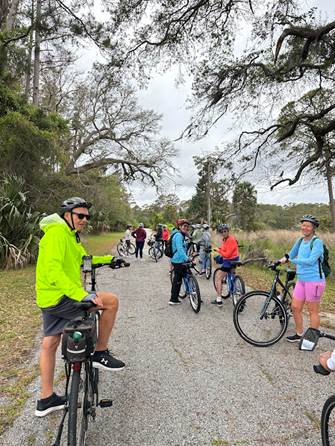
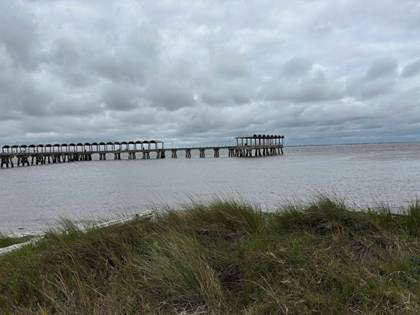
Our group is getting organized below, and the landscape along the ocean pathway.

The pathways circle the island, offering magnificent views of the ocean on one side. On the other side, the paths ring hotels, beach houses. The landscaping was outstanding on the entire island.

I found one disadvantage of riding in a group is the lack of opportunity to stop and take pictures when approaching a particularly attractive landscape. On the other hand, the guides lead us to the most photogenic sites.

We saw one of those unique sites today, Driftwood Beach. The picture below describes it better than I could.

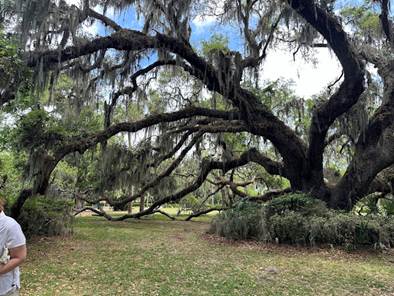
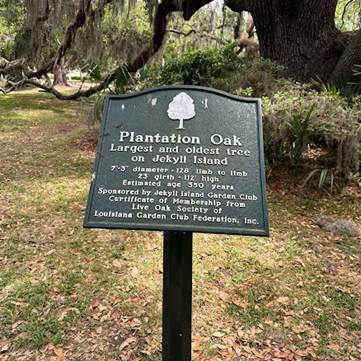
The oldest tree on the Island, a live oak, was also spectacular with its huge overhanging branches.

We averaged 8 miles per hour riding. Surprisingly, we spent only 2 to 3 hours riding while being on the road all day. The reason is that we visited historical, cultural, and environmental sites, enriching Jekyll Island. But just riding on Jekyll Island alone is a very rewarding experience and I would certainly recommend it. Next time, however, I will take my road bikes and not use the coaster bikes available for rent.

The Round Table in Winston-Salem, NC; Discussion of Gun Laws


April 23, 2026

The round table is in a courtyard providing access to four spacious bungalows. In one of those lives my brother-in-law and his wife, whom we visit a few times a year. Weather permitting, we sit around the round table each day for cocktail hour and discuss affairs, current and past. The volume of the discourse escalates proportionally to the amount of alcohol we consume and the nature of the subject matter.

The subject last night was a shooting at a local high school. Two people died, and four were injured, all under 18 years of age; they were high school students. It was a prearranged brawl. I have never heard of this type of get-together, where gangs or just groups of people arrange to meet for a fight, or brawl, or whatever. One of us at the round table described his experiences with such brawls in the past, except that there were no guns in those days. It was baseball bats, with which he said, “they beat the shit out of each other.” But with guns, the situation has changed. Of the five injured students, four were girls, and one was only twelve years old.

NC has an open carry law, meaning that one can carry a gun visibly. Sitting with us around the table, Wes and Beth have guns; Wes has a couple of dozen guns, a variety, including an AR15. The most expensive firearm he ever bought was US$3000. And following the law, he locks the guns away when not in use. He said that he used to carry one all the time, but less so now. He used to go to the gun range for practice and took courses for gun owners. Beth also used to practice on the range. They have never had to use a firearm, but Wes explained that it makes him feel safer carrying one. He also has a license for a “concealed weapon,” which allows him to carry a weapon on his body in a concealed location.

Huw does not have a gun but said some people attending his church may carry them, not visibly, because one cannot open carry a gun in a church or in government buildings. Why would anyone carry a gun into a church, into God’s house? Where one should believe in love and friendship and respect their neighbor, and so on. Isn’t this a contradiction of your beliefs?

I asked Wes why he has guns when he has never experienced the need for one. He said that the situation may arise when he needs one, when approchng suspicious looking people. Huw suggested that we should do away with guns, teasing Wes. But no, Wes said that “the bad guys can always acquire guns even if the government took all firearms away from people. And then the bad guys would have guns while the good guys would have no defense.” I asked whether he had forgotten about the police’s role in safety. But, of course, the police would take some time to respond, while people present, with guns, could take charge of the situation and shoot the shooter, was the response.

This take-charge attitude seemed to be Wes’ preferred approach to life and demonstrated his manliness by arriving in his huge Ford Explorer (six cylinders with 450 hp) and stepping out of the cab with a beer in hand.

Statistics on firearms I have read clearly indicate that in countries with strict gun laws or where guns are outlawed, the homicide rate by firearms is very low, compared to the US rates, by many orders of magnitude. But of course, how would the US get rid of guns, and at what cost? Not only financial but also political costs.

Just this morning, I read that there have been over one hundred seventy school shootings this year in the US. That is a huge number, and how many students have been killed? I think that this gun culture, with overtones of machismo, is vastly overrated and costly.

Some nasty overtones and dark broodings come to my mind when guns are used in video games and in real life. I have no hope that there is the political will to change this violent and aggressive behavior in the short run, that results from our fascination with gun culture. But then again, I realize that children, especially boys, like to play soldiers, and perhaps it is built into our genes, going back in history as part of the evolution of human society.

And just what happened this morning here in Winston-Salem, another school shooting, right after the school shooting yesterday. Two boys got involved in an argument with one shooting the other. The shooter was arrested shortly after.

The round table discussion was interesting, and we did not get into any uncivilized arguments. I did not learn anything new, except for some details about how open and concealed carry laws work. And I was flabbergasted to learn that some people attending church may carry a gun as a matter of course. But I have never met people before, who believe in having guns, practice shooting, and firmly believe in the value of carrying guns on their bodies in everyday life.

Book Club Insights: Discussing Albright’s Take on Fascism


April 19, 2026

We thought our book club would have a great discussion of Albright’s book on fascism. And we did. Our group’s politics is mostly in the middle of the spectrum, from right to left. But we have someone on the far left, I would think about him as a tree hugger, with social views, and he is a vegetarian. A strong believer in climate change, who cycles everywhere when he can. At the same time, he has a Tesla and another car. And then we have someone on the right, who questions climate change and has been a supporter of Trump. I am not sure if he is still supporting him, although he followed the line justifying the Iran war by saying that for decades no President has had the balls to tackle Iran’s nuclear arsenal. I looked forward to our discussion.

Let’s not forget: our group starts with lunch, the quality of which has been improving with each meal, as if we are competing for better lunches. This time, we started with vegetable soup, with maple syrup as the key flavoring. Although I do not favor sweet soups, this soup was excellent and the cook was proud of his creation. Following the soup were sandwiches with any filling you wished for. With chips as well. And, oh, the desert was a cake, six inches in diameter and equally tall. It was a lemon cake that we cut into eight pieces; there were eight of us. We do not consume any alcoholic beverages yet, but I think it could come soon. Coffee was made, and we moved to the living room to continue our book discussion which had already started over lunch.

I asked, “What is fascism?” One club member explained that according to Albright, it is a form of autocracy, although not all autocrats are fascists. I took some time to digest this idea. In Albright’s view, autocrats try to dominate the judiciary, the press, universities, and are willing to use force and violence to enforce their rules. The examples Albright related in her book were Mussolini, Hitler, Erdogan, and others, and I was wondering whether perhaps Orban was an autocrat but not a fascist, since he did not use violence, to the extent that I am familiar with his story.

It did not take long before the discussion veered over to the present time and whether Trump is a fascist. Albright does talk about Trump’s first administration which exhibited characteristics of fascism but never called him a fascist. And it also did not take long to talk about the Iran war, triggering a flashpoint between our club members, between the far left and far right members. Tempers flared, and I interrupted the conversation by raising the question of how one country can interfere in another’s affairs; on what basis would such behavior be acceptable? I thought that measures to create temporary peace for a few years would be acceptable, providing time for further negotiations, and who knows what may happen in the next few years that may ameliorate current issues. I was called a “prag,” and I asked, “What?” Again, I was called a “prag,” which I suddenly realized was a term for a pragmatist, never heard that before. OK. I could live with that.

The book is written in an easy style, with anecdotes from Albright’s career that make it interesting to read (she was Secretary of State under President Bill Clinton). I found the book very relevant and entertaining, as it related to recent events I remember well from reading the papers and listening to the news. But I was surprised that Albright did not discuss Mao and Stalin, perhaps she did not consider them fascists, although both acted like autocrats, and used their power to intimidate their people, and used violence to enforce their governing philosophy. Mao and Stalin adhered to communist philosophy and nationalized assets while Mussolini and Hitler left private enterprise carry on.

The economic descriptions of countries she mentioned lacked numbers. I would have preferred to see numbers on economic growth, unemployment, industry trends, and similar matters to ground her broad characterizations, such as that Germany had a poor economy that helped Hitler gain traction. But I realize that she was a historian or political scientist, not an economist, and the book was not a research exercise.

Having read some more scientific books on climate change and cryptocurrency in our book club recently, this book was a nice change, offering a clear, plain-English account of recent history I could relate to. And we spent as much time on the book discussion as we did eating; I suspect some members joined to socialize.  However we all would probably agree that the club encourages us to read books.

Troubleshooting iMac to MacBook Air: A Personal Experience


April 17, 2026

You’d think it is easy to upgrade your computer gear. Just buy a new computer, plug it in, and that’s it. Well, let me share our experience replacing an old iMac. Not to give you the conclusion of our story, but just to say that it took us one week to get the new MacBook Air functional, while using words not appropriate in polite company.

It began when Kathy’s 14-year-old iMac couldn’t load the Revenue Canada files needed to prepare taxes. We tried her 2-year-old iPad, which easily downloaded them, but it wasn’t suitable for doing taxes. The iMac had security issues, so I suggested that it was time for a new computer.

The first question was whether she wanted another 28-inch iMac. She decided to switch to a smaller one, perhaps a laptop. Since she was using Apple devices, we went to the Apple store to shop. She insisted that we get someone knowledgeable to set up her new computer and migrate the info from the old to the new device.

I said, ” Sure, let’s have someone do the entire installation, and the geniuses at the Apple store will do it for us.” Entering the store, a pleasant lady asked what we were there for and, upon learning that we’d like to buy a laptop, called another person to help us.

The young gentleman who came to assist us was very personable and provided the choices for screen size, color, and data storage on the computer. Once Kathy selected her choices, the salesman wrote up the order and brought out the selection from the back and led us to a table where another genius helped us start the computer and enter the date, time, email, and other basic information.

When finished with the initial tasks, I asked, “How do you transfer the data from the old iMac?” The fourth person, replacing the previous helper who went on her lunchtime, explained that we could do it at home, or bring in our mammoth 28inch iMac from home, and they would do it. Then he checked with the geniuses in the back, who advised that our iMac is too old to migrate its content to the new shiny MacBook Air. The explanation, if I understood it, was that they would download the iMac’s content to a storage device and then upload it to the new laptop, except that they did not have the appropriate storage device, or our iMac was too old for the task.

Instead, they advised us to call Apple support to do it ourselves. Ok, so we went home, and the first thing was to hook up the laptop to our internet service. And then the trouble started. We discovered that Apple, of course, has iCloud installed for its email system, but Kathy uses Gmail, which is not installed on an Apple device. So, we tried to install the Gmail program. And we tried and tried and tried again to no avail. No password that we knew was accepted.

Ended up calling Apple support and talked with a very courteous woman who advised us to go through the same steps we just did a dozen times to no avail. She concluded that it was a Google issue, not an Apple issue, so we should talk to Google.

I started with a Google chatbot, which, or should I say who, asked a dozen questions, very courteously in a mellifluous tone, and then decided to refer me to an actual person. The final instruction from the bot was to sign on a plan to pay five dollars, refundable, I was told, before I could talk to a real person. When I read the fine print on the plan, I discovered it would cost $90 a month, with cancellation at any time. I do not like signing up for these plans. I sometimes forget how many plans I have until I notice the charges on my VISA card, and then I have to hunt down the account to cancel it. So I just exited the chatbot.

My next line of attack was to have someone come to our house. She showed up late. After she tried to follow the instructions to install Gmail, just as we did before, and was unsuccessful, as we were, she left, suggesting that we figure out our passwords and have her come back for another visit.

We still needed help, so I left messages with a couple of service outfits. Surprisingly, many of these technical shops opened at 10am and closed at 3pm. I thought private industry would be more diligent and work longer hours.

Then I found one shop that had a timetable for making appointments online, and, more surprisingly, there were empty time slots for the same day. The tech expert at the store explained that Google had locked us out because we had tried to change the password 5 times. But he suggested that using our home internet service would recognize our Google account, and we could change the password there. He came to our house, came up with a new password, and started migrating data from the old iMac to the MacBook Air. It took all night to complete the migration.

It was a frustrating experience finding expert service and taking time to be present to answer questions about passwords. (Needed Face ID or fingerprint ID every time you logged in to either computer, or a password for the device, for your Apple account, and for Google). I had a steady supply of coffee and offered some to the tech expert, but he did not drink coffee or tea. He was from Mumbai; coffee or tea may not be a popular drink there.
Going to School in Hungary in the 1950s


April13,2026

The first memory that came to mind when I thought about attending elementary school in the early 1950s was getting hit on the knuckles with a ruler by a nun because I wrote with my left hand, and the nuns trained me to use my right hand for writing. I was eight years old.

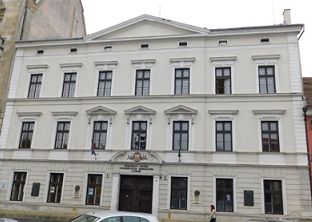
While searching for a Catholic school in Sopron, Hungary on Google Maps, I found the St. Orsolya Roman Catholic School (run by the Ursulines, established in 1757), and the road I took to go to this school came back to me. I used to walk alone about a kilometer from our apartment, a reflection of a time when it was once safe for children.

The nuns were strict at St. Orsolya. Homework was checked every day, and the class stayed quiet, or punishment followed. This could involve not only hitting your knuckles but also being slapped. Complaining to my parents was useless. They always sided with the teachers and thought I deserved punishment for whatever I did. Corporal punishment was accepted in those days.

One day, a classmate spat on me. I do not remember why. I did not get into a fight beyond pushing. When I came home, I told my father about the incident. He just listened. Then he told me to go to the boy’s house and tell his father what happened. My older brother came with me. I was flabbergasted at what happened. As soon as I told my classmate’s father that his son spat on me, he flew into a rage and started yelling that no son of his spits on people and began slapping his son with such vehemence that my brother and I just left their place in a rush. I did not think the punishment was fair. I did not think too much about the incident, nor did I understand the apparent significance of spitting on people. My father just listened when I told him what happened and said nothing.

After a year at the Catholic school, my parents transferred me to a public school on Deak Ter (Square), possibly because it was closer to where we lived. The building was old, with long hallways and a single bathroom at the end of each floor, with one toilet serving ten classrooms. I recall once waiting so long for someone using the toilet that I was late for class, earning harsh words from the teacher and a note to my parents. Despite this, discipline was less strict than at the Catholic school, and there was no physical punishment.

Continuing my education, I attended high school at the Berzsenyi Gymnasium (established in 1557) on Széchenyi Ter, about a kilometer from our apartment (until October 23, 1956 when I walked to Vienna). We stayed in our classroom all day, and the different teachers came to our room to teach the usual courses such as Hungarian language, Russian language, science, and history, except for physical education, which was in the gym. I think the school was for boys only, I cannot recall any girls in my class.

We had 50-minute classes and a ten-minute break every hour, from 8 am to 1 pm, six days a week. The ten minutes between classes gave students time to release energy, and we rushed into the courtyard behind the school, a dirt-and-gravel area bounded by buildings on all sides. Our favorite entertainment was playing soccer, kicking rocks around the courtyard.

Among the teachers, I especially enjoyed listening to the history teacher, who would leave his desk at the front of the room, sit on a school desk with us, and share stories about kings and emperors. I remember  his habit of sliding his glasses down his nose to review his notes, then pushing them back up before recounting gory events from medieval history.

Homework was assigned daily, and teachers often called students to the front at the start of class to answer questions from the previous lecture. The first ten minutes were tense as we waited to see who would be chosen, typically two or three students each session. Teachers kept an alphabetical list of the class, and we watched anxiously as the teacher leafed through the pages, trying to guess who was next.

Discipline consisted of teachers raising their voices. If that did not work, they sent the student to the corner and made him do squats. Sometimes this could go on for half an hour before he was excused, although the squatters took a break when the teacher turned away and did not see them standing around. Doing squats for any length of time can be strenuous. I felt like I was going to collapse when I was sent to the corner once. The squatting took place at the front of the classroom, so all the classmates watched and snickered.

High school teachers had a great reputation and were held in high esteem in Hungary. In the 1950s, most young people did not go to university, and high school was the highest level of education most people achieved.

I had respect for all my teachers except for one, who taught Russian. We had Russian language classes every year in high school, but they were taught by someone who had just learned Russian and was not very good at teaching it. My teacher spent much time on Russian grammar and made us memorize vocabulary, paying scant attention to speaking, since she was not fluent herself. And we did not like learning Russian; the Russians occupied Hungary at that time and were not welcome at all.

Looking back, my education was of pretty good quality. I learned discipline in doing homework, and all the memorization, poems, historical dates, events, and even Russian vocabulary helped me later when learning other languages. And I was always good in maths and the sciences, when I entered university in Canada with only a grade ten education, I performed well.