Going to School in Hungary in the 1950s


April13,2026

The first memory that came to mind when I thought about attending elementary school in the early 1950s was getting hit on the knuckles with a ruler by a nun because I wrote with my left hand, and the nuns trained me to use my right hand for writing. I was eight years old.

While searching for a Catholic school in Sopron, Hungary on Google Maps, I found the St. Orsolya Roman Catholic School (run by the Ursulines, established in 1757), and the road I took to go to this school came back to me. I used to walk alone about a kilometer from our apartment, a reflection of a time when it was once safe for children.

The nuns were strict at St. Orsolya. Homework was checked every day, and the class stayed quiet, or punishment followed. This could involve not only hitting your knuckles but also being slapped. Complaining to my parents was useless. They always sided with the teachers and thought I deserved punishment for whatever I did. Corporal punishment was accepted in those days.

One day, a classmate spat on me. I do not remember why. I did not get into a fight beyond pushing. When I came home, I told my father about the incident. He just listened. Then he told me to go to the boy’s house and tell his father what happened. My older brother came with me. I was flabbergasted at what happened. As soon as I told my classmate’s father that his son spat on me, he flew into a rage and started yelling that no son of his spits on people and began slapping his son with such vehemence that my brother and I just left their place in a rush. I did not think the punishment was fair. I did not think too much about the incident, nor did I understand the apparent significance of spitting on people. My father just listened when I told him what happened and said nothing.

After a year at the Catholic school, my parents transferred me to a public school on Deak Ter (Square), possibly because it was closer to where we lived. The building was old, with long hallways and a single bathroom at the end of each floor, with one toilet serving ten classrooms. I recall once waiting so long for someone using the toilet that I was late for class, earning harsh words from the teacher and a note to my parents. Despite this, discipline was less strict than at the Catholic school, and there was no physical punishment.

Continuing my education, I attended high school at the Berzsenyi Gymnasium (established in 1557) on Széchenyi Ter, about a kilometer from our apartment (until October 23, 1956 when I walked to Vienna). We stayed in our classroom all day, and the different teachers came to our room to teach the usual courses such as Hungarian language, Russian language, science, and history, except for physical education, which was in the gym. I think the school was for boys only, I cannot recall any girls in my class.
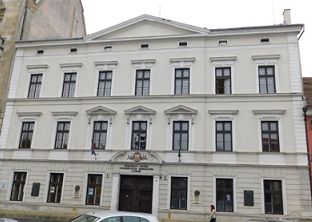
We had 50-minute classes and a ten-minute break every hour, from 8 am to 1 pm, six days a week. The ten minutes between classes gave students time to release energy, and we rushed into the courtyard behind the school, a dirt-and-gravel area bounded by buildings on all sides. Our favorite entertainment was playing soccer, kicking rocks around the courtyard.

Among the teachers, I especially enjoyed listening to the history teacher, who would leave his desk at the front of the room, sit on a school desk with us, and share stories about kings and emperors. I remember  his habit of sliding his glasses down his nose to review his notes, then pushing them back up before recounting gory events from medieval history.

Homework was assigned daily, and teachers often called students to the front at the start of class to answer questions from the previous lecture. The first ten minutes were tense as we waited to see who would be chosen, typically two or three students each session. Teachers kept an alphabetical list of the class, and we watched anxiously as the teacher leafed through the pages, trying to guess who was next.

Discipline consisted of teachers raising their voices. If that did not work, they sent the student to the corner and made him do squats. Sometimes this could go on for half an hour before he was excused, although the squatters took a break when the teacher turned away and did not see them standing around. Doing squats for any length of time can be strenuous. I felt like I was going to collapse when I was sent to the corner once. The squatting took place at the front of the classroom, so all the classmates watched and snickered.

High school teachers had a great reputation and were held in high esteem in Hungary. In the 1950s, most young people did not go to university, and high school was the highest level of education most people achieved.

I had respect for all my teachers except for one, who taught Russian. We had Russian language classes every year in high school, but they were taught by someone who had just learned Russian and was not very good at teaching it. My teacher spent much time on Russian grammar and made us memorize vocabulary, paying scant attention to speaking, since she was not fluent herself. And we did not like learning Russian; the Russians occupied Hungary at that time and were not welcome at all.

Looking back, my education was of pretty good quality. I learned discipline in doing homework, and all the memorization, poems, historical dates, events, and even Russian vocabulary helped me later when learning other languages. And I was always good in maths and the sciences, when I entered university in Canada with only a grade ten education, I performed well.
Life in my Early Years


April 7, 2026

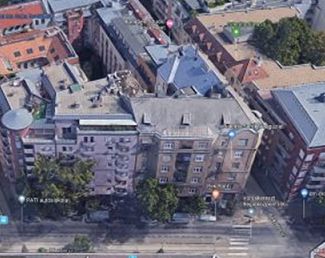
I’m unsure of my earliest memory. It may have been at age two or three. What I reall is that we lived in an apartment on the fourth floor, with the building facing a major street. I remember the address: 39 Mester Ucca (Expert Street) in Budapest, Hungary. It’s odd I remember the address but few other details, perhaps my parents ensured I knew it in case I got lost.

An early, clear memory I have is of the windows in the apartment. We covered them at night to darken and hide the building from incoming Russian bombers. As soon as the sirens shrieked, we rushed down into the basement for security. It occurred frequently. It was in 1944, during World War II.

The basement bunker was cold. People from the apartments huddled together, some on mattresses, others on the floor. I was scared as German soldiers and Hungarian Nazis searched for Jews to deport. The bunker was full; some may have been Jewish. At four, I didn’t understand the situation but saw fear. I pretended to sleep and waited for the soldiers to leave. The memory of Nazis searching for Jews in the bunker has stayed with me. I must have heard adults talk about it and seen soldiers question people. At age four I saw what was happening with no understanding of the context.

The Nazis also came upstairs to the apartments searching for Jews. We were warned by messages from each floor as they moved up. We awaited them with fear. My aunt Rose hid behind the china closet, which was placed diagonally across the corner to provide space for her to stand, hide, and wait until the Nazis left.

After these events in Budapest, my father, a medical doctor, was drafted into the Hungarian army, which was aligned with the Germans. We then all moved to an army camp in Szatmarnemeti, which was part of Hungary at the time but is now Romania. Father served on the military trains running in Ukraine. During our time at the camp, we lived in a modest military house, under the watch of a soldier. With the war ongoing, I vividly remember Russian planes swarming over the camp daily. Whenever the sirens alerted us to incoming bombers, the soldier would practically throw my brother and me into a four-foot-deep hole in front of the house, covering it with plywood. We shuddered inside, listening to the planes overhead, until the all-clear siren sounded, when the soldier pulled us out.

I cannot recall how long we stayed at the camp in Szatmarnemeti before returning to Budapest. After our return, Mother took my older brother and me out to a park a few blocks away on most days. This park had some play equipment: a sandbox, swings, and a rotating plaything. We walked there, an open, green space surrounded by concrete. The area where we lived had apartment buildings up to six stories high along the major streets, and two-story buildings on the local streets.

Our building had an elevator that never worked. It was in a cage-like structure with the staircase winding around it. We raced up four floors with my brother, always trying to beat each other to the apartment. The building was L-shaped. The entrance to the apartments on each floor was via an open balcony running along the inside of the building, facing a courtyard.

In terms of the neighborhood where we lived, I remember that gypsies lived in a large housing block, which my parents advised us to avoid. The housing block was doughnut-shaped with an entrance from the street. Inside was a courtyard surrounded by two-story buildings, occupied by gypsies who, I understood, lived communally.

The first level of apartment buildings along major roads housed commercial businesses, typical of European cities. A tramway ran on Mester Ucca. The neighborhood was noisy, and we rarely ventured far except when we moved to Szatmarnemeti.

I cannot remember where I went to school. No friends or images of a school building come to mind. Still, I must have attended school because we stayed in Budapest until I was eight years old, when my father became the director of the local hospital in Sopron, and we moved there.

Overall, I cannot say that I had a good time in my early life. But I did not have a bad time either. We never went without food. And I do not recall having friends or playmates who came to our apartment or whom I visited.

Beyond these hazy memories, I can’t recall anything unique. I can’t picture the room I slept in, though I likely shared it with my brother. I don’t recall specific toys or a single friend from eight years in that apartment. My most memorable early experiences relate to World War II.

The First Question Writing a Memoir: What Emotions Arise When Sharing Your Life Story


April 5, 2026

The first question when you write a memoir: What emotions arise when you think about sharing your life story?

That is a loaded question. For anyone writing a memoir, it may be the first consideration: are you prepared to reveal your personal history and inner thoughts to others? Which aspects of your life would you share, with whom, and would sharing bring you happiness or sorrow?

That raises a followup question: would I, or should I, experience emotion when sharing my story? By emotion, I mean feelings of pride or shame, excitement or boredom when discussing myself. I might downplay or amplify achievements. I could even conceal parts of my story, perhaps out of shyness or avoid recalling painful memories. When prompted, I think I would be happy to share but I would not initiate such discussions unless the setting was appropriate.

Another consideration: what is my life story? Is it focused on my career, chronological list of positions held? Or does it center on pivotal moments that shaped my life? Or would my story be marked by how I navigated adversity, or by how I capitalized on—or missed—opportunities?

Then, the audience matters. Am I sharing my story with people of my generation, who have similar accomplishments and backgrounds, such as fellow immigrants? Would I discuss it with someone experiencing homelessness when I have financial stability? Would I share it with children, and for what purpose?

For example, I would share my adventures and challenging experiences with those who have faced similar situations, but I might feel uneasy sharing with people whose lives have been sheltered. They might not relate to or value my experiences.

Issues of comparability can also lead to uncomfortable situations. We have seven grandchildren. People without grandchildren have said we’re lucky and well-off for that reason. I agree. But I am sensitive to such situations, and I do not want to cause discomfort, so I avoid the topic unless asked. People adapt their life stories to their listeners.

Another example, do you want to describe your children’s success, even if the other person had misfortune with theirs? There have been instances when such situations could have led to negative comparisons between my experience and theirs. I try to avoid those situations.

In conclusion: Would I share my story with someone? Yes. I have nothing to hide and would be glad to talk if someone is interested. However, I’ve noticed people are rarely curious about others’ experiences; even travel stories are met with polite acknowledgment unless the listener traveled the same routes.

I would prefer sharing my experiences with those who have backgrounds similar to mine, so we can genuinely connect over common ground.

If I were to share my life story, I would begin with my childhood in Hungary under the Communist regime, describing what that experience was like. A major turning point came when I walked to Vienna, where I was temporarily placed in high school. Afterward, I lived in Manchester, England, for a few months before flying to Vancouver, Canada, and start a new life. Other significant moments included attending university, getting married, having children, and building my career. Each of these events represents a critical event that shaped who I am today.

As my story continued, I would include my experiences in consulting and as a lobbyist, sharing what each role entailed. I would also discuss the countries we visited and the lessons we learned by exploring diverse cultures. Through these experiences, both professional and personal, my life story would come together as a collection of challenges, opportunities, and discoveries.

Some subjects, such as troublesome family matters, might be harder to share honestly. Although I could speak more openly about deceased family members, I might still avoid sensitive subjects.

Overall, I feel positive about sharing my life story when there is genuine interest, especially when I know my story will not make listeners uncomfortable.

The Echoes of 1956 in Today’s Middle East


February 5, 2026

One stated aim of this Middle Eastern war is to help the Iranian people replace their current regime. As the argument goes, the Iranian economy is weak, and with the pummeling of the country by bombs, this is an opportune time for the people to take over and establish the form of government they wish to have. This situation feels familiar to me, I remember the Hungarian uprising of 1956, when the US encouraged the Hungarian people to take over their government, leading people to hope for support that never materialized.

Let me go back to my memories. In my youth, I tinkered with bicycles, and then built a basic crystal radio. I am talking about the 1960s; we have come a long way technologically since crystal radio.

The “people’s radio” with one channelwas the standard radio set in Hungary in the 1950s. the channel boadcast government propaganda and communist/socialist ideas, tracing their routes back to Marx and Engels. I learned that a “rheostat” could change all that, and I bought one at the local hardware store. Once I installed it into one of the “people’s radios, I was ecstatic and danced around in my room, hearing all the foreign stations (German, French, English).

Mind you, reception was not good; all the foreign channels except the Hungarian official channel were jammed. I discovered that reception was better at night, and the foreign channels moved to different frequencies to avoid the jamming. Of course, the jammers searched for the moving stations, but during the time the jammers discovered and logged on to the new frequencies, I heard music and news.

It’s important to understand that altering people’s radios was against the law, as was tuning in and listening to foreign radio stations. I am not sure how the secret police could monitor people listening to foreign stations, but illegal activities were punished by jail and torture, so just knowing that something was illegal was enough to deter such activity.

Aware of the political atmosphere, I did not tell my parents what I had done; in fact, they could have gotten into trouble by an accusation that they let their son engage in an illegal activity. So, I listened to my new device at night and hid the radio under my blanket listening to foreign channels.

And this is how I heard it: in Hungarian, Radio Free Europe (FRE), a US agency, advocating the overthrow of the then-current Hungarian government. And the voice on RFE encouraged the Hungarian people to organize mass demonstrations on Budapest’s major streets and to take over the government.

Behind the RFE messaging was the view of John Foster Dulles, the Secretary of State under President Eisenhower, advocating the overthrow of the government. Hungarians were ecstatic; they thought the US was about to help the revolution by sending soldiers and ammunition. And they waited. And waited. But help never came.

Reading historical notes now, I learned that although Dulles encouraged the uprising to move to take over the government, but he later changed his mind, considering that Hungary was not a potential ally and that assisting the uprising might antagonize the Russians. He was also preoccupied with the Suez Canal crisis happening at the same time. But he took the Hungarian situation to the UN Security Council, proposing a diplomatic approach to resolve the uprising. The Russians, knowing the Americans would not interfere, came in with tanks on November 4, 1956, and crushed the uprising, which started on November 23.

The Russian tanks had taken a few weeks to reoccupy the country. By mid-November the situation appeared hopeless, and my brother and I walked out to Vienna (Austria) on the highway. Subsequently, we found our way to Manchester (England), and finally, to Vancouver, Canada, as refugees. I wonder how many Iranians are considering, or able, to leave their country.

All these memories came back when I heard the US encouraging the Iranian people to take over the government. Clearly, Hungary and Iran are vastly different countries; one has a population of 9 million, while the other has 92 million. Also, Hungary did not have nuclear ambitions. But inciting local populations to rebel and take over their government is a bold and drastic initiative with major consequences. The lack of follow-up to keep the uprising going, encouraged by the messaging of Radio Free Europe, was a crushing disappointment for the Hungarians in 1956.

An Evening at the Harvest Ball: Food, Music, and Memories


November 13, 2025

The challenge was figuring out what to wear to the Harvest Ball. I thought I had a sports jacket, but it wasn’t in the closet; then I remembered I’d given it to the charity store years ago. I have collared shirts and some fancy T-shirts, but the only formal wear I have is a black suit I haven’t worn in decades, and I was not sure if it still fits. The question was: What do people wear to a Ball today?

The Ball, organized by the Ottawa Hungarian House, was held at the Hungarian community hall, an informal space in an industrial building. I decided the safest thing to wear was the formal suit. But I could take off the jacket in the beginning, and with no tie and an open shirt, I would match the space’s informality.

We arrived 30 minutes early: the dinner was at 6pm. The hall was almost empty except for the organizers. There were no seating arrangements, so we picked a table on the side, next to a well-dressed woman sitting alone at the table next to us. By way of introduction, she said she was Clara and that she and her husband had come from Hungary in 1967. She spoke in Hungarian. When I said that Kathy does not speak Hungarian, she asked if she spoke English or French. When we settled on English, she said that she and her husband started a fur-making business and moved to Baie-Comeau, Quebec, in the early seventies, where the demand for furs was strong. When the local mining industry died and demand for fur declined, they moved to Ottawa. They continued making furs in their basement factory.

I went to the bar to buy a couple of glasses of wine. When I returned, a  Hungarian couple sat down at our table. His name was Zoltan, and I remarked that it was a good Hungarian name. I did not catch the wife’s name; it was getting noisy. Nokia hired Zoltan when he finished university in Hungary. After a couple of decades, Nokia transferred him to Seattle for two years, and then to Ottawa. They have been in Ottawa for a couple of years and like it here.

Zoltan’s wife was talkative and said that life is much easier here with all the appliances available, than in Hungary. I gathered they would like to stay on after their four-year work visa expires.

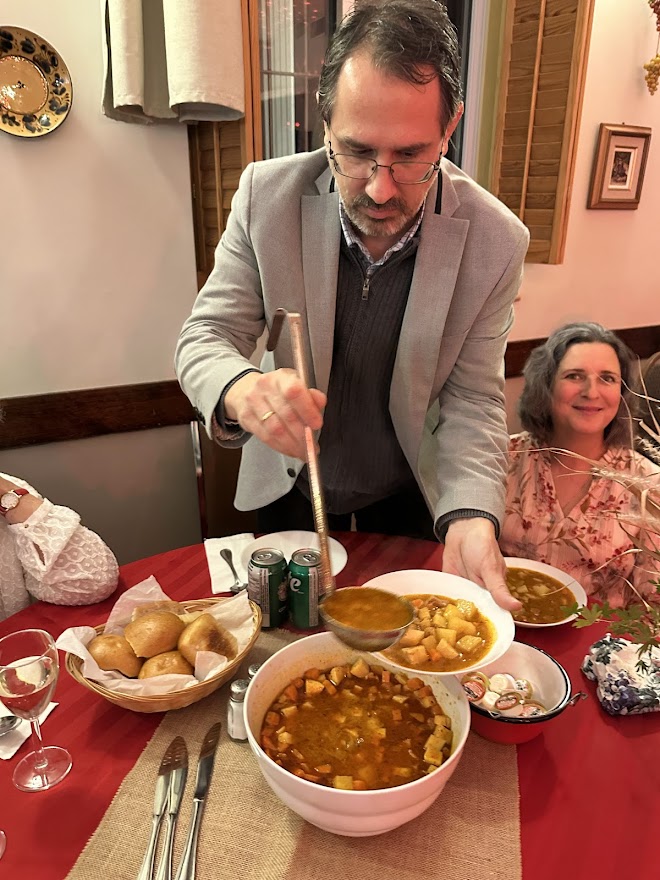
A huge bowl arrived at our table, filled with porkolt (pork stew). Although there were only four of us, the bowl could have served twice as many people. We served ourselves in family style. I enjoyed the porkolt, which was liquid and felt more like soup than stew. After tasting the porkolt, Zoltan’s wife thought that no real Hungarian paprika was used and that the porkolt could have been spicier. I agreed, but I enjoyed it with chunks of pork, carrots, and potatoes.

Oue Hungarian table companion serving “porkolt” family style

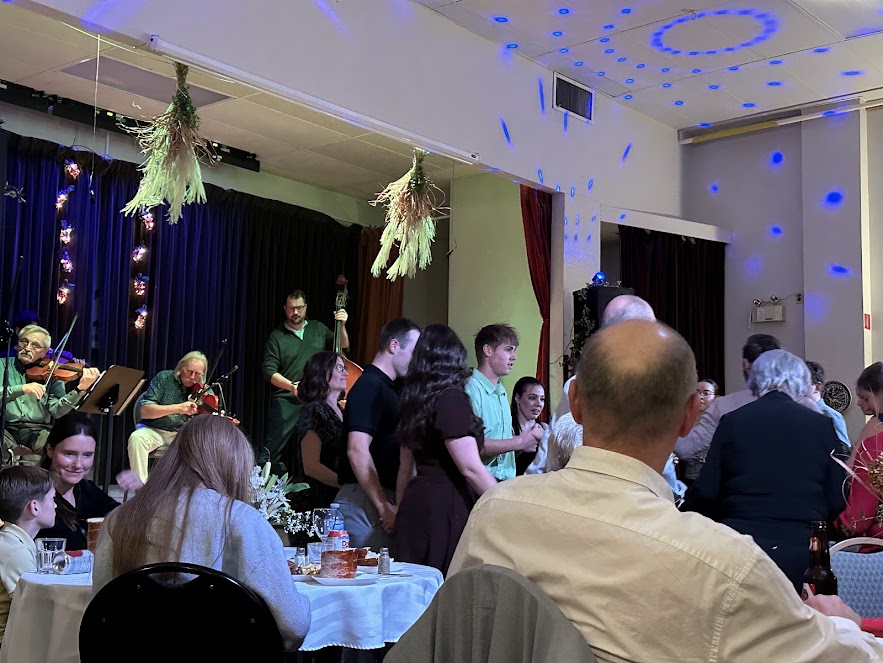
A couple of violinists and a bassist started playing Hungarian folk songs during the meal. The instruments reminded me of the music of Django Reinhardt – gypsy music with a swing – but these musicians played chardas, for Hungarian folk dance. People got up to dance, and soon the dance floor was packed. By now, the community hall had become extremely noisy, with over a hundred people talking, and dancing to the music. It was hard to speak and listen to our table companions.

As I have recently joined the Ottawa Hungarian House, I did not know anyone there. I have never been ethnically oriented. When we came to Canada, we were the type of immigrants who wanted to amalgamate into Canadian society. We did not live the life of the old country. And I married an American girl I met in graduate school at the University of North Carolina. We always spoke English at home, and the children grew up as native Canadians. I came to this event to hear some Hungarian spoken; I may be getting sentimental.

However, I knew some people from my high school in Hungary who studied with me at the University of British Columbia in Vancouver. I heard they came to Ottawa and approached the bartender if he knew any of my old friends, the twins Kalman and Peter Roller.  

He said, “Of course, Pista Roller is sitting back there,” and he took me to him, who was not Kalman or Peter but looked like their spitting image. Pista told me there were four brothers in the family. I was shocked to hear that the twins were dead: one had brain cancer and the other dementia. One was a pharmacist doing research in China and the other worked for the National Institutes of Health in Washington, DC. I wanted to follow up on this information and asked for his phone number to arrange for a get together.

Dessert came when I got back to my table. It was a caramelized pastry in the shape of a tube, four inches in diameter, and eight inches tall. I looked inside, thinking that there was some cream or fruit there. No, there was nothing inside; you ate the tube. The Hungarian couple explained that you tear a piece off with your hand, eat it, then keep tearing it apart and eating it. It is called kurtoskalach (chimney cake) and is a popular Hungarian dessert.

Chimney cake

It was an enjoyable evening of contrasts, combining ethnic foods, music, and dancing with people reading their iPhones and speaking English. The evening brought up memories. I described to our tablemates how we escaped from Hungary during the Hungarian Uprising of 1956. Our table companions who came to Canada two years ago acted like Canadians their age. And the Hungarians who came out decades ago enjoyed reliving the music and food of the time they left Hungary.