Bike Theft at Hotel and Digital Locks


May 16, 2026

This episode happened in Greenville, SC, on May 6. We came to cycle in GA, SC, NC, and VA, had our bikes on a Thule bike rack fastened to the back of the car, and locked with a plastic-covered braided wire cable. Well, the bikes were stolen overnight at the La Quinta, Heywood Hotel, where we stayed a couple of years ago, and we thought it was a safe place to leave the bikes on the bike rack, locked. I find it difficult to describe my feelings when I discovered the bikes had been stolen. I felt violated, ashamed for being stupid for not thinking to take the bikes inside the hotel, and upset at the same time. The built-in cable into the Thule bike rack gave me a sense of security, which was one reason that I bought this bike rack. It turned out to be a false sense of security. But the cable was cleanly cut with a wire cutter, and the straps holding the bikes down were snipped as well, but left in the grooves. It looked like it was a professional job.

When I exited the back door of the hotel and noticed there were no bicycles at the rear of my car, a very strange feeling of impending catastrophe came over me. I looked at the cut cable and the snipped straps, then immediately entered the hotel, walked to the reception, and, in a serious voice, described my misfortune to the clerk. He seemed stunned and said this had never happened at this hotel. Standard defensive comments that I did not believe for a moment but asked him what he suggested I do. The first thing he told me was that the hotel has signs posted in many locations stating they are not responsible for any items in cars parked in their lot. He suggested that I file a police report but did not offer to provide a phone number or call the police himself.

I asked whether the hotel monitors its parking lot? Yes, of course, he said they have cameras around the hotel and showed me the twenty-four or so live videos showing on a TV screen above the reception desk. So, I asked, ” Can you roll through the video stream showing the area at the back door where my car was?” He said it may not show anything, contrary to what a normal person would expect, perhaps because they turn off the cameras at night. And perhaps the overnight receptionist does not watch the cameras. I found our entire conversation wholly unsatisfactory. But what surprised me when I walked back to my car to take pictures of the cut cable was that I met a policeman who indicated they patrolled the area because of frequent criminal activity. I filed a report with the policeman and then walked back to the hotel and conferred with the Assistant Manager, who expressed the mandatory sorry for the incident but emphasized again that the hotel is not responsible for objects in or attached to the car on their lot, although my property insurance may cover loss of personal assets.

I thought the security around the hotel was lacking, despite the cameras placed throughout the exterior. Cameras do not provide security unless they are monitored in real time.

At a bike store in Durham, NC, I bought a Kryptonite bicycle lock after consulting with the store manager. He explained that the only 100% way to keep a bicycle safe is to take it into the hotel where one is staying when traveling. His bike was stolen once, and since then, he has always taken it into the hotel when traveling. But locks help when stopping for a coffee during the day; people looking for a bike are unlikely to steal one with a lock on it during the daytime in a parking lot.

Armed with this information and the newly purchased lock, I started my car and noticed a Starbucks sign at a Barnes & Noble bookstore. It was time for a good coffee, so I entered the store. I thought it advisable to empty my bladder before buying a coffee and starting on Interstate 40 towards Winston-Salem, and searched for the washroom in the bookstore. The door had a digital lock. OK. I searched for an attendant to learn the code. While serving a customer, she handed me a small piece of paper with a five-digit code.

The code worked, but I wondered what the purpose of using the code was; would they refuse to provide the piece of paper to anyone? It inconveniences customers who must ask for the code. But the process also gives the attendants an opportunity to assess the customer requesting the code. Is that the purpose of using a code to access the washrooms? And how do the attendants assess whether to provide the code to the customers? Or do they think that if the washroom is not open, some customers would just walk out of the store? I found the system interesting, but couldn’t understand its purpose or how it would be used. It inconveniences customers and gives store clerks an opportunity to assess who wants to use the washroom. But would they ever refuse a customer the use of the washroom, and on what basis?

These are just a couple of ad hoc examples of security methods. But clearly, one purpose of security systems is to identify people who may commit criminal activity, cause damage, or be unsavory and/or undesirable to visit the premises. While monitored cameras can be useful, digital locks are less so without articulated policies on who is allowed to have the code.
Finding Travel Partners: Lessons from Ottawa West Probus


February 6, 2026

I was disappointed attending an organizational meeting for a travel group. The Ottawa West Probus Club decided to establish a travel interest group. A volunteer arranged the meeting to discuss what we should do. We met in a cold church room with no coffee provided. A poor beginning for me. On top of this, only five people showed up, including me. A very inauspicious start, when we have two hundred people in the Probus Club.

Right off the bat, someone mentioned privacy concerns. She took exception to the spreading of personal emails; I assumed she was referring to the invitation to this meeting. I wondered how difficult it would be to organize a group without using email today. Should we use a phone instead and call each participant? Would that be time-consuming? The same person also expressed a dislike for people taking pictures when the lunch group meets.

After this curious discussion of privacy issues, the organizer asked what we wanted to get out of this meeting! Since this was the second meeting of this group, and since only I and another person were new, I thought the purpose of this group had already been established. But no, the agenda was wide open.

I suggested three options based on experience: holding monthly meetings with travel slide shows, inviting guest speakers from travel companies, or organizing group trips ourselves.

These options were not what the organizer had in mind; she explained that this group would serve only as a “travel dating” site, where people with similar travel interests would be introduced to one another. And once such a group coalesced, they would handle travel arrangements like flights, hotels, and tours. Ok. But why is such a service needed?

Well, she explained, people do not like to travel solo and look for company. Family or friends, I assume. The assumption is that people do not find family members or friends available to travel with and look for travel companions with similar interests, likely members of the Probus Club.

I agree with her opinion. It is a challenge to find friends or family to travel with, as preferences for travel differ—some enjoy cruising, while others prefer five-star hotels. Our nascent travel group aims to connect Probus Club members with similar travel interests and preferences.  

The idea of traveling in a group with local people made me think of what we used to do. We used to arrange our trips and travel with a backpack, just the two of us. We looked forward to meeting local people in faraway countries, tasting their food, whether spicy or not, and learning about their culture. Getting lost on our way was always a highlight, a learning experience, and I thought we were enriched by such unanticipated adventures.

I am not sure that I want to travel with our Probus friends; in fact, traveling with a group often limits interaction with locals. Guided tours are efficient for planning, but limit opportunities to engage with locals. Some prefer arranged trips, while others enjoy planning their own trip.

I left the meeting with no information on the next steps. But it has become clear to me that the organizer should explain the idea for this travel group in the Probus Club newsletter. And that there should be a structure in place to allow people to sign up for trips of their choice.

Considering all this, I left the meeting seeing limited value of this travel group for our Probus Club. But I give full credit to the organizer for trying to get this group off the ground.

Note: Probus is a worldwide organization run by volunteers. It is a non-profit organization for semi-retired and retired professionals and businesspeople, with no political or religious ties.   It started in the United Kingdom by a Rotary Club.

The Allure of Discovery Trips: Why We Travel to Discover


February 5, 2026

We travel not just for leisure, but for discovery. At a recent lunch, friends talked about the journeys they hope to take before age or health makes such trips impossible. This made me wonder: why does traveling hold such appeal? I am not thinking of holidays or beach escapes, but of trips to countries unknown to us—adventures I call discovery trips.

Discovery trips offer a sense of freedom. Packing minimally—a suitcase and a backpack for daily excursions, I leave behind daily commitments. Far from home, it feels liberating not to worry about bills or routine chores like taking out the garbage. In unfamiliar countries, every day offers discovery: meeting new people, sampling local dishes, observing architecture, and learning to navigate local buses. Conversations with locals often become both enjoyable and necessary as we find our way.

Travel also offers an education. Seeing things with new eyes becomes inevitable. The visible poverty in India, for example, places North America’s general wellness into sharp relief. Comparing Ottawa’s traffic to maneuvering through downtown Dhaka, Bangladesh, showed me how minor our own traffic woes are in comparison.

Before these trips, I research our destination. After returning, I expand on what I’ve learned. I once knew about the Indian caste system in theory, but witnessing it firsthand deepened my understanding of its implications.

The memory of an incident at Kolkata’s airport remains vivid. A well-dressed man suddenly placed his suitcases in front of ours as we waited in a long line for x-ray inspection. My temper flared, and I pushed his suitcase aside, firmly telling him we had arrived much earlier than he had. He made no argument—perhaps because we were foreigners. That experience prompted me to return home and delve into the history and evolution of India’s caste system.

There was also the night our hosts in Dhaka took us to their favorite restaurant. When they ordered goat brains during a period of mad cow disease in England, curiosity mingled with courtesy. We ate. The dish resembled scrambled eggs, though spiced differently.

Each trip required us to set aside our Canadian routines. We engaged all our senses with local culture, cuisine, and people. I took no notes at the time, yet I now realize that relying on memory allowed me to reflect and better recall details that differ from our own way of life.

Boldt Castle Visit: History and Architecture Unveiled


October 22, 2025

October 11. We played tourists today. Although we live just an hour and a half’s drive from Boldt Castle, we had never visited it until now. I’ve heard of the castle, of course, but it’s located on Heart Island, in the Thousand Islands region of New York State, on the St. Lawrence River. Visiting from Canada requires a passport, and since we don’t carry our passports with us every day, we never thought about making the trip.

One can visit the castle from Alexandria Bay in New York State or from Canada, with ferries departing from Gananoque and Rockport, Ontario. We decided to go from Rockport to save time, as driving to Alexandria Bay takes longer.

Upon arriving in Rockport, we noticed eight large tour buses. To my surprise, many tourists from China started disembarking. A local who was familiar with the area explained that Chinese workers are often rewarded with tours to Canada, and many of them visit Montreal, or Toronto, making a side trip to Rockport on their way to Niagara Falls. We also encountered other visitors in the parking area, including a couple from Toronto who were making the long drive back home the same day. We met another couple from Pennsylvania, who decided to sightsee in Canada before visiting the castle. I hadn’t realized how popular the castle is as a tourist attraction. A guide told me that five hundred to two thousand people visit the castle each day.

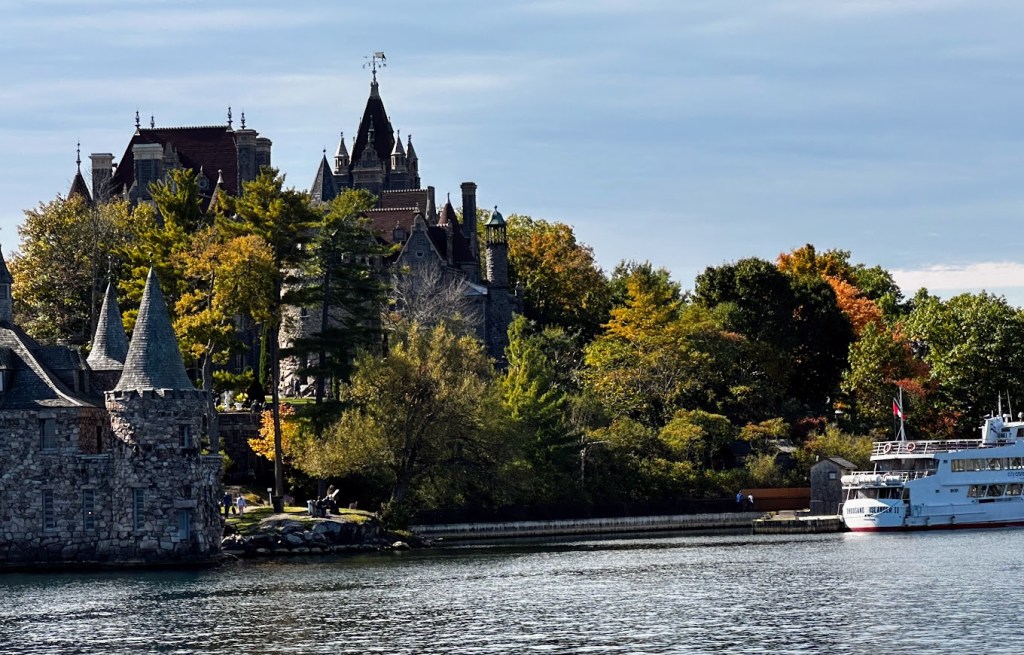
The boat trip to Heart Island takes about half an hour and passes by some extravagant cottages that resemble large houses more than typical summer homes. Upon landing on Heart Island, we went through U.S. border control, which took a while due to the long lineup of visitors. After we cleared the U.S. border, where they took a photo of us without hats and with our glasses off, we had a couple of hours to explore the island and the castle. Then, we returned to the dock for our trip back.

The view from the ferry

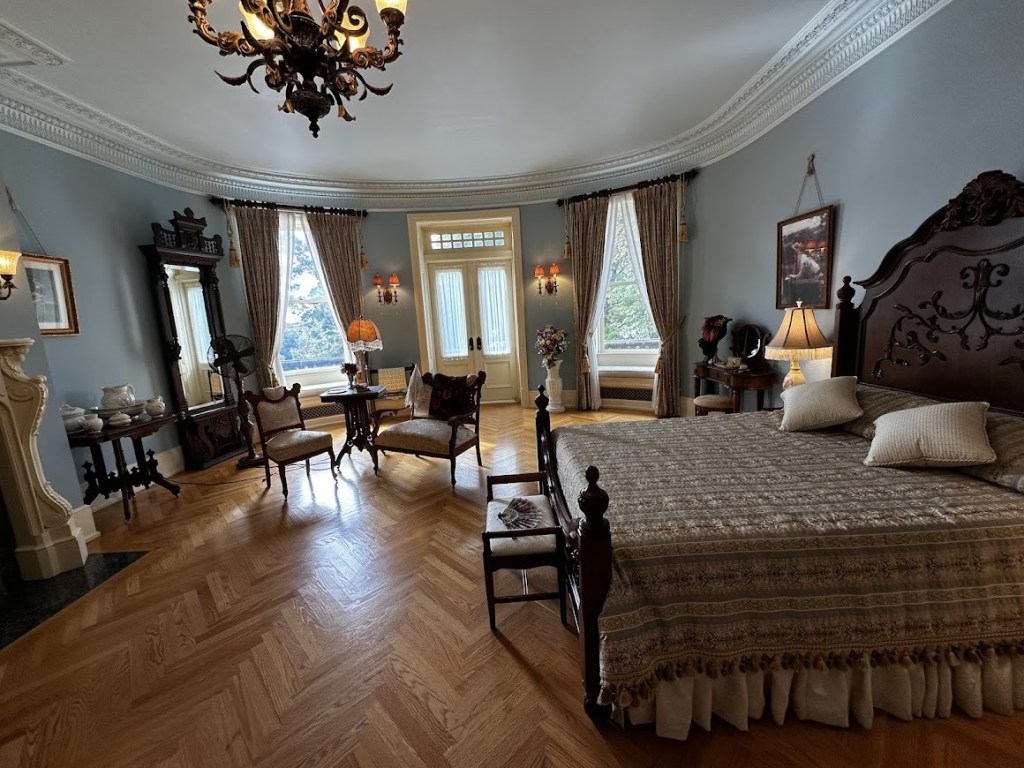
As we approached the castle, we saw a wedding on the front lawn and were asked to leave by the organizers. Fortunately, the castle was open, so we explored the large central hall and the enormous dining room before heading upstairs to see the bedrooms. The castle has a total of one hundred and twenty rooms.

The main hall

On the second floor, we watched a short film about the history of George Boldt and the castle. George Boldt emigrated from Prussia to the US at the age of thirteen. He started working in the kitchen of a hotel in Philadelphia and quickly rose through the ranks to manage the hotel at a young age. He became the manager of New York’s Waldorf Hotel and merged it with the Astoria Hotel across the street, becoming the well-known Waldorf Astoria Hotel.

The dining room and a bedroom

As part of his heritage, Boldt is credited with popularizing the “Thousand Island” salad dressing in his hotel. The name originated in the Thousand Islands region of upstate New York, and its original version was made with mayonnaise, ketchup, and pickles. He also created the Waldorf salad, a classic American dish made with diced apples, celery, and mayonnaise.

The Boldt family spent their summers in upstate New York, where George Boldt decided to build a castle on Heart Island for his wife. He was going to give the castle to her on Valentine’s Day. The architecture resembles a Rhineland castle. Construction began at the turn of the century. However, in 1904, tragedy struck when George’s wife passed away unexpectedly. He called off the construction and laid off the three hundred workers who had been building the castle. George never returned to the island, and the castle remained untouched for seventy-three years, falling into a ramshackle state. In 1977, the Thousand Islands Bridge Authority took over the property and invested millions of dollars in its rehabilitation, preserving it for public enjoyment.

Also on the second floor, we saw the rehabilitated bedrooms decorated in period style, belonging to George, his wife, and their children. The floors above have not yet been fully renovated; they currently hold architectural drawings and additional information about the castle.

The garden is also worth visiting, featuring an Italian garden and professionally landscaped grounds with benches. We sat on one of the benches to enjoy our lunch, grateful for a moment of rest after climbing the stairs. It’s important to note that the ceiling heights in the castle are much higher than the typical eight-foot ceilings found in residential homes; climbing four floors felt more like going up six to eight floors in a standard building today.

On the return ferry trip, I bought a cold drink from the bar, which was refreshing and helped me process everything I had seen. If you have visited castles in Europe, this one may not impress you much. However, North America has very few buildings like this one, the Biltmore Estate in Asheville, NC, or Hearst Castle in San Simeon, CA. Visiting this Castle is certainly educational, especially for children. It is also steeped in history and serves as an essential example of the architectural style built during the Gilded Age. I recommend it as a great family outing on a sunny day.

Discovering Rajasthan: Bollywood and Traditional Thali Experiences


September, 23, 2025

He said Rajasthan. A young man from Rajasthan offered landscaping services at my door.  A wonderful place that we visited a few years ago with a guide, Shyaam. The memories that popped up overwhelmed me and I engaged in a discussion with the fellow at the door about the desert and the havelis in his home state. One highlight of our trip was Jaipur.

Jaipur, the capital of Rajasthan, is a city with a population exceeding two million. The drive from Agra took more than six hours. On the way, we stopped to have a thali lunch. They served it on a large metal plate (they also call the plate a thali), on which they arranged many small dishes around the edge, filled with ingredients such as yogurt, dal, vegetables, and chutney. Rice and chapati went in the middle of the thali dish. Eating was done with your fingers; these highway restaurants had a sink at one end of the room where you washed your hands before and after eating. Shyaam explained that the idea behind thali was to offer six different flavors: sweet, salt, bitter, sour, astringent, and spicy on one plate. According to Indian food customs, a proper meal should perfectly balance all these flavors. I was unsure what perfect balance meant among flavors, but we enjoyed the meal and improved our eating skills with our fingers.

The highlight of our stay in Jaipur was seeing and experiencing a Bollywood movie at the Raj Mandir Cinema. The movie house was a large circular building similar to an opera house, where there must have been at least one thousand seats, all occupied, quite a contrast to the smaller theaters we are used to in Canada, which are hardly ever filled.

The film had a cute and typical storyline: a boy falls in love with a girl who rejects him. Both the boy’s and the girl’s families reject romance, and the boy loses sleep, his job, and upsets his family. There are fights between the boy and the girl’s friends in various locations where the boy gets beaten up, but his disheveled hair and clothing are still picture-worthy. The girl’s and the boy’s relatives try to stop the relationship. Then the girl makes a telephone call, after which she disappears. Boy tracks down the baddies and rescues the girl who cries. There were singing and dancing events in various locations, but ultimately, the girl falls for the boy, and the relatives decide the boy is not so bad. The story ends with a large wedding with lots of singing and dancing. This storyline is, apparently, quite typical of Bollywood movies.

What I found more interesting than the movie was how the audience reacted to the scenes with clapping, singing, approving comments, and a loud reception. There was cheering when the boy enticed the girl and booing when the villains lost fistfights. At the wedding at the movie’s end, the entire audience was on their feet, cheering. It was a genuine experience in audience participation and quite a contrast with what I am familiar with, where even people with a cough are shushed by the other moviegoers.

We stayed at the Bissau Palace. The descendants of the royal family ran the hotel/palace (and lived on-site), and the hotel was one of the very few in Jaipur recognized by Indian authorities as a genuine Heritage Hotel. Set back from the iron gates within a village-like compound, it featured a temple, shops and a sizeable pool. The exterior of this century-old building needed some paint and maintenance, but the ramshackle look added to the charm; in fact, renovations would ruin the vibe. But our room was faultless and spotless, featuring hand-painted ceilings, lead-light windows (decorative glass supported by lead cames), and old-fashioned wooden furniture. And the food was native Indian to our liking.