Bike Theft at Hotel and Digital Locks


May 16, 2026

This episode happened in Greenville, SC, on May 6. We came to cycle in GA, SC, NC, and VA, had our bikes on a Thule bike rack fastened to the back of the car, and locked with a plastic-covered braided wire cable. Well, the bikes were stolen overnight at the La Quinta, Heywood Hotel, where we stayed a couple of years ago, and we thought it was a safe place to leave the bikes on the bike rack, locked. I find it difficult to describe my feelings when I discovered the bikes had been stolen. I felt violated, ashamed for being stupid for not thinking to take the bikes inside the hotel, and upset at the same time. The built-in cable into the Thule bike rack gave me a sense of security, which was one reason that I bought this bike rack. It turned out to be a false sense of security. But the cable was cleanly cut with a wire cutter, and the straps holding the bikes down were snipped as well, but left in the grooves. It looked like it was a professional job.
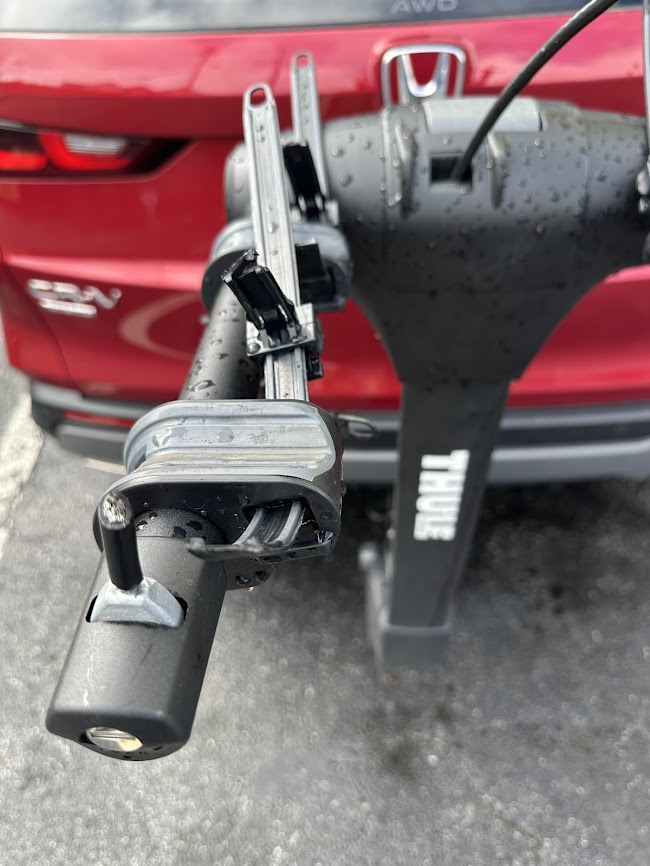
When I exited the back door of the hotel and noticed there were no bicycles at the rear of my car, a very strange feeling of impending catastrophe came over me. I looked at the cut cable and the snipped straps, then immediately entered the hotel, walked to the reception, and, in a serious voice, described my misfortune to the clerk. He seemed stunned and said this had never happened at this hotel. Standard defensive comments that I did not believe for a moment but asked him what he suggested I do. The first thing he told me was that the hotel has signs posted in many locations stating they are not responsible for any items in cars parked in their lot. He suggested that I file a police report but did not offer to provide a phone number or call the police himself.

I asked whether the hotel monitors its parking lot? Yes, of course, he said they have cameras around the hotel and showed me the twenty-four or so live videos showing on a TV screen above the reception desk. So, I asked, ” Can you roll through the video stream showing the area at the back door where my car was?” He said it may not show anything, contrary to what a normal person would expect, perhaps because they turn off the cameras at night. And perhaps the overnight receptionist does not watch the cameras. I found our entire conversation wholly unsatisfactory. But what surprised me when I walked back to my car to take pictures of the cut cable was that I met a policeman who indicated they patrolled the area because of frequent criminal activity. I filed a report with the policeman and then walked back to the hotel and conferred with the Assistant Manager, who expressed the mandatory sorry for the incident but emphasized again that the hotel is not responsible for objects in or attached to the car on their lot, although my property insurance may cover loss of personal assets.

I thought the security around the hotel was lacking, despite the cameras placed throughout the exterior. Cameras do not provide security unless they are monitored in real time.

At a bike store in Durham, NC, I bought a Kryptonite bicycle lock after consulting with the store manager. He explained that the only 100% way to keep a bicycle safe is to take it into the hotel where one is staying when traveling. His bike was stolen once, and since then, he has always taken it into the hotel when traveling. But locks help when stopping for a coffee during the day; people looking for a bike are unlikely to steal one with a lock on it during the daytime in a parking lot.

Armed with this information and the newly purchased lock, I started my car and noticed a Starbucks sign at a Barnes & Noble bookstore. It was time for a good coffee, so I entered the store. I thought it advisable to empty my bladder before buying a coffee and starting on Interstate 40 towards Winston-Salem, and searched for the washroom in the bookstore. The door had a digital lock. OK. I searched for an attendant to learn the code. While serving a customer, she handed me a small piece of paper with a five-digit code.

The code worked, but I wondered what the purpose of using the code was; would they refuse to provide the piece of paper to anyone? It inconveniences customers who must ask for the code. But the process also gives the attendants an opportunity to assess the customer requesting the code. Is that the purpose of using a code to access the washrooms? And how do the attendants assess whether to provide the code to the customers? Or do they think that if the washroom is not open, some customers would just walk out of the store? I found the system interesting, but couldn’t understand its purpose or how it would be used. It inconveniences customers and gives store clerks an opportunity to assess who wants to use the washroom. But would they ever refuse a customer the use of the washroom, and on what basis?

These are just a couple of ad hoc examples of security methods. But clearly, one purpose of security systems is to identify people who may commit criminal activity, cause damage, or be unsavory and/or undesirable to visit the premises. While monitored cameras can be useful, digital locks are less so without articulated policies on who is allowed to have the code.
Exploring Covington, GA: A Family Dinner and Scenic Trails


May 10, 2026

We drove to Covington, GA, to have dinner with our granddaughter, who works in Atlanta. Covington is within the Atlanta metro area. And it has the Cricket Frog Trail, which we wanted to ride and compare to the Spanish Moss Trail, which we rode in Beaufort, SC, a day earlier.

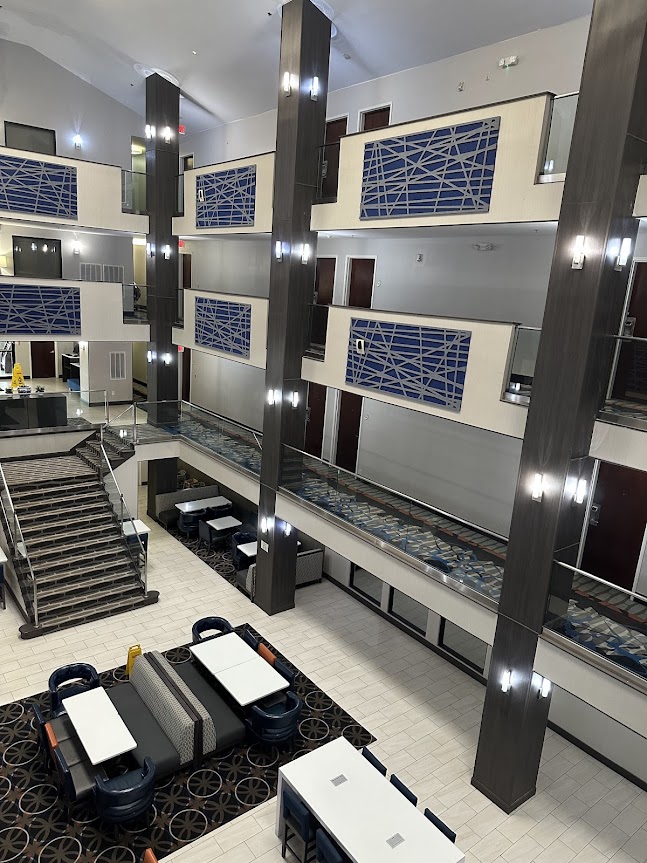
The hotel we stayed at was unique for having a four-story-high atrium with a skylight in the middle. The rooms were accessible via an open corridor running around each floor facing the atrium. We have never stayed in a hotel with such singular architecture, although the concept is similar to that of havelis in Rajasthan, except that havelis have uncovered courtyards.

The hotel in Covington with atrium

Arriving early afternoon gave us time to go downtown and walk around before meeting our granddaughter for dinner. Covington Square in the middle of town reminded me of the zócalos in Mexican towns, but without pre-teens approaching to offer to shine your shoes, even your running shoes that do not need a shine.

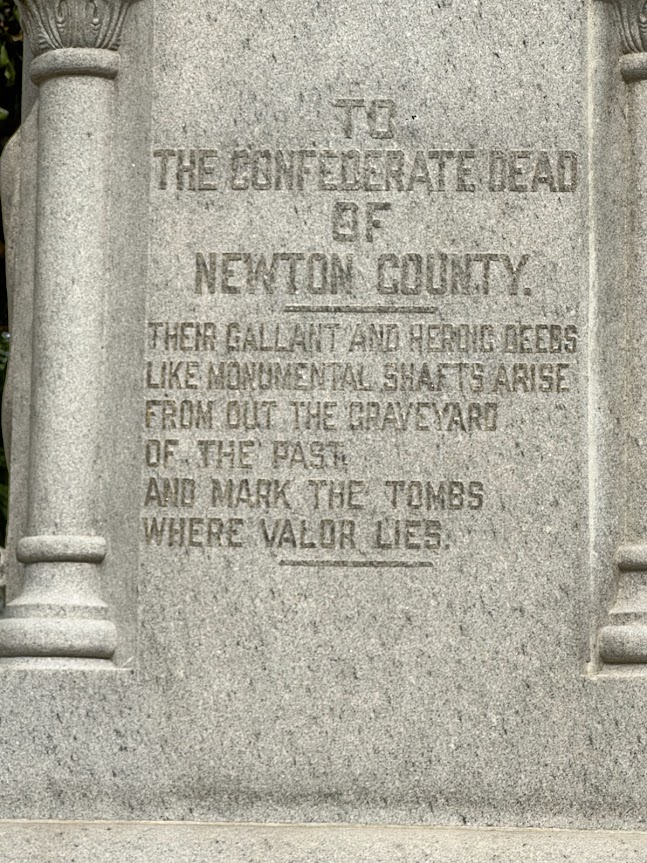
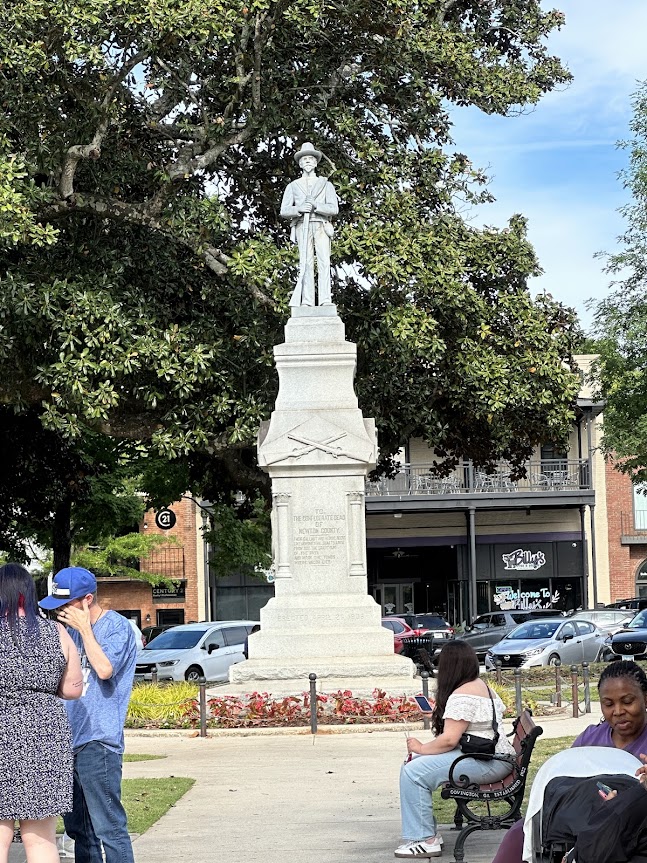
In the middle of the square was a statue honoring the Confederate soldiers who had perished during the Civil War. Paved walkways crisscrossed the square, with people resting on benches along the walkways, enjoying the mild weather. And there were people walking around the square, sitting at a café, and shopping in funky stores that populated the street fronts around the square.

The Confederate monument

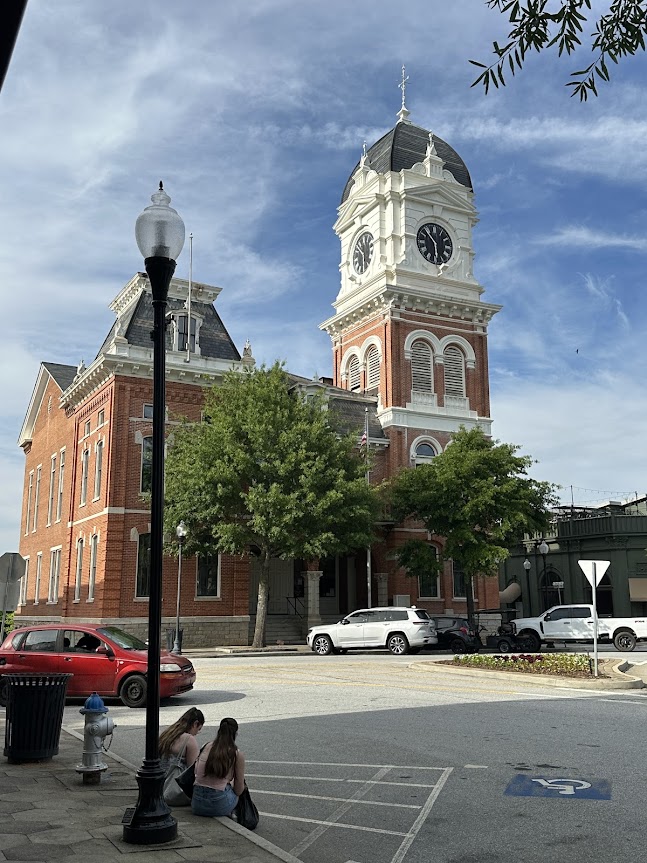
The Clocktower, which is part of the courthouse, dominates the square. It reminded me of the dominating churches at the Mexican zócalos. While researching the history of the Clocktower, I came across an AI summary that described it as a “classic design with detailed architecture” built in the early 1900s. That is pure nonsense. What is classic design? And what is detailed architecture? Then I found another history on Wikipedia stating that it was designed in 1884 in the Second Empire style by Bruce&Morgan, after the original courthouse burnt down in 1883. I believe the second description rings truer because of its specificity.

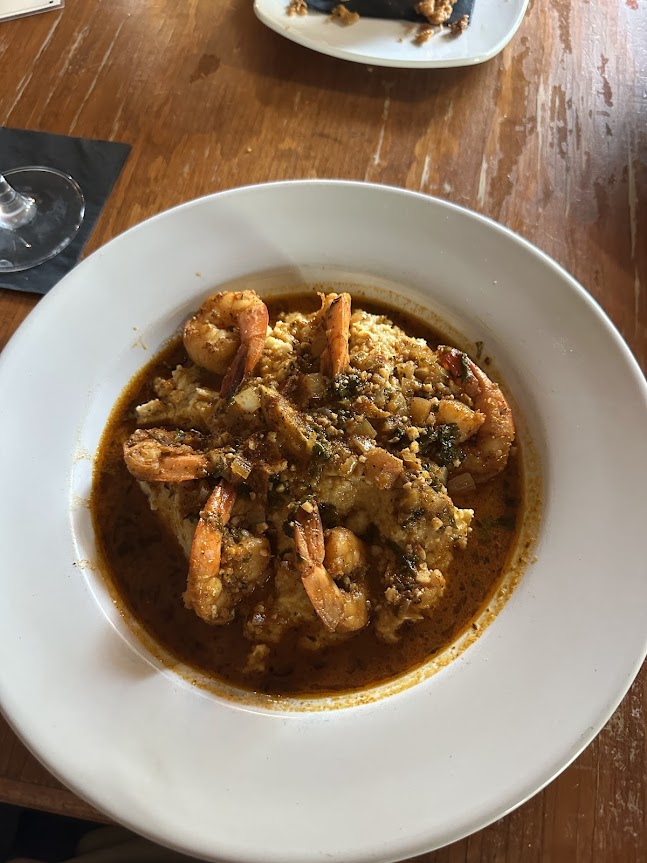
The Clocktower, the Mystic Grill and the Shrimp and Grits

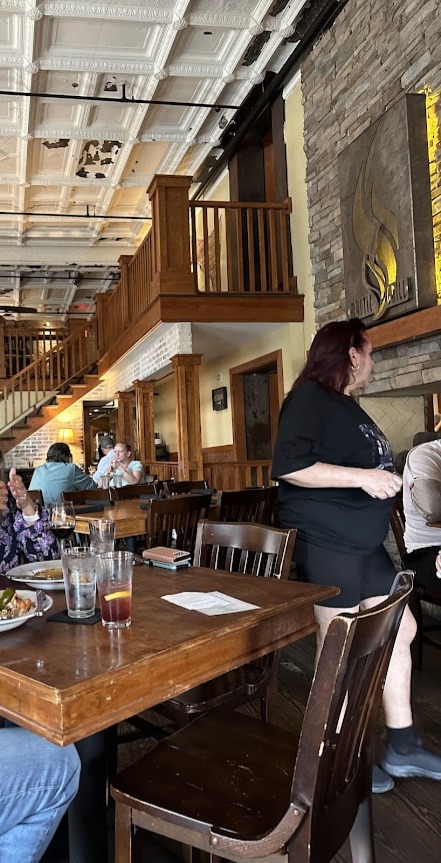
We had dinner at the Mystic Grill, located next to the Clocktower. The shrimp and grits were one of the best I have ever had; they were made with stone-ground grits, bacon, garlic, shallots, cilantro, and lime juice. The next best shrimp and grits I had was a week ago at Jekyll Island, GA, where the dish contained mushrooms, cheese, and andouille sauce.

The restaurant was noisy, making conversation difficult for me, especially with the larger tables to talk across and the conversations ricocheting in the dining room. But the atmosphere was very inviting, with a 2-story-high coffered ceiling and local historical pictures and memorabilia on the walls.

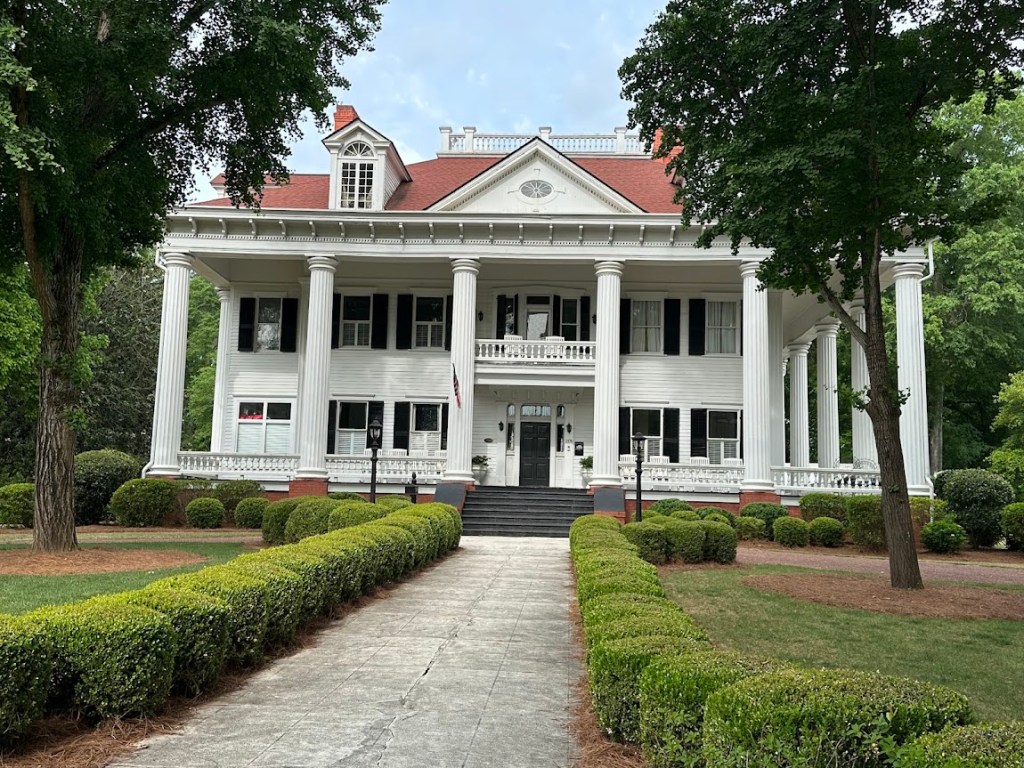
But Covington has some antebellum homes, the most famous of which is Twelve Oaks, which served as the model for the 1939 film Gone with the Wind. The 1939 movie was based on Margaret Mitchell’s book of the same name, published in 1936. A pricey B&B today with themed rooms and a manicured, landscaped yard, it still features the 12 oak trees around the home, from which the name was derived.

The Twelve Oaks B&B

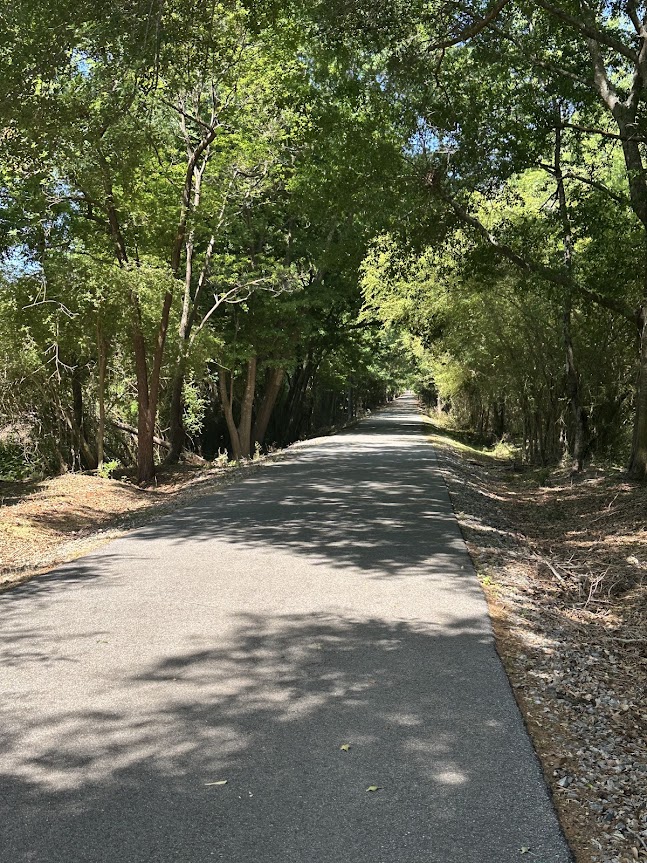
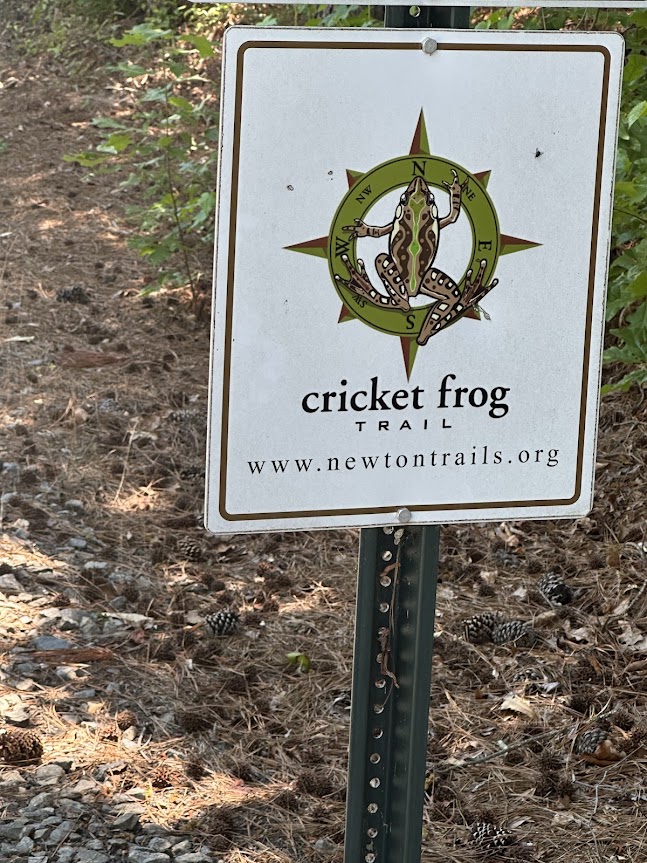
We rode the Cricket Frog Trail the next day, a 14-mile-long rail-to-trail, once traveled by the Central of Georgia Railroad. The paved trail is a bit hilly with some curves; I wondered about how fast the trains moved along it. We started riding at the rural trailhead and cycled towards Covington. Once we reached the outskirts of the town and encountered traffic, we turned back. It was a pleasant ride, and I saw many estates along the trail.

Coming back to the two rail-to-trails we rode, one in Beaufort, SC, the Spanish Moss Trail, and the other in Covington, GA, the Cricket Frog Trail, I prefer the Cricket Frog for having mostly cyclists and a shaded pathway along the way. The Spanish Moss Trail runs through more urbanized areas, with walkers and people walking dogs, contributing to slower cycling and frequent shouts of “on the left”. And it was also mostly a straight path, which felt boring at times. However, there are a couple of nice coffee shops in Port Royal at the end of the trail and a rookery that boasted innumerable birds, a very cool experience. And I like to end my rides at a coffee shop with quality coffee and some sweets. For riding, the Cricket Frog Trail is better, but for interest, the Spanish Moss Trail is preferable.

Cycling on Jekyll Island, Georgia, with a Road Scholar group


April 29, 2026

The challenge we faced while riding around Jekyll Island was using a coaster bike. It was unexpected, and we have not used those bikes in decades. It took some time to reacquaint ourselves with getting on and off those bikes.

Another challenge was cycling up the sand dunes with only one gear. Stopping was the final challenge when the cyclist just ahead of us suddenly stopped. We were to follow each other by one bicycle length. Most of us decided to follow the cyclist ahead of us by 30 feet.

We found the local drivers very courteous; they stopped for us and let us cross the road, even though it took a few minutes for the twenty of us to cross, riding in a peloton.

But once we got on the bikes, the pathways and scenery were worth the trouble of getting going on the coaster bikes. The island pathways were all paved, although I prefer dirt roads, in case I fall. Falling on the pavement could be painful. We were comfortable riding during the weekdays, but I suspect that on the weekends, cycling traffic might be heavy, especially given the pavement width, which was not 8 feet wide.

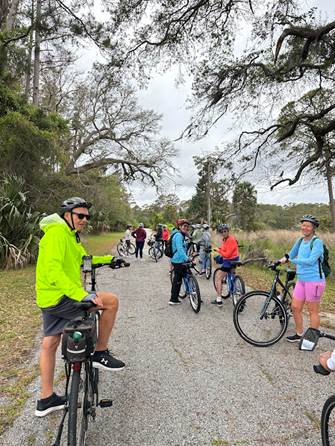
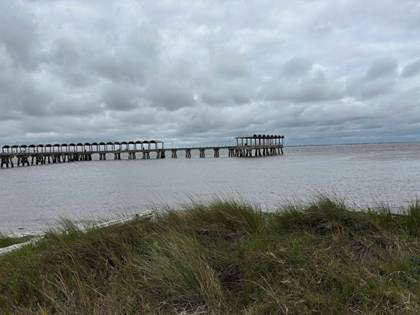
Our group is getting organized below, and the landscape along the ocean pathway.

The pathways circle the island, offering magnificent views of the ocean on one side. On the other side, the paths ring hotels, beach houses. The landscaping was outstanding on the entire island.

I found one disadvantage of riding in a group is the lack of opportunity to stop and take pictures when approaching a particularly attractive landscape. On the other hand, the guides lead us to the most photogenic sites.

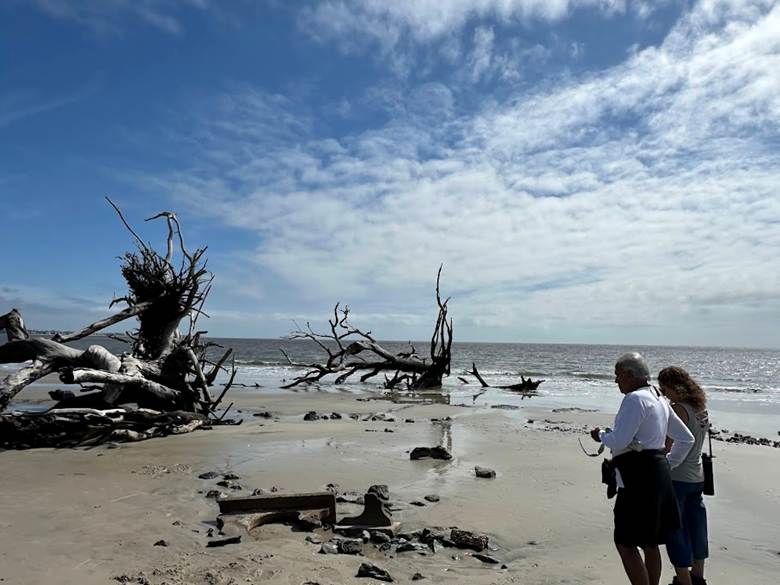
We saw one of those unique sites today, Driftwood Beach. The picture below describes it better than I could.

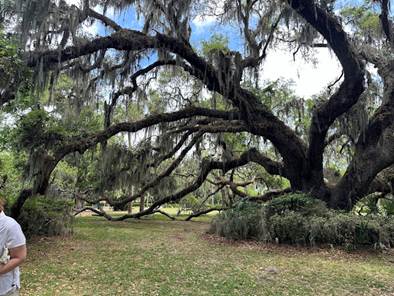
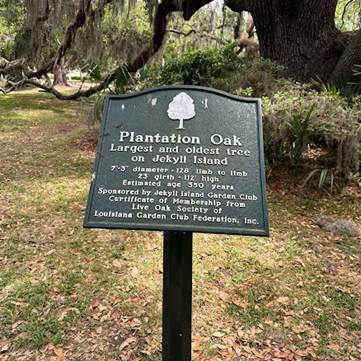
The oldest tree on the Island, a live oak, was also spectacular with its huge overhanging branches.

We averaged 8 miles per hour riding. Surprisingly, we spent only 2 to 3 hours riding while being on the road all day. The reason is that we visited historical, cultural, and environmental sites, enriching Jekyll Island. But just riding on Jekyll Island alone is a very rewarding experience and I would certainly recommend it. Next time, however, I will take my road bikes and not use the coaster bikes available for rent.

Life Experiences fit Together like a Mosaic….Sometimes


April 1, 2026

Three recent experiences connected in my mind last week. The pieces clicked, as in a mosaic. These three experiences led me to stories about people who saw demand for services that were unavailable. Their instincts led to successful companies.

The first experience was a talk I went to hear by a business professor. He introduced himself by describing his usual pitch to students, which is to ask them what motivates business. He said the answer is usually money. He responds to that view by describing a situation, a business transaction: when he goes shopping, he wants to purchase specific goods, such as vegetables. Business is about buying and selling goods and services. Money is simply the vehicle that enables goods and services to change hands.

The next experience was speaking with a physiotherapist, who advised me to strengthen my aching legs. Without going into details, I may have something called lazy butt syndrome, or butt amnesia. Muscles can lose their ability to function properly, so it’s important to use targeted exercises to help them remember how to work.  During our consultation, we talked about cycling and bike racks. I mentioned my intent to buy one. She suggested I visit Rack Attack, a store specializing in racks for cars that carry bikes, skis, and other outdoor gear.

The third experience was buying a hanging bike rack from Amazon, which came from Rack Attack. The rack came in a box, partially assembled. Not fully understanding the assembly instructions, I drove over to Rack Attack and asked for help. The young assistant was excellent, showing me how to prepare the full assembly. Searching the store’s website, I learned that the founder of this chain emphasizes customer relations, focusing on the sales, installation, and maintenance of a variety of racks.

Reflecting on these three experiences, that took place in a couple of days, led me to think about what makes companies successful in business.

The very satisfying experience with Rack Attack made me look into the store’s history. Chris Sandy, the founder, worked at a bike shop in Vancouver, BC, Canada. He noticed that most racks did not fit the more aerodynamic car models, which lacked traditional rain gutters. Attaching sports gear racks to these newer cars was difficult. He decided to open a store catering to outdoor enthusiasts who carry gear in their cars. He started by selling products from Thule, Yakima, and others that fit newer cars.

The first store opened in 1996, and Chris quickly expanded by establishing stores in Toronto and other Canadian cities. In 2014, he sold his stores to Banyan Capital Partners, a private equity investor, to raise money for further growth. By 2026, Rack Attack had over 40 stores, with 30 in the US.

The Rack Attack story reminded me of the Running Room, a specialty store selling running shoes and related products. Running Rooms always have a running club. I used to run with them in Ottawa for years. Running with a group is motivating. You meet people with similar interests. On-the-road discussions fill time and take your mind off tired muscles.

John Stanton established the Running Room in Edmonton, Alberta, Canada, in 1984. He was a chubby food industry executive who needed to change his lifestyle for his health. Embarrassed by neighbors watching him try to run, he went outside at dawn to run. He could hardly run a block before sucking for air. But he persevered, became a runner, and opened a one-room store in Edmonton to sell running gear. The store was a huge success, and he expanded the Running Room stores across Canada and the US. Today, there are over 100 Running Rooms, with 8 in the US. The chain employs 1,300 people. John still works and manages the chain with his two sons.

Another example is the Tim Horton franchise. Tim Horton, an NHL player, sought a business after his hockey career ended. He tried several ventures—first, a burger joint, followed by a car dealership, and finally a coffee-and-doughnut shop in Hamilton, Ontario, in 1964. He imagined creating a community hub where people could mingle and enjoy coffee and fresh doughnuts. The idea proved successful: today, there are more than 6,000 locations in 14 countries, growth fueled by key mergers with Wendy’s in 1995 and Burger King in 2014.

These stories back up the business professor’s view of what business is: at its most basic tenet, it is finding an opportunity to sell a product people want. The money part is secondary; the priority is to fulfill an unmet demand for which people are willing to pay. And clearly, the business must be profitable in the long run, otherwise it becomes unsustainable. I would add that good service is also essential to sustain a company and an enthusiastic founder could be a catalyst for future success.

The question is, where can you find ideas for a sustainable business? I do not know that. But, in the high-tech industry, common wisdom says one out of ten startups goes bankrupt. One makes it. The rest struggle on.

In conclusion, it was worth attending the professor’s lecture; it made me think about what business is.

A Culinary Journey on Two Wheels: Cycling and Cuisine


September 30, 2025

These days, we are looking for flat biking routes and prefer to avoid steep, mountainous areas. The rail-to-trail paths are ideal for us, so we decided to cycle along the Petit Train du Nord linear park in Quebec, just north of Montreal.

The recommended ride is from the northern end of the trail at Mont Laurier to St. Jerome, just outside Montreal, because there is a slight slope in that direction. The distance is approximately 200 kilometers, and it can be covered in a few days.

Typically, the cyclist would drive to St. Jerome, leave the car there, and take a bus that goes once a day to transport them to the northern end. However, by the time I called, there was no room on the bus for the day we had planned to go. Instead, we reserved a room at a hotel along the trail, closer to the northern end, to avoid the busier section near Montreal, and planned to cycle in both directions.

That turn of events was fortuitous, as Kathy had pulled a leg muscle while working out at the gym, limiting her ability to cycle for longer distances. Staying at a hotel provided us the opportunity to take shorter rides with rest in between.

Our trip got off to a great start when we drove into Montebello on our way to the trail and discovered a chocolate factory. We couldn’t resist buying some chocolate bars and truffles, completely forgetting about the prices. For lunch, we chose a bistro—after all, it’s Quebec! The French onion soup we had there was delicious.

With tables arranged closely together and the bistro full, the noise level was high, making conversation difficult unless one spoke loudly. However, the proximity to other diners allowed us to engage with our neighbors, which we did. Surprisingly, we ended up discussing politics without any arguments, likely because we shared similar views.

We attempted to use our French, which was more than rusty. Since we rarely have the opportunity to speak French, we struggled to find the right words when communicating with the service people. But it is always satisfying to express oneself in another language when the locals understand you. My feeling was that the locals appreciated our efforts to communicate in French.

In contrast to the bistro, our dinner at the Club du Golf Nominingue hotel restaurant was a more formal affair. While it was also noisy, the dining room was spacious, with tables dressed in white tablecloths and with elegant wine glasses. The service was prompt and attentive to our questions. Although I didn’t find the menu particularly unique to Quebec cuisine, the presentation of the food we ordered was stunning. I felt compelled to take pictures of our plates, which resembled sculptures, even though the food itself was pretty ordinary.

For example, I ordered saucisse artisanale du Québec, which seemed to me to be regular hot dogs, split in two, served with vegetables, and accompanied by French fries, presented in a wire mesh dish. While I wouldn’t consider any of the ingredients unusual, the presentation was truly remarkable.

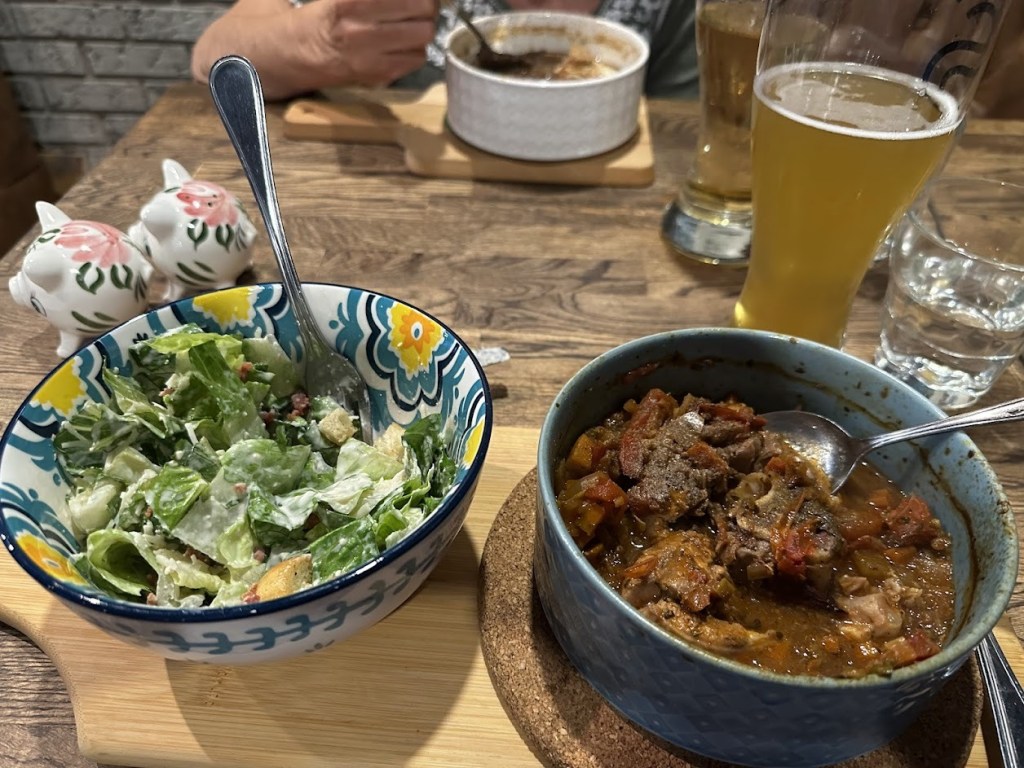
The next day, we discovered a local bistro that was a lot of fun. It was extremely noisy, with people yelling from the bar to the other side of the restaurant, conversing in French, of course. It seemed that all the locals gathered at the bistro in the evening. We enjoyed local beer and cider, and I ordered osso buco, which is pork hocks in English, and it was delicious. For dessert, we had mousse fromage érable, which was delightful.

Beef bourgignon with ceasar salad

With all the food we consumed, we needed to burn off some calories, so we rode the Petit Train du Nord with plenty of energy. Like many trails of this nature, there are long, straight sections that can feel relaxing at times, while at other moments, they may become a bit boring. However, the trail was flat, with a grade that never exceeded four percent.

I was surprised by the number of electric bikes we encountered. Although I knew these bikes were popular, I didn’t expect most of the cyclists we saw to be using them, especially since there was no need for supplemental power on such level terrain. It was also interesting to see how many people were dressed in heavy clothing; I wore just a T-shirt and shorts, while others wore winter jackets. I thought riding an electric bike at higher speeds could feel quite chilly.

Although the speed limit on the trail was 22 kilometers per hour, we maintained a leisurely pace of 10 to 15 kilometers per hour, taking breaks to admire the surrounding landscape.

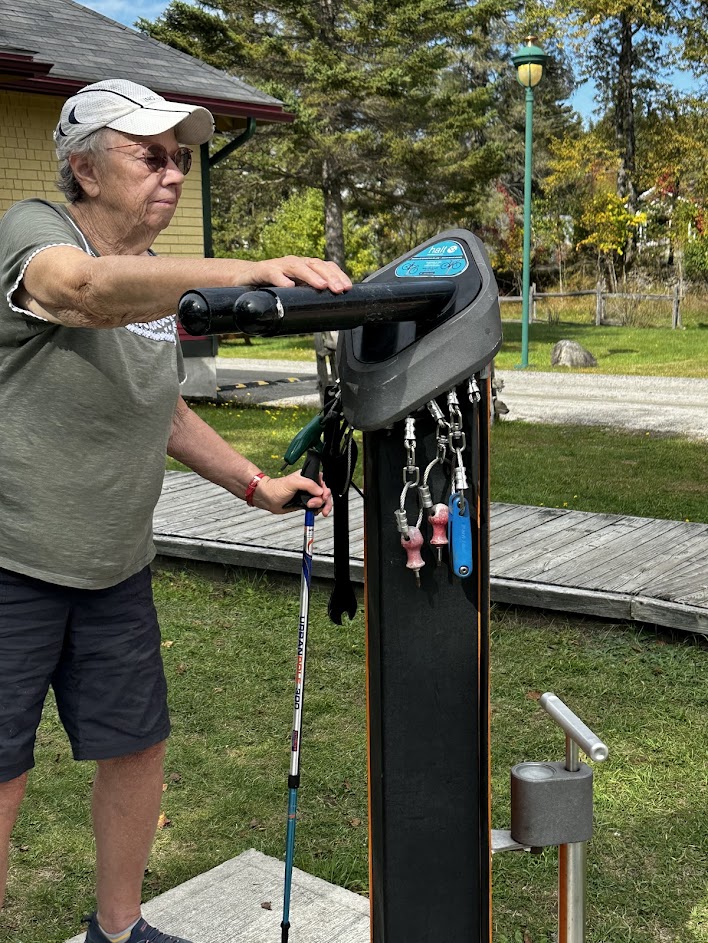
I have to commend the Quebec government for the development and excellent maintenance of this trail. It is entirely paved, and cracks in the pavement are clearly marked with yellow chalk. In areas with a buckling surface, a “danger” sign is placed to alert cyclists. More importantly, there are picnic tables, shelters, water fountains, and even bicycle maintenance pillars equipped with all the necessary tools. This is the most developed trail I have ever experienced. We have cycled on trails in Virginia (the Virginia Creeper), South Carolina (the Spanish Moss Trail), North Carolina (the Tobacco Trail), and many trails in Ontario.

The ambiance at the Le Club et Hotel de Golf Nominingeu, where we stayed, and on the trail, the Quebecois people, the food, and, not least, the cycling trail all contributed to a pleasurable trip. We absolutely have to return for another adventure. We thoroughly enjoyed interacting with the Quebecois people, who, without a doubt, tend to be more expressive, animated, and louder than their English counterparts. One of the highlights of our trip was the opportunity to improve our French language skills. The locals appreciated our efforts, even when our conversations switched to English.