May 4, 2026
Exploring the Historical Layers of Jekyll and St. Simons Islands in Georgia: A Cyclist’s Journey with Road Scholar. History is woven into nearly every stop and story on these remarkable islands, from grand clubs and pivotal events to deeply meaningful landmarks.
We cycled for a few hours each day, spending the rest of the time visiting historical and other unique sites across the two barrier islands.
Among the many stops we made on Jekyll Island, the most fascinating story for me involved the Jekyll Island Club and its founders. The original owner of the Island, Eugene du Bignon, a Frenchman, sold it to New York investors looking for a wintering place for hunting and recreation in 1886. Fifty shares were sold to industry elites in New York, including the Morgans, the Rockefellers, the Vanderbilts, and other titans of industry. Joseph Pulitzer was one of the original owners as well. He built his fortune publishing the St. Louis Dispatch-Post and later the New York World. A hotel was built, and some shareholders also built “their cottages,” which measured up to 10,000 square feet. The cottages had no kichens, all the people ate at the Club.
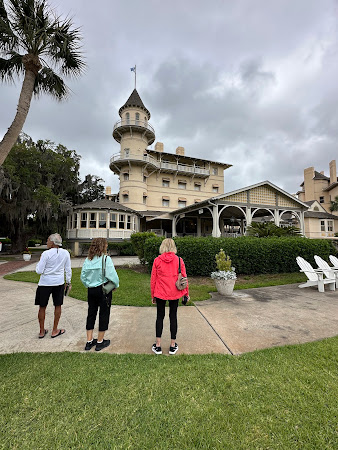
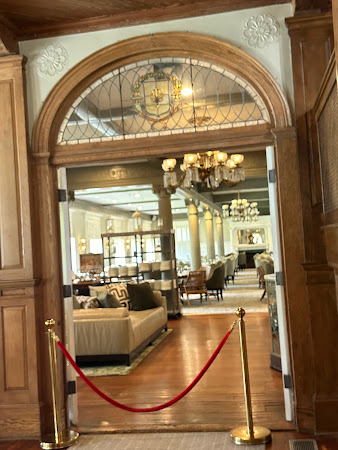
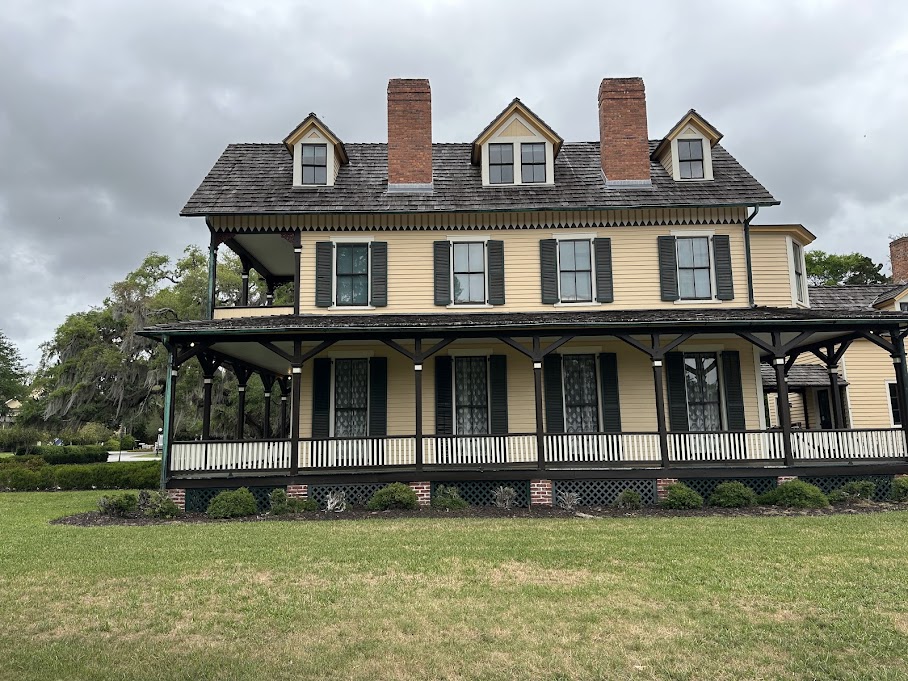
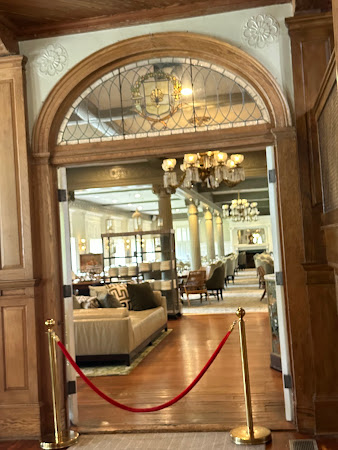
The Jekyll Island Clubhouse and the dining room. Below are two cottages.
Among the Club’s many noteworthy events was a 1910 gathering of American financial leaders, who drafted legislation that would later serve as the foundation for the Federal Reserve system.
The depression impacted the industrialist owners of Jekyll Island and their use of the Club diminished. Also, travel opportunities expanded in the 1940s, and the original owners’ descendants lost interest in Jekyll Island and the Club. After the Club closed in 1942, the Island was expropriated by the State of Georgia in 1947 for $647,000, designated a historic landmark, and turned into a State Park managed by a Governor-appointed Commission.
The architecture of the Clubhouse is in the Queen Anne style, with a typical four-story turret, wraparound porches, and complex rooflines. The interior is in the Gilded Age style, with luxurious furnishings that made me think about how the ultrarich lived in the late 1800s and early 1900s. Thwae Clubhouse is a magnificent building in my opinion and is open as a luxury hotel today.
Turning to another chapter of the island’s history, the story of the Wanderer stood out. This luxury schooner, built in 1856, was converted into a slave ship two years later. Businessmen brought over more than 400 slaves from the Congo in 1858 to Jekyll Island and sold the slaves in the South, that was against federal law since 1808 in the United States. The businessmen were indicted but not convicted, and the ship was seized by the Union Navy and later sunk by Cuba. The Wanderer Memory Trail on Jekyll Island relates the story of the slaves brought over from Africa. I found the exhibits along the trail fascinating, espemcially the musical instruments and the foods the black people brought over from Africa. Walking along the trail and listening to the audio stories gave me a bad feeling.
On St. Simons Island, two key points of interest drew my attention. First was Harrington House, which was once a one-room schoolhouse for black children in grades 1 to 7. Inside the building were pictures and artifacts related to the schoolhouse’s operation, as well as information about the students who attended. After the Brown v. Board of Education decision in 1954 (the desegregation legislation), the school closed, and the students were transferred to the wider public school system in Brunswick. The school docent was from the local community and had vast knowledge of the school’s history and explained that the island’s black population has decreased due to gentrification, falling from over 80 percent to just 1 to 2 percent of the current 13,000 residents.
The island’s past also comes alive at Fort Frederika, built in 1736 by James Oglethorpe. Now a National Monument, the fort was at the heart of 18th-century debates between Spanish and British governments over lands south of Savannah. Oglethorpe asked the King for a land grant to establish a colony, to serve as a defense against the Spanish. Like civil war sites, the Fort Frederika National Monument is a grassy field today with remnants of buildings and ramparts.
Oglethorpe was a visionary, and in 1736, he laid out a town, a utopian kind of village with streets forming a grid pattern, giving each resident a 50-by-100-foot piece of land on which to build a house and a fifty-acre site for agricultural uses. And he brought over from England indebted people in prison as colonists.
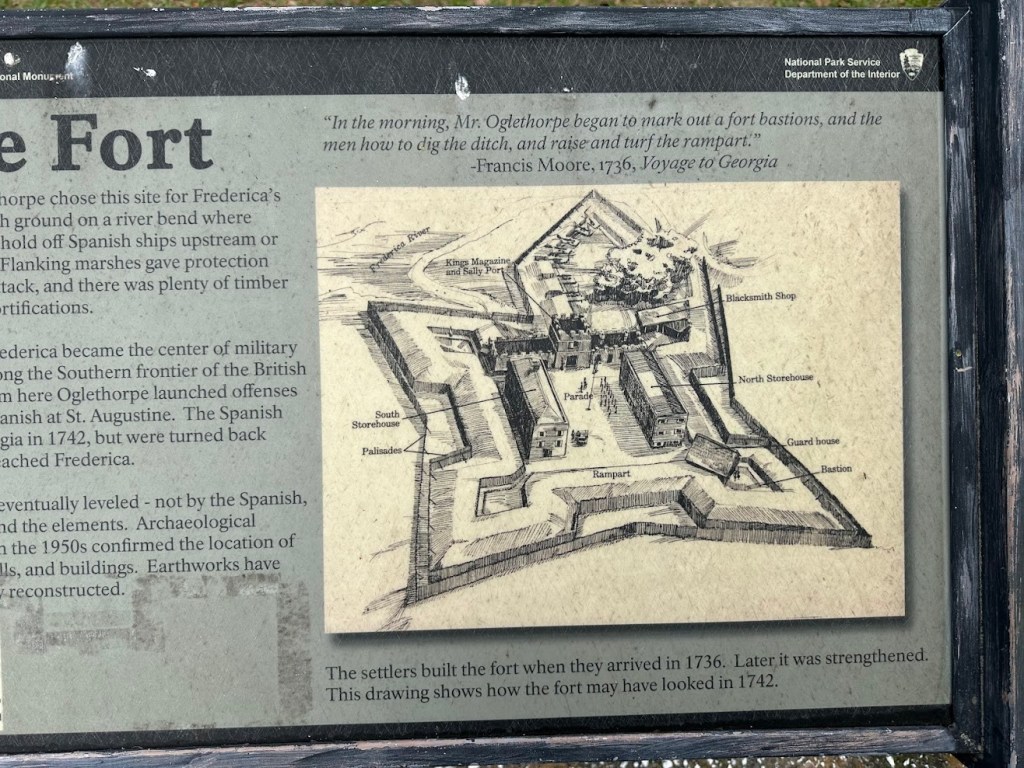
Fort Frederika.
I learned that the houses were built with “tabby”, a material made of crushed seashells, mixed with sand and water, the combination of which resembles concrete.
Before concluding my journey, I visited another unique destination: the Georgia Sea Turtle Center on Jekyll Island. It is a hospital for sick turtles as well as an educational and research center. I learned that turtles lay hundreds of eggs a few times a year, but only after reaching 30 years of age; after that, they lay eggs every second year up until they die, which might be at 100 years of age. But only one egg will grow into a full turtle out of 3,000 eggs!
The expert also explained that after the eggs hatch, the baby turtles are guided by moonlight to find their way into the water. She advised us not to use flashlights at night when watching the move of the turtles because that may confuse them and lead them away from the water.
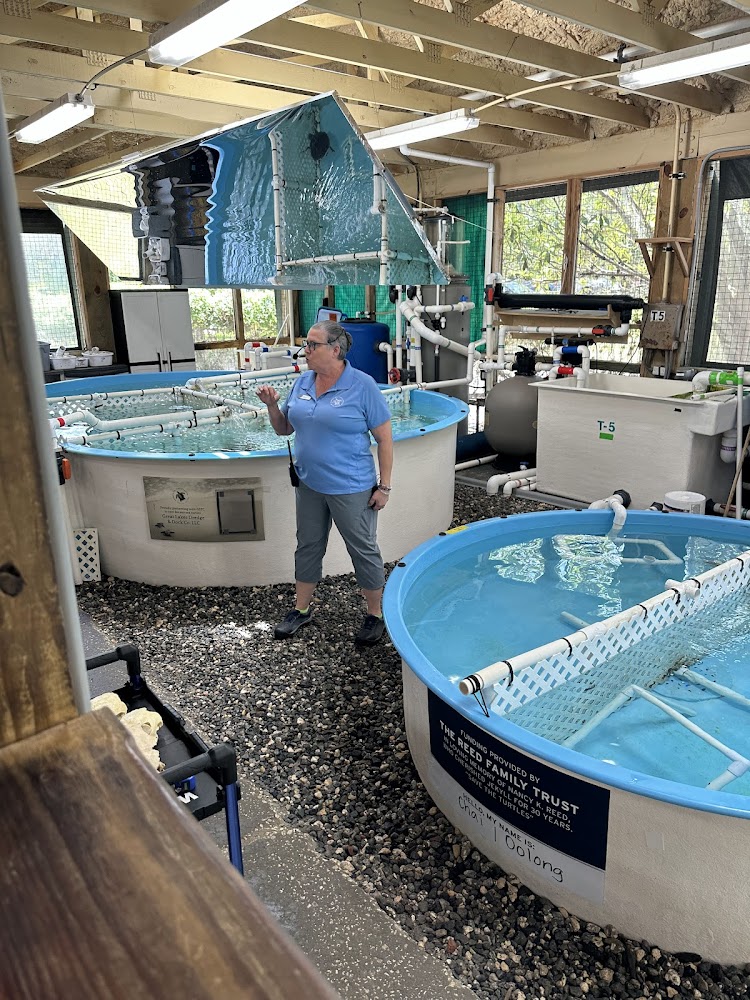
Tanks with recuperating turtles.
In addition to listening to an expert on turtles describing their lives, we observed technicians examining a turtle in a lab, behind a window. Next to the exhibition space on turtles was an industrial warehouse, filled with huge tanks housing recuperating turtles. Interestingly, there was only one turtle in each tank. Apparently, turtles are solitary animals, and if more than one is in a tank, they attack each other. Most of the turtles in the tanks came from Cape Cod; the cold water at the Cape caused hypothermia in turtles and were brought to this hospital for recuperation.
Visiting the two barrier islands offered a unique window into American history—from colonial times, through the Civil War and Gilded Age, to the civil rights period. The experience reminded me how these islands encapsulate the evolving story of the region, illustrating why their preservation and interpretation matter so much today.
 andrasthehun.ca