Bike Theft at Hotel and Digital Locks


May 16, 2026

This episode happened in Greenville, SC, on May 6. We came to cycle in GA, SC, NC, and VA, had our bikes on a Thule bike rack fastened to the back of the car, and locked with a plastic-covered braided wire cable. Well, the bikes were stolen overnight at the La Quinta, Heywood Hotel, where we stayed a couple of years ago, and we thought it was a safe place to leave the bikes on the bike rack, locked. I find it difficult to describe my feelings when I discovered the bikes had been stolen. I felt violated, ashamed for being stupid for not thinking to take the bikes inside the hotel, and upset at the same time. The built-in cable into the Thule bike rack gave me a sense of security, which was one reason that I bought this bike rack. It turned out to be a false sense of security. But the cable was cleanly cut with a wire cutter, and the straps holding the bikes down were snipped as well, but left in the grooves. It looked like it was a professional job.
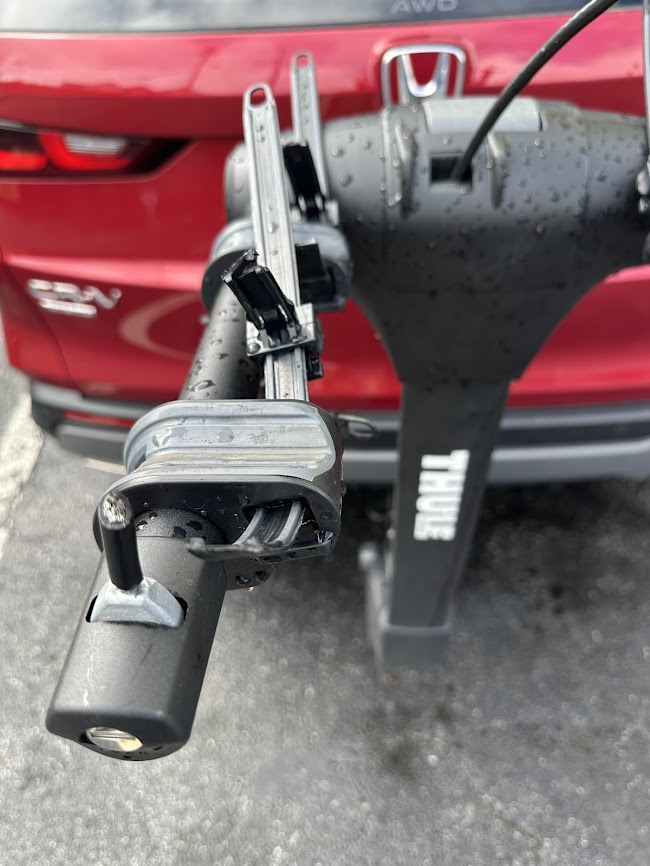
When I exited the back door of the hotel and noticed there were no bicycles at the rear of my car, a very strange feeling of impending catastrophe came over me. I looked at the cut cable and the snipped straps, then immediately entered the hotel, walked to the reception, and, in a serious voice, described my misfortune to the clerk. He seemed stunned and said this had never happened at this hotel. Standard defensive comments that I did not believe for a moment but asked him what he suggested I do. The first thing he told me was that the hotel has signs posted in many locations stating they are not responsible for any items in cars parked in their lot. He suggested that I file a police report but did not offer to provide a phone number or call the police himself.

I asked whether the hotel monitors its parking lot? Yes, of course, he said they have cameras around the hotel and showed me the twenty-four or so live videos showing on a TV screen above the reception desk. So, I asked, ” Can you roll through the video stream showing the area at the back door where my car was?” He said it may not show anything, contrary to what a normal person would expect, perhaps because they turn off the cameras at night. And perhaps the overnight receptionist does not watch the cameras. I found our entire conversation wholly unsatisfactory. But what surprised me when I walked back to my car to take pictures of the cut cable was that I met a policeman who indicated they patrolled the area because of frequent criminal activity. I filed a report with the policeman and then walked back to the hotel and conferred with the Assistant Manager, who expressed the mandatory sorry for the incident but emphasized again that the hotel is not responsible for objects in or attached to the car on their lot, although my property insurance may cover loss of personal assets.

I thought the security around the hotel was lacking, despite the cameras placed throughout the exterior. Cameras do not provide security unless they are monitored in real time.

At a bike store in Durham, NC, I bought a Kryptonite bicycle lock after consulting with the store manager. He explained that the only 100% way to keep a bicycle safe is to take it into the hotel where one is staying when traveling. His bike was stolen once, and since then, he has always taken it into the hotel when traveling. But locks help when stopping for a coffee during the day; people looking for a bike are unlikely to steal one with a lock on it during the daytime in a parking lot.

Armed with this information and the newly purchased lock, I started my car and noticed a Starbucks sign at a Barnes & Noble bookstore. It was time for a good coffee, so I entered the store. I thought it advisable to empty my bladder before buying a coffee and starting on Interstate 40 towards Winston-Salem, and searched for the washroom in the bookstore. The door had a digital lock. OK. I searched for an attendant to learn the code. While serving a customer, she handed me a small piece of paper with a five-digit code.

The code worked, but I wondered what the purpose of using the code was; would they refuse to provide the piece of paper to anyone? It inconveniences customers who must ask for the code. But the process also gives the attendants an opportunity to assess the customer requesting the code. Is that the purpose of using a code to access the washrooms? And how do the attendants assess whether to provide the code to the customers? Or do they think that if the washroom is not open, some customers would just walk out of the store? I found the system interesting, but couldn’t understand its purpose or how it would be used. It inconveniences customers and gives store clerks an opportunity to assess who wants to use the washroom. But would they ever refuse a customer the use of the washroom, and on what basis?

These are just a couple of ad hoc examples of security methods. But clearly, one purpose of security systems is to identify people who may commit criminal activity, cause damage, or be unsavory and/or undesirable to visit the premises. While monitored cameras can be useful, digital locks are less so without articulated policies on who is allowed to have the code.
Exploring Covington, GA: A Family Dinner and Scenic Trails


May 10, 2026

We drove to Covington, GA, to have dinner with our granddaughter, who works in Atlanta. Covington is within the Atlanta metro area. And it has the Cricket Frog Trail, which we wanted to ride and compare to the Spanish Moss Trail, which we rode in Beaufort, SC, a day earlier.

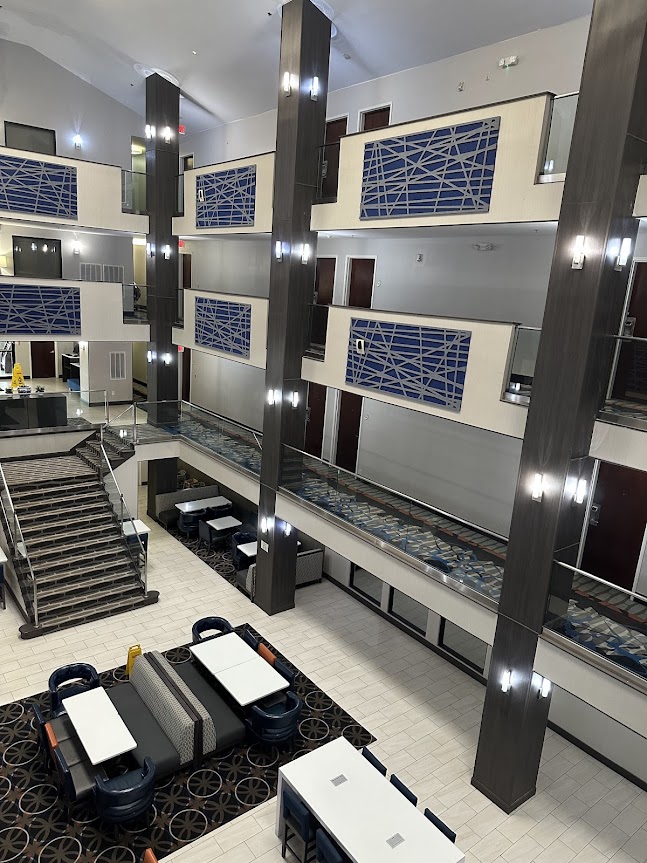
The hotel we stayed at was unique for having a four-story-high atrium with a skylight in the middle. The rooms were accessible via an open corridor running around each floor facing the atrium. We have never stayed in a hotel with such singular architecture, although the concept is similar to that of havelis in Rajasthan, except that havelis have uncovered courtyards.

The hotel in Covington with atrium

Arriving early afternoon gave us time to go downtown and walk around before meeting our granddaughter for dinner. Covington Square in the middle of town reminded me of the zócalos in Mexican towns, but without pre-teens approaching to offer to shine your shoes, even your running shoes that do not need a shine.

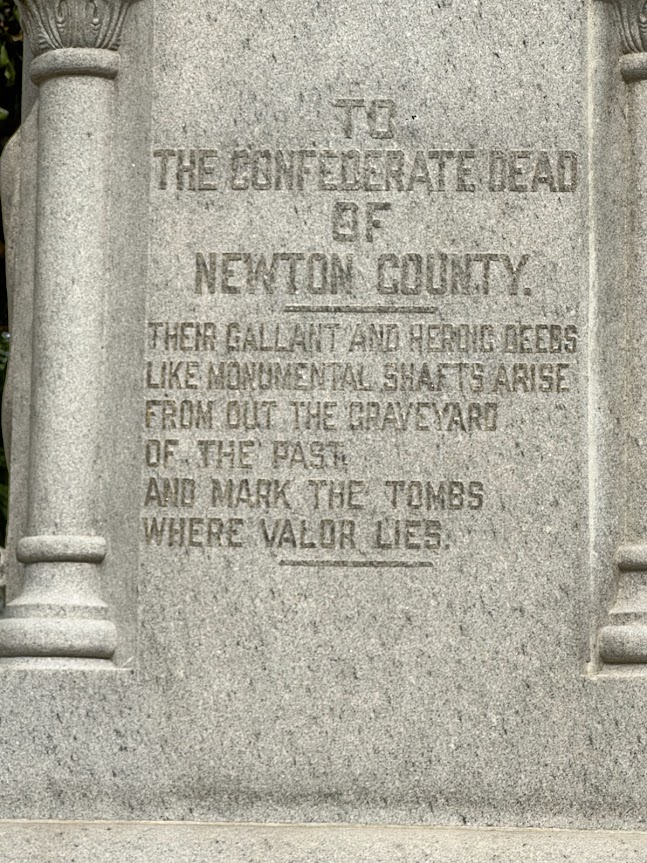
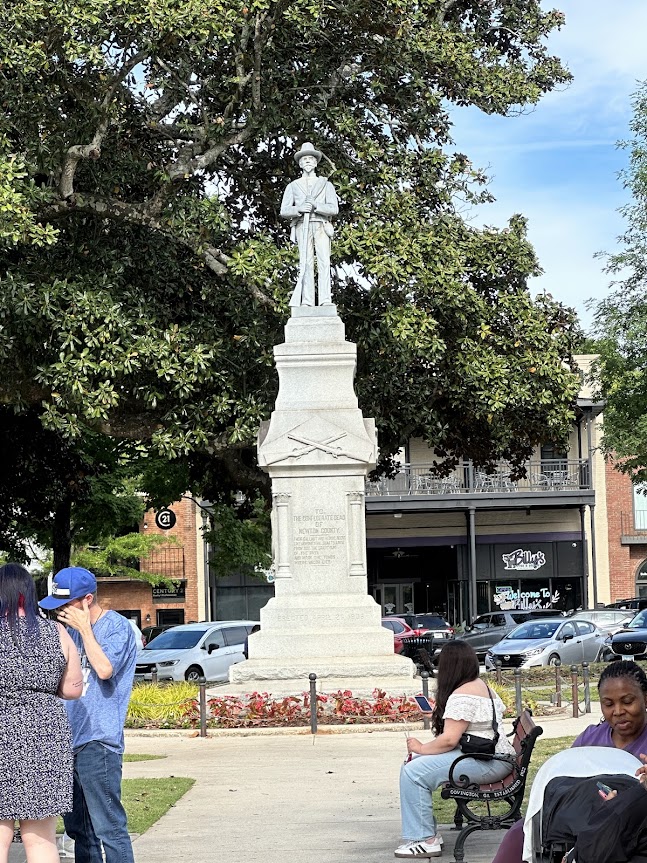
In the middle of the square was a statue honoring the Confederate soldiers who had perished during the Civil War. Paved walkways crisscrossed the square, with people resting on benches along the walkways, enjoying the mild weather. And there were people walking around the square, sitting at a café, and shopping in funky stores that populated the street fronts around the square.

The Confederate monument

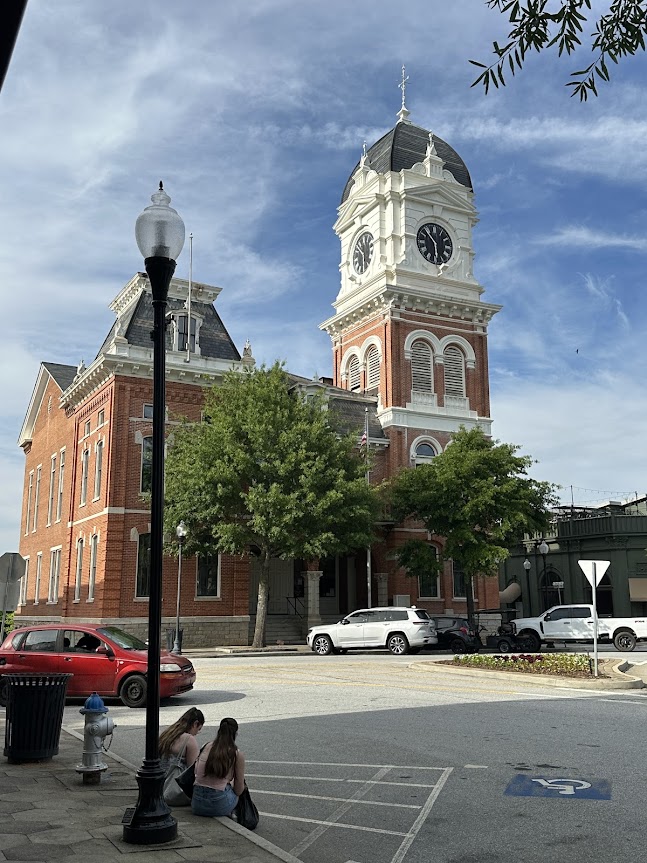
The Clocktower, which is part of the courthouse, dominates the square. It reminded me of the dominating churches at the Mexican zócalos. While researching the history of the Clocktower, I came across an AI summary that described it as a “classic design with detailed architecture” built in the early 1900s. That is pure nonsense. What is classic design? And what is detailed architecture? Then I found another history on Wikipedia stating that it was designed in 1884 in the Second Empire style by Bruce&Morgan, after the original courthouse burnt down in 1883. I believe the second description rings truer because of its specificity.

The Clocktower, the Mystic Grill and the Shrimp and Grits

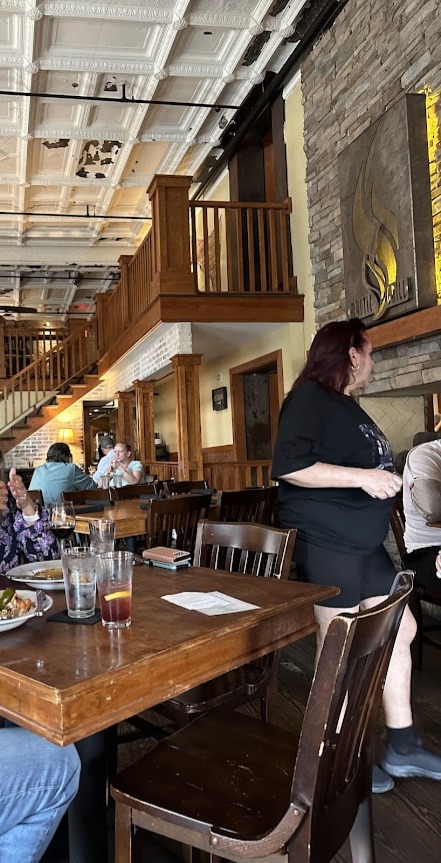
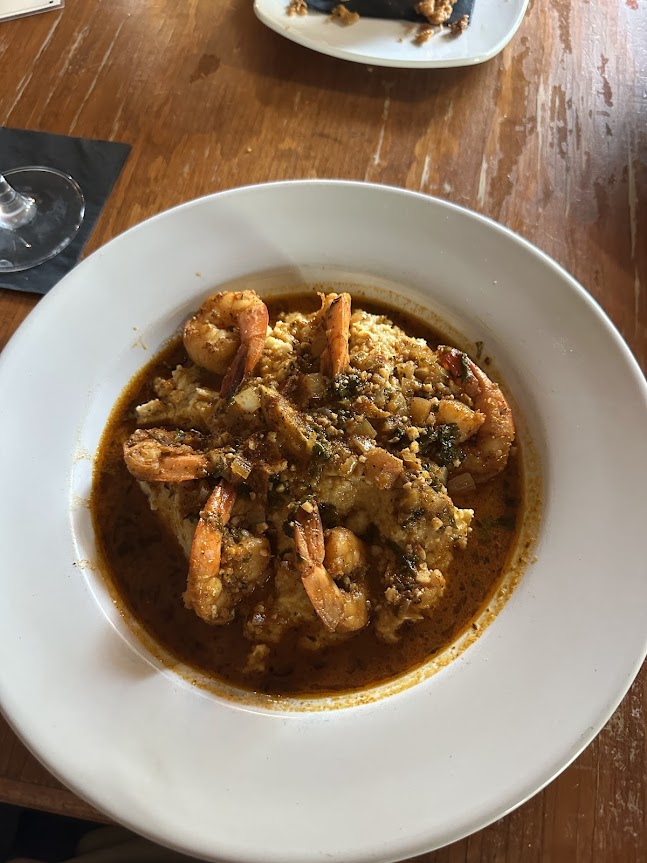
We had dinner at the Mystic Grill, located next to the Clocktower. The shrimp and grits were one of the best I have ever had; they were made with stone-ground grits, bacon, garlic, shallots, cilantro, and lime juice. The next best shrimp and grits I had was a week ago at Jekyll Island, GA, where the dish contained mushrooms, cheese, and andouille sauce.

The restaurant was noisy, making conversation difficult for me, especially with the larger tables to talk across and the conversations ricocheting in the dining room. But the atmosphere was very inviting, with a 2-story-high coffered ceiling and local historical pictures and memorabilia on the walls.

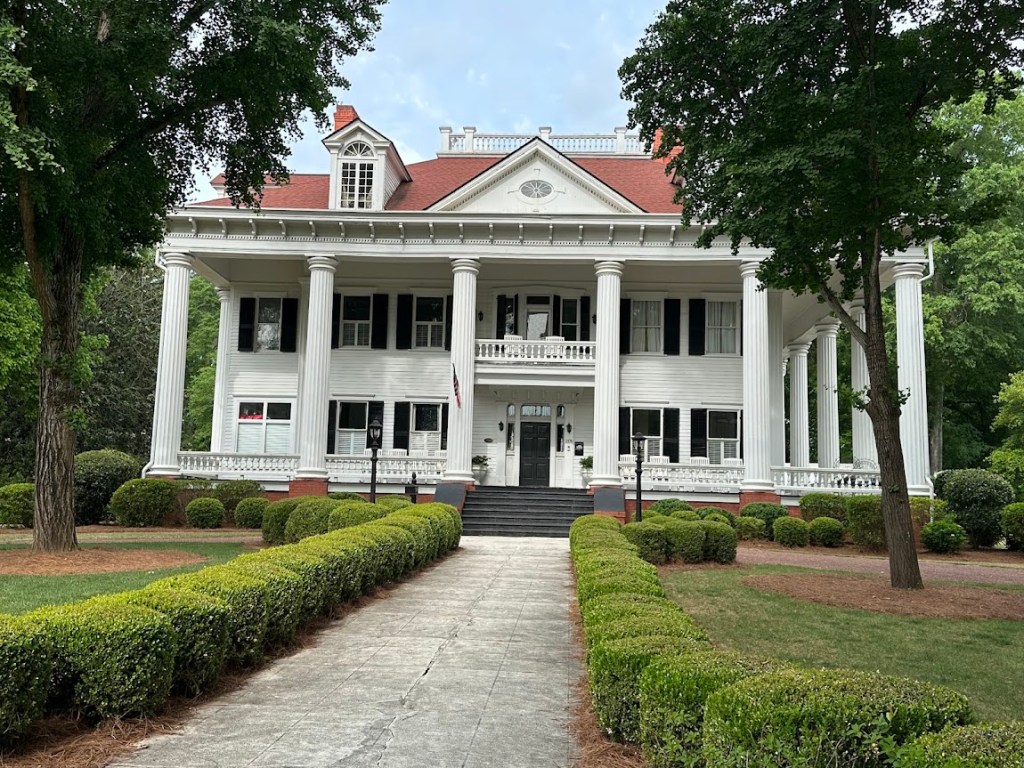
But Covington has some antebellum homes, the most famous of which is Twelve Oaks, which served as the model for the 1939 film Gone with the Wind. The 1939 movie was based on Margaret Mitchell’s book of the same name, published in 1936. A pricey B&B today with themed rooms and a manicured, landscaped yard, it still features the 12 oak trees around the home, from which the name was derived.

The Twelve Oaks B&B

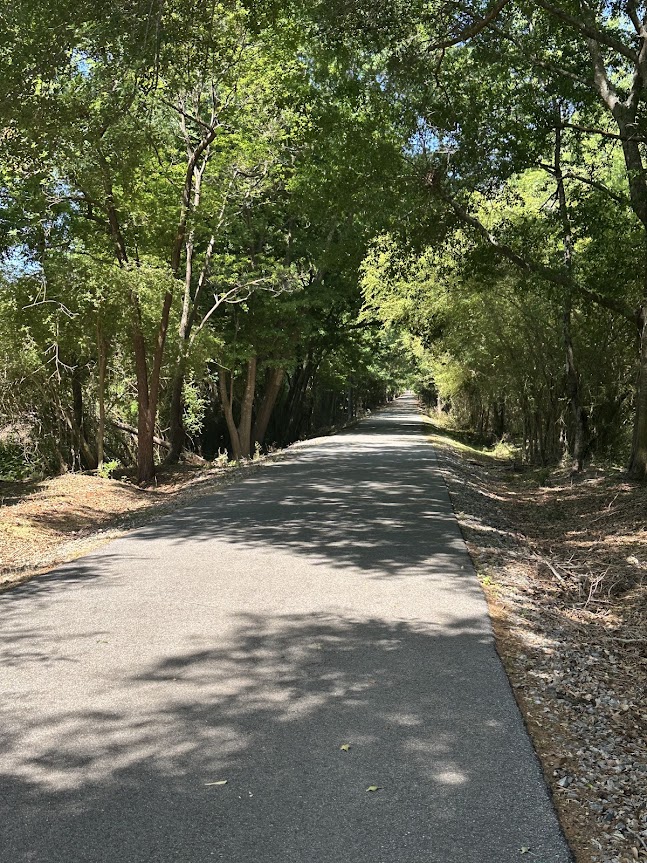
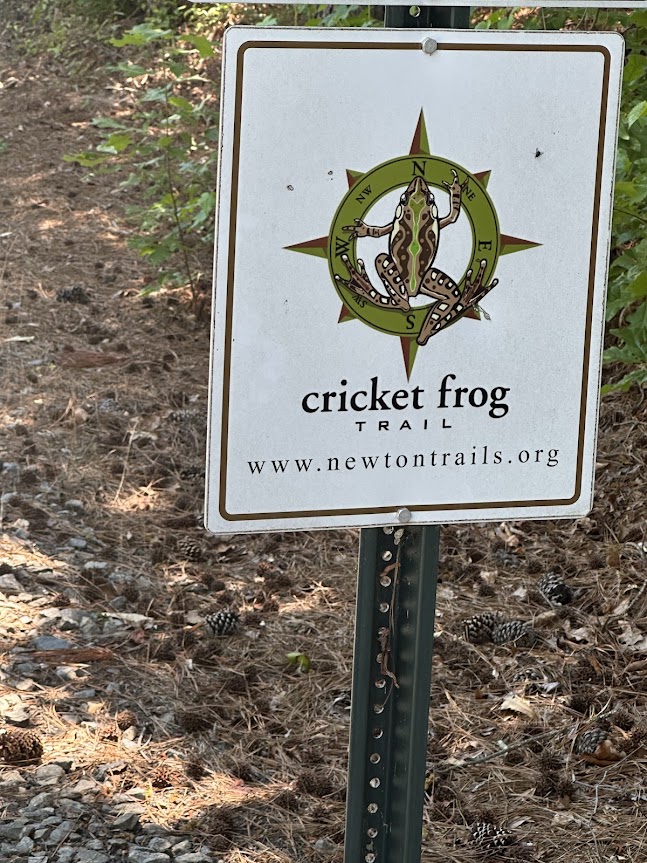
We rode the Cricket Frog Trail the next day, a 14-mile-long rail-to-trail, once traveled by the Central of Georgia Railroad. The paved trail is a bit hilly with some curves; I wondered about how fast the trains moved along it. We started riding at the rural trailhead and cycled towards Covington. Once we reached the outskirts of the town and encountered traffic, we turned back. It was a pleasant ride, and I saw many estates along the trail.

Coming back to the two rail-to-trails we rode, one in Beaufort, SC, the Spanish Moss Trail, and the other in Covington, GA, the Cricket Frog Trail, I prefer the Cricket Frog for having mostly cyclists and a shaded pathway along the way. The Spanish Moss Trail runs through more urbanized areas, with walkers and people walking dogs, contributing to slower cycling and frequent shouts of “on the left”. And it was also mostly a straight path, which felt boring at times. However, there are a couple of nice coffee shops in Port Royal at the end of the trail and a rookery that boasted innumerable birds, a very cool experience. And I like to end my rides at a coffee shop with quality coffee and some sweets. For riding, the Cricket Frog Trail is better, but for interest, the Spanish Moss Trail is preferable.

Cycling on Jekyll Island, Georgia, with a Road Scholar group


April 29, 2026

The challenge we faced while riding around Jekyll Island was using a coaster bike. It was unexpected, and we have not used those bikes in decades. It took some time to reacquaint ourselves with getting on and off those bikes.

Another challenge was cycling up the sand dunes with only one gear. Stopping was the final challenge when the cyclist just ahead of us suddenly stopped. We were to follow each other by one bicycle length. Most of us decided to follow the cyclist ahead of us by 30 feet.

We found the local drivers very courteous; they stopped for us and let us cross the road, even though it took a few minutes for the twenty of us to cross, riding in a peloton.

But once we got on the bikes, the pathways and scenery were worth the trouble of getting going on the coaster bikes. The island pathways were all paved, although I prefer dirt roads, in case I fall. Falling on the pavement could be painful. We were comfortable riding during the weekdays, but I suspect that on the weekends, cycling traffic might be heavy, especially given the pavement width, which was not 8 feet wide.

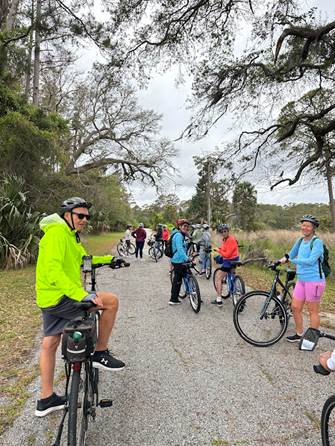
Our group is getting organized below, and the landscape along the ocean pathway.

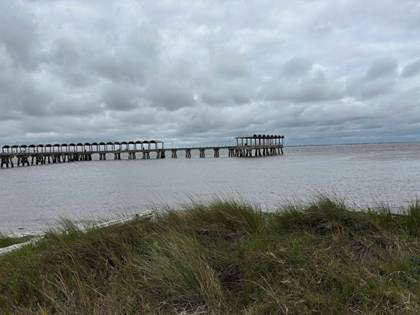
The pathways circle the island, offering magnificent views of the ocean on one side. On the other side, the paths ring hotels, beach houses. The landscaping was outstanding on the entire island.

I found one disadvantage of riding in a group is the lack of opportunity to stop and take pictures when approaching a particularly attractive landscape. On the other hand, the guides lead us to the most photogenic sites.

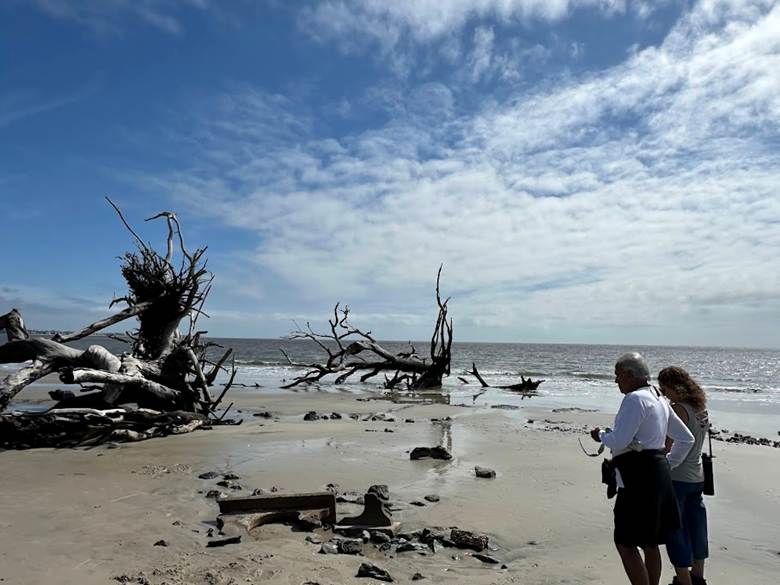
We saw one of those unique sites today, Driftwood Beach. The picture below describes it better than I could.

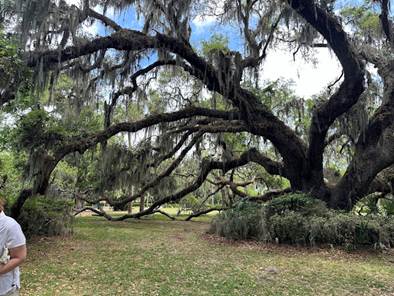
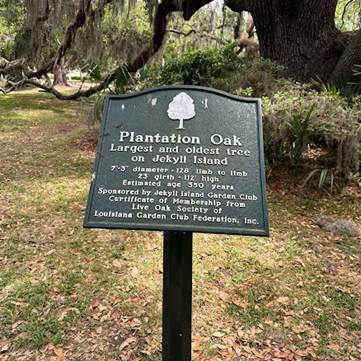
The oldest tree on the Island, a live oak, was also spectacular with its huge overhanging branches.

We averaged 8 miles per hour riding. Surprisingly, we spent only 2 to 3 hours riding while being on the road all day. The reason is that we visited historical, cultural, and environmental sites, enriching Jekyll Island. But just riding on Jekyll Island alone is a very rewarding experience and I would certainly recommend it. Next time, however, I will take my road bikes and not use the coaster bikes available for rent.

The First Question Writing a Memoir: What Emotions Arise When Sharing Your Life Story


April 5, 2026

The first question when you write a memoir: What emotions arise when you think about sharing your life story?

That is a loaded question. For anyone writing a memoir, it may be the first consideration: are you prepared to reveal your personal history and inner thoughts to others? Which aspects of your life would you share, with whom, and would sharing bring you happiness or sorrow?

That raises a followup question: would I, or should I, experience emotion when sharing my story? By emotion, I mean feelings of pride or shame, excitement or boredom when discussing myself. I might downplay or amplify achievements. I could even conceal parts of my story, perhaps out of shyness or avoid recalling painful memories. When prompted, I think I would be happy to share but I would not initiate such discussions unless the setting was appropriate.

Another consideration: what is my life story? Is it focused on my career, chronological list of positions held? Or does it center on pivotal moments that shaped my life? Or would my story be marked by how I navigated adversity, or by how I capitalized on—or missed—opportunities?

Then, the audience matters. Am I sharing my story with people of my generation, who have similar accomplishments and backgrounds, such as fellow immigrants? Would I discuss it with someone experiencing homelessness when I have financial stability? Would I share it with children, and for what purpose?

For example, I would share my adventures and challenging experiences with those who have faced similar situations, but I might feel uneasy sharing with people whose lives have been sheltered. They might not relate to or value my experiences.

Issues of comparability can also lead to uncomfortable situations. We have seven grandchildren. People without grandchildren have said we’re lucky and well-off for that reason. I agree. But I am sensitive to such situations, and I do not want to cause discomfort, so I avoid the topic unless asked. People adapt their life stories to their listeners.

Another example, do you want to describe your children’s success, even if the other person had misfortune with theirs? There have been instances when such situations could have led to negative comparisons between my experience and theirs. I try to avoid those situations.

In conclusion: Would I share my story with someone? Yes. I have nothing to hide and would be glad to talk if someone is interested. However, I’ve noticed people are rarely curious about others’ experiences; even travel stories are met with polite acknowledgment unless the listener traveled the same routes.

I would prefer sharing my experiences with those who have backgrounds similar to mine, so we can genuinely connect over common ground.

If I were to share my life story, I would begin with my childhood in Hungary under the Communist regime, describing what that experience was like. A major turning point came when I walked to Vienna, where I was temporarily placed in high school. Afterward, I lived in Manchester, England, for a few months before flying to Vancouver, Canada, and start a new life. Other significant moments included attending university, getting married, having children, and building my career. Each of these events represents a critical event that shaped who I am today.

As my story continued, I would include my experiences in consulting and as a lobbyist, sharing what each role entailed. I would also discuss the countries we visited and the lessons we learned by exploring diverse cultures. Through these experiences, both professional and personal, my life story would come together as a collection of challenges, opportunities, and discoveries.

Some subjects, such as troublesome family matters, might be harder to share honestly. Although I could speak more openly about deceased family members, I might still avoid sensitive subjects.

Overall, I feel positive about sharing my life story when there is genuine interest, especially when I know my story will not make listeners uncomfortable.

Finding Travel Partners: Lessons from Ottawa West Probus


February 6, 2026

I was disappointed attending an organizational meeting for a travel group. The Ottawa West Probus Club decided to establish a travel interest group. A volunteer arranged the meeting to discuss what we should do. We met in a cold church room with no coffee provided. A poor beginning for me. On top of this, only five people showed up, including me. A very inauspicious start, when we have two hundred people in the Probus Club.

Right off the bat, someone mentioned privacy concerns. She took exception to the spreading of personal emails; I assumed she was referring to the invitation to this meeting. I wondered how difficult it would be to organize a group without using email today. Should we use a phone instead and call each participant? Would that be time-consuming? The same person also expressed a dislike for people taking pictures when the lunch group meets.

After this curious discussion of privacy issues, the organizer asked what we wanted to get out of this meeting! Since this was the second meeting of this group, and since only I and another person were new, I thought the purpose of this group had already been established. But no, the agenda was wide open.

I suggested three options based on experience: holding monthly meetings with travel slide shows, inviting guest speakers from travel companies, or organizing group trips ourselves.

These options were not what the organizer had in mind; she explained that this group would serve only as a “travel dating” site, where people with similar travel interests would be introduced to one another. And once such a group coalesced, they would handle travel arrangements like flights, hotels, and tours. Ok. But why is such a service needed?

Well, she explained, people do not like to travel solo and look for company. Family or friends, I assume. The assumption is that people do not find family members or friends available to travel with and look for travel companions with similar interests, likely members of the Probus Club.

I agree with her opinion. It is a challenge to find friends or family to travel with, as preferences for travel differ—some enjoy cruising, while others prefer five-star hotels. Our nascent travel group aims to connect Probus Club members with similar travel interests and preferences.  

The idea of traveling in a group with local people made me think of what we used to do. We used to arrange our trips and travel with a backpack, just the two of us. We looked forward to meeting local people in faraway countries, tasting their food, whether spicy or not, and learning about their culture. Getting lost on our way was always a highlight, a learning experience, and I thought we were enriched by such unanticipated adventures.

I am not sure that I want to travel with our Probus friends; in fact, traveling with a group often limits interaction with locals. Guided tours are efficient for planning, but limit opportunities to engage with locals. Some prefer arranged trips, while others enjoy planning their own trip.

I left the meeting with no information on the next steps. But it has become clear to me that the organizer should explain the idea for this travel group in the Probus Club newsletter. And that there should be a structure in place to allow people to sign up for trips of their choice.

Considering all this, I left the meeting seeing limited value of this travel group for our Probus Club. But I give full credit to the organizer for trying to get this group off the ground.

Note: Probus is a worldwide organization run by volunteers. It is a non-profit organization for semi-retired and retired professionals and businesspeople, with no political or religious ties.   It started in the United Kingdom by a Rotary Club.