Cycling Through Jekyll and St. Simons Islands: A Historical Journey


May 4, 2026

Exploring the Historical Layers of Jekyll and St. Simons Islands in Georgia: A Cyclist’s Journey with Road Scholar. History is woven into nearly every stop and story on these remarkable islands, from grand clubs and pivotal events to deeply meaningful landmarks.

We cycled for a few hours each day, spending the rest of the time visiting historical and other unique sites across the two barrier islands.

Among the many stops we made on Jekyll Island, the most fascinating story for me involved the Jekyll Island Club and its founders. The original owner of the Island, Eugene du Bignon, a Frenchman, sold it to New York investors looking for a wintering place for hunting and recreation in 1886. Fifty shares were sold to industry elites in New York, including the Morgans, the Rockefellers, the Vanderbilts, and other titans of industry. Joseph Pulitzer was one of the original owners as well. He built his fortune publishing the St. Louis Dispatch-Post and later the New York World. A hotel was built, and some shareholders also built “their cottages,” which measured up to 10,000 square feet. The cottages had no kichens, all the people ate at the Club.
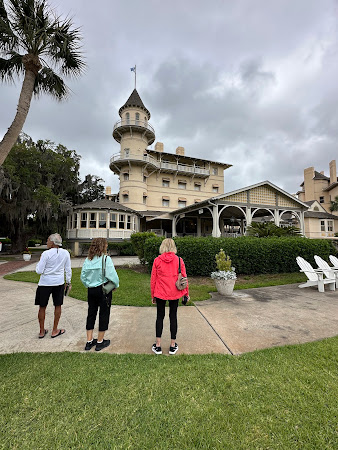
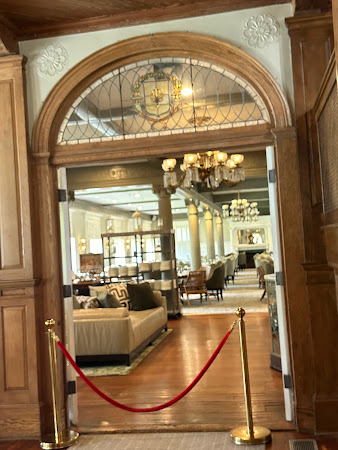
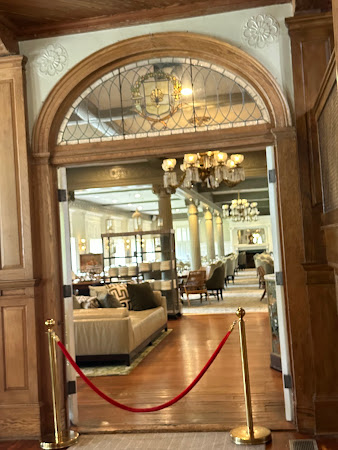
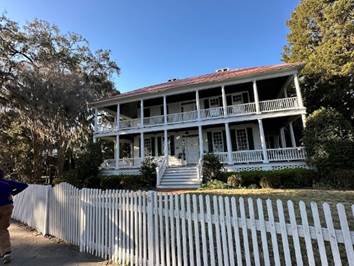
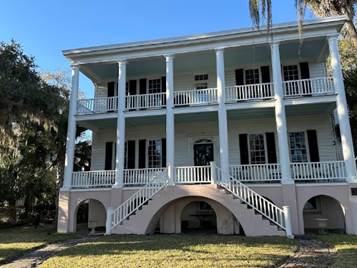
The Jekyll Island Clubhouse and the dining room. Below are two cottages.
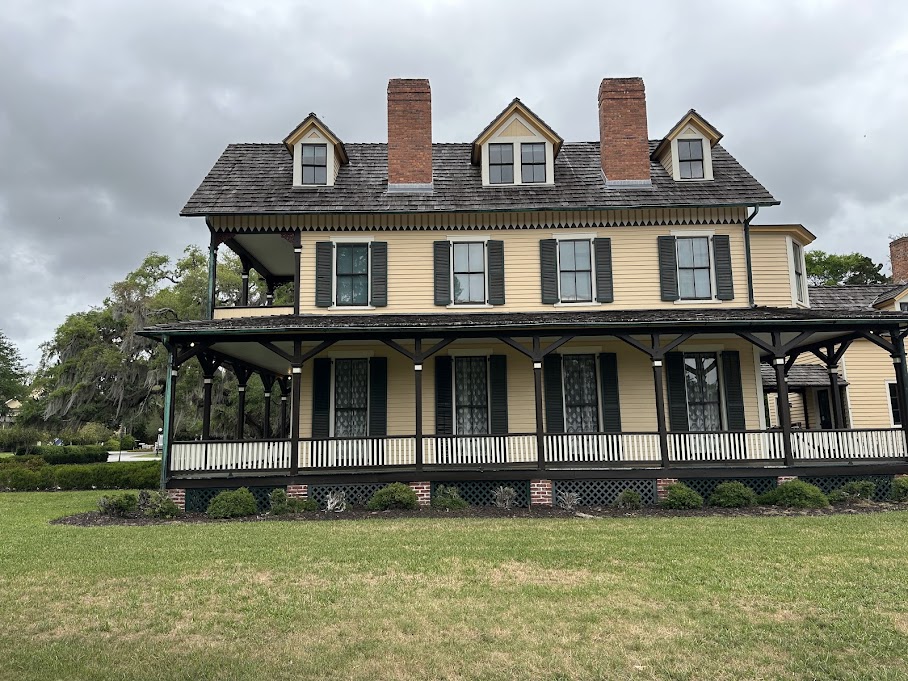
Among the Club’s many noteworthy events was a 1910 gathering of American financial leaders, who drafted legislation that would later serve as the foundation for the Federal Reserve system.

The depression impacted the industrialist owners of Jekyll Island and their use of the Club diminished. Also, travel opportunities expanded in the 1940s, and the original owners’ descendants lost interest in Jekyll Island and the Club. After the Club closed in 1942, the Island was expropriated by the State of Georgia in 1947 for $647,000, designated a historic landmark, and turned into a State Park managed by a Governor-appointed Commission.

The architecture of the Clubhouse is in the Queen Anne style, with a typical four-story turret, wraparound porches, and complex rooflines. The interior is in the Gilded Age style, with luxurious furnishings that made me think about how the ultrarich lived in the late 1800s and early 1900s. Thwae Clubhouse is a magnificent building in my opinion and is open as a luxury hotel today.

Turning to another chapter of the island’s history, the story of the Wanderer stood out. This luxury schooner, built in 1856, was converted into a slave ship two years later. Businessmen brought over more than 400 slaves from the Congo in 1858 to Jekyll Island and sold the slaves in the South, that was against federal law since 1808 in the United States. The businessmen were indicted but not convicted, and the ship was seized by the Union Navy and later sunk by Cuba. The Wanderer Memory Trail on Jekyll Island relates the story of the slaves brought over from Africa. I found the exhibits along the trail fascinating, espemcially the musical instruments and the foods the black people brought over from Africa. Walking along the trail and listening to the audio stories gave me a bad feeling.

On St. Simons Island, two key points of interest drew my attention. First was Harrington House, which was once a one-room schoolhouse for black children in grades 1 to 7. Inside the building were pictures and artifacts related to the schoolhouse’s operation, as well as information about the students who attended. After the Brown v. Board of Education decision in 1954 (the desegregation legislation), the school closed, and the students were transferred to the wider public school system in Brunswick. The school docent was from the local community and had vast knowledge of the school’s history and explained that the island’s black population has decreased due to gentrification, falling from over 80 percent to just 1 to 2 percent of the current 13,000 residents.

The island’s past also comes alive at Fort Frederika, built in 1736 by James Oglethorpe. Now a National Monument, the fort was at the heart of 18th-century debates between Spanish and British governments over lands south of Savannah. Oglethorpe asked the King for a land grant to establish a colony, to serve as a defense against the Spanish. Like civil war sites, the Fort Frederika National Monument is a grassy field today with remnants of buildings and ramparts.

Oglethorpe was a visionary, and in 1736, he laid out a town, a utopian kind of village with streets forming a grid pattern, giving each resident a 50-by-100-foot piece of land on which to build a house and a fifty-acre site for agricultural uses. And he brought over from England indebted people in prison as colonists.
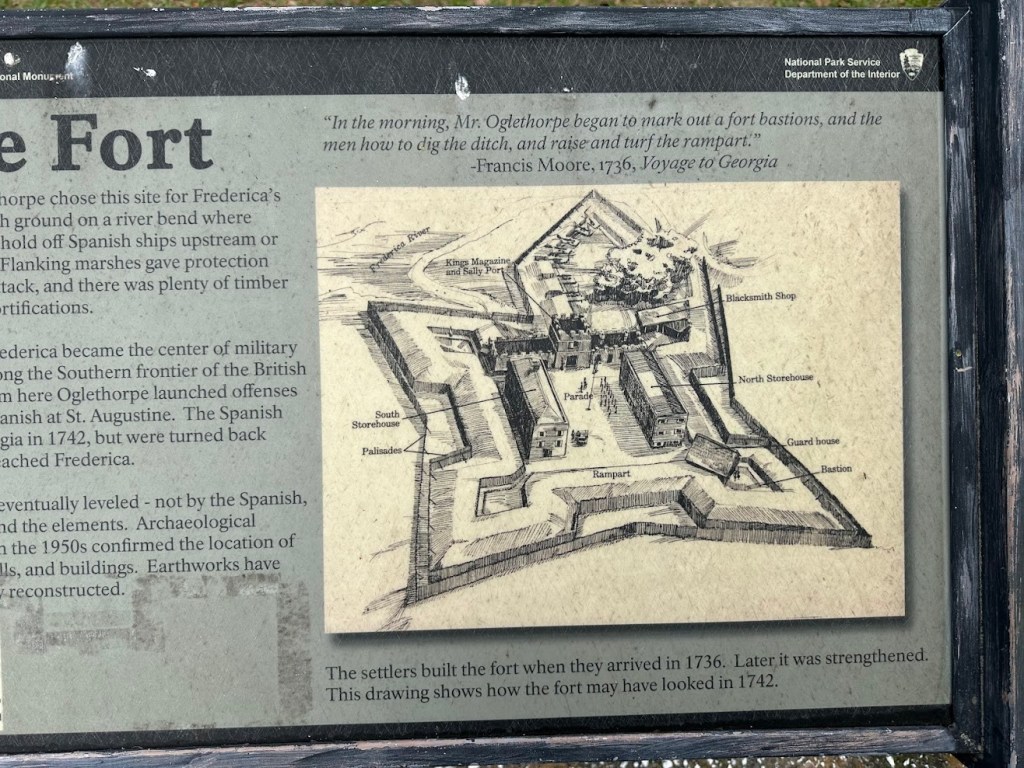
Fort Frederika.

I learned that the houses were built with “tabby”, a material made of crushed seashells, mixed with sand and water, the combination of which resembles concrete.

Before concluding my journey, I visited another unique destination: the Georgia Sea Turtle Center on Jekyll Island. It is a hospital for sick turtles as well as an educational and research center. I learned that turtles lay hundreds of eggs a few times a year, but only after reaching 30 years of age; after that, they lay eggs every second year up until they die, which might be at 100 years of age. But only one egg will grow into a full turtle out of 3,000 eggs!

The expert also explained that after the eggs hatch, the baby turtles are guided by moonlight to find their way into the water. She advised us not to use flashlights at night when watching the move of the turtles because that may confuse them and lead them away from the water.
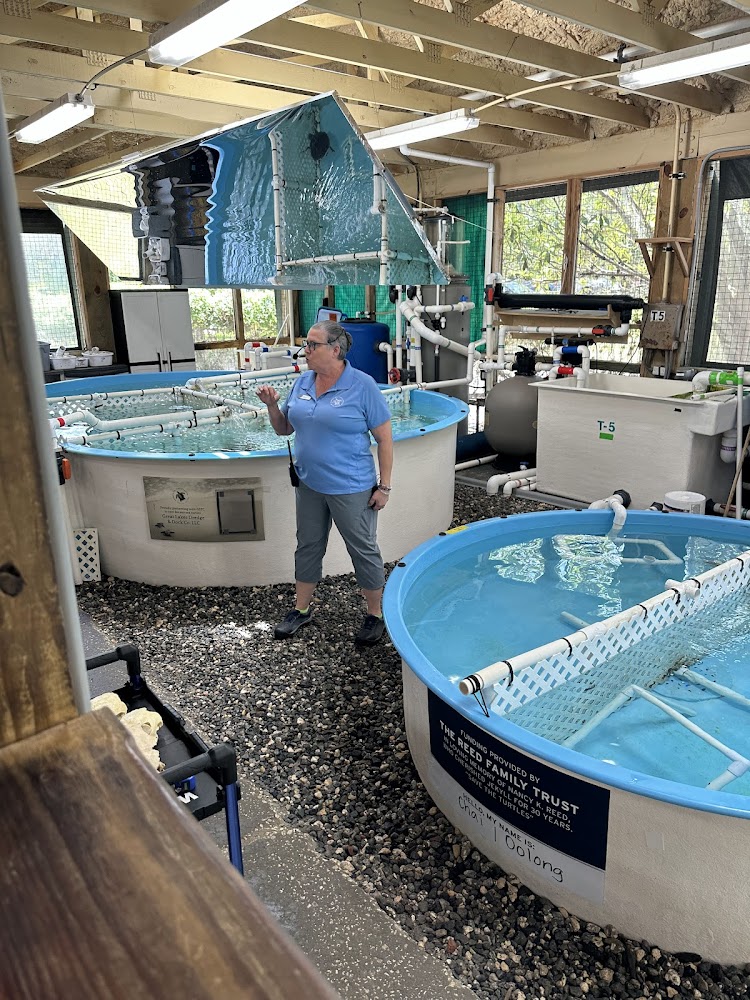
Tanks with recuperating turtles.

In addition to listening to an expert on turtles describing their lives, we observed technicians examining a turtle in a lab, behind a window. Next to the exhibition space on turtles was an industrial warehouse, filled with huge tanks housing recuperating turtles. Interestingly, there was only one turtle in each tank. Apparently, turtles are solitary animals, and if more than one is in a tank, they attack each other. Most of the turtles in the tanks came from Cape Cod; the cold water at the Cape caused hypothermia in turtles and were brought to this hospital for recuperation.

Visiting the two barrier islands offered a unique window into American history—from colonial times, through the Civil War and Gilded Age, to the civil rights period. The experience reminded me how these islands encapsulate the evolving story of the region, illustrating why their preservation and interpretation matter so much today.
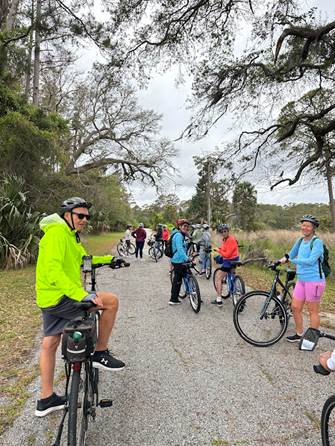
Cycling on Jekyll Island, Georgia, with a Road Scholar group


April 29, 2026

The challenge we faced while riding around Jekyll Island was using a coaster bike. It was unexpected, and we have not used those bikes in decades. It took some time to reacquaint ourselves with getting on and off those bikes.

Another challenge was cycling up the sand dunes with only one gear. Stopping was the final challenge when the cyclist just ahead of us suddenly stopped. We were to follow each other by one bicycle length. Most of us decided to follow the cyclist ahead of us by 30 feet.

We found the local drivers very courteous; they stopped for us and let us cross the road, even though it took a few minutes for the twenty of us to cross, riding in a peloton.

But once we got on the bikes, the pathways and scenery were worth the trouble of getting going on the coaster bikes. The island pathways were all paved, although I prefer dirt roads, in case I fall. Falling on the pavement could be painful. We were comfortable riding during the weekdays, but I suspect that on the weekends, cycling traffic might be heavy, especially given the pavement width, which was not 8 feet wide.

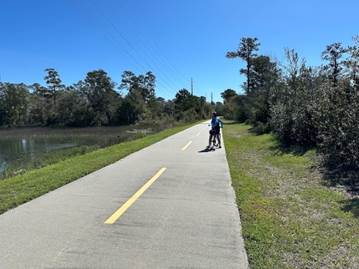
Our group is getting organized below, and the landscape along the ocean pathway.

The pathways circle the island, offering magnificent views of the ocean on one side. On the other side, the paths ring hotels, beach houses. The landscaping was outstanding on the entire island.

I found one disadvantage of riding in a group is the lack of opportunity to stop and take pictures when approaching a particularly attractive landscape. On the other hand, the guides lead us to the most photogenic sites.

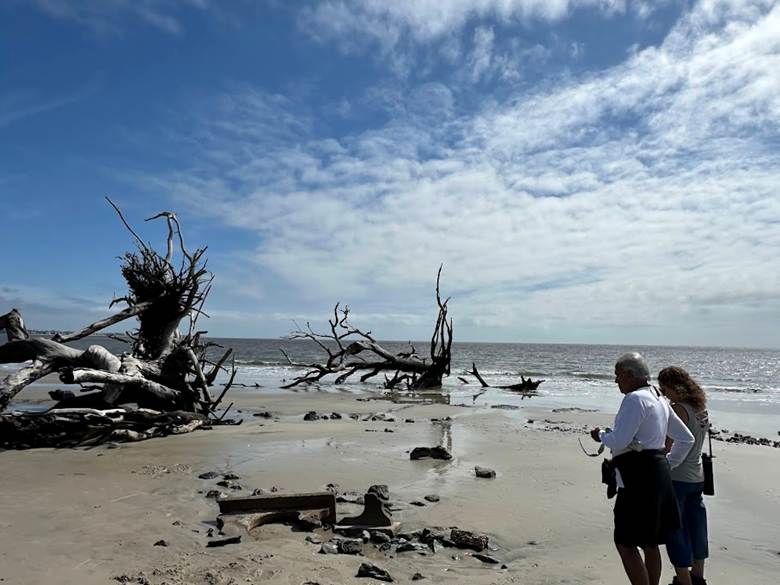
We saw one of those unique sites today, Driftwood Beach. The picture below describes it better than I could.

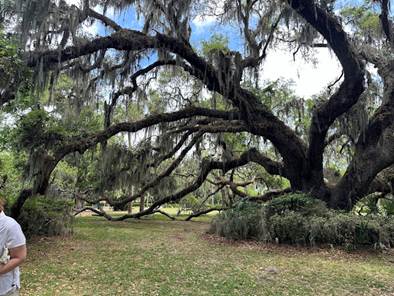
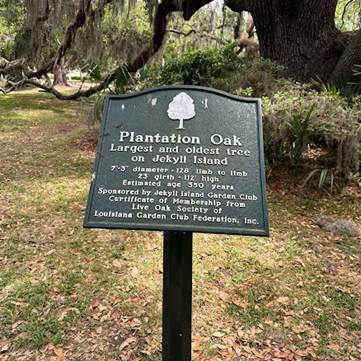
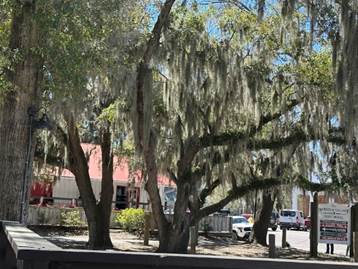
The oldest tree on the Island, a live oak, was also spectacular with its huge overhanging branches.

We averaged 8 miles per hour riding. Surprisingly, we spent only 2 to 3 hours riding while being on the road all day. The reason is that we visited historical, cultural, and environmental sites, enriching Jekyll Island. But just riding on Jekyll Island alone is a very rewarding experience and I would certainly recommend it. Next time, however, I will take my road bikes and not use the coaster bikes available for rent.

Exploring Beaufort: A Cyclist’s Paradise in South Carolina


March 24,2025


We drove south to leave the winter of Ottawa, even though we enjoy snowshoeing. Escaping springtime offers a welcome reprieve from the winter’s cold and snow. Despite my pollen allergies (managed by Claritin), late March in the Carolinas offers ideal cycling weather.

Driving south towards Beaufort, South Carolina, I sighed in relief at leaving the crowded, monotonous, and speedy Interstate 95 behind. Driving for hours had numbed my feet, so I hoped for less, slower traffic on Route 21 East. Although slower, the traffic picked up closer to Beaufort on a four-lane highway.


The expansion of military bases (Parris Island and Beaufort), resort construction (Hilton Head Island), and a Northern retiree influx have driven development along South Carolina’s east coast.
We learned from a hotel employee at check-in that Beaufort’s population has almost doubled since the pandemic, nearing 15,000. It is not only retirees but also people working remotely who have arrived to take advantage of lower housing and living costs.

When Kathy stayed here thirty years ago, she stayed in one of the huge antebellum houses on the waterfront, used as a B&B in those days. Today, developers meticulously redeveloped the waterfront, and they restored the antebellum homes along the waterfront to their original designs. The city designated the downtown area a historic district, and we enjoyed a quiet walk admiring the architecture.

Cycling the Spanish Moss Trail from Beaufort to Port Royal was a smooth ride (it follows the old Magnolia rail line). The paved, twelve-foot-wide trail was flat, crossing marshes with many boardwalks and with the temperature in the mid-twenties (in the seventies in Fahrenheit), was ideal for a bike ride. Much of the Trail crossed areas with oak trees from which Spanish moss hung. I assume the source of the name for the Trail. Although the hanging moss is attractive, avoid touching it because it might contain chiggers.

The paved trail was great for riding, but I knew that falling off the bike would be rough, experiencing injury if going at the maximum allowed speed of 15 mph.

We sped through the twelve-mile trail, pausing to talk with people going in the opposite direction. We avoided talking about politics. We did not know how local people would react to talking to us Canadians, in view of Trump’s desire to annex Canada.

I noticed different organizations took responsibility for maintaining sections of the trail, which included benches at viewing sites, including the military that were in abundance in the area.

In less than a couple of hours, we arrived at Port Royal, at the other end of the trail. We were ready for a cup of coffee and found in the center of Port Royal a home converted to a restaurant with a name Corner Perk that offered fancy coffees. Their muffins were so special we couldn’t resist.

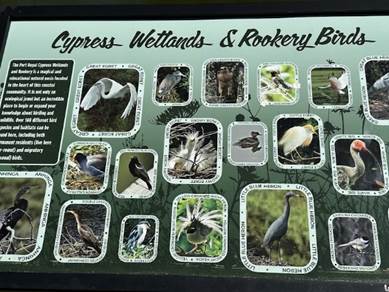
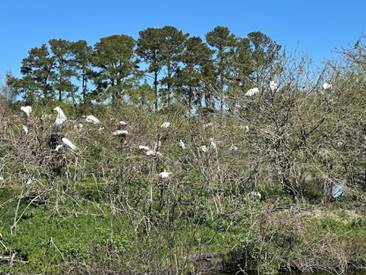
Next, we saw a sign for the Cyprus Wetlands rookery, home to hundreds of local birds (egrets, cormorants, bats, herons, etc.), right by the coffee shop. A boardwalk crosses a lake, going by an island with small trees that provide nesting grounds for birds. We noticed many turtles and alligators also slept on the shore of the island.

Returning to Port Royal, we found a small house converted to a restaurant boasting a sign for Griddle and Grits and the menu included grits with shrimp, with chorizo and grits with different ingredients. I like spicy foods and chose chorizo on grits, which turned out to be excellent. Kathy chose she crab soup, which also turned out to be a good choice.

On the return journey, we paused on a bench and were approached by a man who looked like a bear of an angler, who sat down, smoked a cigarette and started a conversation. He wanted to know all about us and then described his entire life story, including where he was born, where his family members were born and all the ailments they each had. I gathered he has been a floater with jobs in many states before settling in Beaufort. We could not resist listening to him; overall, it was an enjoyable social engagement.

We stopped at a Publix grocery store on the way home to pick up dinner. The Spanish Moss Trail is a nice, paved trail, but it was a bit too tame for us. We like longer and wilder trails with fewer refinements.

A Slice of America, where Tennessee, Georgia and North Carolina Meet


June 2, 2022

Sometimes one drives through a small geographic area and discovers its small towns have a rich history. One such area we encountered is where the states of Tennessee, Georgia, and North Carolina meet. The area experienced the expulsion of the Cherokee Nation from their ancestral lands, the discovery of copper, the development of a company town mining copper, and the destruction of the environment leading to remediation. These have been major historical events. So how did we get there?

My daughter rented a vacation home in Murphy, North Carolina. The area is famous for hiking, walking, rafting, and mountain biking and daughter Megan and family wanted to enjoy these activities. The rental home was so big that we were all invited, though I left rafting and mountain biking for the younger generation. But l discovered other places to visit that interested me: the Cherokee Museum in Murphy, NC, and the Ducktown Copper Museum in Ducktown, TN.

The vacation home we drove to in western North Carolina (on the Tennessee border and a couple of hours from Atlanta, GA), was hugging the hill, almost sliding down, with huge picture windows facing the mountains and trees pruned in front to enhance the view. We took a serpentine road to access the vacation home, which was more like a mansion, with huge rooms and many bathrooms. It was difficult to turn the car around at the entrance to the home. But to go down the driveway, we had to turn around the car: it would have been impossible to back down the steep, curvy, and narrow laneway.

Murphy, NC (population 1600 in 2020), was a few minutes away from our vacation home, and housed the Cherokee County Museum, with panels describing the Trail of Tears, the 800-mile trek the Cherokees took after President Andrew Jackson signed the Indian Removal Act in 1830, pushing the Indians out of their ancestral lands onto federal territory (now Oklahoma). Some people called it ethnic cleansing in response to the settlers’ demand to take away the Cherokees’ land for their use. Over 4,000 Cherokees, about a quarter of the Cherokee Nation’s people perished on the trek.

We believe in Canada we were cruel to our native population by taking their children away from their families by force, to educate them in residential schools into our culture. In the US, the government chased them out of their native lands by force and put them into camps until all of them were cleared out of their ancestral territory. 

On leaving the Museum, I asked the receptionist if they employ any Cherokees. I would not have known if she was Cherokee and was simply curious.  She responded obliquely by saying that the Museum sells native crafts made by Cherokees. She may have misunderstood my question. To me, it seemed to make sense that in a museum dedicated to Cherokee history, they would employ people of Cherokee heritage. But then I remembered that the government chased all the natives out of their territory; perhaps there were no Cherokees left in this area. 

Then we saw the Ducktown Copper Museum. Ducktown, TN (population 560 in 2020) was a ten-minute drive from our rent, named after the Cherokee Chief, whose Cherokee name translated to Duck. (called Duck), in their native language. The Ducktown Mining Museum occupies the old headquarters of the Tennessee Copper Company (TCC). Our guide was a white-haired woman, a native of Ducktown – whose husband, brother, and father had all worked in the mines. She said that people started working for TCC as young as thirteen years of age and stayed with the company all their lives. 

TCC had a good reputation for labor relations, and was good to its employees, she said, although I found that there were strikes by the workers demanding higher wages and benefits.  When I asked, she confirmed the strikes but was proud of the company and showed us around explaining how copper was mined at a depth of twenty-five hundred feet. She said that she went down into the tunnels with her husband. I found it surprising to hear from her that the elevator could go down to the bottom of the mine in a couple of minutes; it must have been fast. 

Our guide also described how Ducktown had become the center of mining for copper, after a European American panning for gold in 1943, found copper instead. A copper rush resulted. In a couple of decades, over thirty companies explored and produced copper. Berra Berra Copper Company was the biggest mine at that time headed by a German-born mining engineer, Julius Raht. The company had expanded when roads were built to transport the ore.

During the American Civil War, the Confederates took over the Berra Berra Copper Company, the largest copper mine, and used its production for ninety percent of their needs for copper during the war effort.

But there were environmental impacts. The smelters built to separate the copper from the rock needed fire, and the logging for timber used to fire up the smelters denuded the entire landscape.

The constant burning spewed sulfuric gas into the air which, when mixed with water vapor in the atmosphere, became sulfuric acid and came down as acid rain, ruining all the vegetation and further resulting in topsoil erosion. The acid rain killed aquatic life as well in the Ocoee River. The entire area of sixty square miles had become a moonscape, visible by satellite imagery from the sky. 

But the mines created upwards of 2500 jobs and a booming economy and the environmental degradation had been ignored. To reduce the impact of acid rain, the mining companies erected tall chimneys, hoping for the dispersion of sulfates, only resulting in the dispersion of sulfites in a larger area.

The farmers in close-by Georgia suffered as a consequence of the acid rain and the Government of Georgia, on behalf of the farmers, sued the Tennessee Copper Company (TCC) for damages, in the early twentieth century. The lawsuit ended up with the US Supreme Court, which agreed with the plaintiff and called for an injunction to stop the operation of the mine, which was never enforced because the TCC started collecting the sulfuric acid and selling it as a byproduct of the copper mining process. 

In the early twentieth century, the TCC acquired many of the smaller copper companies and ran a store where the employees purchased all their requirements, and the store deducted the cost of their purchases from their wages. Often, employees developed a large debt that they could not repay and were forced to keep on working for the company. The guide explained that the company provided housing and clothing for the employees as well. I was wondering what life felt like in a company town, where the company ran everything.

With copper prices dropping, all the mines finished operating in 1987. By that time environmental remediation had been going on by the State of Tennessee, the Tennessee Valley Authority, and others. The guide said that although many million trees have already been planted, some moon-like areas were left intact for people to see what the landscape looked like during mining operations. 

I found it interesting to discover that even small places that are drive-throughs for most people, have unique histories, once you scratch the surface. While Murphy was, at one time, the center of the Cherokee Nation, it is now devoid of Cherokee people, except for a Museum dedicated to the Cherokees. And Ducktown, once a booming mining town with thousands of people, has shrunk to a few hundred people, having only a museum commemorating the once huge copper mining operation.