It was not on our bucket list. We had never thought of visiting it before; in fact, I knew of it by name only. What happened was that I looked for something to do in early December, and a Road Scholar trip fit the bill. So, why did I search for an activity in early December? Let me explain.
In July, we reserved a B&B for a family get-together in December, just before Christmas. Our children live in Durham and Charlotte, NC, and Baton Rouge, LA, and I tried to rent a place central to all three. Just north of Chattanooga, TN, I found a place large enough to accommodate all the family.
Then in November, we told our children we would attend Thanksgiving dinner, assuming one of them would organize it.
The availability of three weeks – the time between Thanksgiving and the family get-together – prompted me to look for something to do during that period; we had no desire to drive from Ottawa south twice, a distance of a thousand miles each way.
I remembered my son’s mother-in-law enjoyed Road Scholar trips and looked up what trips were available in early December. A yoga class in North Carolina sounded interesting, but it was fully booked. Sightseeing trips to New York City and St Augustine did not appeal to us, but a kayaking trip in the Everglades did.
One concern was that the Everglades are another thousand miles further from our children’s homes where we would have our Thanksgiving dinner. But it would take us to a warm place and include a physical activity, kayaking, that we are fond of.
Reviewing the kayaking program, I had another concern: Road Scholar rates this trip hard on a scale they use to alert people of the physical difficulty of their trips. They advise that to participate, one should be able to kayak for 6 miles and walk 2 miles a day. The walking component was not a concern, but paddling six miles was. On balance, we decided we could do it since we kayak every summer, often for hours. So, I reserved the last two spots available.
With Thanksgiving Day approaching, I learned that my older son, Tony, was renovating his kitchen and not ready to prepare for a family dinner, which he has done for many years. Daughter Megan decided to take a job in Williamsburg, VA, and planned her move from Baton Rouge in early December, clearly not ready for entertainment. And David’s children and wife planned to visit family in Beaufort, SC, for Thanksgiving. Well, that was that, and instead of traveling south, we stayed in Ottawa and celebrated US Thanksgiving at home. We left for Everglade City the following Monday, on December 1.
Upon reflection, if we had not planned to have Thanksgiving dinner with family, I would not have reserved the Road Scholar trip because we would have just travelled to Tennessee for the family get-together. So, the real trigger to kayak in the Everglades was our intention to have Thanksgiving dinner with family. Funny how plans can have unintended consequences.
The challenge was figuring out what to wear to the Harvest Ball. I thought I had a sports jacket, but it wasn’t in the closet; then I remembered I’d given it to the charity store years ago. I have collared shirts and some fancy T-shirts, but the only formal wear I have is a black suit I haven’t worn in decades, and I was not sure if it still fits. The question was: What do people wear to a Ball today?
The Ball, organized by the Ottawa Hungarian House, was held at the Hungarian community hall, an informal space in an industrial building. I decided the safest thing to wear was the formal suit. But I could take off the jacket in the beginning, and with no tie and an open shirt, I would match the space’s informality.
We arrived 30 minutes early: the dinner was at 6pm. The hall was almost empty except for the organizers. There were no seating arrangements, so we picked a table on the side, next to a well-dressed woman sitting alone at the table next to us. By way of introduction, she said she was Clara and that she and her husband had come from Hungary in 1967. She spoke in Hungarian. When I said that Kathy does not speak Hungarian, she asked if she spoke English or French. When we settled on English, she said that she and her husband started a fur-making business and moved to Baie-Comeau, Quebec, in the early seventies, where the demand for furs was strong. When the local mining industry died and demand for fur declined, they moved to Ottawa. They continued making furs in their basement factory.
I went to the bar to buy a couple of glasses of wine. When I returned, a Hungarian couple sat down at our table. His name was Zoltan, and I remarked that it was a good Hungarian name. I did not catch the wife’s name; it was getting noisy. Nokia hired Zoltan when he finished university in Hungary. After a couple of decades, Nokia transferred him to Seattle for two years, and then to Ottawa. They have been in Ottawa for a couple of years and like it here.
Zoltan’s wife was talkative and said that life is much easier here with all the appliances available, than in Hungary. I gathered they would like to stay on after their four-year work visa expires.
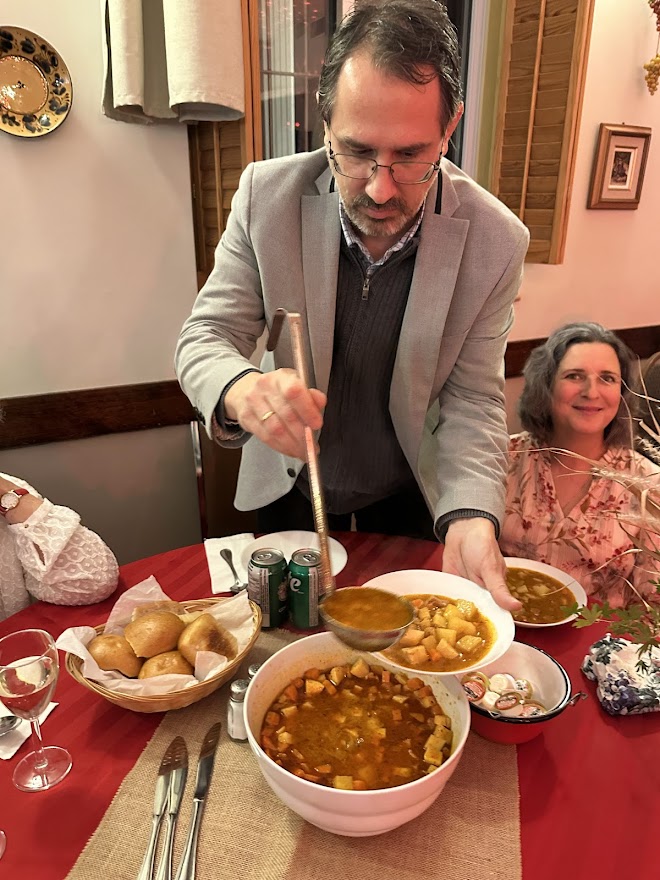
A huge bowl arrived at our table, filled with porkolt (pork stew). Although there were only four of us, the bowl could have served twice as many people. We served ourselves in family style. I enjoyed the porkolt, which was liquid and felt more like soup than stew. After tasting the porkolt, Zoltan’s wife thought that no real Hungarian paprika was used and that the porkolt could have been spicier. I agreed, but I enjoyed it with chunks of pork, carrots, and potatoes.
Oue Hungarian table companion serving “porkolt” family style
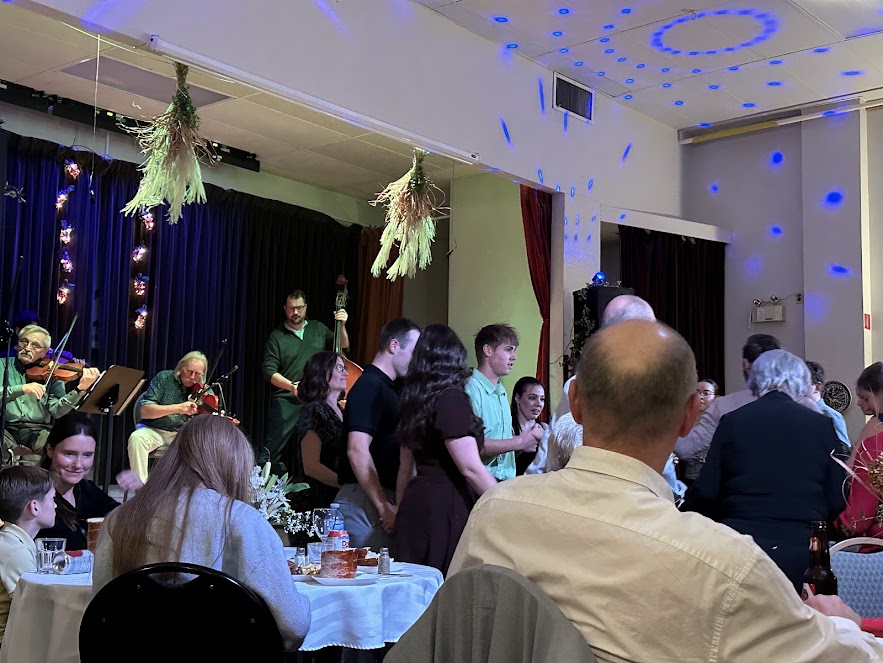
A couple of violinists and a bassist started playing Hungarian folk songs during the meal. The instruments reminded me of the music of Django Reinhardt – gypsy music with a swing – but these musicians played chardas, for Hungarian folk dance. People got up to dance, and soon the dance floor was packed. By now, the community hall had become extremely noisy, with over a hundred people talking, and dancing to the music. It was hard to speak and listen to our table companions.
As I have recently joined the Ottawa Hungarian House, I did not know anyone there. I have never been ethnically oriented. When we came to Canada, we were the type of immigrants who wanted to amalgamate into Canadian society. We did not live the life of the old country. And I married an American girl I met in graduate school at the University of North Carolina. We always spoke English at home, and the children grew up as native Canadians. I came to this event to hear some Hungarian spoken; I may be getting sentimental.
However, I knew some people from my high school in Hungary who studied with me at the University of British Columbia in Vancouver. I heard they came to Ottawa and approached the bartender if he knew any of my old friends, the twins Kalman and Peter Roller.
He said, “Of course, Pista Roller is sitting back there,” and he took me to him, who was not Kalman or Peter but looked like their spitting image. Pista told me there were four brothers in the family. I was shocked to hear that the twins were dead: one had brain cancer and the other dementia. One was a pharmacist doing research in China and the other worked for the National Institutes of Health in Washington, DC. I wanted to follow up on this information and asked for his phone number to arrange for a get together.
Dessert came when I got back to my table. It was a caramelized pastry in the shape of a tube, four inches in diameter, and eight inches tall. I looked inside, thinking that there was some cream or fruit there. No, there was nothing inside; you ate the tube. The Hungarian couple explained that you tear a piece off with your hand, eat it, then keep tearing it apart and eating it. It is called kurtoskalach (chimney cake) and is a popular Hungarian dessert.
Chimney cake
It was an enjoyable evening of contrasts, combining ethnic foods, music, and dancing with people reading their iPhones and speaking English. The evening brought up memories. I described to our tablemates how we escaped from Hungary during the Hungarian Uprising of 1956. Our table companions who came to Canada two years ago acted like Canadians their age. And the Hungarians who came out decades ago enjoyed reliving the music and food of the time they left Hungary.
Dana Milbank’s recent Washington Post article about forest bathing caught my attention. Forest bathing is like a walk in the park, but with a focus on the forest’s sights, sounds, and smells. Forest bathing, a trend originating in Japan in the late 1800s known as shinrin-yoku, is spreading in the U.S. The Harvard Medical School even offers a course on it for its overworked residents, highlighting its significance.
Forest bathing involves taking a leisurely walk in a forest while disconnecting from digital devices and focusing on sensory experiences. It includes stopping to contemplate your surroundings and even taking off your shoes to feel the ground beneath you. Engaging in conversations with trees and plants is also part of the experience. The walk can last anywhere from an hour to a few hours, and the beneficial effects can last for days or weeks.
According to enthusiasts, the benefits include improving the immune system, lowering blood pressure, promoting relaxation, and enhancing sleep. Walking among trees allows you to breathe in tree oils known as phytoncides and plant compounds called terpenes. Studies suggest that these chemicals may help prevent cancer and protect against dementia. While I’m not entirely convinced of all the claims, this information has inspired me to give forest bathing a try.
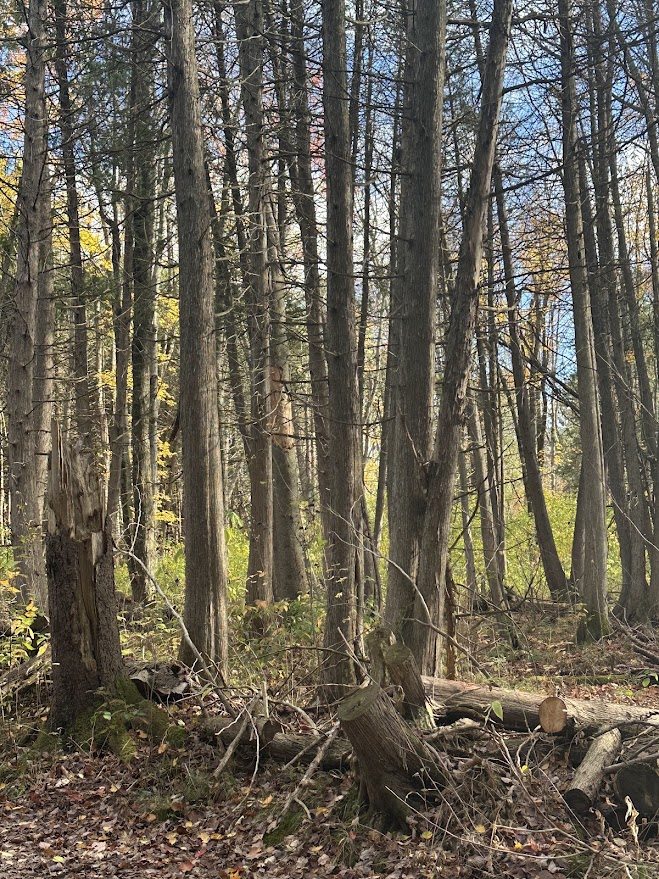
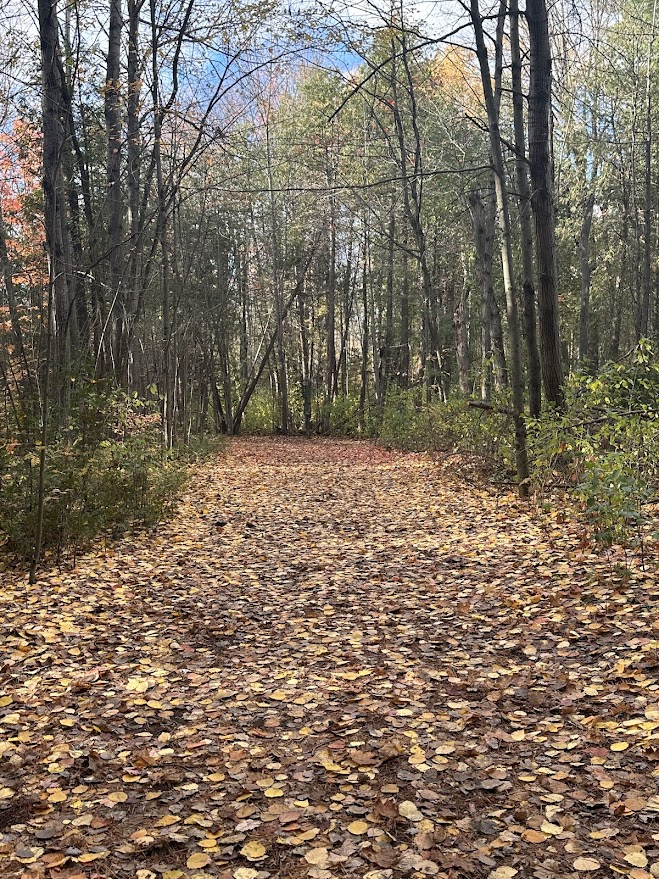
I visited the paths behind Ottawa’s Sportsplex. I strolled at a leisurely pace of three kilometers per hour (about two miles per hour), fully engaging my senses. I could hear airplanes flying overhead and the sounds of traffic from the major roads surrounding the park. The traffic noise was quite noticeable, especially since there were no leaves on the trees to act as a buffer. I did hear leaves falling, but I didn’t hear any birds singing; they must have flown south for the winter, as it is November.
As I looked around, I noticed the attractive tapestry of leaves on the ground. Many trees lay on the ground, some having fallen during windstorms and others cut down to clear pathways. Many fellow walkers, some with their dogs, greeted me and engaged in conversations.
The ground felt soft beneath my feet, and I could feel the wind gently brushing against my face. The bark of the trees felt cold to my touch. Apart from a few dogs licking my hands, I didn’t experience other tactile sensations.
I decided to slow down even more and took a break, sitting on a fallen log. I attempted to meditate but was unsuccessful: as people walked by, they would say hello, and I felt compelled to respond. I could use some guidance on how to engage more deeply with nature and avoid distractions to fully benefit from walking in the forest.
On the internet, I searched for “forest bathing near me.” I found a company advertising a forest bathing walk in Arnprior, a community sixty kilometers from my home, scheduled for next week. The registration cost was $40 for a three-hour guided walk, which was worth it. However, I couldn’t find an online registration page, so I emailed to request a spot.
A few days later, I received a response informing me that the guide was sick, and the walk had been canceled. Another company advertised various activities, such as dancing, meditation, and yoga, in addition to forest bathing. However, their leader was in India and, according to the website, was “locked up” in a happy state.
While browsing online, I came across the Arizona organization that certifies people as forest bathing guides. Lucky for me, they had a scheduled Zoom session just a few days later, so I quickly registered. However, I was disappointed when I listened to the meeting; it wasn’t what I had expected; it was a sales pitch for a course.
On the Zoom call, two forest bathing practitioners presented information about a training course for becoming a certified guide. One practitioner spoke from Boston, and the other from Portugal. The six-month online course is priced at over US$3,000, with an extra US$500 required for a one-week on-site training. Instead of a commercial for a training course, I had hoped for hands-on instruction on how to conduct a forest bathing walk.
I have always enjoyed the outdoors for many activities, including walking. With friends, we walked the Chilkoot Trail, the Camino Santiago, and other trails. Still, I was not aware of forest bathing at that time and paid less attention to sensory experiences. But walking in nature has some challenges. Let me give some examples.
While walking under the foliage of giant maple trees at our cottage a few years ago, I stumbled upon a ball made of leaves and small twigs on the ground. When I picked it up to examine it, an army of wasps came buzzing around my face. I quickly ran back to the cottage to escape them. Subsequently, I received shots for several years to immunize myself.
By some stroke of luck, I’ve attracted ticks at the cottage two years ago. I was treated for Lyme disease with doxycycline for four weeks. This year, I’ve become popular with ticks again and ended up contracting another illness spread by ticks, called anaplasmosis, which put me in a hospital for four days. Again, I was treated with doxycycline.
I’m not suggesting that the outdoors is so dangerous that it should be avoided, but that there are hazards to be aware of. Given the years I’ve spent hiking in the forest and enjoying the outdoors, these misadventures feel like brief moments. So, by all means, go into the forest and enjoy walking.
The literature I’ve read on forest bathing advises disconnecting from urban life, embracing the outdoors, and living in the present moment. The practice of forest bathing encourages slowing down—rather than walking briskly to reach a destination, meander and explore unknown paths, and discover nature through your senses. Although my experience indicates that, depending on the season, one should combine DEET bathing with forest bathing.
I found that forest bathing is more challenging in practice than it is in theory. Letting go of your thoughts on daily life can be difficult, as is avoiding distractions from others you may encounter, or pausing conversations with a companion, while walking. It’s best to go alone at times when there aren’t many dog walkers in the park.
This week, I attended a flag-raising ceremony commemorating the sixty-ninth anniversary of the Hungarian uprising of October 23, 1956, at Ottawa City Hall. I looked forward to meeting some grey-haired Hungarian refugees, with whom I could make contact, talk about the old country, and share our experiences in Canada.
About fifty people showed up for the ceremony. I did hear a few people speaking Hungarian, chatting in small groups. They seemed happy to talk with each other. I went by myself, looking for some social interaction and discussion. Still, nobody seemed interested in making contact, even though I walked around and tried to break into conversations.
When I found a young fellow standing by himself, I asked him if he was Hungarian. To my surprise, he said he was an RCMP officer. I wondered if he was on an assignment to ensure security at the event, requested because staff from the Hungarian Embassy and other diplomats were in attendance. the event organizers.
Another person I approached was a black woman who, with a friendly smile, explained with a friendly smile that she was with the Nigerian Embassy and had been invited to this event. I found myself confused; while I understood the logic behind inviting certain European nations, I questioned the inclusion of African countries. Nevertheless, she was charming, and we talked about Africa and my trip to Tanzania.
Although the flag-raising was outside, due to inclement weather, the group moved to City Hall first to listen to the speeches by the dignitaries. The small conference room inside was insufficient to seat everyone, so I stood in the hallway listening to the speakers.
The Deputy Mayor, Sean Devine, who, by the way, is my local City Councilor, opened the ceremony. He paid tribute to the courageous Hungarians who perished during the 1956 uprising and commented on the contributions the refugees made to Canada. Although Sean did not mention it, well-known people such as Anna Porter, a writer and publisher, and Robert Lantos, a film director, were fifty-sixers, among others.
Ms. Katalin Haas, Charge d’Affaires at the Hungarian Embassy, spoke about the significance of the 1956 rebellion and invited representatives of the Canada-Hungary Parliamentary Friendship Group and a representative of Global Affairs Canada to speak.
Many speakers mentioned the 38,000 people who arrived in Canada after the uprising looking for freedom and dignity and the over 300,000 people of Hungarian descent now residing here. All the speakers emphasized the Hungarian people’s desire for freedom and dignity.
Adam van Koeverdan, Co-Chair of the Canada-Hungary Friendship Group, spoke about his mother, who escaped Hungary during the uprising. That made me feel old. I was sixteen years old when I fled Hungary, and he was talking about his mother! Further indicating my age was a group of young people talking about being fourth-generation Hungarians. I felt ancient by that time.
The speeches were well delivered but seemed hollow to me, as the speakers lacked a fundamental understanding of the nature of life in Hungary in the 1950s that sparked the rebellion. None of the speakers had firsthand experience of life in Hungary at the time of the rebellion. The speakers’ comments were sincere but lacked the emotional gravity that people with direct experience could have brought.
For example, I remember when our neighbor in the apartment house where we lived disappeared one night, and nobody said anything about it. Nobody raised any questions. Or when my father, a medical doctor, was called many nights to patch up people caught trying to break through the Iron Curtain or swim across Lake Ferto. Or when my brother, a student in Budapest, walked home to Sopron, a distance of 200 kilometers, when the revolution broke out. During the uprising, the absence of cell phones or live communication made it difficult to receive updates from him for several days. This lack of information caused considerable concern among our family about his safety. The family feared the worst. After coming home from school one day, our mother told Peter and me to set off along the highway to Vienna, each of us carrying a sandwich in our backpacks, a memory that has stayed with me ever since.
I thought that a few refugees talking about their escape, or a film showing the tanks in Budapet crawling with students during the uprising, would have been relevant and impactful. However, I recognise that the objective of the ceremony was to honour those who lost their lives, rather than revisit the events of the uprising. Those people attending who were old enough to witness the rebellion personally may not have felt completely satisfied. I wondered, how many of us oldtimers attended?
October 11. We played tourists today. Although we live just an hour and a half’s drive from Boldt Castle, we had never visited it until now. I’ve heard of the castle, of course, but it’s located on Heart Island, in the Thousand Islands region of New York State, on the St. Lawrence River. Visiting from Canada requires a passport, and since we don’t carry our passports with us every day, we never thought about making the trip.
One can visit the castle from Alexandria Bay in New York State or from Canada, with ferries departing from Gananoque and Rockport, Ontario. We decided to go from Rockport to save time, as driving to Alexandria Bay takes longer.
Upon arriving in Rockport, we noticed eight large tour buses. To my surprise, many tourists from China started disembarking. A local who was familiar with the area explained that Chinese workers are often rewarded with tours to Canada, and many of them visit Montreal, or Toronto, making a side trip to Rockport on their way to Niagara Falls. We also encountered other visitors in the parking area, including a couple from Toronto who were making the long drive back home the same day. We met another couple from Pennsylvania, who decided to sightsee in Canada before visiting the castle. I hadn’t realized how popular the castle is as a tourist attraction. A guide told me that five hundred to two thousand people visit the castle each day.
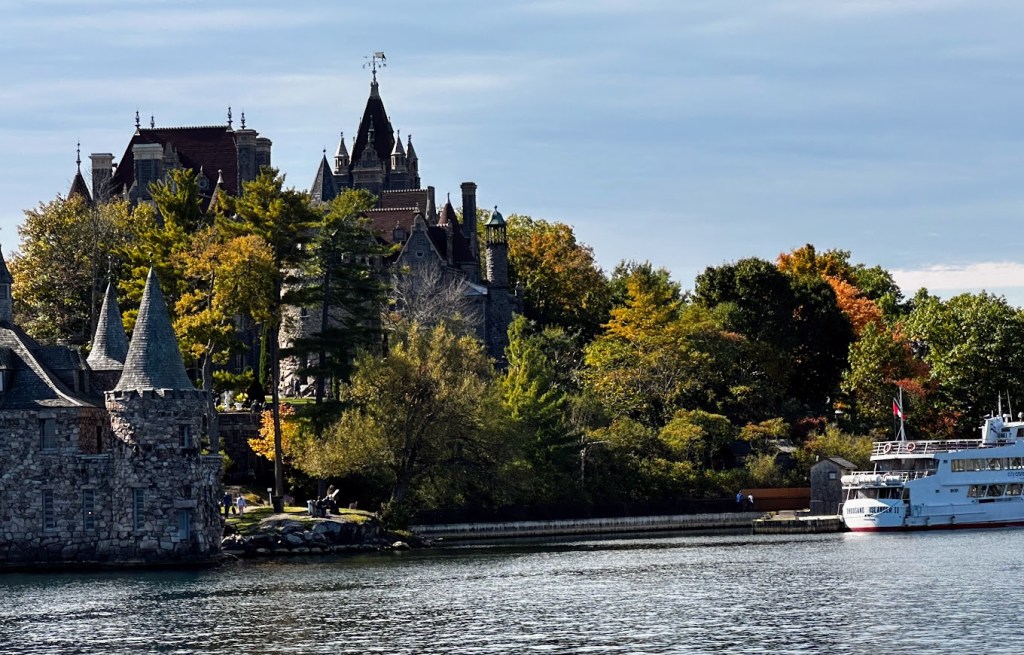
The boat trip to Heart Island takes about half an hour and passes by some extravagant cottages that resemble large houses more than typical summer homes. Upon landing on Heart Island, we went through U.S. border control, which took a while due to the long lineup of visitors. After we cleared the U.S. border, where they took a photo of us without hats and with our glasses off, we had a couple of hours to explore the island and the castle. Then, we returned to the dock for our trip back.
The view from the ferry
As we approached the castle, we saw a wedding on the front lawn and were asked to leave by the organizers. Fortunately, the castle was open, so we explored the large central hall and the enormous dining room before heading upstairs to see the bedrooms. The castle has a total of one hundred and twenty rooms.
The main hall
On the second floor, we watched a short film about the history of George Boldt and the castle. George Boldt emigrated from Prussia to the US at the age of thirteen. He started working in the kitchen of a hotel in Philadelphia and quickly rose through the ranks to manage the hotel at a young age. He became the manager of New York’s Waldorf Hotel and merged it with the Astoria Hotel across the street, becoming the well-known Waldorf Astoria Hotel.
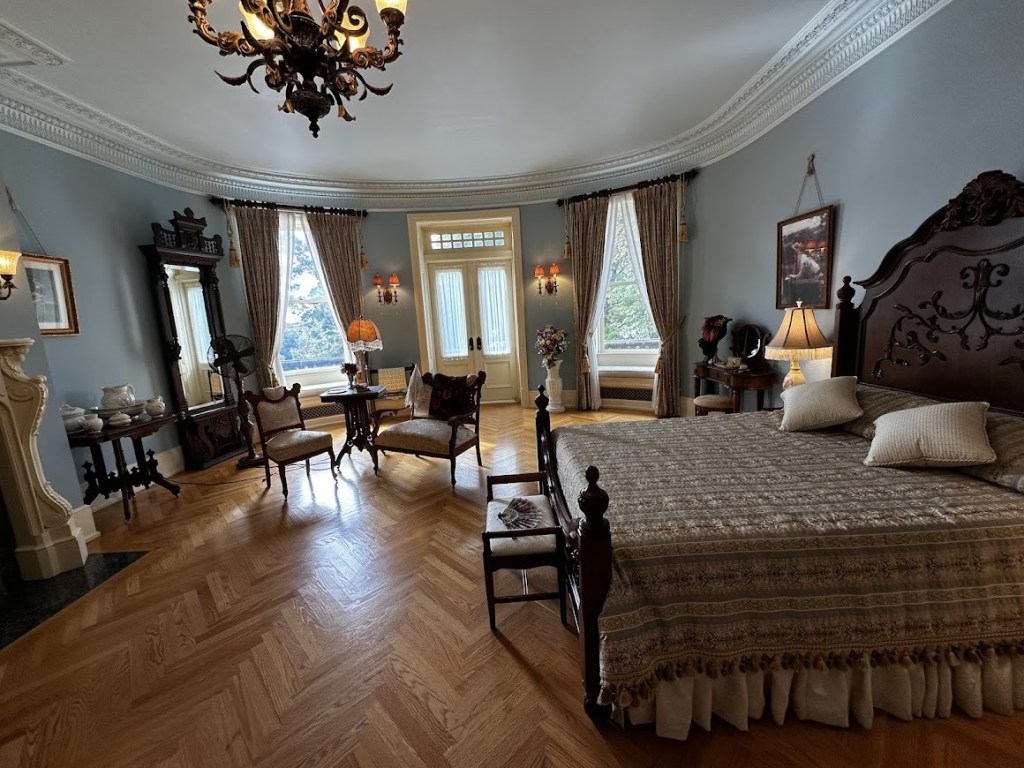
The dining room and a bedroom
As part of his heritage, Boldt is credited with popularizing the “Thousand Island” salad dressing in his hotel. The name originated in the Thousand Islands region of upstate New York, and its original version was made with mayonnaise, ketchup, and pickles. He also created the Waldorf salad, a classic American dish made with diced apples, celery, and mayonnaise.
The Boldt family spent their summers in upstate New York, where George Boldt decided to build a castle on Heart Island for his wife. He was going to give the castle to her on Valentine’s Day. The architecture resembles a Rhineland castle. Construction began at the turn of the century. However, in 1904, tragedy struck when George’s wife passed away unexpectedly. He called off the construction and laid off the three hundred workers who had been building the castle. George never returned to the island, and the castle remained untouched for seventy-three years, falling into a ramshackle state. In 1977, the Thousand Islands Bridge Authority took over the property and invested millions of dollars in its rehabilitation, preserving it for public enjoyment.
Also on the second floor, we saw the rehabilitated bedrooms decorated in period style, belonging to George, his wife, and their children. The floors above have not yet been fully renovated; they currently hold architectural drawings and additional information about the castle.
The garden is also worth visiting, featuring an Italian garden and professionally landscaped grounds with benches. We sat on one of the benches to enjoy our lunch, grateful for a moment of rest after climbing the stairs. It’s important to note that the ceiling heights in the castle are much higher than the typical eight-foot ceilings found in residential homes; climbing four floors felt more like going up six to eight floors in a standard building today.
On the return ferry trip, I bought a cold drink from the bar, which was refreshing and helped me process everything I had seen. If you have visited castles in Europe, this one may not impress you much. However, North America has very few buildings like this one, the Biltmore Estate in Asheville, NC, or Hearst Castle in San Simeon, CA. Visiting this Castle is certainly educational, especially for children. It is also steeped in history and serves as an essential example of the architectural style built during the Gilded Age. I recommend it as a great family outing on a sunny day.



 andrasthehun.ca