Reflections on the 1956 Hungarian Uprising Remembrance

October 28, 2025

This week, I attended a flag-raising ceremony commemorating the sixty-ninth anniversary of the Hungarian uprising of October 23, 1956, at Ottawa City Hall. I looked forward to meeting some grey-haired Hungarian refugees, with whom I could make contact, talk about the old country, and share our experiences in Canada.

About fifty people showed up for the ceremony. I did hear a few people speaking Hungarian, chatting in small groups. They seemed happy to talk with each other. I went by myself, looking for some social interaction and discussion. Still, nobody seemed interested in making contact, even though I walked around and tried to break into conversations.  

When I found a young fellow standing by himself, I asked him if he was Hungarian. To my surprise, he said he was an RCMP officer. I wondered if he was on an assignment to ensure security at the event, requested because staff from the Hungarian Embassy and other diplomats were in attendance. the event organizers.

Another person I approached was a black woman who, with a friendly smile, explained  with a friendly smile that she was with the Nigerian Embassy and had been invited to this event. I found myself confused; while I understood the logic behind inviting certain European nations, I questioned the inclusion of African countries. Nevertheless, she was charming, and we talked about Africa and my trip to Tanzania.  

Although the flag-raising was outside, due to inclement weather, the group moved to City Hall first to listen to the speeches by the dignitaries. The small conference room inside was insufficient to seat everyone, so I stood in the hallway listening to the speakers.

The Deputy Mayor, Sean Devine, who, by the way, is my local City Councilor, opened the ceremony. He paid tribute to the courageous Hungarians who perished during the 1956 uprising and commented on the contributions the refugees made to Canada. Although Sean did not mention it, well-known people such as Anna Porter, a writer and publisher, and Robert Lantos, a film director, were fifty-sixers, among others.

Ms. Katalin Haas, Charge d’Affaires at the Hungarian Embassy, spoke about the significance of the 1956 rebellion and invited representatives of the Canada-Hungary Parliamentary Friendship Group and a representative of Global Affairs Canada to speak.

Many speakers mentioned the 38,000 people who arrived in Canada after the uprising looking for freedom and dignity and the over 300,000 people of Hungarian descent now residing here. All the speakers emphasized the Hungarian people’s desire for freedom and dignity.  

Adam van Koeverdan, Co-Chair of the Canada-Hungary Friendship Group, spoke about his mother, who escaped Hungary during the uprising. That made me feel old. I was sixteen years old when I fled Hungary, and he was talking about his mother! Further indicating my age was a group of young people talking about being fourth-generation Hungarians. I felt ancient by that time.

The speeches were well delivered but seemed hollow to me, as the speakers lacked a fundamental understanding of the nature of life in Hungary in the 1950s that sparked the rebellion. None of the speakers had firsthand experience of life in Hungary at the time of the rebellion. The speakers’ comments were sincere but lacked the emotional gravity that people with direct experience could have brought.

For example, I remember when our neighbor in the apartment house where we lived disappeared one night, and nobody said anything about it. Nobody raised any questions. Or when my father, a medical doctor, was called many nights to patch up people caught trying to break through the Iron Curtain or swim across Lake Ferto. Or when my brother, a student in Budapest, walked home to Sopron, a distance of 200 kilometers, when the revolution broke out. During the uprising, the absence of cell phones or live communication made it difficult to receive updates from him for several days. This lack of information caused considerable concern among our family about his safety. The family feared the worst. After coming home from school one day, our mother told Peter and me to set off along the highway to Vienna, each of us carrying a sandwich in our backpacks, a memory that has stayed with me ever since.  

I thought that a few refugees talking about their escape, or a film showing the tanks in Budapet crawling with students during the uprising, would have been relevant and impactful. However, I recognise that the objective of the ceremony was to honour those who lost their lives, rather than revisit the events of the uprising. Those people attending who were old enough to witness the rebellion personally may not have felt completely satisfied. I wondered, how many of us oldtimers attended?

Memories of Chapel Hill: Love, Weddings, and History

April 1, 2025

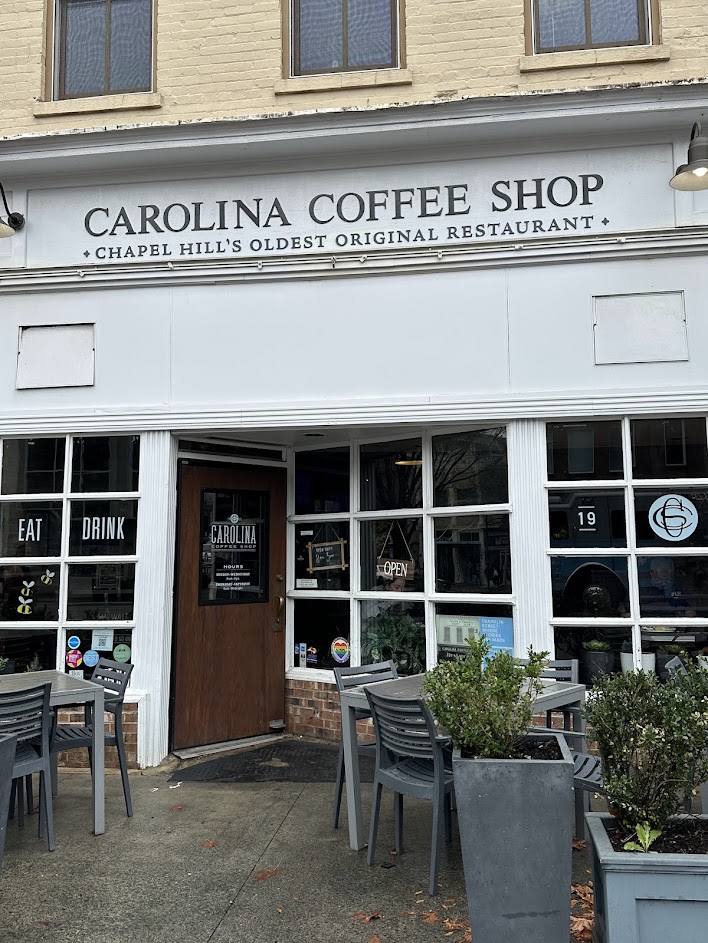
Chapel Hill. The University of North Carolina. Ah! All the memories came rushing back as we drove around, parked the car, and walked along Franklin Street in Chapel Hill, North Carolina.

I recalled meeting the Dean of City Planning, who welcomed me upon my arrival. He greeted me warmly and instilled confidence in me that I could not fail here. After I met my future wife, we listened to Johnny Cash on the quad, frequented local pubs, and eventually got married!

We initially had a civil ceremony in South Carolina without informing our families; it was one of those spur-of-the-moment decisions. The experience of the civil process, alongside that of four other couples, felt rather mundane. Returning to Chapel Hill, my Peugeot 403 broke down on the road, and we had to hitchhike back.

Returning to our dorms after the ceremony was exhilarating. We had a piece of paper that officially declared us married, and we were embarking on a new life together, forever. I wondered if this was the same experience that pioneers felt when loading their wagons on the journey west.

At that moment, no one knew we were married—not even our school friends.

This exhilarating feeling lasted for a few weeks until we had our church wedding in the Episcopal Chapel of the Cross, which was attended by family and my classmates, with whom I had just graduated. In the lead-up to the wedding, the pastor asked us if our differing religious beliefs would ever cause friction between us. It seemed unlikely: I was a non-practicing Roman Catholic, while Kathy was Episcopalian. Having a church wedding was the traditional way to get married, which both our families accepted.

The memories bubbling up were from over fifty years ago. The Town of Chapel Hill has also aged. We walked along Franklin Street starting from Martin Luther King Jr. Boulevard. There were many more restaurants, coffee shops, and fraternity and sorority houses than we could recall from the past, in addition to newer tourist shops, vaping lounges, and art galleries.

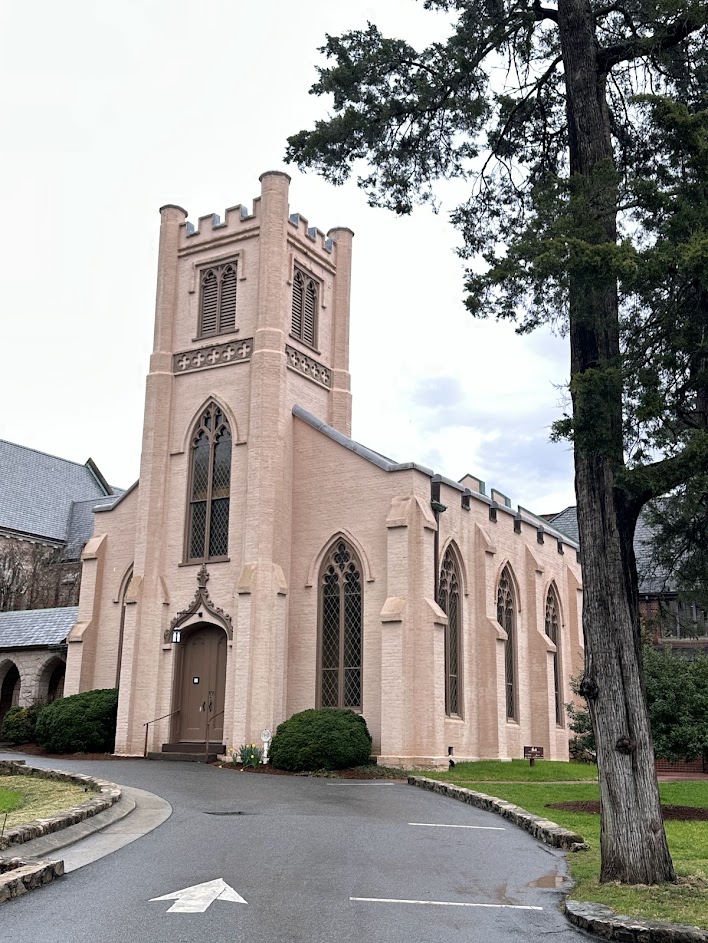
As we crossed Franklin Street, we approached the Chapel of the Cross, where we were married decades ago. I couldn’t remember much about the building except for the circular driveway in front. I remember it well because, after the ceremony, when we tried to drive away in Kathy’s car, my classmates had blocked our tires with rocks. I felt embarrassed as I heard all my friends laughing. I quickly exited the vehicle and moved the stones. However, a loud noise came from the wheels during my next attempt to speed off. I decided to ignore the noise as we drove away, stopping a few blocks later to empty the rocks from the hubcaps.

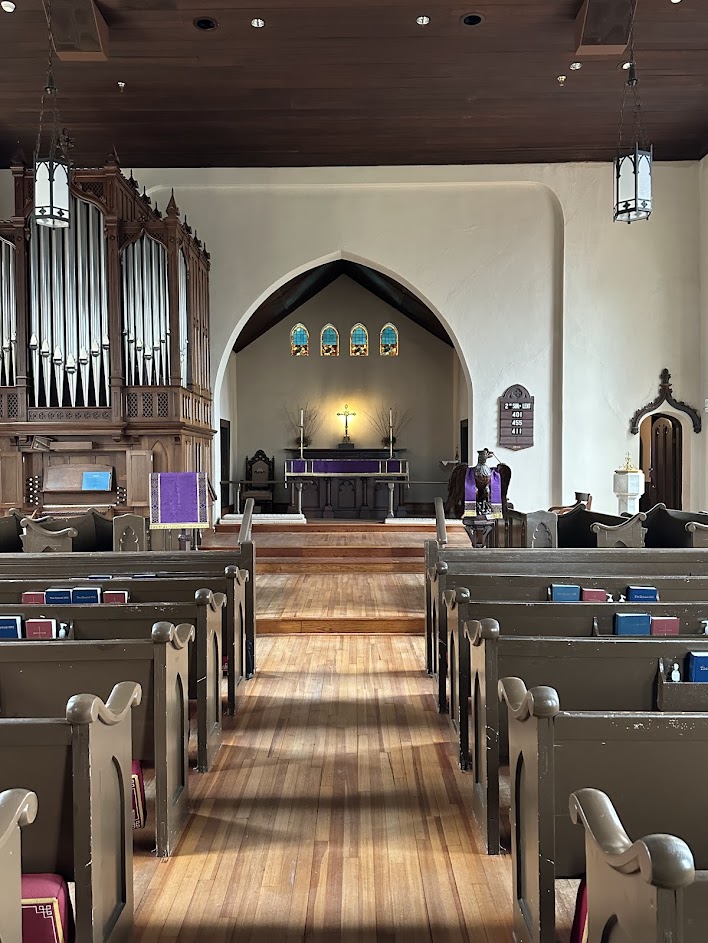
To my surprise, the Chapel did not evoke any strong emotions within me. I struggled to recall its architecture and viewed the Chapel as if I were seeing it for the first time. However, once we entered the building, the historical information provided in a brochure added to a cultural dimension that was entirely new to me and left a lasting impression.

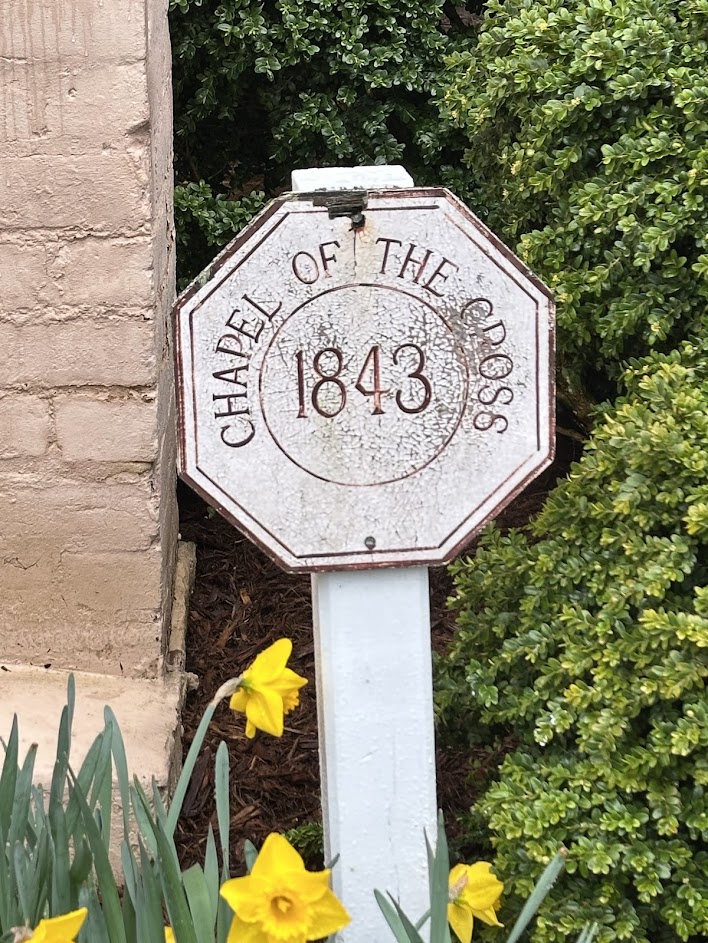
Mary Ruffin Smith (1814-1885) was an early benefactor of the Chapel, constructed in 1843. Her father, a plantation owner, physician, and congressman, paid $450 for a mulatto slave, a fifteen-year-old girl, for Mary. One of Mary’s brothers took a fancy to the slave girl, Harriet, and stalked and sexually assaulted her. Mary’s other brother, Frank, took exception and pummeled Sidney, ordering him to stay away from Harriet. Sidney stayed away from Harriet after the incident, during which she gave birth to a girl, Cornelia. However, Frank fell in love with the girl and had three daughters with Harriet. Mary cared for Harriet and the four girls, bought them from the plantation, and took them to the Chapel of the Cross every Sunday. All the colored people sat on the balcony of the Chapel, not permitted to sit with the white folks. Mary had all four girls baptized at the Chapel, as well as Harriet.

The story continued with Pauli Murray (1910-1985), the granddaughter of Cornelia, the oldest of Harriet’s daughters. Murray was an author, activist, and writer. In 1938, she attempted to enroll at the University of North Carolina (UNC), but her admission was denied due to her race, despite her close relationship with her great-aunt Mary, who had donated a significant portion of her land to the university. Pauli Murray went on to become a lawyer and practice law. In 1977, she made history as the first African American woman to be ordained as an Episcopal priest in the United States. After her ordination, Rev. Pauli Murray took communion in the Chapel where her enslaved grandmother had been baptized.

This story left a significant impression on me. Perhaps it’s because topics like plantations, slavery, the significance of skin color, and religion are not part of my background. Instead, I could discuss the Iron Curtain, Communism, and the experiences of the Pioneers (the communist equivalent of the Boy Scouts), as I spent my youth in Hungary under Russian domination.

The Men’s Book Club

March 19, 2024

One suggested forming a book club at our monthly luncheon of retired friends. It could have been the spicy food at the Indian restaurant that triggered our brain cells to ponder that our wives belong to book clubs while we do not. We discussed that women have many social networks while men do not. Some argued that men traditionally went to work while women raised children at home, needing social networks to survive, indicating our age more than the current reality. Be it as it may, we decided to form a book club.

We did a quick internet survey on where and when we would meet. The majority agreed to meet at lunchtime; we do not want to compete with rush hour traffic. The options considered for a meeting place were a restaurant that would cost money and force us to share space with loud customers. Or a coffee house like Starbucks, where we may not be welcome to occupy many chairs for hours while buying a single cup of coffee.

As a result, we chose to meet at someone’s house who would also provide a light lunch. Nine people showed up at the first meeting; the original lunch group expanded with friends we thought would be interested. We all proposed a book for our review and picked one for our first meeting. The one suggesting the book would moderate what we envisioned, a free-for-all discussion.

Although I joined the group, I had some misgivings about its future. Monthly meetings are good for socializing, but should we also be voracious readers? I used to read books in my youth and loved thrillers (Agatha Christie, Ken Follett, John Grisham) and westerns (Zane Grey, Louis L’amour, Charles May), but now I read primarily political news and no books. I gathered from talking with my friends that they are not bookworms except a couple who read a book weekly. But I thought, let’s give it a try.

Our recent meeting focused on John Le Carre’s book The Looking Glass War. It is a Cold War story, a spy novel set mainly in the United Kingdom during the 1960s.

Although the discussion flowed, people were cautious in expressing their views, perhaps because of their science, engineering, and finance backgrounds. Some thought the plot was complex without explaining why, while others believed there was too much detail describing a crystal radio with Morse code transmission. Someone else questioned why the author did not conclude the situation, leaving the readers to figure out what happened. Still others characterized the book as British history. With no explanation, someone said he did not like the book. We did not pursue any of these comments; perhaps the group must jell to be mature enough to dive into more detailed discussions without antagonizing each other.

I told them I enjoyed how the first chapter got my attention and hooked me into reading the book in one sitting. And how the plot builds up into a crescendo of excitement towards the end, the chapters becoming shorter and shorter as the actions become more and more dangerous.

Placing an English agent over the Iron Curtain in East Germany is vital to the plot. I thought of my experience with the Cold War, living in Hungary then, and the Iron Curtain’s impact on me. Living near the Iron Curtain, I knew it was a no man’s land, cleared of vegetation and mined, with dogs roaming between the two electrified fences patrolled by soldiers and lighted at night by watchtowers. As a medical doctor, my father patched up many people trying to escape across the Iron Curtain, caught by the dogs, the soldiers, or the electrified wire fence trying to escape using wire-cutters.

Reading about the crystal radio set reminded me of my childhood experience building one. I remember the excitement I felt getting radio signals from the West on my crystal radio; in Hungary, the only reception one had was Hungarian propaganda broadcast on the “people’s” radio with one channel during the Cold War.

After the meeting, I wondered: Did I enjoy the book more than the others? Was it perhaps my experiences that connected in many ways with the story while the others had no similar experiences? That thought made me think that knowing the context of a story makes one more knowledgeable and appreciative of a story than others with no such experiences.

I look forward to our next meeting to see if my theory holds.