Eating and Walking: Discovering Wheeler’s Maple Sugar Shack

April 18, 2025

We went to a sugar shack in April this year. April weather is ideal for maple syrup flow, which happens when nighttime temperatures are -5 °C and daytime highs are 5°C (24°F to 40°F). Such weather is a pleasure to walk about, especially in contrast with the much colder weather in February and March.

I enjoy visiting maple sugar farms for their restaurants, which serve delectable pancakes with freshly made maple syrup, sausages, and beans. And post-lunch, I enjoy strolling through the woods and checking out the maple trees’ syrup containers.

We went to Wheeler’s this year for our annual sugar shack trip and pancake feast. The hour-long journey was worthwhile; a sunny day with blue skies followed the snowstorm, leaving the fields white.

Maple sugar shacks now typically require reservations. Despite this, the restaurant had few patrons when we got there. I think the idea is to ensure enough seats if a busload of tourists arrives.

The coffee flowed endlessly at Wheeler’s, and the enormous pancakes were eight inches in diameter. Thinking I was hungry for lunch, I ordered a two-pancake meal with three sausages and a side of beans. It was too much food, so I knew I would need a long walk afterward to burn off the meal. I recalled visiting a different sugar bush where we sampled local beer with friends last year.

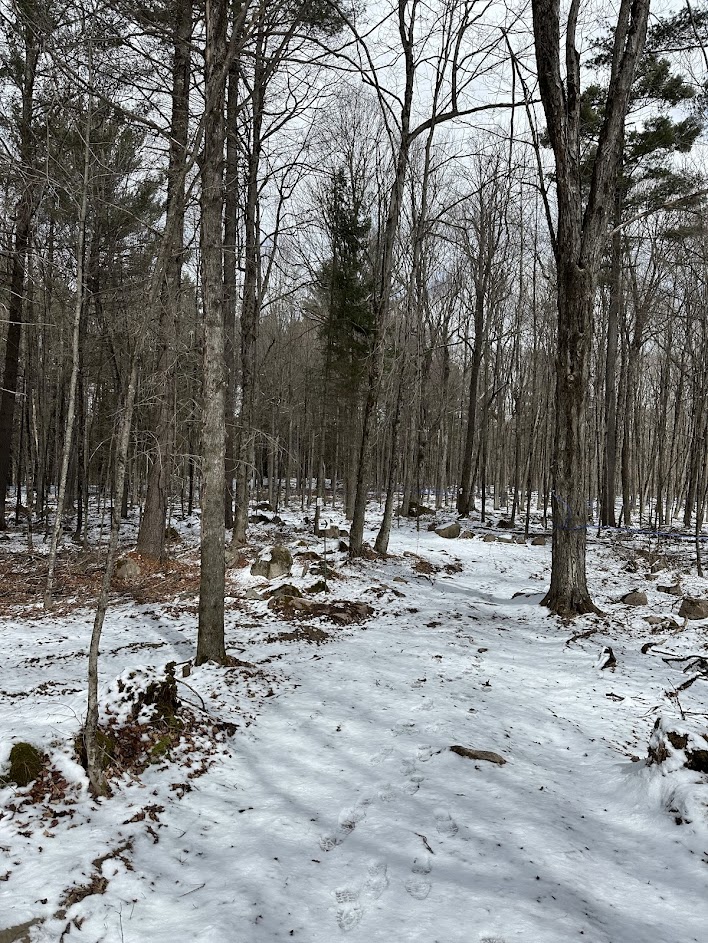
We found many trails outside and took the longest, five kilometers long. The snow covered the ground, with some icy patches in places. Only a few people were walking, and the silence in the woods was peaceful, perfect for yoga classes.

The history of this farm is fascinating. Vernon and Judy Wheeler purchased the farm and planted sugar maples, and they, along with their four children, still operate the farm today. It takes thirty years for the trees to be ready for tapping, and they tapped their first trees in 1978. They installed six hundred kilometers of plastic pipes to collect sap from forty thousand trees. Vernon’s local builder helped construct the restaurant using local wood, which opened in 1996. Vernon also wrote a book about the farm’s history, available in the restaurant’s lobby.

The Wheelers keep the farm open year-round for visitors, with the only exception being Christmas Day. Families enjoy exploring the farm during the summer by hiking the grounds, while cross-country skiing and snowshoeing are popular winter activities.

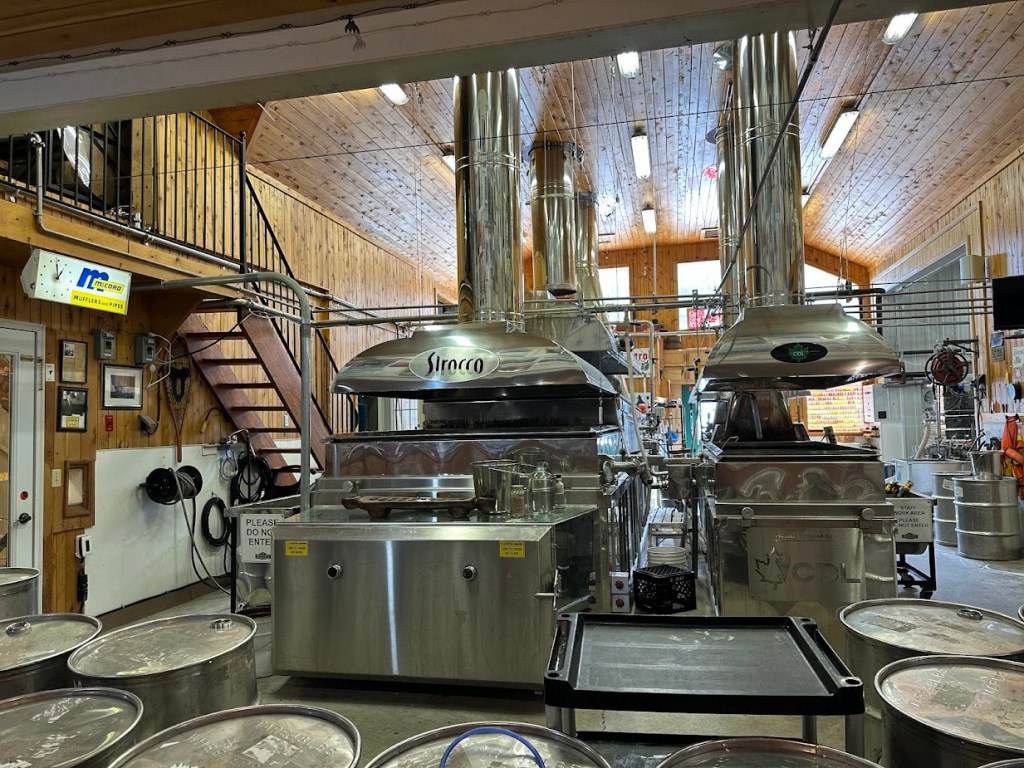
Syrup production involves boiling sap down to a 40:1 ratio. Boiling the sap further makes a sweeter, darker, and thicker syrup. Customers can choose from three grades of syrup, ranging from light to dark, when making their purchases

Previously, people boiled sap outside in large kettles to evaporate the water. Today, however, they use reverse osmosis to produce the syrup. The factory at Wheeler’s is open for inspection and features a large room with advanced equipment. A kitchen and a small shop offering maple syrup items are situated between the appealing post-and-beam restaurant and the factory.

Panels within the plant’s viewing area show information about the maple syrup industry. Canada provides over 80 percent of the global maple syrup supply, 90 percent of which originates from Quebec, and 4 percent from Ontario.

It was an Indigenous child who discovered maple syrup hundreds of years ago by sucking on the icicle of a branch from a maple tree. The sugary taste was delightful, a treat Indigenous people quickly learned to harvest. It took about a hundred years for them to develop the method of boiling the sap to create today’s sweet syrup.

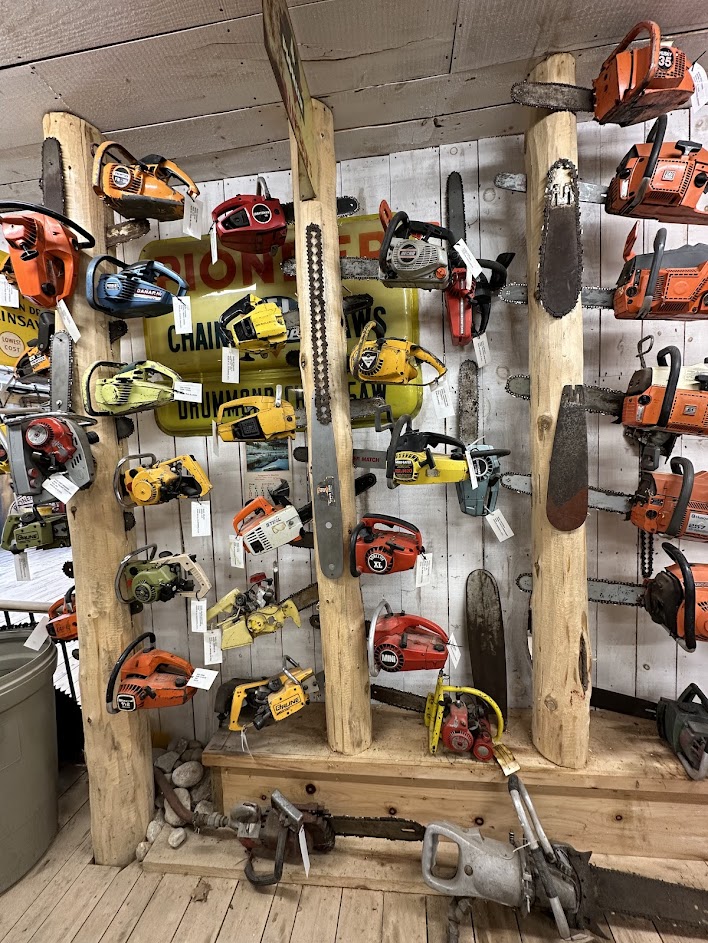
The two museums on Wheeler’s farm are possibly the most interesting part. One museum displays hundreds of maple syrup artifacts, the other shows Mr. Wheeler’s extensive chainsaw collection. The chainsaw collection amazed me; there are over four hundred old models, some of which I recognized, while others were unfamiliar.

      
A couple of soulful llamas stared at us as we approached the museums. The presence of llamas on this farm, among other options, puzzled me.

Maple syrup is a quintessential Canadian product. I recall trips to Europe where we searched for gifts for family and friends to take with us. We often bought small jars of maple syrup. Thankfully, travel for fresh maple syrup is no longer necessary; our neighbours’ parents run a maple farm, and we can purchase fresh maple syrup from them at wholesale prices.

Memories of Chapel Hill: Love, Weddings, and History

April 1, 2025

Chapel Hill. The University of North Carolina. Ah! All the memories came rushing back as we drove around, parked the car, and walked along Franklin Street in Chapel Hill, North Carolina.

I recalled meeting the Dean of City Planning, who welcomed me upon my arrival. He greeted me warmly and instilled confidence in me that I could not fail here. After I met my future wife, we listened to Johnny Cash on the quad, frequented local pubs, and eventually got married!

We initially had a civil ceremony in South Carolina without informing our families; it was one of those spur-of-the-moment decisions. The experience of the civil process, alongside that of four other couples, felt rather mundane. Returning to Chapel Hill, my Peugeot 403 broke down on the road, and we had to hitchhike back.

Returning to our dorms after the ceremony was exhilarating. We had a piece of paper that officially declared us married, and we were embarking on a new life together, forever. I wondered if this was the same experience that pioneers felt when loading their wagons on the journey west.

At that moment, no one knew we were married—not even our school friends.

This exhilarating feeling lasted for a few weeks until we had our church wedding in the Episcopal Chapel of the Cross, which was attended by family and my classmates, with whom I had just graduated. In the lead-up to the wedding, the pastor asked us if our differing religious beliefs would ever cause friction between us. It seemed unlikely: I was a non-practicing Roman Catholic, while Kathy was Episcopalian. Having a church wedding was the traditional way to get married, which both our families accepted.

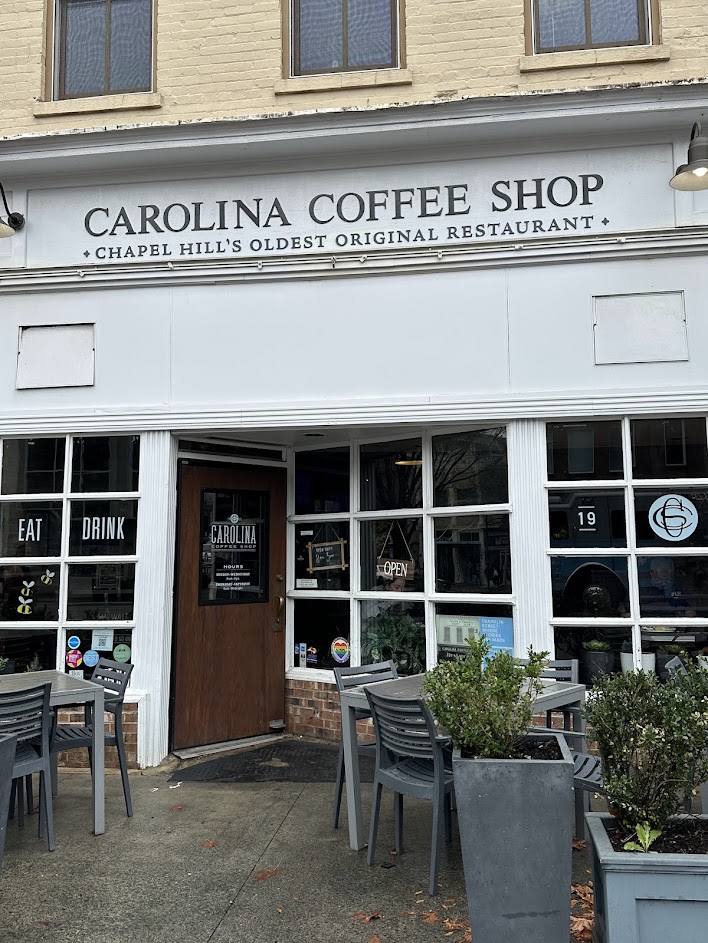
The memories bubbling up were from over fifty years ago. The Town of Chapel Hill has also aged. We walked along Franklin Street starting from Martin Luther King Jr. Boulevard. There were many more restaurants, coffee shops, and fraternity and sorority houses than we could recall from the past, in addition to newer tourist shops, vaping lounges, and art galleries.

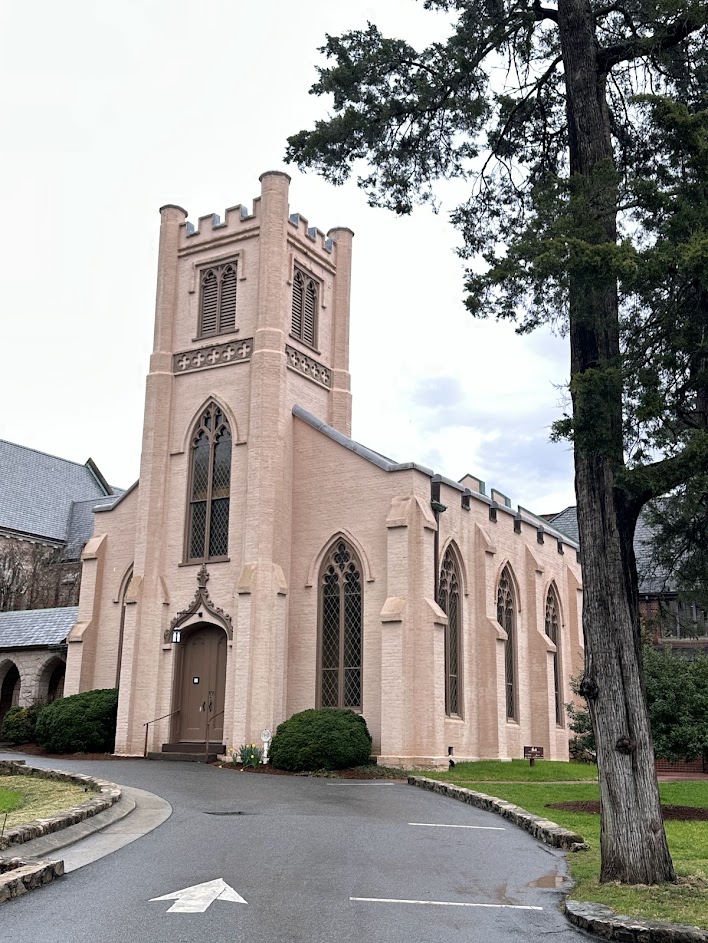
As we crossed Franklin Street, we approached the Chapel of the Cross, where we were married decades ago. I couldn’t remember much about the building except for the circular driveway in front. I remember it well because, after the ceremony, when we tried to drive away in Kathy’s car, my classmates had blocked our tires with rocks. I felt embarrassed as I heard all my friends laughing. I quickly exited the vehicle and moved the stones. However, a loud noise came from the wheels during my next attempt to speed off. I decided to ignore the noise as we drove away, stopping a few blocks later to empty the rocks from the hubcaps.

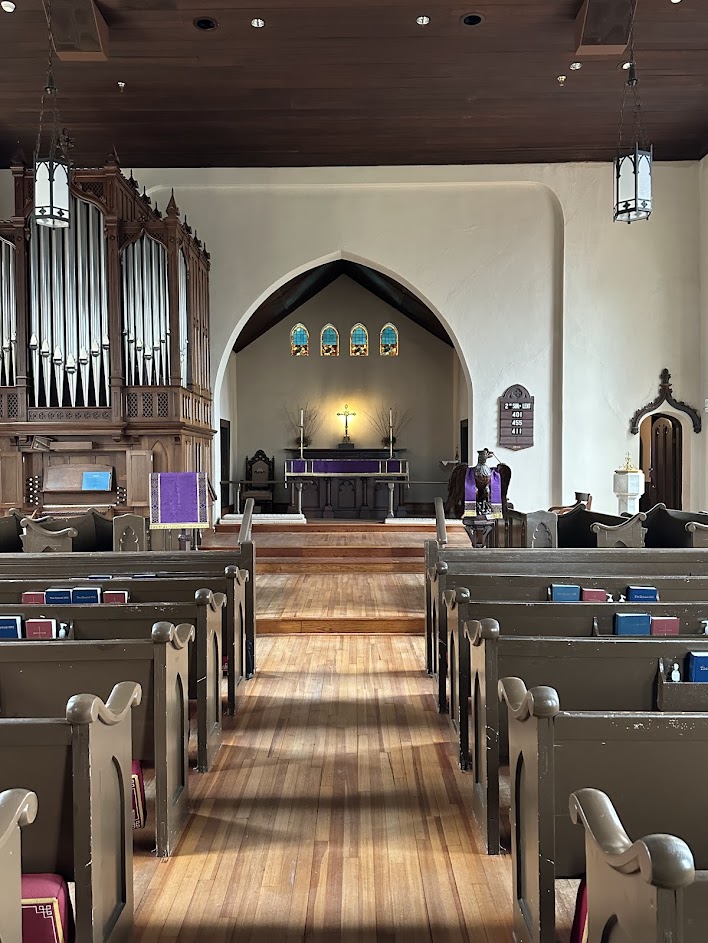
To my surprise, the Chapel did not evoke any strong emotions within me. I struggled to recall its architecture and viewed the Chapel as if I were seeing it for the first time. However, once we entered the building, the historical information provided in a brochure added to a cultural dimension that was entirely new to me and left a lasting impression.

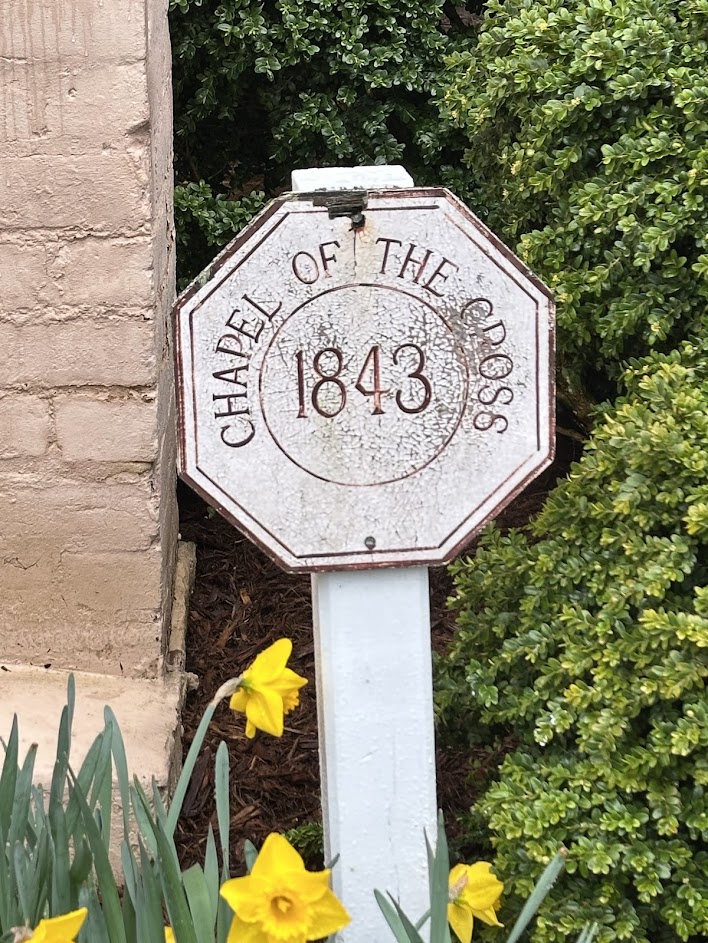
Mary Ruffin Smith (1814-1885) was an early benefactor of the Chapel, constructed in 1843. Her father, a plantation owner, physician, and congressman, paid $450 for a mulatto slave, a fifteen-year-old girl, for Mary. One of Mary’s brothers took a fancy to the slave girl, Harriet, and stalked and sexually assaulted her. Mary’s other brother, Frank, took exception and pummeled Sidney, ordering him to stay away from Harriet. Sidney stayed away from Harriet after the incident, during which she gave birth to a girl, Cornelia. However, Frank fell in love with the girl and had three daughters with Harriet. Mary cared for Harriet and the four girls, bought them from the plantation, and took them to the Chapel of the Cross every Sunday. All the colored people sat on the balcony of the Chapel, not permitted to sit with the white folks. Mary had all four girls baptized at the Chapel, as well as Harriet.

The story continued with Pauli Murray (1910-1985), the granddaughter of Cornelia, the oldest of Harriet’s daughters. Murray was an author, activist, and writer. In 1938, she attempted to enroll at the University of North Carolina (UNC), but her admission was denied due to her race, despite her close relationship with her great-aunt Mary, who had donated a significant portion of her land to the university. Pauli Murray went on to become a lawyer and practice law. In 1977, she made history as the first African American woman to be ordained as an Episcopal priest in the United States. After her ordination, Rev. Pauli Murray took communion in the Chapel where her enslaved grandmother had been baptized.

This story left a significant impression on me. Perhaps it’s because topics like plantations, slavery, the significance of skin color, and religion are not part of my background. Instead, I could discuss the Iron Curtain, Communism, and the experiences of the Pioneers (the communist equivalent of the Boy Scouts), as I spent my youth in Hungary under Russian domination.

Exploring Beaufort: A Cyclist’s Paradise in South Carolina

March 24,2025


We drove south to leave the winter of Ottawa, even though we enjoy snowshoeing. Escaping springtime offers a welcome reprieve from the winter’s cold and snow. Despite my pollen allergies (managed by Claritin), late March in the Carolinas offers ideal cycling weather.

Driving south towards Beaufort, South Carolina, I sighed in relief at leaving the crowded, monotonous, and speedy Interstate 95 behind. Driving for hours had numbed my feet, so I hoped for less, slower traffic on Route 21 East. Although slower, the traffic picked up closer to Beaufort on a four-lane highway.


The expansion of military bases (Parris Island and Beaufort), resort construction (Hilton Head Island), and a Northern retiree influx have driven development along South Carolina’s east coast.
We learned from a hotel employee at check-in that Beaufort’s population has almost doubled since the pandemic, nearing 15,000. It is not only retirees but also people working remotely who have arrived to take advantage of lower housing and living costs.

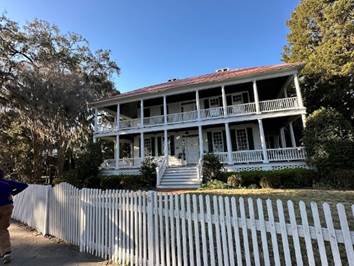
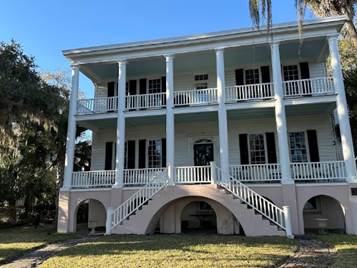
When Kathy stayed here thirty years ago, she stayed in one of the huge antebellum houses on the waterfront, used as a B&B in those days. Today, developers meticulously redeveloped the waterfront, and they restored the antebellum homes along the waterfront to their original designs. The city designated the downtown area a historic district, and we enjoyed a quiet walk admiring the architecture.

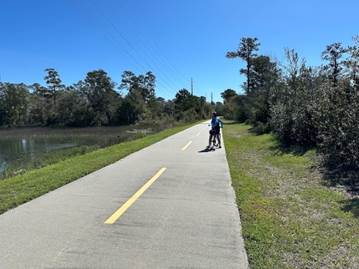
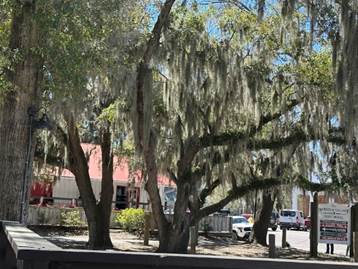
Cycling the Spanish Moss Trail from Beaufort to Port Royal was a smooth ride (it follows the old Magnolia rail line). The paved, twelve-foot-wide trail was flat, crossing marshes with many boardwalks and with the temperature in the mid-twenties (in the seventies in Fahrenheit), was ideal for a bike ride. Much of the Trail crossed areas with oak trees from which Spanish moss hung. I assume the source of the name for the Trail. Although the hanging moss is attractive, avoid touching it because it might contain chiggers.

The paved trail was great for riding, but I knew that falling off the bike would be rough, experiencing injury if going at the maximum allowed speed of 15 mph.

We sped through the twelve-mile trail, pausing to talk with people going in the opposite direction. We avoided talking about politics. We did not know how local people would react to talking to us Canadians, in view of Trump’s desire to annex Canada.

I noticed different organizations took responsibility for maintaining sections of the trail, which included benches at viewing sites, including the military that were in abundance in the area.

In less than a couple of hours, we arrived at Port Royal, at the other end of the trail. We were ready for a cup of coffee and found in the center of Port Royal a home converted to a restaurant with a name Corner Perk that offered fancy coffees. Their muffins were so special we couldn’t resist.

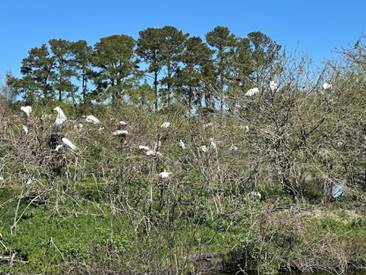
Next, we saw a sign for the Cyprus Wetlands rookery, home to hundreds of local birds (egrets, cormorants, bats, herons, etc.), right by the coffee shop. A boardwalk crosses a lake, going by an island with small trees that provide nesting grounds for birds. We noticed many turtles and alligators also slept on the shore of the island.

Returning to Port Royal, we found a small house converted to a restaurant boasting a sign for Griddle and Grits and the menu included grits with shrimp, with chorizo and grits with different ingredients. I like spicy foods and chose chorizo on grits, which turned out to be excellent. Kathy chose she crab soup, which also turned out to be a good choice.

On the return journey, we paused on a bench and were approached by a man who looked like a bear of an angler, who sat down, smoked a cigarette and started a conversation. He wanted to know all about us and then described his entire life story, including where he was born, where his family members were born and all the ailments they each had. I gathered he has been a floater with jobs in many states before settling in Beaufort. We could not resist listening to him; overall, it was an enjoyable social engagement.

We stopped at a Publix grocery store on the way home to pick up dinner. The Spanish Moss Trail is a nice, paved trail, but it was a bit too tame for us. We like longer and wilder trails with fewer refinements.

Udaipur’s Heritage: Lake Pichola Hotel Experience

March 11, 2025

The Lake Pichola Hotel

Shyaam, our guide, had reserved a room at the Lake Pichola Hotel in Udaipur, Rajasthan. This opulent heritage hotel, formerly Piplia Haveli, was built in the eighteenth century as a private residence for the Jagirdars (nobility) of Thikana Piplia. The hotel’s corridors were adorned with royalty images, illustrating Udaipur’s rich history and property. The owner of the Lake Pichola Hotel is a descendant of the rulers of Udaipur and has taken over the management of this heritage hotel.

Our large, comfortable room faced Lake Pichola and opened onto a balcony with windows all around. The balcony was furnished only with sumptuous pillows, reminiscent of harem rooms we had seen in pictures; it looked incredibly inviting after a long drive. We relaxed on the cushions, enjoying the beautiful views of the lake, the Udaipur Palace across the water, and the Oberoi Hotel, where James Bond’s “Octopussy” was filmed. As we sipped our drinks, we watched women at the lakeside washing laundry, a stark reminder of the contrasts between wealth and poverty in India.

According to Oxfam, seventy-three percent of the wealth generated in 2017 went to the top one percent of the population. The number of billionaires increased from nine in 2000 to over one hundred in 2017. I reflected on these numbers, but seeing poor people washing clothes in the lake opened my eyes.

We met our guide, Shyaam, in the hotel dining room, where authentic Indian food was served. By then, we were running low on rupees, and many of the smaller stores we visited either did not accept dollars or charged exchange rates that seemed exorbitant. We asked Shyaam where we could exchange our U.S. dollars for rupees. Although he did not mention any ATMs or banks, he suggested a contact of his who offered money exchange services. It sounded dubious, but he claimed we would get the best exchange rate from this contact. We decided to take a chance on his offer, partly because we trusted Shyaam, who worked with the travel company Intrepid, and partly because we didn’t see any other options.).

The next day, we walked up the street to an office address and entered a small room on the main floor. Some people were working in the back office. We sat in the waiting room, hoping that Shyaam had indeed arranged a meeting with his contact, the money changer. We waited, uncertain of what to expect, until a dapper, well-dressed gentleman in a suit and tie, carrying a briefcase, entered the room. He asked if we were Shyaam’s clients, and when we confirmed that we were, he set down his briefcase. He then inquired how much money we wanted to convert and informed us of the exchange rate he offered. It was a better rate than the banks charged, and our only concern was whether his money was legitimate or counterfeit.

The money changer seemed honest, so we decided to exchange some currency, although not as much as we had initially planned, to be cautious in case the bills were counterfeit. He examined our dollars individually, selecting only the ones in excellent condition without tears. After calculating the equivalent amount in rupees, he opened his briefcase filled with rupees, counted out a stack for us, and handed it over. There was no official receipt, and he left immediately after the transaction. I remain uncertain about whether this market activity was legitimate in Udaipur. I wondered if it might have been part of a black market; India likely has various money exchange options. Another thought that crossed my mind was whether Shyaam was involved in this exchange—whether he was assisting clients as a tour guide for a major travel company or if he was part of the transaction and receiving payoffs. However, we had no issues with the money the money changer provided us.

With our newly acquired rupees, we walked toward the center of Udaipur, climbing a hill in search of the famous miniature paintings, sized 4″ x 12″. This art form originated in the sixteenth century, with artists creating these paintings as memoirs for kings, capturing important historical events. The paintings depict vignettes of a king’s life from the past, and even today, they are created and sold as decorative art.

The artists use a meticulous process to manufacture pigments and colors from scratch. We stopped at several stores to admire these paintings. Unable to resist, we decided to purchase a few as souvenirs. They were beautiful and unique to Udaipur and easy to transport due to their small size. Although we could have bought them unframed for easier transport, we opted for framed pieces, which cost much less than a frame at home. 

As we left the store, we spotted an elephant coming up the hill toward us. A mahout was riding on the elephant, sitting more than ten feet off the ground. I quickly grabbed my camera to take a picture. However, as soon as the mahout noticed me, he began protesting and waved both hands, trying to stop me from taking the shot. He made the international gesture of asking for money by rubbing his fingers together with his palm facing upwards. Even if I had wanted to give him money, I couldn’t have reached him, and it was clear he wasn’t planning to stop the elephant or dismount.

Suddenly, the elephant started to pee, creating a river streaming down the asphalt. I couldn’t believe the volume that came out! I felt grateful to be wearing closed-toe sandals at that moment. I noticed some tourists walking behind the elephant, trying to capture the scene on camera, but maintaining a safe distance to avoid the chaos. All of them were wearing open-toed sandals. I felt sorry for them but was reminded once again why open-toed footwear isn’t the best choice for sightseeing.

Our wanderings in Udaipur took us to the City Palace, an imposing structure with a 250-meter frontage and several entrances. This multi-level complex stands 30 meters high and is beautifully situated on a hilltop. The upper floors overlook Lake Pichola, providing excellent views.

The palace was constructed entirely from marble and granite, with construction beginning in 1576 and continuing for four centuries. It is an interconnected complex made up of various palaces built by successive dynasties.

I remember how we had to navigate many staircases to explore the building, which left us feeling quite exhausted. However, it was a remarkable historical and cultural journey. We admired stunning wall paintings, intricate murals, exquisite marble work, detailed inlay work, and remarkable architectural features, including cupolas, domes, towers, and balconies.

After a few weeks on the tour, I felt overwhelmed by the many palaces and forts I had seen. By this point, I preferred conversing with local people rather than admiring centuries-old artifacts, no matter how beautiful or historically significant they were. I found discussions with tuk-tuk drivers about their families fascinating, even though many did not speak English. While I still appreciated history, I realized traveling became much more fulfilling when interacting with the local residents.

The Lake Pichola Hotel.

Exploring the Rat Temple in Bikaner and other Unique Cultural Experiences

March 9, 2025

Rat Temple and Local Fair


Traveling in India never ceased to surprise us with its diversity in languages, food, and beliefs rooted in thousands of years of history and customs. One example of a remarkable story and a highlight of our journey was visiting the Rat Temple in Bikaner. In this temple, rats are considered holy and revered.


The origin of the Rat Temple dates back to the fourteenth century. According to legend, the Goddess Karni Mata lost her youngest son, Lakhan, who drowned. In her grief, the Goddess commanded Yama, the god of death, to bring Lakhan back to life. Yama, however, explained that he could not do so but that Karni Mata (an incarnation of Durga, the Goddess of war, power, and protection) could restore her son’s life. Karni Mata decreed that her family would be reincarnated as rats.

Today, around six hundred families claim to be descendants of Karni Mata. These descendants maintain the temple, clean up after the rats, and prepare food for them, often sharing meals in their presence.

To enter the temple and enjoy the experience of 20,000 black rats running freely, you must be barefoot, as some rats may even scurry over your feet. Upon entering, we removed our shoes and felt the rats scampering across our toes. This experience is certainly not for the faint-hearted! A deep sense of emotion ripples through the worshippers when they spot an albino rat, which is believed to bring good luck. Kathy spoke with several visitors who had made the trip, hoping to see a white rat to enhance their fortune. Unfortunately, on the day we visited, we didn’t see an albino rat or anyone else. We stepped outside the temple for refreshments and regained our sense of reality.

Our next stop left a deep impression on me. Our guide, Shyaam, took us to a local festival with arts and crafts, Rajasthani foods, and entertainment. Although the festival’s nature was familiar and similar to North America’s, the begging scene that enveloped us shocked me. Beggars were prevalent, and Westerners present were their primary focus.

The most grotesque and upsetting memory that I have is of a skinny, undernourished boy of maybe ten years of age who had only one leg and was running after me on his two hands and his one leg like a spider, reaching with one hand to me begging for anything. I was unable to escape him. His tenacity forced me to leave the venue and go to the parking lot before he would leave me alone. He chased me from the festival!

I felt sick to my stomach and dispirited to see this deformed beggar. I read about the maiming of children by the begging mafia in India who steal children and maim them to make them more profitable in begging, but seeing one was awful. It was the most disturbing experience that I had in India. Although I read Rohinton Mistry’s Fine Balance and we had gone to see the Slumdog Millionaire film before we went to India, seeing the slums and the beggar children in real-time was shocking. Seeing this poor, deprived child made me think about the unfortunate circumstances that led to his life in begging.


Still, I knew that despite being a tough moral choice, giving to beggars inevitably meant being swarmed, overwhelmed, and in danger of physical harm in such crowded situations (we had such experience in Asia).


When driving, Shyaam delighted us with his discussion of the unique aspects of Indian culture. On our drives, he explained to us the caste system of India, which he was proud of. He was a Singh, implying the second highest caste: the warriors and rulers. Military service ran in his family. Caste, we learned, does not guarantee wealth or even education, but it imparts status. Shyaam was a tour guide and lived a modest life. He explained Brahmins were priests and teachers, comprising the highest caste. Next to the warriors were the farmers, traders, and merchants, followed by the laborers. The Dalits were outcasts, the street sweepers (and not part of the caste system).

Interestingly, India’s history includes a prime minister who was a Dalit, and many merchant classes have become quite wealthy. I was initially unsure about the meaning of the caste system, especially since individuals from various backgrounds could become prime ministers or pursue higher education, leading to what we might describe as an upper-class lifestyle filled with money and possessions. We observed that the caste system was more apparent in the North of India, where there are more Hindus, compared to Chennai or Tamil Nadu, which has a more diverse population that includes non-Hindus.

We had an interesting discussion with our guide about ultrasounds for pregnant women, which Shyaam explained can be dangerous for women. I was about to debate with him when Kathy quietly suggested that I stay silent on the topic. I understood that in India, there is a preference for boys because they provide support to the older generations, benefit from a dowry when they marry, and light their parents’ funeral pyres. Having a boy ensures that the family name continues.

I’ve read that there is a worsening gender imbalance in India. In 1994, a law was passed to address this issue; the law discourages prenatal sex determination, monitors these procedures, and prevents the gender imbalance that could lead to a shortage of women for marriageable men. The murder of baby girls has become an ethical concern in India, according to articles I’ve come across