Jazz Memories: My Journey with Oscar Peterson’s Music

October 17, 2025

My son reminded me of a time when, after dinner, I lay down on the couch, closed my eyes, and listened to Oscar Peterson as loudly as the family could tolerate. Oscar Peterson has always been my favorite jazz pianist. In my youth, I enjoyed listening to my mother play jazz: she had a perfect ear and could play any song without sheet music, picking out chords as she went along. Perhaps because of her influence, I started playing the piano at an early age and continued until I rebelled in my early teens against the long practice sessions. This background helps explain my passion for jazz piano. In my opinion, as a jazz pianist, Oscar Peterson is unmatched, even when compared to greats like Ramsey Lewis, Ahmad Jamal, or Art Tatum.

Oscar Peterson’s fame is indeed global. He won eight Grammy Awards and collaborated with legends like Ella Fitzgerald, Louis Armstrong, and Nat King Cole. He also received the Order of Canada, among many other accolades. His success is especially inspiring considering he grew up in Little Burgundy, a predominantly Black neighborhood in Montreal, where racism was alive. His father worked as a porter and a sleeping car attendant for Canadian Pacific Railways (CPR). However, he was also a musician who encouraged his children to pursue music.

Oscar displayed his talent for the piano from an early age. He studied under Paul de Marky, a Hungarian classical pianist who had studied with Stephan Thoman, a pupil of Franz Liszt. Although he initially showed an interest in classical piano, Oscar’s musical path evolved significantly early in his life. He played in jazz clubs in Montreal as a teenager and later performed at Carnegie Hall in New York in 1929 when he was twenty-four years old. Over his lifetime, he recorded around two hundred albums before passing away in 2007.

I remember seeing Oscar Peterson perform at Norfolk State College in 1968. He played spirituals to an all-black audience—we were the only white folks at the college. I had a job in Norfolk, VA, but I was mostly ignorant of the racial issues in the United States at the time. When we entered the auditorium and realized we were the only white people there, we felt a bit out of place. However, the audience was enthusiastic, wholly immersed in the music, and ignored us. The auditorium seemed to come alive with people stomping their feet and clapping to the rhythm.

While in Norfolk, I cannot forget the time when I played some Oscar Peterson music at full blast, and a black pastor knocked on my door looking for donations. The first thing he said was that I was listening to some great music. Naturally, I gave him a large donation.

When the announcement was made that the Oscar Peterson Centennial Quartet would be performing at the National Arts Centre in Ottawa, I quickly purchased tickets. I wasn’t familiar with the Quartet, but I assumed they would play Oscar Peterson’s music. I was particularly eager to hear the pianist, even though I knew that no one could match Oscar’s virtuosity.

In honor of Oscar’s 100th birthday, the Centennial Quartet was formed this year. The organizers assembled a group of accomplished musicians for the Quartet. The performance we attended featured Ulf Wakenius on guitar, who had played with Peterson for ten years, from 1997 until Oscar’s passing. On piano was Robi Botos, a former student of Oscar’s in Toronto. The drummer, Tom Doxas, and bassist, Mike Downes, are both well-known figures in the Canadian jazz scene. The Quartet is touring globally, and while the musicians may change depending on the venue, the music remains consistent.

Upon arriving at the theater, we were treated to a multimedia presentation of Oscar’s life on a giant screen above the stage. Then, Celine Peterson, Oscar’s youngest daughter, took the stage to share anecdotes about her father. The concert began with Celine introducing the drummer, who performed a quiet drum solo. The bassist was introduced next and joined the drummer in a soft swing while Celine continued speaking. Following them, the guitarist and pianist joined in, and the Quartet launched into one of Oscar’s compositions, “Night Train,” apparently inspired by the composer’s father’s work as a sleeping car attendant for the CPR.

The Quartet’s interpretations of Peterson’s compositions, including “Hymn to Freedom,” “Cakewalk,” and “Place St. Henry,” were met with enthusiasm and loud applause. In addition to these pieces, the Quartet also performed popular classics like “Sophisticated Lady,” a composition by Duke Ellington, and others. The audience’s warm reception was so overwhelming that after finishing their set, the Quartet had to perform an encore to calm the audience’s applause. I was bobbing my head and stomping my foot to the rhythm throughout the concert. As the smiling crowd exited the auditorium, I stopped at a table in the lobby to browse the CDs for sale by members of the Centennial Quartet. I decided to buy one—the one featuring pianist Roby Botos—hoping to enjoy jazz piano in the style of Oscar Peterson. And as soon as we entered our house, I started playing all of my Peterson’s CDs.

Residents Voice Concerns at Fisher Heights Community Meeting

October 12, 2025

The Annual General Meeting of the Fisher Heights and Area Community Association turned into a session filled with complaints. Though the term “bitch session” might seem harsh, it accurately described the atmosphere.

The President began the meeting by summarizing the association’s events from the past year and spent about ten minutes reviewing the financial statements. After that, he opened the floor for discussion, with the local City Councilor present at the head table.

The first concern raised by a resident, amid the mostly grey-haired and entirely white attendees, was the rat population thriving in his home. Many others joined in, revealing that the area is facing a significant rat problem. I recalled that this same issue was discussed last year, with residents blaming the increase in rats on the construction of the Light Rail Transit (LRT) system downtown. The excavation for the underground rail disturbed the rats, causing them to migrate into the suburbs—specifically, into our neighborhood. No solutions were proposed last year, and using poison was deemed not an option since children lived in the rat-infested area.

 Our councilor addressed the discussion by explaining that the city is taking the rat issue seriously and has started mapping the geographic areas where rats thrive. Residents are encouraged to report any rat sightings in their homes to the city. The councilor also mentioned that a rat committee has been established, and a dedicated section about this issue has been created on the city’s website.

Additionally, the councilor advised us that rats tend to flourish in “messy woodpiles,” “overgrown grass,” and “compost bins.” He urged residents to clean up their woodpiles, maintain their lawns, and consider limiting or discontinuing composting altogether. While this advice is practical, it may not be well-received by those who enjoy composting. Although the information provided was helpful, it remains unclear how these measures will effectively improve the situation in our community.

The discussion then shifted to parking problems in the community. Residents voiced strong objections to having parked cars in front of their homes, even when those vehicles were on public streets. Their concerns appeared to arise from a desire to prevent strangers from parking near their houses. This situation raised questions about whether their objections were related to safety, the aesthetic appeal of the neighborhood, or simply a feeling of ownership over the street in front of their homes.

In response, our councilor suggested that larger households in our area were contributing to this issue. This statement was surprising, as our community has been aging, resulting in fewer children. So, where are all these new residents coming from? One possibility is that the rental complex in our area has begun charging for visitor parking, which forces guests to park on public streets. Others pointed out that many young adults are staying at home with their parents because they cannot afford to buy their own homes. The councilor also noted that redevelopment in the area has led to higher housing densities, resulting in more households in the community and, consequently, more cars on the streets.

Many audience members asked why the city cannot install more no-parking signs. The councilor explained that no-parking signs are placed only in areas where intersections create dangerous driving conditions. In these instances, people often find alternative parking spots elsewhere in the neighborhood, which means the identified parking issue is simply shifted to another location. This approach hardly resolves the problem!

Additionally, parking is becoming a bigger issue due to the new zoning bylaw, which reflects the city’s growing population. The city council views densification as the only solution, aside from an unlikely massive investment in public transit. Ultimately, higher population densities will lead to more cars on the streets.

Another topic discussed was the overflowing garbage bins in city parks. Since we have curbside garbage pickup, someone asked why the garbage truck doesn’t also empty the garbage containers in the parks when it passes by. The councilor explained that this is more complicated because the public works and parks departments use different contractors for garbage collection. Could better coordination between the two departments improve efficiency and reduce costs? I wondered if the councilor would consider taking this suggestion back to the city for further discussion.

Continuing on the topic of our parks, someone raised a concern about the absence of no-smoking signs in these areas. This individual observed people smoking cannabis in public spaces—likely due to the smell—where young school children walk. I thought we had already implemented a bylaw regarding this. The councilor responded by discussing the challenges of enforcing a no-smoking bylaw in city parks. He mentioned a shortage of bylaw enforcement officers and indicated that enforcing such a bylaw was not a top priority. Additionally, the potential revenue from this bylaw would be minimal compared to the significantly more profitable option of ticketing for illegal parking.

Another individual complained about loud construction noises at night. A construction company working on a high-rise building accidentally damaged a water pipe, necessitating emergency repairs overnight. The infrastructure maps provided by the city to the company failed to mark the location of this major water pipe, which supplied water to a nearby dialysis clinic. Restoring the water supply became urgent.

The person who raised the noise complaint stated that she was not concerned about the work at the dialysis clinic; rather, she objected to the nighttime noise, which deprived her of sleep. This comment troubled me, not only because of her lack of understanding of the situations that can arise on construction sites, but also due to her apparent lack of compassion for the patients at the dialysis clinic. To compound her complaint, she asked if the contractor was fined for breaking the water pipe. My goodness! It was an accident! Moreover, it was the city that provided an outdated map. Should the city fine itself for that?Continuing on the topic of our parks, someone asked why there are no no-smoking signs in these areas. This individual observed people smoking cannabis in public spaces (I assume he noticed it by the smell) where young school children walk. I thought we already had such a bylaw. The councilor addressed the topic by discussing the challenges of enforcing a no-smoking bylaw in city parks. He mentioned the shortage of bylaw enforcement officers. He indicated that enforcing such a bylaw would not be a top priority. Additionally, the potential revenue generated from implementing this bylaw would be minimal compared to the significantly more profitable option of ticketing people for parking illegally.

Still another person complained about loud construction noises at night. A construction company working on a high-rise building accidentally damaged a water pipe, necessitating emergency repairs overnight. The infrastructure maps provided by the city to the company failed to mark the location of a major water pipe. Since this pipe supplied water to a nearby dialysis clinic, restoring the water supply became an urgent matter.

The person who raised the noise issue stated that she was not concerned about the work at the dialysis clinic; instead, she objected to the nighttime noise, which deprived her of sleep. This comment troubled me not only because of the lack of understanding for a situation that is likely to occur on construction sites, but also due to her apparent lack of compassion for the patients at the dialysis clinic. To compound her complaint, she asked if the contractor was fined for breaking the water pipe. My goodness! It was an accident! Moreover, it was the city that provided an outdated map. Should the city fine itself for that?

At that point, I had reached my limit with the complaints and decided to leave the meeting. I found myself questioning the positive actions the association had taken over the past year. I heard that they had painted some lines on a basketball court, replaced the flooring in the community center, and allocated funds for a bicycle repair station in one of the parks. They also organized several community events, including this meeting, where residents could voice their concerns and speak with our councilor. While these are positive steps, I wondered if they were sufficient to justify the existence of a community association.

As I drove home, I realized that the meeting did not address the various clubs the association sponsors, such as a bridge club and fitness classes in the community center. Including presentations from these clubs could have been beneficial, as it might have encouraged more people to participate in the association’s activities. I also questioned the absence of a proposed budget outlining the association’s priorities for the upcoming year. I left the meeting feeling that it was a missed opportunity to make the association more relevant to the community. Overall, I don’t think our community has any significant issues at this time.

Summer Reflections: Closing the Cottage Experience

October 8, 2025

It is a bittersweet event. This past summer experienced record-high temperatures, resulting in lake conditions suitable for extended periods of comfortable swimming. Family visited, and friends came, to enjoy the water activities. As we near the end of the summer, the forecast indicates colder weather next week. Although we swam with our short wetsuits on this weekend, the water cooled us off, and our stay in the water was brief. But we kayaked every day when the lake was smooth as ice and went for walks in the back.

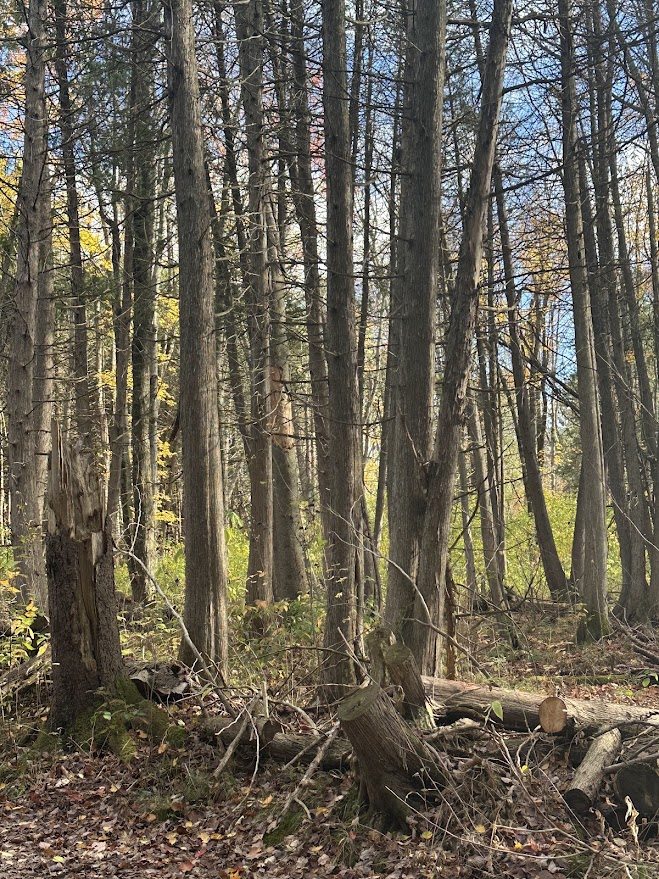
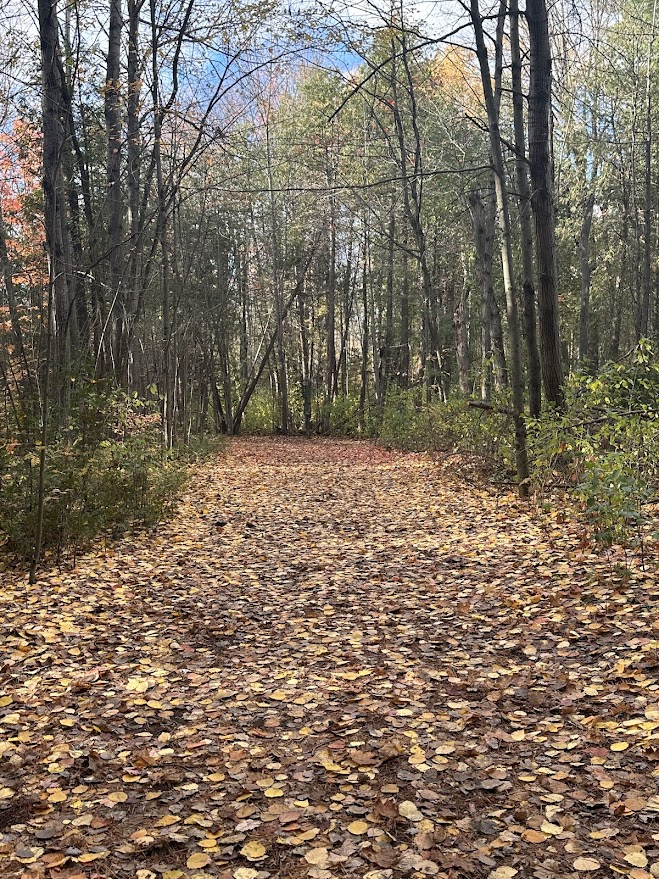
With the leaves falling, we saw much more sky than during the summer. We have giant maple trees around us. But now with much of the foliage falling, the ground was bathed in sunlight, and the leaves formed a thick, carpet-like cover. And there were no bugs, no mosquitoes, no ticks. Nevertheless, I still wore my tick-proof jacket and long pants for protection from nasty bugs, just in case.

I saw a massive fungus on an old and diseased tree; the fungus must be over a foot in diameter, with a yellowish color and parallel lines across its surface, making it artsy. While walking through the forest after leaf fall, we observed prominent burls, mushrooms, and lichens on the trees, which were readily apparent.  And I recognized the sounds of many birds, such as the black-capped chickadee, Canada geese, American crows, blue jays, and an app on my iPhone identified the yellow-rumped warbler. The loudest, of course, were the loons on the lake.

Crossing the large green pasture, we met three deer, looking at us. They always notice you before you see them. They hear the crunch of the leaves under our feet, while they remain quiet in their movements in the forest, avoiding attention from people passing by. And they always stand sideways with their heads turned, looking at us, waiting to see if we’re going to chase them or feed them. We stopped and took some pictures of them facing us sideways. I know the fellow who lives next to the pasture most of the year and feeds the deer. That is why they are friendly towards people.

Kayaking around the lake is a friendly affair; we always chat with people sitting on their decks. And there are the fishermen who talk about the number of fish caught that day. Yesterday, the surprising social event on the water was meeting three women standing in the water. They proudly announced that that day was a record for them in terms of being in the water this late in the season. I admired them for cheerfully chattering, but surely they were suffering the pain of standing in the cold water

But it was time to close the cottage despite the summer-like weather. All the neighbors were gone except a handful of fishermen on the lake.

Closing the cottage is a process that we have done many times, and it follows a routine. I unhooked the seats in the kayaks and pulled them up onto the shore, storing them upside down along with the windsurfers and canoes. I stored the seats and paddles in the storage hut. Covering the outdoor furniture with tarps was next, while Kathy cleared out the main fridge.

The final closing steps are moving all the stuff we take home to the boat and turning off the hot water tank and pump. My friend Jeff drains the water lines and adds antifreeze to the plumbing for winter.  And a local contractor pulls my floating dock around into quiet waters to protect it from breaking from the harsh winter ice.

The last activity is to place mouse poison around the cottage. Every ten years, there is a mouse invasion. We experienced it once and try to avoid it.

We drove the boat slowly to the marina, feeling the sun on our backs and watching the shore, one final enjoyment on the lake this year. Oh, and we’ll have to let the marina know that our propeller needs straightening; we had the misfortune of hitting a rock a week ago in the extremely shallow water resulting from the hot and dry summer.

A Culinary Journey on Two Wheels: Cycling and Cuisine

September 30, 2025

These days, we are looking for flat biking routes and prefer to avoid steep, mountainous areas. The rail-to-trail paths are ideal for us, so we decided to cycle along the Petit Train du Nord linear park in Quebec, just north of Montreal.

The recommended ride is from the northern end of the trail at Mont Laurier to St. Jerome, just outside Montreal, because there is a slight slope in that direction. The distance is approximately 200 kilometers, and it can be covered in a few days.

Typically, the cyclist would drive to St. Jerome, leave the car there, and take a bus that goes once a day to transport them to the northern end. However, by the time I called, there was no room on the bus for the day we had planned to go. Instead, we reserved a room at a hotel along the trail, closer to the northern end, to avoid the busier section near Montreal, and planned to cycle in both directions.

That turn of events was fortuitous, as Kathy had pulled a leg muscle while working out at the gym, limiting her ability to cycle for longer distances. Staying at a hotel provided us the opportunity to take shorter rides with rest in between.

Our trip got off to a great start when we drove into Montebello on our way to the trail and discovered a chocolate factory. We couldn’t resist buying some chocolate bars and truffles, completely forgetting about the prices. For lunch, we chose a bistro—after all, it’s Quebec! The French onion soup we had there was delicious.

With tables arranged closely together and the bistro full, the noise level was high, making conversation difficult unless one spoke loudly. However, the proximity to other diners allowed us to engage with our neighbors, which we did. Surprisingly, we ended up discussing politics without any arguments, likely because we shared similar views.

We attempted to use our French, which was more than rusty. Since we rarely have the opportunity to speak French, we struggled to find the right words when communicating with the service people. But it is always satisfying to express oneself in another language when the locals understand you. My feeling was that the locals appreciated our efforts to communicate in French.

In contrast to the bistro, our dinner at the Club du Golf Nominingue hotel restaurant was a more formal affair. While it was also noisy, the dining room was spacious, with tables dressed in white tablecloths and with elegant wine glasses. The service was prompt and attentive to our questions. Although I didn’t find the menu particularly unique to Quebec cuisine, the presentation of the food we ordered was stunning. I felt compelled to take pictures of our plates, which resembled sculptures, even though the food itself was pretty ordinary.

For example, I ordered saucisse artisanale du Québec, which seemed to me to be regular hot dogs, split in two, served with vegetables, and accompanied by French fries, presented in a wire mesh dish. While I wouldn’t consider any of the ingredients unusual, the presentation was truly remarkable.

The next day, we discovered a local bistro that was a lot of fun. It was extremely noisy, with people yelling from the bar to the other side of the restaurant, conversing in French, of course. It seemed that all the locals gathered at the bistro in the evening. We enjoyed local beer and cider, and I ordered osso buco, which is pork hocks in English, and it was delicious. For dessert, we had mousse fromage érable, which was delightful.

Beef bourgignon with ceasar salad

With all the food we consumed, we needed to burn off some calories, so we rode the Petit Train du Nord with plenty of energy. Like many trails of this nature, there are long, straight sections that can feel relaxing at times, while at other moments, they may become a bit boring. However, the trail was flat, with a grade that never exceeded four percent.

I was surprised by the number of electric bikes we encountered. Although I knew these bikes were popular, I didn’t expect most of the cyclists we saw to be using them, especially since there was no need for supplemental power on such level terrain. It was also interesting to see how many people were dressed in heavy clothing; I wore just a T-shirt and shorts, while others wore winter jackets. I thought riding an electric bike at higher speeds could feel quite chilly.

Although the speed limit on the trail was 22 kilometers per hour, we maintained a leisurely pace of 10 to 15 kilometers per hour, taking breaks to admire the surrounding landscape.

I have to commend the Quebec government for the development and excellent maintenance of this trail. It is entirely paved, and cracks in the pavement are clearly marked with yellow chalk. In areas with a buckling surface, a “danger” sign is placed to alert cyclists. More importantly, there are picnic tables, shelters, water fountains, and even bicycle maintenance pillars equipped with all the necessary tools. This is the most developed trail I have ever experienced. We have cycled on trails in Virginia (the Virginia Creeper), South Carolina (the Spanish Moss Trail), North Carolina (the Tobacco Trail), and many trails in Ontario.

The ambiance at the Le Club et Hotel de Golf Nominingeu, where we stayed, and on the trail, the Quebecois people, the food, and, not least, the cycling trail all contributed to a pleasurable trip. We absolutely have to return for another adventure. We thoroughly enjoyed interacting with the Quebecois people, who, without a doubt, tend to be more expressive, animated, and louder than their English counterparts. One of the highlights of our trip was the opportunity to improve our French language skills. The locals appreciated our efforts, even when our conversations switched to English.

Discovering Rajasthan: Bollywood and Traditional Thali Experiences

September, 23, 2025

He said Rajasthan. A young man from Rajasthan offered landscaping services at my door.  A wonderful place that we visited a few years ago with a guide, Shyaam. The memories that popped up overwhelmed me and I engaged in a discussion with the fellow at the door about the desert and the havelis in his home state. One highlight of our trip was Jaipur.

Jaipur, the capital of Rajasthan, is a city with a population exceeding two million. The drive from Agra took more than six hours. On the way, we stopped to have a thali lunch. They served it on a large metal plate (they also call the plate a thali), on which they arranged many small dishes around the edge, filled with ingredients such as yogurt, dal, vegetables, and chutney. Rice and chapati went in the middle of the thali dish. Eating was done with your fingers; these highway restaurants had a sink at one end of the room where you washed your hands before and after eating. Shyaam explained that the idea behind thali was to offer six different flavors: sweet, salt, bitter, sour, astringent, and spicy on one plate. According to Indian food customs, a proper meal should perfectly balance all these flavors. I was unsure what perfect balance meant among flavors, but we enjoyed the meal and improved our eating skills with our fingers.

The highlight of our stay in Jaipur was seeing and experiencing a Bollywood movie at the Raj Mandir Cinema. The movie house was a large circular building similar to an opera house, where there must have been at least one thousand seats, all occupied, quite a contrast to the smaller theaters we are used to in Canada, which are hardly ever filled.

The film had a cute and typical storyline: a boy falls in love with a girl who rejects him. Both the boy’s and the girl’s families reject romance, and the boy loses sleep, his job, and upsets his family. There are fights between the boy and the girl’s friends in various locations where the boy gets beaten up, but his disheveled hair and clothing are still picture-worthy. The girl’s and the boy’s relatives try to stop the relationship. Then the girl makes a telephone call, after which she disappears. Boy tracks down the baddies and rescues the girl who cries. There were singing and dancing events in various locations, but ultimately, the girl falls for the boy, and the relatives decide the boy is not so bad. The story ends with a large wedding with lots of singing and dancing. This storyline is, apparently, quite typical of Bollywood movies.

What I found more interesting than the movie was how the audience reacted to the scenes with clapping, singing, approving comments, and a loud reception. There was cheering when the boy enticed the girl and booing when the villains lost fistfights. At the wedding at the movie’s end, the entire audience was on their feet, cheering. It was a genuine experience in audience participation and quite a contrast with what I am familiar with, where even people with a cough are shushed by the other moviegoers.

We stayed at the Bissau Palace. The descendants of the royal family ran the hotel/palace (and lived on-site), and the hotel was one of the very few in Jaipur recognized by Indian authorities as a genuine Heritage Hotel. Set back from the iron gates within a village-like compound, it featured a temple, shops and a sizeable pool. The exterior of this century-old building needed some paint and maintenance, but the ramshackle look added to the charm; in fact, renovations would ruin the vibe. But our room was faultless and spotless, featuring hand-painted ceilings, lead-light windows (decorative glass supported by lead cames), and old-fashioned wooden furniture. And the food was native Indian to our liking.