Is There a Role for AI in Healthcare? Exploring Its Potential

February 25, 2026

A talk I listened to on how AI works with healthcare left me puzzled. A PhD working at the hospital explained LLMs (Large Language Models), such as Co-Pilot, ChatGPT, and Gemini, and compared them to search engines like Google and Bing. I thought I understood the difference: while search engines provide sources for queries, such as links or URLs, LLMs combine multiple sources into text and provide a human-like form of written communication.

According to the speaker, search engines maintain up-to-date information by constantly crawling the web, while LLMs remain current only up to the time they were trained, that is, the information they were given. This is so because not all LLMs are tied to the internet, so they do not have up-to-date information. So, I took it that search engines are good for research, while LLMs offer text and context to a query.

Both tools share the same starting point: the prompt. A question or prompt to a search engine would bring up links and URLs, while an LLM would generate a complete essay on the subject.

I was aware of much of this information; I have used search engines for years, and in the last year, I tried my hand at using some LLMs, for example, Co-Pilot, which is built into the MS Office suite. But how does all this technology relate to healthcare? That was the title of the presentation. So, I asked for an example at the end of the lecture. I said I see a cardiologist sitting at a computer, an MRI image on the screen, and a patient on the side. What does he do to use AI? Does he use a prompt about the MRI taken of the patient sitting next to him? Instead of a direct answer, the speaker explained that the infrastructure for using AI is not yet complete; for example, the hospital must have its own storage for the data, it cannot use storage elsewhere due to privacy concerns.

Also, I did not find answers to how doctors are trained to use AI or what percentage of them are currently using it. Anecdotally, I remember that when I last visited my ophthalmologist, he was concerned and dubious about computerizing his patients’ information. I wonder how long it may take for the medical profession to embrace and use computer technology, especially AI.

Coming back to a live example of how the medical profession may use AI, would he/she ask AI to examine the MRI and identify any medical problem shown on the image? The speaker emphasized that AI is only a tool to use and ultimately, the doctor decides on treatment, potentially using information gleaned with AI tools. After the lecture, I told the speaker that a few examples of medical professionals using AI would have been useful.

To test what I learned, I came home and used a prompt: “Write 300 words on the Vatican Museum”, and asked Google and Co-Pilot, to respond. To my surprise, both apps wrote a nice essay. It appears that the boundaries between search engines and LLMs are blurring, especially as technology advances and these tools integrate.

However, while both can provide information, their use in the specialized, privacy-sensitive field of healthcare remains challenging. There is potential, but also barriers in infrastructure, training, and trust.

PS. In today’s Washington Post, February 24, there is an article by a doctor about how to use AI in medical practice. “AI didn’t replace me as a doctor. It made me better.” By Ashish K. Jha

https://www.washingtonpost.com/opinions/2026/02/24/health-care-ai-doctors-chatbots/

Snow’s Impact on Ottawa Life and Art at the Gallery

February 20, 2026

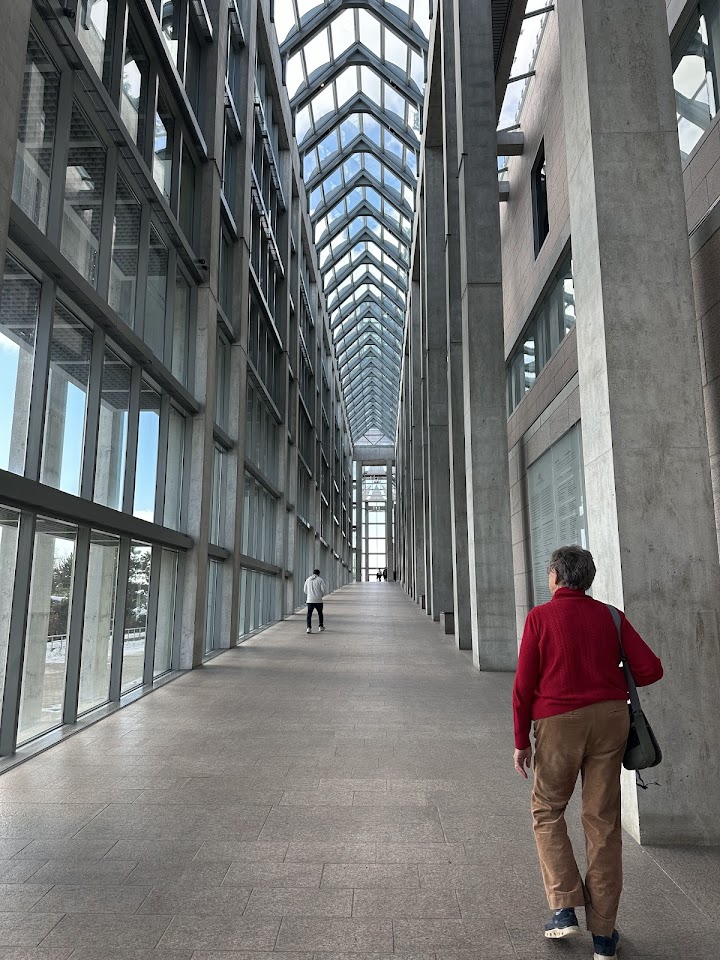
Walking along the snowy pathways behind the Sportsplex brought to mind the snow-themed exhibit currently at the National Gallery of Canada. Drawn by memories of past visits and the Gallery’s dramatic architecture, we decided to visit the exhibit.

The entrance to the galleries is via a long, upward-sloping hallway with a towering glass wall on the left. The building has an almost gothic feel, when walking up the hallway toward the impressive great room, which features an intricate ceiling with an open design. Notably, the building’s design was the result of an international competition won by Moshe Safdie, a renowned architect and McGill University graduate in Montreal. Safdie is a Canadia Israeli, and US citizen.

Inside, the theme of snow was immediately evident. What color is snow? That question on a flyer greeted us at the National Gallery. Melting snow on my driveway revealed shades of grey, blue, and yellow as the sun set. Walking the snowy paths in the park, I noticed various colors on the ground—especially where people had walked dogs. Snow displays many colors, from sunny to cloudy days and into the night.

Reflecting on the exhibit, I realized what a great idea it was to spotlight snow, as it defines our winters for three months of the year. With snow enabling so many activities, skiing, sledding, and snowball fights, it’s central to our outdoor lives and fitness. Exhibiting snow photos is a perfect way to celebrate the true spirit of our winters.

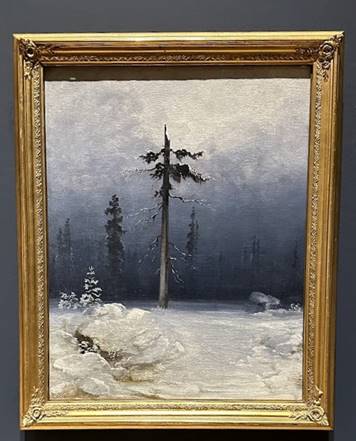
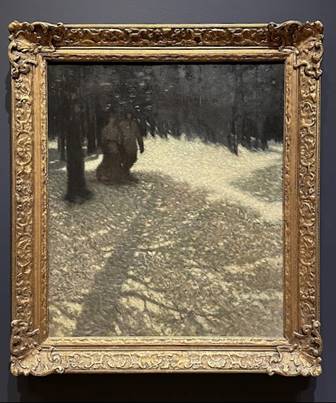
This appreciation for snow was evident throughout the Gallery, which featured over 160 pictures with snow on them. The Gallery curated paintings of Canadian artists, in collaboration with other European museums. Noteworthy were pictures of the Group of Seven landscape artists, Canadian native artists, Swedish and Norwegian painters, and pictures by Monet and Pissarro from France. Among the many rooms, some showed daytime scenes, and others showed night scenes.

The snow scenes were cleverly displayed: daytime paintings were shown in white rooms, which felt cold, while night snow scenes were in black rooms with dim lighting, creating a unique atmosphere for the exhibit.

Snow dominates winter life in Ottawa, affecting daily routines. Residents carry extra shoes to swap for boots indoors, wear parkas and toques outside, and equip cars with snow tires, scrapers, and salt. Snow accumulates along streets, making clearing the driveway essential. When I moved from Washington, DC, our first Ottawa winter brought over ten feet of snow—I had to shovel just to open the door. Over time, we adapted and came to enjoy it.

Exploring Contemporary European Man in Szalay’s _All That Man Is_

February 13, 2026

The book All That Man Is by David Szalay has short stories about European men. The stories unfold chronologically from April to December, the first story starting with the youngest man, who is 17, and each subsequent story featuring an older man, culminating in the last story, which features a man who is 73.

The book has nine stories, starting with two students sightseeing in Berlin and Prague, followed by a young Frenchman vacationing in Cyprus. The subsequent stories are about a university student and his girlfriend driving ftrom Oxford, England to Poland; a bodyguard with his boss and the boss’ wife from Budapest working in London; a Danish journalist digging up dirt on a politician in Amsterdam; an English realtor selling condos in the Swiss Alps; an Englishman living on the Croatian Riviera; a Russian oligarch trying to commit suicide on his yacht on the Mediterranean, and a retired British diplomat living in Italy.

The stories center on white, heterosexual European males traveling or living in a country other than their home in Europe. Does this group of characters represent what it means to be the typical European man today, as the book’s title suggests? I think the author is exploring whether these men collectively illustrate a modern archetype.

I really enjoyed the book. The stories are compelling with well-written plots and fascinating characters whose problems feel real. The smooth language is punctuated by dialogue, balancing longer passages introducing the characters and describing the localities.

Some events are quite funny, as in the story where a married woman in Prague tries to seduce a young, shy boy and ends up sleeping with boy’s friend. Or, when the oversized girl and Bernard put the mattress on the floor in the Cyprus hotel in order to accommodate their lovemaking. However, the author never mocks the inept subjects. Instead, he uses gentle language to describe their frailties and haplessness.

A recurring theme in the stories is the lack of, or search for, meaning in life. This led me to question whether Szalay portrays contemporary European men as lacking purpose, ambition and opportunities, focusing instead on vacations, drinking, and sex. Through these motifs, the book prompts us to ask: Is this what defines the European man today?

An interesting writing craft the author uses is leaving the stories hanging at the end, with no conclusion about what happens next. For example, when the student finds out that his girlfriend is pregnant, he assumes an abortion will solve the problem, while the girlfriend absolutely refuses to do so and wants to keep the baby. The story ends without the reader knowing what happens with the couple. Another example is the Russian oligarch who wants to commit suicide but does not know how to do it. Again, the reader is left with uncertainty about what happens in the end. I found the stories with uncertain conclusions entertaining, leaving the reader to speculate about potential ends.

The stories are realistic; the plots are familiar. The book In Praise of Older Women came to mind while reading the first two stories about young men and older women (Stephen Vizinczey, 1978). The realtor story recalled brochures for ski chalets in Canada, and the story of the Hungarian woman in London reminded me of Central European girls brought to the US for prostitution. The Danish minister’s affair with a married woman is typical of politicians’ scandals. Such familiar situations made the book feel genuine to me.

The short stories also reminded me of Alice Munro’s work, such as Runaway (2004). However, in contrast to the women who suffer in Munro’s stories, the men in Szalay’s stories end up the losers. For example, Murray, retired on the Croatian Riviera, is chasing validation of his masculinity by going after a barmaid, and when losing her to a Dutch friend, he goes after the barmaid’s mother, not upscale choices by any standard.

If Szalay’s stories attempt to define the contemporary European male, I wonder about their lasting relevance. As Europe’s demographics change, will the image of the European man in this book remain accurate or become outdated? The book was short-listed for the Man Booker Prize, and I found it thought-provoking and enjoyable.

Reflecting on Daily Life: My First Journaling Experience

February 9, 2026

Digital media often invades privacy, or should I say always. Ads for shoes, books, and cars follow online searches. Banners even remind me to journal (writing down daily thoughts, feelings and experiences). I’ve never done this before but yesterday was both challenging and interesting and decided to put it to writing.

Yesterday was challenging because the garage door would not open. Both cars were locked in, leaving us immobile with no public transit nearby. It took time to discover the problem—the spring was broken. Bottom line: I couldn’t get the 2010 Mazda3 to a repair shop for an appointment. The car needed a diagnosis for a knocking noise when turning right, and the brakes were pulsating.

I tried to disengage the door from the lift engine and just push it up. Because the spring was broken, the door was too heavy for me to lift. I used an 8-foot-long 2×4 stud as a lever but still could not lift it. A neighbor came over to help me. Together, we raised the garage door and put a stud under it to keep it from closing. I managed to drive the car to the repair shop, arriving late for my appointment.

Addressing the garage door issue promptly was important, as an open garage without cars inside can jeopardize security. Once I managed to drive out, I called the repair service, and fortunately, they had time in the afternoon to come over to fix it. This was an unanticipated and unwelcome expenditure, adding to the day’s complexity; I got lost driving to the garage even with my GPS on. I took an Uber taxi home.

Yesterday’s other event that made an impression on me involved the Uber driver and the two garage door technicians—all were recent immigrants. It made me wonder: are most service workers in Canada immigrants? While my sample was small, I found it interesting that all of them I met in one day were newcomers.

In halting English, the Uber driver related that he came from Cameroon 8 months ago; he was French speaking. This was his first winter in Canada. I gathered that he had three children under 10 years of age, and that his wife worked as well; they needed two incomes for the family to live. Driving a cab gave Yves, the driver, the opportunity to get home when the children needed him.

He could not find employment in Cameroon in his field, food processing, and immigrated to Italy, where his wife was already living. There, however, he felt that Italians were too close-knit and would not embrace foreigners. For example, he said he never saw a black bus driver in Milan. So, they decided to come to Canada and arrived last summer. On this day, the temperature was minus 20 degrees Celsius or minus 4 degrees Fahrenheit yesterday, a huge climatic difference from Cameroon.

I also had interesting conversations with the two technicians who came to fix the garage door in the aafternoon. The lead technician was from Punjab, India. With his Punjabi accent, he explained the meaning of ‘Punjab’ to me; it means ‘five rivers’ in Punjabi. He also talked about the partition of India while instructing the other repairman, who identified himself as a Palestinian.

Talking with the Palestinian, I learned that he grew up in Jordan but never goes to Gaza, where he has relatives, because of the Israeli road checks. In spite of carrying a Canadian passport, whenever he tried to cross into Gaza, the Israeli soldiers harassed him. So, he no longer visits. On leaving, he advised me to oil the moving parts of the garage door a few times a year and showed me the product he used, which is available at Home Depot. I never thought of oiling the garage door before, a learning experience.

Meeting three immigrants prompted me to reflect on Canada’s diversity. Statistics show that 1 in 4 Canadians is a first-generation immigrant, and another 17% are second-generation. Over 40% of the population has recent immigrant roots—it’s a remarkable diversity. I would not be surprised to find Canada to be the most diverse country in the world.

Late afternoon, I called the repair shop to check on my car. I was shocked to learn their huge estimate to make the car “safe” again. However, after discussing it with the mechanic and hearing his detailed explanation, I felt confident in his recommendation. I realized I had not had the car repaired for years, I thought it was indestructible.

I had to decide whether to choose repairs, knowing that more issues might arise soon, or consider buying a new/used one. First, I thought it was time to trade up. However, I reconsidered; the suggested repairs could extend the car’s use for another year or two. I have spent nothing on this car for years, and I liked the gearshift; they do not make gearshift cars anymore.

Reflecting on journaling, I do not expect every day to be as eventful as yesterday, worthy of journaling. Writing the journal required time and thought. It made me realize the importance of maintenance and discovered the impact of immigration on Canada via direct experience. Some days may be less striking, but journaling can still offer value.

Finding Travel Partners: Lessons from Ottawa West Probus

February 6, 2026

I was disappointed attending an organizational meeting for a travel group. The Ottawa West Probus Club decided to establish a travel interest group. A volunteer arranged the meeting to discuss what we should do. We met in a cold church room with no coffee provided. A poor beginning for me. On top of this, only five people showed up, including me. A very inauspicious start, when we have two hundred people in the Probus Club.

Right off the bat, someone mentioned privacy concerns. She took exception to the spreading of personal emails; I assumed she was referring to the invitation to this meeting. I wondered how difficult it would be to organize a group without using email today. Should we use a phone instead and call each participant? Would that be time-consuming? The same person also expressed a dislike for people taking pictures when the lunch group meets.

After this curious discussion of privacy issues, the organizer asked what we wanted to get out of this meeting! Since this was the second meeting of this group, and since only I and another person were new, I thought the purpose of this group had already been established. But no, the agenda was wide open.

I suggested three options based on experience: holding monthly meetings with travel slide shows, inviting guest speakers from travel companies, or organizing group trips ourselves.

These options were not what the organizer had in mind; she explained that this group would serve only as a “travel dating” site, where people with similar travel interests would be introduced to one another. And once such a group coalesced, they would handle travel arrangements like flights, hotels, and tours. Ok. But why is such a service needed?

Well, she explained, people do not like to travel solo and look for company. Family or friends, I assume. The assumption is that people do not find family members or friends available to travel with and look for travel companions with similar interests, likely members of the Probus Club.

I agree with her opinion. It is a challenge to find friends or family to travel with, as preferences for travel differ—some enjoy cruising, while others prefer five-star hotels. Our nascent travel group aims to connect Probus Club members with similar travel interests and preferences.  

The idea of traveling in a group with local people made me think of what we used to do. We used to arrange our trips and travel with a backpack, just the two of us. We looked forward to meeting local people in faraway countries, tasting their food, whether spicy or not, and learning about their culture. Getting lost on our way was always a highlight, a learning experience, and I thought we were enriched by such unanticipated adventures.

I am not sure that I want to travel with our Probus friends; in fact, traveling with a group often limits interaction with locals. Guided tours are efficient for planning, but limit opportunities to engage with locals. Some prefer arranged trips, while others enjoy planning their own trip.

I left the meeting with no information on the next steps. But it has become clear to me that the organizer should explain the idea for this travel group in the Probus Club newsletter. And that there should be a structure in place to allow people to sign up for trips of their choice.

Considering all this, I left the meeting seeing limited value of this travel group for our Probus Club. But I give full credit to the organizer for trying to get this group off the ground.

Note: Probus is a worldwide organization run by volunteers. It is a non-profit organization for semi-retired and retired professionals and businesspeople, with no political or religious ties.   It started in the United Kingdom by a Rotary Club.