Understanding Misinformation on U.S. Travel

January 30, 2026

Amazing how much misinformation permeates reality today. My coffee buddy told me not to enter the United States because I’ll have trouble at the border. I told him I am going to visit friends and family in the Carolinas and Florida, which triggered a long rant from him about why he does not visit the US these days. To cut a long story short, we had no trouble at all at the border. The official at the gate wished us a good trip south after a brief, friendly conversation.

Why did my friend have a negative impression of travelling south? He must have seen too many headlines about border agents harassing tourists, read too many articles on the internet about tight immigration policies into the US, and probably seen too many digital media videos on how US immigration agents manhandle travellers.

Confirming the bad publicity surrounding travel to the US, I met a Dutch fellow in the Everglades in Florida who said that travellers from Europe must hand over their cell phones to US immigration officers for a scan of their digital accounts to see if anything there reflects negaitvely on President Trump. If any such messages are found on their phones, they may be banned from visiting the US for a couple of years, he told me.

In our conversation, I learned that he has a condo in Naples that he has not been able to rent due to the significant decline in visitors this year that he attributed to the current US official position towards foreigners and visitors. I read recently that there is a proposal to launch a search program for critical views of Trump on the digital accounts of US visitors, but it is not in effect yet. This type of misinformation is pervasive and spreads by word of mouth.

Misinformation also happened in my family. When we travelled to Florida years ago, my mother, who lived in Vancouver, British Columbia, warned us against swimming off the coast of Florida for all the crocodiles there. Well, there are no crocodiles where we traveled. I do not know where my mother obtained her information.

The subject of how much people are misinformed is discussed in a recent book by Hans Rosling, entitled “Factfulness”. The author conducted numerous surveys worldwide on people’s opinions and knowledge about common topics such as population size and growth. The author concluded that people are ignorant, less than thirty percent were the correct answers in his surveys.

Rosling describes numerous reasons for people’s ignorance; for example, people tend to project the future based on straight-line projections. The world’s population doubled or grew from four to eight billion over the last fifty years. Projecting the doubling of the population over the next fifty years would bring the world’s population to sixteen billion by 1976. The author’s projection, based on economic, family formation and fertility trends, projects the world population peaking at around 11 billion people.

Rosling’s work is data driven. He cites statistics from many sources (such as those from the United Nations) supplemented by the surveys he has conducted. I am not sure that data and surveys together provide an adequate picture and would suggest that, in addition, direct observations may help shed light on reality. For example, if you watch the major TV channels today, you cannot avoid seeing the chaotic environment in Minneapolis. So, you may jump on the idea that Minneapolis is typical of the entire US. But the US is a big country, and life goes on without federal agents interfering in most places.

We traveled in December to North Carolina, Florida, and Tennessee, and have not witnessed any civil disruptions. Stayed a few days in Winston-Salem, Durham, and Charlotte in North Carolina, Orlando and Everglades City in Florida, and Decatur, Tennessee, and had a great time meeting friendly people. Real-time experience defies what you see on TV.

I am not saying that my experience provides an accurate picture of what is going on in the US. What I am saying is that, in addition to what you see and read in the media, it should be complemented by other sources of information, including personal observation and common sense.

And reflecting on my view of life in the US is but a small part of reality. We traveled in a few cities, met a few people, and I’d be the first to admit that my observations are limited in number. But what I learned is that what you see in the media is just one part of the big picture, and the best way to find out what is going on is to travel, to gain a better picture of reality.
Exploring Beaufort: A Cyclist’s Paradise in South Carolina

March 24,2025


We drove south to leave the winter of Ottawa, even though we enjoy snowshoeing. Escaping springtime offers a welcome reprieve from the winter’s cold and snow. Despite my pollen allergies (managed by Claritin), late March in the Carolinas offers ideal cycling weather.

Driving south towards Beaufort, South Carolina, I sighed in relief at leaving the crowded, monotonous, and speedy Interstate 95 behind. Driving for hours had numbed my feet, so I hoped for less, slower traffic on Route 21 East. Although slower, the traffic picked up closer to Beaufort on a four-lane highway.


The expansion of military bases (Parris Island and Beaufort), resort construction (Hilton Head Island), and a Northern retiree influx have driven development along South Carolina’s east coast.
We learned from a hotel employee at check-in that Beaufort’s population has almost doubled since the pandemic, nearing 15,000. It is not only retirees but also people working remotely who have arrived to take advantage of lower housing and living costs.

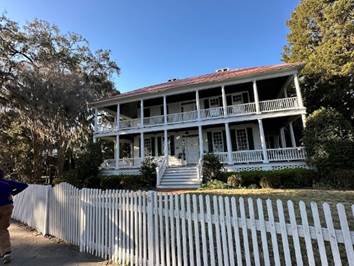
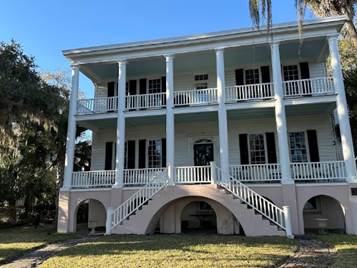
When Kathy stayed here thirty years ago, she stayed in one of the huge antebellum houses on the waterfront, used as a B&B in those days. Today, developers meticulously redeveloped the waterfront, and they restored the antebellum homes along the waterfront to their original designs. The city designated the downtown area a historic district, and we enjoyed a quiet walk admiring the architecture.

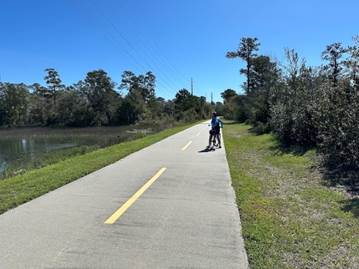
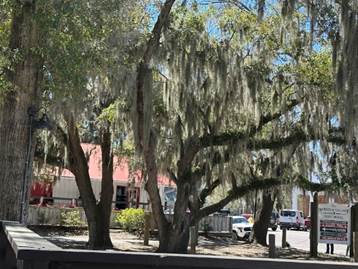
Cycling the Spanish Moss Trail from Beaufort to Port Royal was a smooth ride (it follows the old Magnolia rail line). The paved, twelve-foot-wide trail was flat, crossing marshes with many boardwalks and with the temperature in the mid-twenties (in the seventies in Fahrenheit), was ideal for a bike ride. Much of the Trail crossed areas with oak trees from which Spanish moss hung. I assume the source of the name for the Trail. Although the hanging moss is attractive, avoid touching it because it might contain chiggers.

The paved trail was great for riding, but I knew that falling off the bike would be rough, experiencing injury if going at the maximum allowed speed of 15 mph.

We sped through the twelve-mile trail, pausing to talk with people going in the opposite direction. We avoided talking about politics. We did not know how local people would react to talking to us Canadians, in view of Trump’s desire to annex Canada.

I noticed different organizations took responsibility for maintaining sections of the trail, which included benches at viewing sites, including the military that were in abundance in the area.

In less than a couple of hours, we arrived at Port Royal, at the other end of the trail. We were ready for a cup of coffee and found in the center of Port Royal a home converted to a restaurant with a name Corner Perk that offered fancy coffees. Their muffins were so special we couldn’t resist.

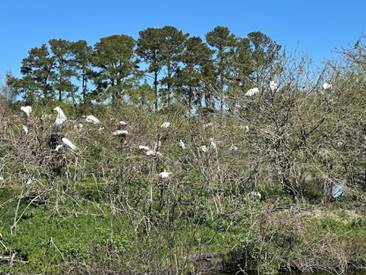
Next, we saw a sign for the Cyprus Wetlands rookery, home to hundreds of local birds (egrets, cormorants, bats, herons, etc.), right by the coffee shop. A boardwalk crosses a lake, going by an island with small trees that provide nesting grounds for birds. We noticed many turtles and alligators also slept on the shore of the island.

Returning to Port Royal, we found a small house converted to a restaurant boasting a sign for Griddle and Grits and the menu included grits with shrimp, with chorizo and grits with different ingredients. I like spicy foods and chose chorizo on grits, which turned out to be excellent. Kathy chose she crab soup, which also turned out to be a good choice.

On the return journey, we paused on a bench and were approached by a man who looked like a bear of an angler, who sat down, smoked a cigarette and started a conversation. He wanted to know all about us and then described his entire life story, including where he was born, where his family members were born and all the ailments they each had. I gathered he has been a floater with jobs in many states before settling in Beaufort. We could not resist listening to him; overall, it was an enjoyable social engagement.

We stopped at a Publix grocery store on the way home to pick up dinner. The Spanish Moss Trail is a nice, paved trail, but it was a bit too tame for us. We like longer and wilder trails with fewer refinements.

Exploring North Carolina: Vineyards, Memories, and Family

May 15, 2024

Sitting in the sun, shaded partly by an umbrella at Shelton’s vineyard in North Carolina, was hugely relaxing. Helping the relaxation was the Cabernet Sauvignon that we sipped. The food was average: pulled pork on an open sandwich base, or perhaps it was a pizza. I am not sure, but it tasted like pub food, appropriate in the setting.

Driving away from the lush meadows of the Yadkin Valley where Shelton’s grows its grapes, my thoughts turned towards the many times we visited North Carolina over the last few decades, and my memory lane took me back to the first time I drove to Chapel Hill, NC.

That was when the Dean of the Graduate School of City Planning welcomed me with an open smile; Jack Parker welcomed each planning student. His intimate reception touched me, and he generated a feeling that I’d succeed in my studies. It was a competitive program, but I have known no one who failed. The UNC Planning School admitted me for the January session; I applied to many other Ivy League schools, but UNC took me mid-year, and I accepted the offer, not waiting for the other schools to respond. But let me explain how I decided to attend planning school.

After graduating from the School of Architecture at the University of British Columbia in Vancouver, Canada, I worked with a small architectural firm in Vancouver. I lasted six months before getting bored with mundane designs of lobbies for high-rise buildings put up by developers. Another job with an even smaller firm was more interesting: designing a recreation center for a specific location in Vancouver. This project came about as a request for proposals for a competition our firm did not win.

After my brief experience with two architectural firms, I decided that I did not fit the mold of an architect. Architecture envisions plenty of attractive and well-appointed living spaces unavailable for most people worldwide. Architecture is irrelevant to people who have no choice but to tolerate less attractive environments. So, that was the impetus for me to search for a new field of endeavor. City planning appeared to be a related field, so I started applying to graduate planning schools in the fall, which is how I ended up in Chapel Hill in January.

When I arrived, I felt I was in paradise, experiencing southern hospitality and the positive energy generated by, and friendships made with, the planning students. Living at a campus-type university was another positive for me; UBC was a city university where moststudents lived off-campus. In contrast, campus life at UNC was rich with lectures and performances I could attend. For example, at the annual Jubilee Music Festival in the spring, I listened to Johnny Cash while sitting with thousands of students on the ground of the quadrangle. It was a memorable concert. 

Another primary reason North Carolina holds deep memories is that I spent considerable time with my future wife during our second year there. Although we met in Washington, DC, where we both had summer jobs, upon returning to UNC for our second year, we saw each other daily, starting with breakfast in thestudent dining room,Lenoir Hall, when it cost forty cents. And we spent many evenings talking late into the night at the Rathskeller, a student pub in Chapel Hill. We married at year’s end at the Anglican Church on the campus with family and all my classmates in attendance. The audience had a big laugh when the newlyweds left in the car with a colossal ruckus created by the rocks my friends put into the hubcaps of our vehicle.

A career launch and meeting my lifelong partner provide deep roots in North Carolina. But there is more to it. Our three children applied to US universities after finishing high school in Ontario. Although they did get into Canadian universities, they thought going to American schools would be more adventurous, perhaps influenced by their parent’s experience there. The upshot of their leaving Canada was that Tony and David attended UNC in Chapel Hill, while Megan graduated from Duke University in Durham.

They married after graduating from university; the two boys married North Carolina girls and settled in Charlotte and Durham. Further, Kathy’s brother, Huw, retired from Washington, DC to Winston-Salem, near where his wife had grown up. Our recent visits to North Carolina span from Charlotte to Winston-Salem to Durham, all of these locations along Interstate 40, within three hours of driving time.

Innumerable opportunities have existed to visit our children and their growing families in North Carolina, share a vacation, help them move, or see them. Over the years, I wore out several car tires along Interstate 81, driving from Ottawa to North Carolina. However, the visits have also provided opportunities to see the state and enjoy what it offers.

Huw and Judy introduced us to vineyards while driving around Wiinston-Salem. With the decay of the tobacco industry, growing grapes had taken over the rich agricultural soil. My attraction to visiting vineyards goes beyond sipping wines; they happen in areas with lush vegetation on rolling hills, with a lake and a fountain facing the tasting room.

Having visited Shelton’s vineyard, where the wine was tasty, but the food was not the best, we decided to visit Shadow Springs Vineyards with Huw and Judy on our last visit before returning to Ottawa. They do not have a restaurant, and since we do not sip wine without some food at lunchtime, we stopped at the Shiloh General Store in Hammondville to pick up a sandwich.

Amish people run the store, and the owner, Phil Graber, was on cash. I learned from him that the area has over fifty Amish families. Phil and his wife Mary established the store in the early 2000s and expanded it to over thirty-five hundred square feet. The store sells homemade products with fresh ingredients, such as pickled vegetables, dry soup mixes, Amish noodles, pretzels, and crackers.

They made a tasty sandwich for us. I found their order-taking fascinating. You choose on a piece of paper the type of bread, meat, spread, vegetables, and sides you want and place it in a window. Then, they prepare the sandwich and call your name. There was no limit on what you could ask for, and I thought, why not order pulled pork and chicken under meats? And low and behold, my sandwich had both meats!

Armed with our sandwich, we entered Shadow Springs’ tasting room. Judy selected a 2022 Seyval Blancand a2022 Chardonnay while we settled at a table on the lakefront, cranking up the umbrella to provide shade from the sun’s heat at midday. The chatty hostess in the tasting room described how Chuck Johnson, the owner, decided to retire from his corporate job to his home state and look for another career opportunity after missing too many of his son’s ball games. Chuck and his wife Mary went winetasting upon their return to NC and decided that winemaking might be an excellent opportunity for starting a new life. They looked at dozens of farms for sale until they found this piece of land with the proper orientation and soil qualities to make wine. They started making wine in 2005.

And we were not disappointed with their wines. We spent the two-hour lunch sipping wine in sunny weather, sitting outside with a huge fountain making a bubbling sound in the middle of the lake next to us. What a way to spend our last day in North Carolina before returning to Ottawa, where the trees were getting leafy.  

Family Spring Break Adventures in North Carolina

May 1, 2024

Our April spring break, a time for family and adventure, began at 5 p.m. on a Thursday in Ottawa. We embarked on a journey that would take us fifteen hours to North Carolina, with a stopover in Courtland, NY. This annual tradition of ours, filled with shared experiences, is one of many times we see our far-flung family annually.

The Red Roof Inn in Courtland had its own unique character. Despite the room being refurbished, there was no breakfast provided, not even a simple muffin or toast. This was a departure from the norm even in economy-priced hotels. However, this unexpected change had its benefits. It allowed us to start our day early, without any unnecessary morning delays.

Our spring break is also an excuse to leave Ottawa, which has snow and cold weather. Mind you, this year’s winter was the mildest in my memory, and getting away was not like escaping cabin fever; the first year we moved to Ottawa, the temperature never came above zero Fahrenheit in January, and going south in March was a treat.

Our first full day in North Carolina was filled with cultural and sporting activities. We attended a Jazz Musical Appreciation Adjudication event, where twenty-five high schools showcased their talent. Our granddaughter, Zinnia, plays the trombone with the Jazz Combo of the Jordan High School, her school participated in the event.

Millbrook High School, a magnet school in Raleigh hosted the event. I entered the building, and the music room immediately impressed me with all the electronic gear. Further in, a large, designed-for-acoustics auditorium sloped towards the stage where the bands played. I cannot recall this level of educational resources at the high schools our children attended.

Listening to the bands performing songs by Charlie Parker, Neal Hefti, Hoagy Carmicheal, and Bobby Timmons brought back memories of the music I listened to in the ’60s. Another classic one band played was Duke Ellington’s Satin Doll.

After the three songs Zinnia’s jazz combo played, it was time for the adjudicators to comment on their performance. In addition to an overview critique, they took the time to discuss the players’ techniques and delivery, offering valuable insights. One adjudicator, in particular, stood out. He had brought his trumpet along and demonstrated what some songs should sound like. The combo members listened intently and demonstrated their understanding by playing their instruments in the style recommended by the adjudicator.

We were in Raleigh for the event, although Dave lives in Durham; the entire area is part of what is called the Research Triangle Park (RTP) of North Carolina. It is interconnected by interstate highways 40 and 85. It boasts many well-known educational, recreational, and cultural facilities (such as Duke University, UNC, NC State University, Duke Gardens, and NC Botanical Garden). The area also boasts a professional hockey team, the Hurricanes, who play out of Raleigh, and top-notch college basketball teams – think of the perennial rival Duke and UNC teams.

A few decades ago, the RTP had a well-developed high-tech sector. Nortel was a significant employer in communications, along with Newbridge Networks, where I worked. I remember management telling us to be careful working on our computers on flights from Ottawa to Raleigh and not to reveal technical secrets should an employee of Nortel sit next to us. Those days, there were daily flights between Ottawa and Raleigh. Since then, Nortel has gone bankrupt, and Alcatel, the global communications company, bought up Newbridge.

My memories lingered until our grandson Zane, ten years of age, invited us to watch his ball team play in the afternoon. Preceding the game was a “slugfest” at Herndon Park. To participate in the slugfest, the boys on the ball team had to fundraise $200 each for the team, which entitled them to “hit” balls from a pitching machine a dozen times.

Curious parents wanted to know who I was and welcomed me enthusiastically, another body cheering for the boys. There might have been more family members enjoying the weather, the outdoors, and watching the slugfest than players. Everybody carried water bottles, and folding chairs sprang up to watch the boys slug it out. A highlight of the slugfest was picture-taking, with each player posing with a bat ready for action and team photos following.

A game followed the slugfest that unfortunately ended in a loss for our team. It did not matter for the cheering parents and siblings who kept up with loud encouragements of “good eye” and “you can do it.” One of the rules for this age group that I learned is that the umpire does not allow a new inning to start after an hour and forty-five minutes of play. I am not a baseball fan, but this rule is good because the rule limits the duration of the game. Although the parents were disappointed in the outcome, the boys were too tired to dwell on the loss and ended up with a smoothie.

Our activities in Durham were far from over. The next day, we stumbled upon the ‘American Tobacco Trail’ (ATT), a hidden gem in the city. Despite the drizzle, we were eager to experience this outdoor activity. The section of the ATT we walked on was a tree-lined corridor, where the tree canopy provided a cozy shelter from the rain. Our ball-player grandson, always full of energy, circled around us on roller skates while the rest of us enjoyed a leisurely walk. It was a delightful discovery, adding a new dimension to our trip.

The ATT is a rails-to-trails right-of-way for walkers, cyclists, and equestrians. The level and mostly straight twenty-two-mile trail has a ten-foot-wide paved surface. The trail’s history goes back to J.B. Duke, who founded the American Tobacco Company in 1890 and built railroads to serve tobacco facilities and plants in the area. The trucking industry superseded railroads, and the rail lines fell into disuse. 1980, the Triangle Rails to Trails Conservancy was formed to preserve the right-of-way for recreational uses. I found it a pretty trail, even in the rain.

Returning to Dave’s house, we changed out of our wet clothing and commented on the many attractions families can visit to enjoy the Research Triangle Park. It is not only the ATT that attracts walkers but also the North Carolina Botanical Gardens, situated next to the University of North Carolina campus, with lovely walking trails and endangered plant species on display. Our granddaughter Zinnia, familiar with the Gardens, guided us around the trails there. Families can also visit the Science Museum in Raleigh, where we took the grandchildren to see the Van Gogh traveling exhibit last year.

We met up with two of our granddaughters in Cary, located part way between Raleigh and Durham, for dinner; Caroline works in Raleigh and Mary Kate attends North Carolina State University in Raleigh.  While there we enjoyed the renovated center of Cary.   With young children, a visit to the park in the renovated center of Cary is a must; it has the most creative modern play structures I have ever seen. Although we spent only a few days in the Durham and Raleigh areas, the rich fabric of recreational and cultural facilities could keep a family busy for days.

Exploring the Art and Wine at Chateau La Coste

November 1, 2023

A jazz trio played forties tunes on the deck of a vineyard, where we sat down after a tiring bicycle ride in the finger-lakes area of New York State. We relaxed by sampling the wine and listening to the music. It was a fall afternoon with the sun going down, illuminating the vinifera below us. Before leaving, we bought some wine for the night to enjoy at our hotel. These are the type of situations my lasting memories are made of.

The first such memory was when I finished university and helped my younger brother learn to drive when he turned sixteen. When he passed the driving test, I convinced him to drive with me from Vancouver to California. I explained to him that he’d do the driving for practice, and I’d do some wine-tasting on the way. He did not need much convincing. And it was a memorable trip.

More recent memories were at vineyards in North Carolina, where after a warm welcome, the hosts offered lunch in addition to the tasting session. What I liked about these visits were driving into an attractive estate with lush vinifera surrounding us, entering an ornate Italianate building or a large historic mansion where the winemaking took place, and partaking in a guided tour of winemaking before sitting down for the tasting session.

So, when we visited Provence in France a month ago and discovered that Chateau La Coste, a well-known vineyard was on our route, I jumped at the opportunity to visit it and bought entry tickets. Chateau La Coste is famous for art, architecture, and wine. The owner, Paddy McKillen, an Irishman, who bought the estate in 2001, commissioned artists to create artwork in the garden and hired world-famous architects to design the buildings (Frank Gehry, Oscar Niemeyer, and others). So my expectations were high only to be disappointed after the visit. Let me explain.

We approached the Chateau driving through fields of vinifera only to arrive at a large, open, unpaved parking lot, with recently planted trees. By talking to other tourists and asking questions, we found our way to the building where our tour started. Nobody welcomed us, nobody provided directions. It was not a promising beginning.

Our group of eleven people was taken on a guided tour of the wine-making plant. Well, production took place in a building that looked like half a barrel on its side, with interesting finishes, mostly aluminum, but nothing else (designed by Jean Nouvel). To me, it looked like any commercial building, like a Quonset hut, huge, but still only a simple shape, a half-barrel sitting on its side. Is this good architecture? The shape conjured up winemaking barrels, was that the idea?

We pondered the front of the building, listening to the guide, standing on a gravelly field, next to a massive excavation, which, I gathered, was going to be the location for a hotel. The surrounding for the hotel and the plant was not what I expected to be a campus-like atmosphere with attractive landscaping.

Once inside the half-barrel, though, the guide gave a detailed tour of the wine-making process and equipment. Surprising to me were the huge metal barrels holding the fermenting wine; I had seen wooden barrels in other vineyards previously (although, admittedly, the other vineyards were smaller than this one).

Wine tasting, the event we all looked forward to, was next and we entered a small nondescript building. We gathered around a U-shaped table, sitting on bar stools. At the open end of the U was the guide and at the bottom of the U were six bottles of the Chateaus brand.

Talking about the qualities of the first bottle, the guide poured a couple of ounces of wine into a wine glass placed in front of each of us. If you did not like it, you could pour it into a tumbler sitting next to the wine glass. The purpose of the tumbler became more obvious as we tasted the next few wines and became a bit tipsy. I began to pour half of my samples into the tumbler, I wanted to walk out at the end, although I did not drive, Kathy drove in Provence.

The two young Australian couples facing us across the U loved their wine and peppered the guide with questions. The three Israeli tourists next to us enjoyed their wine quietly. The two young women from New  York City talked to each other about the wines. Kathy and I practiced our wine-tasting skills by swirling the wine around the glass, smelling it, and observing the prominence of legs in the samples indicating alcoholic content.

During our discussion with the guide, we learned that Le Chateau produces excellent roses because of the soil in the area. And the wines are not scored for sweetness like we do in Canada. We also found out that of the million liters of wine produced annually, a third goes to North America, a third to Europe, and a third is sold domestically. The guide even mentioned some of the best years for each sample we tasted, should we decide to purchase some.

When we discovered, after sampling all six wines, that the fourth was the most expensive, many of us looked ruefully into the tumbler into which we poured some of it; we were all becoming a bit mellow after tasting four samples. But the sampling was a success indicated by how our conversation had become loud and animated, and as a result, in the end, we all tipped the guide. On the way out I bought a bottle of wine that we liked during the tasting, to enjoy at night at the hotel.

By now it was getting late in the afternoon, and we had to drive to Aix-en-Provence for our accommodation that night. We felt it prudent to eat before driving after consuming so much wine and tried one of the restaurants, set in a lovely garden. We were not disappointed with the quality of the food.

On leaving, we went by the gardens and noticed some of the artwork in the distance. When we tried to walk closer, a guard snapped at us and asked for our tickets. We did not know that we had to pay, we saw nothing indicating that on the way in and assumed that our wine-tasting ticket covered the whole vineyard. It was too late to go back to the entrance to buy tickets, so we left without seeing all the artwork. I understood it would take a few hours to see the artwork and the buildings designed by renowned architects, spread across the large estate. I was disappointed; we had seen parts of the vineyard, much of it under development but missed some of the finished areas with the work of famous artists and architects. Next time we come by, I’ll make sure we have sufficient time to fully explore Chateau La Coste.