Reflecting on Daily Life: My First Journaling Experience

February 9, 2026

Digital media often invades privacy, or should I say always. Ads for shoes, books, and cars follow online searches. Banners even remind me to journal (writing down daily thoughts, feelings and experiences). I’ve never done this before but yesterday was both challenging and interesting and decided to put it to writing.

Yesterday was challenging because the garage door would not open. Both cars were locked in, leaving us immobile with no public transit nearby. It took time to discover the problem—the spring was broken. Bottom line: I couldn’t get the 2010 Mazda3 to a repair shop for an appointment. The car needed a diagnosis for a knocking noise when turning right, and the brakes were pulsating.

I tried to disengage the door from the lift engine and just push it up. Because the spring was broken, the door was too heavy for me to lift. I used an 8-foot-long 2×4 stud as a lever but still could not lift it. A neighbor came over to help me. Together, we raised the garage door and put a stud under it to keep it from closing. I managed to drive the car to the repair shop, arriving late for my appointment.

Addressing the garage door issue promptly was important, as an open garage without cars inside can jeopardize security. Once I managed to drive out, I called the repair service, and fortunately, they had time in the afternoon to come over to fix it. This was an unanticipated and unwelcome expenditure, adding to the day’s complexity; I got lost driving to the garage even with my GPS on. I took an Uber taxi home.

Yesterday’s other event that made an impression on me involved the Uber driver and the two garage door technicians—all were recent immigrants. It made me wonder: are most service workers in Canada immigrants? While my sample was small, I found it interesting that all of them I met in one day were newcomers.

In halting English, the Uber driver related that he came from Cameroon 8 months ago; he was French speaking. This was his first winter in Canada. I gathered that he had three children under 10 years of age, and that his wife worked as well; they needed two incomes for the family to live. Driving a cab gave Yves, the driver, the opportunity to get home when the children needed him.

He could not find employment in Cameroon in his field, food processing, and immigrated to Italy, where his wife was already living. There, however, he felt that Italians were too close-knit and would not embrace foreigners. For example, he said he never saw a black bus driver in Milan. So, they decided to come to Canada and arrived last summer. On this day, the temperature was minus 20 degrees Celsius or minus 4 degrees Fahrenheit yesterday, a huge climatic difference from Cameroon.

I also had interesting conversations with the two technicians who came to fix the garage door in the aafternoon. The lead technician was from Punjab, India. With his Punjabi accent, he explained the meaning of ‘Punjab’ to me; it means ‘five rivers’ in Punjabi. He also talked about the partition of India while instructing the other repairman, who identified himself as a Palestinian.

Talking with the Palestinian, I learned that he grew up in Jordan but never goes to Gaza, where he has relatives, because of the Israeli road checks. In spite of carrying a Canadian passport, whenever he tried to cross into Gaza, the Israeli soldiers harassed him. So, he no longer visits. On leaving, he advised me to oil the moving parts of the garage door a few times a year and showed me the product he used, which is available at Home Depot. I never thought of oiling the garage door before, a learning experience.

Meeting three immigrants prompted me to reflect on Canada’s diversity. Statistics show that 1 in 4 Canadians is a first-generation immigrant, and another 17% are second-generation. Over 40% of the population has recent immigrant roots—it’s a remarkable diversity. I would not be surprised to find Canada to be the most diverse country in the world.

Late afternoon, I called the repair shop to check on my car. I was shocked to learn their huge estimate to make the car “safe” again. However, after discussing it with the mechanic and hearing his detailed explanation, I felt confident in his recommendation. I realized I had not had the car repaired for years, I thought it was indestructible.

I had to decide whether to choose repairs, knowing that more issues might arise soon, or consider buying a new/used one. First, I thought it was time to trade up. However, I reconsidered; the suggested repairs could extend the car’s use for another year or two. I have spent nothing on this car for years, and I liked the gearshift; they do not make gearshift cars anymore.

Reflecting on journaling, I do not expect every day to be as eventful as yesterday, worthy of journaling. Writing the journal required time and thought. It made me realize the importance of maintenance and discovered the impact of immigration on Canada via direct experience. Some days may be less striking, but journaling can still offer value.

An Evening at the Harvest Ball: Food, Music, and Memories

November 13, 2025

The challenge was figuring out what to wear to the Harvest Ball. I thought I had a sports jacket, but it wasn’t in the closet; then I remembered I’d given it to the charity store years ago. I have collared shirts and some fancy T-shirts, but the only formal wear I have is a black suit I haven’t worn in decades, and I was not sure if it still fits. The question was: What do people wear to a Ball today?

The Ball, organized by the Ottawa Hungarian House, was held at the Hungarian community hall, an informal space in an industrial building. I decided the safest thing to wear was the formal suit. But I could take off the jacket in the beginning, and with no tie and an open shirt, I would match the space’s informality.

We arrived 30 minutes early: the dinner was at 6pm. The hall was almost empty except for the organizers. There were no seating arrangements, so we picked a table on the side, next to a well-dressed woman sitting alone at the table next to us. By way of introduction, she said she was Clara and that she and her husband had come from Hungary in 1967. She spoke in Hungarian. When I said that Kathy does not speak Hungarian, she asked if she spoke English or French. When we settled on English, she said that she and her husband started a fur-making business and moved to Baie-Comeau, Quebec, in the early seventies, where the demand for furs was strong. When the local mining industry died and demand for fur declined, they moved to Ottawa. They continued making furs in their basement factory.

I went to the bar to buy a couple of glasses of wine. When I returned, a  Hungarian couple sat down at our table. His name was Zoltan, and I remarked that it was a good Hungarian name. I did not catch the wife’s name; it was getting noisy. Nokia hired Zoltan when he finished university in Hungary. After a couple of decades, Nokia transferred him to Seattle for two years, and then to Ottawa. They have been in Ottawa for a couple of years and like it here.

Zoltan’s wife was talkative and said that life is much easier here with all the appliances available, than in Hungary. I gathered they would like to stay on after their four-year work visa expires.

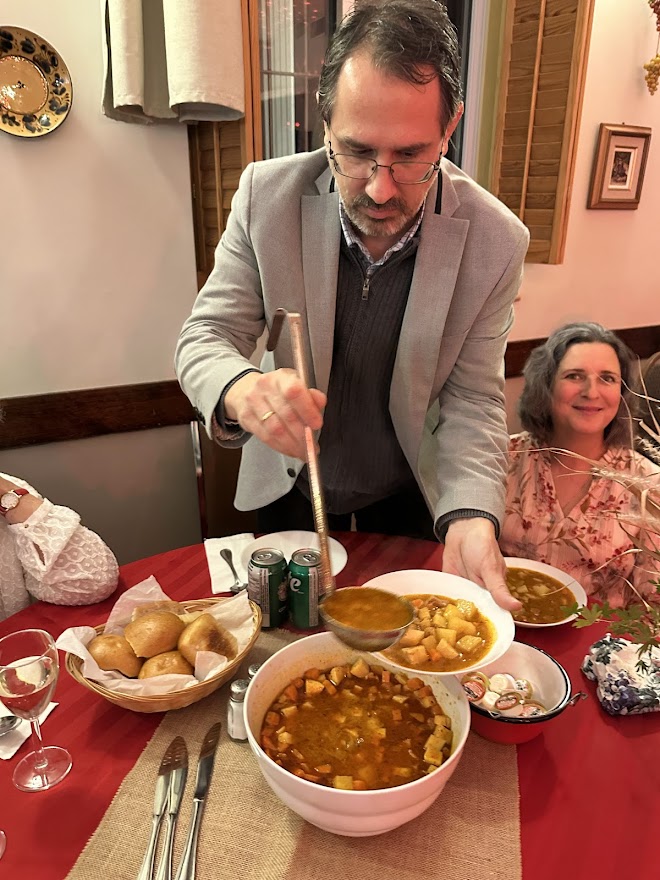
A huge bowl arrived at our table, filled with porkolt (pork stew). Although there were only four of us, the bowl could have served twice as many people. We served ourselves in family style. I enjoyed the porkolt, which was liquid and felt more like soup than stew. After tasting the porkolt, Zoltan’s wife thought that no real Hungarian paprika was used and that the porkolt could have been spicier. I agreed, but I enjoyed it with chunks of pork, carrots, and potatoes.

Oue Hungarian table companion serving “porkolt” family style

A couple of violinists and a bassist started playing Hungarian folk songs during the meal. The instruments reminded me of the music of Django Reinhardt – gypsy music with a swing – but these musicians played chardas, for Hungarian folk dance. People got up to dance, and soon the dance floor was packed. By now, the community hall had become extremely noisy, with over a hundred people talking, and dancing to the music. It was hard to speak and listen to our table companions.

As I have recently joined the Ottawa Hungarian House, I did not know anyone there. I have never been ethnically oriented. When we came to Canada, we were the type of immigrants who wanted to amalgamate into Canadian society. We did not live the life of the old country. And I married an American girl I met in graduate school at the University of North Carolina. We always spoke English at home, and the children grew up as native Canadians. I came to this event to hear some Hungarian spoken; I may be getting sentimental.

However, I knew some people from my high school in Hungary who studied with me at the University of British Columbia in Vancouver. I heard they came to Ottawa and approached the bartender if he knew any of my old friends, the twins Kalman and Peter Roller.  

He said, “Of course, Pista Roller is sitting back there,” and he took me to him, who was not Kalman or Peter but looked like their spitting image. Pista told me there were four brothers in the family. I was shocked to hear that the twins were dead: one had brain cancer and the other dementia. One was a pharmacist doing research in China and the other worked for the National Institutes of Health in Washington, DC. I wanted to follow up on this information and asked for his phone number to arrange for a get together.

Dessert came when I got back to my table. It was a caramelized pastry in the shape of a tube, four inches in diameter, and eight inches tall. I looked inside, thinking that there was some cream or fruit there. No, there was nothing inside; you ate the tube. The Hungarian couple explained that you tear a piece off with your hand, eat it, then keep tearing it apart and eating it. It is called kurtoskalach (chimney cake) and is a popular Hungarian dessert.

Chimney cake

It was an enjoyable evening of contrasts, combining ethnic foods, music, and dancing with people reading their iPhones and speaking English. The evening brought up memories. I described to our tablemates how we escaped from Hungary during the Hungarian Uprising of 1956. Our table companions who came to Canada two years ago acted like Canadians their age. And the Hungarians who came out decades ago enjoyed reliving the music and food of the time they left Hungary.

Reflections on the 1956 Hungarian Uprising Remembrance

October 28, 2025

This week, I attended a flag-raising ceremony commemorating the sixty-ninth anniversary of the Hungarian uprising of October 23, 1956, at Ottawa City Hall. I looked forward to meeting some grey-haired Hungarian refugees, with whom I could make contact, talk about the old country, and share our experiences in Canada.

About fifty people showed up for the ceremony. I did hear a few people speaking Hungarian, chatting in small groups. They seemed happy to talk with each other. I went by myself, looking for some social interaction and discussion. Still, nobody seemed interested in making contact, even though I walked around and tried to break into conversations.  

When I found a young fellow standing by himself, I asked him if he was Hungarian. To my surprise, he said he was an RCMP officer. I wondered if he was on an assignment to ensure security at the event, requested because staff from the Hungarian Embassy and other diplomats were in attendance. the event organizers.

Another person I approached was a black woman who, with a friendly smile, explained  with a friendly smile that she was with the Nigerian Embassy and had been invited to this event. I found myself confused; while I understood the logic behind inviting certain European nations, I questioned the inclusion of African countries. Nevertheless, she was charming, and we talked about Africa and my trip to Tanzania.  

Although the flag-raising was outside, due to inclement weather, the group moved to City Hall first to listen to the speeches by the dignitaries. The small conference room inside was insufficient to seat everyone, so I stood in the hallway listening to the speakers.

The Deputy Mayor, Sean Devine, who, by the way, is my local City Councilor, opened the ceremony. He paid tribute to the courageous Hungarians who perished during the 1956 uprising and commented on the contributions the refugees made to Canada. Although Sean did not mention it, well-known people such as Anna Porter, a writer and publisher, and Robert Lantos, a film director, were fifty-sixers, among others.

Ms. Katalin Haas, Charge d’Affaires at the Hungarian Embassy, spoke about the significance of the 1956 rebellion and invited representatives of the Canada-Hungary Parliamentary Friendship Group and a representative of Global Affairs Canada to speak.

Many speakers mentioned the 38,000 people who arrived in Canada after the uprising looking for freedom and dignity and the over 300,000 people of Hungarian descent now residing here. All the speakers emphasized the Hungarian people’s desire for freedom and dignity.  

Adam van Koeverdan, Co-Chair of the Canada-Hungary Friendship Group, spoke about his mother, who escaped Hungary during the uprising. That made me feel old. I was sixteen years old when I fled Hungary, and he was talking about his mother! Further indicating my age was a group of young people talking about being fourth-generation Hungarians. I felt ancient by that time.

The speeches were well delivered but seemed hollow to me, as the speakers lacked a fundamental understanding of the nature of life in Hungary in the 1950s that sparked the rebellion. None of the speakers had firsthand experience of life in Hungary at the time of the rebellion. The speakers’ comments were sincere but lacked the emotional gravity that people with direct experience could have brought.

For example, I remember when our neighbor in the apartment house where we lived disappeared one night, and nobody said anything about it. Nobody raised any questions. Or when my father, a medical doctor, was called many nights to patch up people caught trying to break through the Iron Curtain or swim across Lake Ferto. Or when my brother, a student in Budapest, walked home to Sopron, a distance of 200 kilometers, when the revolution broke out. During the uprising, the absence of cell phones or live communication made it difficult to receive updates from him for several days. This lack of information caused considerable concern among our family about his safety. The family feared the worst. After coming home from school one day, our mother told Peter and me to set off along the highway to Vienna, each of us carrying a sandwich in our backpacks, a memory that has stayed with me ever since.  

I thought that a few refugees talking about their escape, or a film showing the tanks in Budapet crawling with students during the uprising, would have been relevant and impactful. However, I recognise that the objective of the ceremony was to honour those who lost their lives, rather than revisit the events of the uprising. Those people attending who were old enough to witness the rebellion personally may not have felt completely satisfied. I wondered, how many of us oldtimers attended?

Immigrant Experiences: Inspiring Stories Amidst Challenges in Canada

Septermber 21, 2025

Many Canadians believe that the significant influx of immigrants in recent years has contributed to a shortage of housing units and overwhelmed healthcare services in the country. Since 2021, four million people have arrived in Canada, mostly temporary workers, students, but also refugees, economic migrants, and family members of Canadians.

I understand why many Canadians’ views on immigration have turned negative. However, I enjoy interacting with recent immigrants and discussing their reasons, as well as their plans, for coming to Canada. Let me provide some examples.

When I dropped my car off at the garage, a Lyft driver came to take me home. In a cheerful voice, he asked about my day and engaged me in a friendly conversation, inquiring about what I did. Listening to his accent, I asked him where he was from. He told me he came from Somalia eight years ago and now has a family with young children. His ambition is to establish a business here. He is the kind of person we need in Canada; in fact, all countries would benefit from having young and ambitious individuals like him.

When my car was ready, the garage sent another Lyft driver to pick up my car. Not surprisingly, he was also an immigrant, this time from Rwanda. He came to Canada a year ago and proudly drove a brand-new vehicle, which he mentioned he had bought for cash. He was able to do that by working seven days a week, an astounding achievement in my opinion.

I learned from the driver, Olivier, that he preferred Lyft over Uber, where he had previously worked. Although he had a French name, he did not speak French. He explained that Rwanda was a Belgian colony before gaining independence, which is why many people in the country have French names. After completing his university studies, he went to Belgium to pursue a master’s degree. He ended up staying in Europe for five years, living in England and later obtaining a second master’s degree in Poland. I was surprised to hear this and asked him if he spoke Polish. He clarified that the university program he attended was conducted in English.

From our conversation, Olivier appeared to be a loner, with only a high school friend in Ottawa. He confided in me that he is 33 years old, hopes to start a family, but working seven days a week leaves him little time for socializing and meeting potential partners. In addition to his driving job, he also works part-time at night for a Belgian company, another ambitious immigrant who would be welcomed in most countries.

I should also mention the young man from India who came to fertilize my lawn. He was busy working his Weedman route in the neighborhood but took a few minutes to chat with me when I asked how he liked his job. Although fertilizing keeps him occupied during the summer, he mentioned that he needs employment during the winter months. He plans to enter sales with the company, but he finds the challenge of sales to be significant, as he needs to make at least ten sales or identify leads each day. That’s not an easy task these days, especially when people tend to prefer a do-it-yourself approach.

Engaging in conversations with recent immigrants is both inspiring and motivating, and it has led me to reflect on the richness of the immigrant experience —a perspective I hold dear, having been an immigrant myself.

The sense of satisfaction that comes from adapting successfully to a new country is immense. During the phase of acculturation, individuals face challenges that feel overwhelming. I arrived in Canada with no language skills, no material possessions, and a total lack of knowledge of Canadian culture. To adapt to my new country, I grabbed any available jobs to improve my language skills, earn some money, and learn local customs.

In my first job, I carried furs at an auction for furriers, where they bid on various furs. A memorable moment arrived when the furriers tipped me, and I responded by telling them I only did my job and didn’t accept tips. This response earned me some strange looks. It didn’t take long for me to realize that tipping for good service is standard practice in North America, while it was nonexistent in communist countries like Hungary.

Other jobs followed. I washed dishes at a hospital and later traveled with a survey crew, doing machete work and drafting. On my last day with the survey crew, I overheard my team’s plan to pull down my pants and stick me in an anthill. Fortunately, I managed to escape before they could grab me; my language skills had improved to the extent that I could understand whispering.

To further improve my language skills, I accepted a job with a California company selling Collier’s encyclopedia. It involved knocking on doors and presenting the value of having the encyclopedia in the small towns around Vancouver, BC. I did not last long. I appreciated meeting those who welcomed me, but many older attendees, perhaps lonely, saw my presentation as an opportunity to socialize without planning to make a purchase.  

My early job experiences have significantly contributed to the development of my language skills and self-confidence over time, leading me to pursue a university education.

In summary, the sudden increase in immigration overwhelmed healthcare services and contributed to a housing shortage. And it made immigrants less welcome. But talking with recent immigrants is usually uplifting and inspiring. Before forming an opinion on the pros and cons of immigration, I strongly encourage you to engage in conversations with them.

Can New Housing Strategies Solve Canada’s Affordable Housing Shortage?

April 26, 2025

With the Canadian federal election only days away, all federal parties have offered plans to tackle the housing shortage and its impact on affordability.

High housing prices, expensive rents, and a shortage of homes are key issues, especially for first-time homebuyers. Unfortunately, there are no simple solutions. The proposals presented by party leaders comprise well-worn ideas that have been around for decades.

While one party wants to double the annual housing construction to 500,000 units, another proposes 3 million units over 5 years—an annual rate of 600,000. According to one study, Canada must construct three million housing units by 2030 to satisfy demand and lower prices. The housing industry has averaged only 250,000 units built annually in recent years.

Canadians’ income levels are tied to affordability. The average salary in Canada is $67,000, while the average home price is $670,000. Salaries can vary based on age, occupation, and other factors, and home prices vary across the country depending on location factors. Historically, housing was affordable when an individual’s income was one-third of the home’s price. Home ownership becomes unattainable for many people today when the home price reaches ten times their annual income.

Despite these challenges, the housing market continues to bubble because of two-income households and help from family members.

We can attribute the current housing crisis to the imbalance between supply and demand. Demand has surged because of a rise in immigration; the government has acknowledged this situation and has implemented measures to reduce the number of immigrants. However, the government has not addressed supply.

The major political parties propose a plethora of ideas to increase supply:

A proposal to establish a new government agency, “Build Canada Homes,” immediately caught my attention. Whoa! I remembered the Ministry of State for Urban Affairs, a government agency established years ago that ran into provincial jurisdiction and was abolished. I worked there and learned the hard way not to interfere with provincial matters. And how long would it take to create a new agency?

One party proposes rent control due to steeply escalating rents, averaging over $2,000. Policymakers in Europe and North America have long discussed and implemented this system. However, it has always resulted in a lack of maintenance and deteriorating buildings. Rent control does not increase the housing supply; it does the opposite, although it benefits long-term rentals. It also leads to “renovictions,” or forcible eviction of people for renovations and the subsequent legal rent increase.

Another proposal is to build “affordable” housing units for homeless individuals, students, low-income families, and indigenous people. When I asked my local councillor to define affordable housing, he could not provide one. Subsidies are necessary to encourage developers to construct units that are not based on market rates.

There are also suggestions for building prefabricated housing, which is less expensive than traditional methods but of lower quality.

Yet another idea is to train more people in the building trades. The shortage of skilled labor is one reason Canada builds only about 250,000 housing units yearly.

People blame the cost and duration of the regulatory process, zoning, and associated standards, such as the building code, for increased costs. There’s a convincing argument for reducing standards to lower expenses, but would Canadians go back to smaller bedrooms and less insulation?

While the proposed solutions have merit, a significant issue remains: Most of these pertain to provincial matters, including planning, zoning, rent control, and building codes, all of which fall under local jurisdictions. Local governments are also responsible for education and training, should a program for skilled trades be established.

Housing inventory can only increase through new land development and the densification of existing urban areas. Since local jurisdictions control these functions, the federal government has limited opportunities to expand the housing stock beyond providing financial resources and taxation strategies, such as reducing the GST for first-time homebuyers (proposals also exist to use vacant federal lands and buildings for “affordable” housing).

Besides the limited availability of land and skilled labor for house construction, the rising cost of materials presents a significant barrier to building affordable housing. This begs the question: Can the federal government regulate the price of construction materials?

Considering the housing problem more broadly revealed added complexities. For example, homelessness is often associated with mental health issues and substance abuse, leading to more complex problems that need specific solutions.

Another complicating factor is that, with low unemployment rates in Canada today, many young people may not see the need to train for skilled trades when they already have jobs. Governments should promote training in skilled trades such as carpentry and plumbing, which offer good pay. Employed people, however, might be reluctant to switch careers.

I’m wary of recycled housing solutions presented as novel ideas. The proposed ideas are not fresh: similar proposals have been made before, and I wonder why these proposals have not been implemented. I believe the emphasis should be on cooperative action at all levels of government and execution rather than just rhetoric.