The Book “Red Notice” by Bill Browder Brought up Memories

January 28, 2024

Published in 2015, Red Notice is a memoir spanning the period of Russia’s privatization of state assets during President Yeltsin’s time (1991 to 1999) and the rise of the oligarchs during President Putin’s time (from 2000). Browder noticed business opportunities spawned by privatization and took advantage of them but then ran afoul of the Russian political system, and the government deported him from Russia in 2005.

He returned home to London, but upon learning that his lawyer and friend Sergei Magnitsky died of a beating in Moscow on November 16, 2009, he became a human rights activist. The book describes his advocacy that resulted in the Magnitsky Act in the US, signed by President Obama in 2012.

Born into an intellectual and leftist Jewish family where science and mathematics were the only career choices, Bill rebelled and decided to become a capitalist.

Bill’s grandfather, Earl Browder, was a union organizer in the US. Russia invited him to live in Moscow, where he married and had three sons. When Earl came back to the US with his family, he became the head of the US Communist Party and ran for President in 1936 and 1940, becoming subject to the McCarthy witchhunts of real and perceived communists and jailed for sixteen months.

All of Earl’s sons became noted mathematicians in the US. Bill’s father, Felix, a child prodigy in maths, earned his Ph.D. from Princeton at age 20. He had trouble landing a job because of his father’s communist background. However, Eleanor Roosevelt, then Chair of the Board of Governors at Brandeis University, overruled the Board and hired Felix in 1955. Subsequently, Felix taught at the University of Chicago, Yale, and Princeton

Bill studied economics at the University of Chicago and earned an MBA from Stanford to pursue his career goals. The typical career ladder for MBAs led Bill to join investment banks, but he was not happy until he found an opportunity to go to Eastern Europe. He describes in his book that he longed for some experience that reminded him of his grandfather’s stay in Russia.

Bill describes in his book how the Yeltsin regime privatized state assets. Each Russian citizen received one share to buy any company’s share. Some people realized that accumulating shares cheaply was advantageous; most had no idea what the shares meant and sold them cheaply or for a drink.

Bill had the business training to value Russian companies, and by comparing them to similar companies in the West, he quickly realized that the Russian companies were way undervalued. And he thought he could make a fortune buying into the Russian oil and other companies.

But he needed money to invest, and the first part of the memoir describes his talent in raising capital by cold-calling, networking, and directly asking rich people to trust him to invest their money in Russia. The book reads like the who is who of people with millions of dollars in Europe, the Middle East, and the US.

Studying Russian companies, Bill discovered that the oligarchs, who controlled the enormous Russian companies with their accumulated shares, stole from their companies by splitting off parts of them and selling them to their friends and family at discounted prices. When President Putin came into power in 2000, he took advantage of Bill’s work exposing the corrupt oligarchs. Putin put some of them in jail – the prime example was Khodorkovsky of GasProm – and others agreed to Putin taking a portion of their profits to avoid prison. But when Putin took control of the oligarchs, he had no use for Bill anymore and kicked him out of Russia.

Bill moved back to London and published material on the corrupt business practices of the oligarchs, irritating Putin. In response to the bad publicity, the Russian police arrested Bill’s lawyer, Magnitsky, while other members of Bill’s Moscow staff escaped to London. Attempts to free Magnitsky failed despite newspaper articles and YouTube videos exposing the corruption in Russia. The bad publicity caused international condemnation, and Magnitsky’s jail conditions worsened, culminating in a deadly beating.

Learning of Magnitsky’s death, Bill had become depressed and swore revenge. Instead of focusing on his company, he spent most of this time trying to avenge his friend’s death. As a first step, he collected information on those who contributed to Magnitsky’s death.

Armed with this information, Bill lobbied Senators Durbin and McCain to sponsor a bill to sanction all those responsible for Magnitsky’s death. There is a detailed description of how Bill lobbied, working with the US government and Congress to advocate for the bill. The ultimate result was that Senators Durbin and McCain pushed the Magnitsky Act through Congress, subsequently signed by President Obama in 2012.

Browder has an eye for detail, and I found it fascinating to learn of the people Bill has known. For example, Bill worked with Crysthia Freeland in Moscow when she was the bureau head for the Financial Times. Freeland is the Deputy Prime Minister and Finance Minister in Canada today. He also talks about lunches in specific locations with dates. Maybe he journaled, or he has a fantastic memory.

The book reminded me of my early life living in Hungary under Russian rule in the 1950s. At that time, the state owned most of the property in Hungary, and there was no tax since the government employed all the people and provided all services. There was no private industry. And the secret police were all over. People disappeared overnight, and nobody asked any questions for fear of being the next one to disappear. The socialist system resulted in poverty, much like the situation Browder describes in Russia.

Further enhancing my interest in the book, Felix Browder, Bill’s father, was my brother Peter’s advisor at Yale University for his doctoral dissertation in mathematics in 1964.

The Advent Worship in Clemmons, North Carolina

December 4, 2022

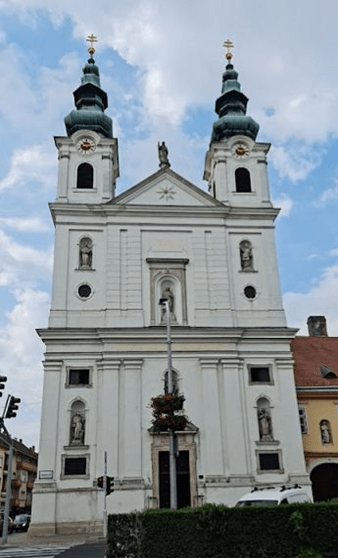
St. Judas Thaddeus Church in Sopron, Hungary

I have never been a church-going person except in my youth when my father, who went to a Jesuit school, made us go to church on holy days like Xmas and Easter.

My memory of going to the old baroque church in Sopron, Hungary – St. Judas Thaddeus, built by the Dominicans in 1715 – is not pleasant (see picture on left). The huge nave of the church was a forbidding, gloomy space for a small kid. It was cold inside with a stone floor.

Nobody received us at the entrance lobby; nobody led us inside. I stood for the service at the back of the church, listening to the sermon; that gave me a quick getaway if I got too cold or bored by the service.

The sermon and the entire mass were in Latin, which I could not understand. (The Catholic Church required that Mass be carried out in Latin until the Second Vatican Council of 1962–1965, which permitted the use of the vernacular.)

And the priest dressed in ecclesiastical clothing for delivering the sermon, giving him – and it was always a “him” – a formal appearance, talking down to us from the pulpit ten feet above us.

And, of course, we had the confessionals in little cubicles on the side of the nave of the church, where it was dark and I had to kneel in front of a wire screen behind which was the priest listening to your sins which were related to disobeying your parents and swearing using religious imagery.

 The salvation for my “mortal” sins, prescribed by the priest, was always saying a prayer fifty times or more, depending on the gravity and length of the list of my sins. I always thought the confessional was a good bargain to repent your “mortal” sins; it never took longer than a half hour to get back on the good side of the Lord.

Once I repented my sins, I lined up for communion wafers, the “sacramental bread”, that tasted good. Then we were free to leave the church.

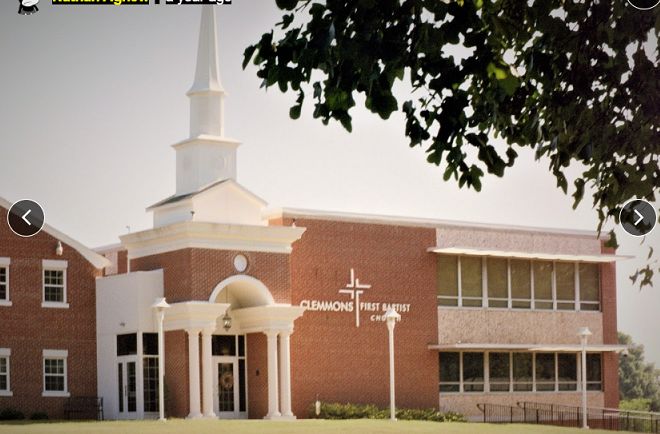
Clemmons First Baptist Church, Clemmons, North Carolina

I encountered a huge contrast to my experience with my baroque church when we visited our family at the end of November in Winston-Salem NC, and joined them for Sunday service at Clemmons First Baptist Church (see picture on left), on the last Sunday of the month, the beginning of Advent.

We entered the modern building with a red-brick façade, where smiling people welcomed us into the well-lighted and comfortable lobby and ushered us into the nave of the church to padded pews.

I felt like I was in a large living room entering the lobby and once we sat down, lively conversation filled the church until the service started. The Pastor welcomed the attending children, and the organist played hymns with the text shown on two gigantic video screens over the stage so that we did not have to pick up the hymn books to follow the songs.

All the people were informally dressed. The Pastor showed up in slacks and a sweater and gave a sermon from notes, speaking freely most of the time.

The Pastor addressed the meaning of Advent by asking us to look at our state in life to make sure we are ready for the second coming of Jesus. He illustrated his point by talking about himself getting old, although he said he is 44 years old; to me, he is a young man. But he said he feels his age when getting up “from a toilet seat”, eliciting laughter from the audience. He added that now one can install higher toilet seats to help with that. This type of informal sermonizing made me feel quite comfortable.

Then the Pastor, in a more serious vein, talked about embracing silence, meditation, and the healing power of nature. I felt quite at home by now: we just came from the New River National Park in West Virginia, where we spent a few days hiking and enjoying nature in silence.

He said there is no need to push yourself to get ready for the second coming by reading the scriptures. Instead, he said, wait until the desire to do so comes from within yourself. I liked his low-key approach to religion; embrace religion when you are ready for it. I was ready to join the church!

At the end of the worship, we followed the Pastor, who walked into the lobby to welcome the audience. I told him how much I enjoyed his sermon, shaking hands with him.

I noticed a board in the lobby with pictures of a dozen deacons (members of the church); I learned that all the families frequenting this church have a deacon who follows their well-being and provides help when needed. For example, should someone get sick and not be able to cook, the deacon would organize members of the church to bring over food. My brother-in-law is a deacon here. I thought the deacons performed an important and valuable role.

If we had had churches like the Clemmons First Baptist Church when I was growing up, I may have been a lifelong churchgoer.

Mixing of the Races?

August 17, 2022

Viktor Orban, the far-right Hungarian Prime Minister, said “We, Hungarians, are not a mixed race…and we do not want to become a mixed race”, in a speech in Romania, in July 2022. I thought his idea was pathetic nonsense. But wait. Let’s examine what his consequential statement means.

The Huns occupied Hungary over a thousand years ago. Since that time, and also because Hungary is the crossroads between Asia and the west, hordes from the east have invaded and trampled on its land many times. As well, the Germans and Russians occupied it recently. No question that intermarriage has happened, witnessed by the names in Hungary and words borrowed from the Turkish, French, German people, and others. Hungarian people today have a rich ancestry of people from many countries. There are Polish, German, and Hun names in my ancestry, among others, but we called ourselves Hungarian. So what does Orban talk about when he says that Hungarians are not a mixed race?

In the same speech, Orban also said “countries where European and non-Europeans mingle were no longer nations”. Aha! Now you say that Orban is OK with the mixing of European people but not others. Who could these others be? He meant African migrants who came to Europe over the past ten years. And, of course, Africans are Arabs and Blacks and many are Moslems. They have different skin colors and religions. He is against these people coming into Europe: there can be no other interpretation of his comments.

The reaction to his comments was swift both in Hungary and in Europe: he was called racist and his statement was out of the Nazi playbook on racial purity.

We can identify race as humans with similar and distinctive physical characteristics, such as skin color or hair texture. But race has no specific identifiers in the human genome. There is only one race: “homo sapiens”. Altho race is a social construct, it has developed connotations for social exclusion, discrimination, and violence towards certain social groups. We often express it in a social hierarchy with white-skinned people with privilege over darker-skinned people.

Unfortunately for Orban, the trend does not support his thesis: the trend is toward increasing interracial marriages. Partially, it is because of migration patterns, people move from Africa to northern locations. It is also because of increased educational levels; with higher education, there is less prejudice. Sometimes it results from the lack of available partners. For example, many men perish in wars, and the incarceration rate among blacks in the US is high.

In Canada, five percent of marriages were interracial, according to the 2011 census. The rate was ten percent in the city of Vancouver. In the US, over eight percent of marriages are interracial, while ten percent of marriages were interracial in 2015. In Honolulu, forty-two percent of marriages are interracial, while in Las Vegas it is thirty percent and in Santa Barbara, CA, it is thirty percent.

There are many people with mixed-race parentage. Just think of President Obama or our own Governor General Mary Simon. My older brother married a Chinese woman from Hong Kong. Peter and Angela had lived in Hong Kong and Toronto. The family accepted and got along well with Peter’s wife. I enjoyed the diversity Peter brought into the family. You may know some people, in your family or outside, who married someone of another race. So what the hell is Orban talking about? The future is already here; interracial marriage is now.