An Evening at the Harvest Ball: Food, Music, and Memories

November 13, 2025

The challenge was figuring out what to wear to the Harvest Ball. I thought I had a sports jacket, but it wasn’t in the closet; then I remembered I’d given it to the charity store years ago. I have collared shirts and some fancy T-shirts, but the only formal wear I have is a black suit I haven’t worn in decades, and I was not sure if it still fits. The question was: What do people wear to a Ball today?

The Ball, organized by the Ottawa Hungarian House, was held at the Hungarian community hall, an informal space in an industrial building. I decided the safest thing to wear was the formal suit. But I could take off the jacket in the beginning, and with no tie and an open shirt, I would match the space’s informality.

We arrived 30 minutes early: the dinner was at 6pm. The hall was almost empty except for the organizers. There were no seating arrangements, so we picked a table on the side, next to a well-dressed woman sitting alone at the table next to us. By way of introduction, she said she was Clara and that she and her husband had come from Hungary in 1967. She spoke in Hungarian. When I said that Kathy does not speak Hungarian, she asked if she spoke English or French. When we settled on English, she said that she and her husband started a fur-making business and moved to Baie-Comeau, Quebec, in the early seventies, where the demand for furs was strong. When the local mining industry died and demand for fur declined, they moved to Ottawa. They continued making furs in their basement factory.

I went to the bar to buy a couple of glasses of wine. When I returned, a  Hungarian couple sat down at our table. His name was Zoltan, and I remarked that it was a good Hungarian name. I did not catch the wife’s name; it was getting noisy. Nokia hired Zoltan when he finished university in Hungary. After a couple of decades, Nokia transferred him to Seattle for two years, and then to Ottawa. They have been in Ottawa for a couple of years and like it here.

Zoltan’s wife was talkative and said that life is much easier here with all the appliances available, than in Hungary. I gathered they would like to stay on after their four-year work visa expires.

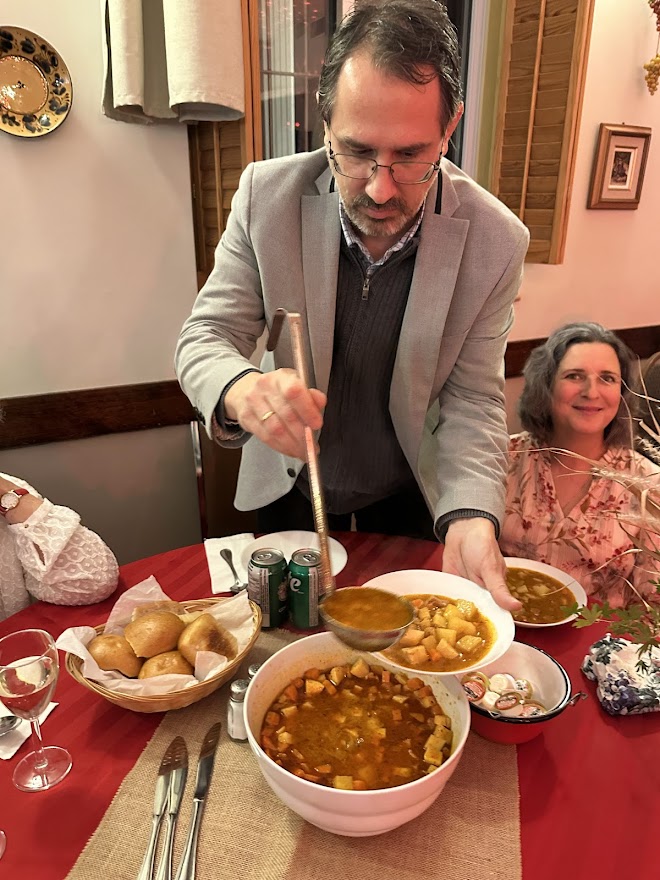
A huge bowl arrived at our table, filled with porkolt (pork stew). Although there were only four of us, the bowl could have served twice as many people. We served ourselves in family style. I enjoyed the porkolt, which was liquid and felt more like soup than stew. After tasting the porkolt, Zoltan’s wife thought that no real Hungarian paprika was used and that the porkolt could have been spicier. I agreed, but I enjoyed it with chunks of pork, carrots, and potatoes.

Oue Hungarian table companion serving “porkolt” family style

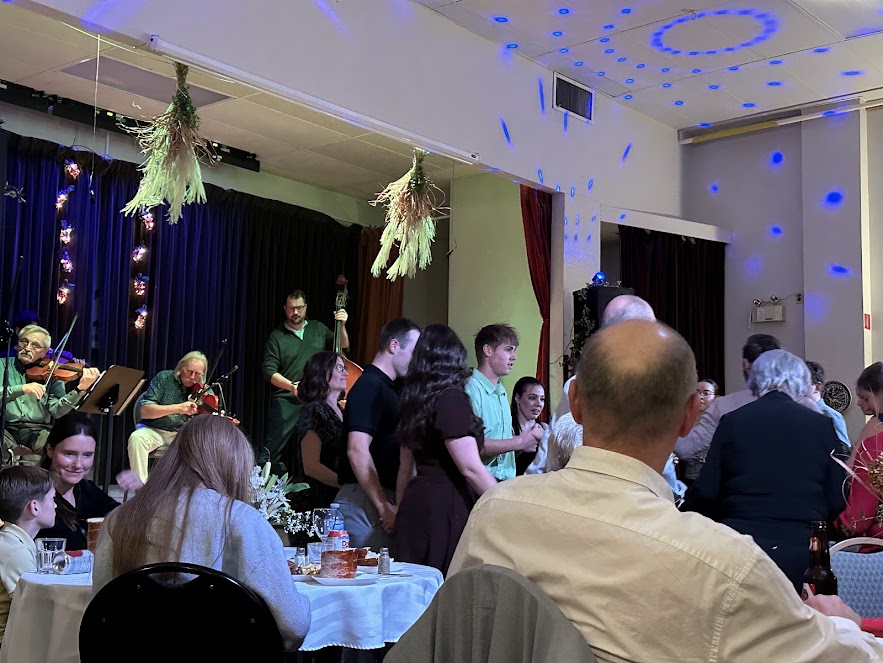
A couple of violinists and a bassist started playing Hungarian folk songs during the meal. The instruments reminded me of the music of Django Reinhardt – gypsy music with a swing – but these musicians played chardas, for Hungarian folk dance. People got up to dance, and soon the dance floor was packed. By now, the community hall had become extremely noisy, with over a hundred people talking, and dancing to the music. It was hard to speak and listen to our table companions.

As I have recently joined the Ottawa Hungarian House, I did not know anyone there. I have never been ethnically oriented. When we came to Canada, we were the type of immigrants who wanted to amalgamate into Canadian society. We did not live the life of the old country. And I married an American girl I met in graduate school at the University of North Carolina. We always spoke English at home, and the children grew up as native Canadians. I came to this event to hear some Hungarian spoken; I may be getting sentimental.

However, I knew some people from my high school in Hungary who studied with me at the University of British Columbia in Vancouver. I heard they came to Ottawa and approached the bartender if he knew any of my old friends, the twins Kalman and Peter Roller.  

He said, “Of course, Pista Roller is sitting back there,” and he took me to him, who was not Kalman or Peter but looked like their spitting image. Pista told me there were four brothers in the family. I was shocked to hear that the twins were dead: one had brain cancer and the other dementia. One was a pharmacist doing research in China and the other worked for the National Institutes of Health in Washington, DC. I wanted to follow up on this information and asked for his phone number to arrange for a get together.

Dessert came when I got back to my table. It was a caramelized pastry in the shape of a tube, four inches in diameter, and eight inches tall. I looked inside, thinking that there was some cream or fruit there. No, there was nothing inside; you ate the tube. The Hungarian couple explained that you tear a piece off with your hand, eat it, then keep tearing it apart and eating it. It is called kurtoskalach (chimney cake) and is a popular Hungarian dessert.

Chimney cake

It was an enjoyable evening of contrasts, combining ethnic foods, music, and dancing with people reading their iPhones and speaking English. The evening brought up memories. I described to our tablemates how we escaped from Hungary during the Hungarian Uprising of 1956. Our table companions who came to Canada two years ago acted like Canadians their age. And the Hungarians who came out decades ago enjoyed reliving the music and food of the time they left Hungary.

Reflections on the 1956 Hungarian Uprising Remembrance

October 28, 2025

This week, I attended a flag-raising ceremony commemorating the sixty-ninth anniversary of the Hungarian uprising of October 23, 1956, at Ottawa City Hall. I looked forward to meeting some grey-haired Hungarian refugees, with whom I could make contact, talk about the old country, and share our experiences in Canada.

About fifty people showed up for the ceremony. I did hear a few people speaking Hungarian, chatting in small groups. They seemed happy to talk with each other. I went by myself, looking for some social interaction and discussion. Still, nobody seemed interested in making contact, even though I walked around and tried to break into conversations.  

When I found a young fellow standing by himself, I asked him if he was Hungarian. To my surprise, he said he was an RCMP officer. I wondered if he was on an assignment to ensure security at the event, requested because staff from the Hungarian Embassy and other diplomats were in attendance. the event organizers.

Another person I approached was a black woman who, with a friendly smile, explained  with a friendly smile that she was with the Nigerian Embassy and had been invited to this event. I found myself confused; while I understood the logic behind inviting certain European nations, I questioned the inclusion of African countries. Nevertheless, she was charming, and we talked about Africa and my trip to Tanzania.  

Although the flag-raising was outside, due to inclement weather, the group moved to City Hall first to listen to the speeches by the dignitaries. The small conference room inside was insufficient to seat everyone, so I stood in the hallway listening to the speakers.

The Deputy Mayor, Sean Devine, who, by the way, is my local City Councilor, opened the ceremony. He paid tribute to the courageous Hungarians who perished during the 1956 uprising and commented on the contributions the refugees made to Canada. Although Sean did not mention it, well-known people such as Anna Porter, a writer and publisher, and Robert Lantos, a film director, were fifty-sixers, among others.

Ms. Katalin Haas, Charge d’Affaires at the Hungarian Embassy, spoke about the significance of the 1956 rebellion and invited representatives of the Canada-Hungary Parliamentary Friendship Group and a representative of Global Affairs Canada to speak.

Many speakers mentioned the 38,000 people who arrived in Canada after the uprising looking for freedom and dignity and the over 300,000 people of Hungarian descent now residing here. All the speakers emphasized the Hungarian people’s desire for freedom and dignity.  

Adam van Koeverdan, Co-Chair of the Canada-Hungary Friendship Group, spoke about his mother, who escaped Hungary during the uprising. That made me feel old. I was sixteen years old when I fled Hungary, and he was talking about his mother! Further indicating my age was a group of young people talking about being fourth-generation Hungarians. I felt ancient by that time.

The speeches were well delivered but seemed hollow to me, as the speakers lacked a fundamental understanding of the nature of life in Hungary in the 1950s that sparked the rebellion. None of the speakers had firsthand experience of life in Hungary at the time of the rebellion. The speakers’ comments were sincere but lacked the emotional gravity that people with direct experience could have brought.

For example, I remember when our neighbor in the apartment house where we lived disappeared one night, and nobody said anything about it. Nobody raised any questions. Or when my father, a medical doctor, was called many nights to patch up people caught trying to break through the Iron Curtain or swim across Lake Ferto. Or when my brother, a student in Budapest, walked home to Sopron, a distance of 200 kilometers, when the revolution broke out. During the uprising, the absence of cell phones or live communication made it difficult to receive updates from him for several days. This lack of information caused considerable concern among our family about his safety. The family feared the worst. After coming home from school one day, our mother told Peter and me to set off along the highway to Vienna, each of us carrying a sandwich in our backpacks, a memory that has stayed with me ever since.  

I thought that a few refugees talking about their escape, or a film showing the tanks in Budapet crawling with students during the uprising, would have been relevant and impactful. However, I recognise that the objective of the ceremony was to honour those who lost their lives, rather than revisit the events of the uprising. Those people attending who were old enough to witness the rebellion personally may not have felt completely satisfied. I wondered, how many of us oldtimers attended?

The Evolving Ethnic Character

November 5, 2024

During the late 1950s, I worked alongside Steve as a draftsman at the Buildings and Grounds Department of the University of British Columbia in Vancouver. Although we were recent Hungarian immigrants, we differed in our behavior in the office; he used to bring his breakfast to work unlike me, I ate at home. He spread some grease paper on his drafting table and ate his breakfast of smelly, garlicky sausage with a thick slice of brown bread. The powerful smell permeating the room bothered the rest of us working there, but nobody wanted to tell him to eat his breakfast at home and save us from the unpleasant smells. Eating a smelly breakfast at work was not Canadian, and still is not. I am not sure if that behavior was Hungarian. However, I heard Steve became a successful architect and integrated into Canadian society in a few years.

In contrast to Steve, some individuals never assimilate into the local culture and instead choose to return home. A Hungarian friend’s mother embraced women’s freedom in Canada and entered the workforce. Her husband was not as successful, and he felt he had lost his masculine dominance in the household, so he returned to Hungary, but the wife stayed in Canada with the children.

I do not know how others in Vancouver perceived my ethnicity when I arrived in Canada in the late 1950s, except that they noticed my English language skills and accent. I improved in record time and assimilated into local culture in many other ways.

One strategy I used was always to try to fit in and go with the flow; for example, I acquired a taste for beer when I drank with my classmates while finishing architectural projects at all-night sessions at the UBC School of Architecture.  I was not too fond of beer then, but drinking with my classmates led me to develop a taste for it.

Other opportunities for cultural assimilation arose when I attended concerts with Elvis Presley at the PNE and Dave Brubeck at the old Georgia Auditorium in Vancouver. Later on, I acquired a taste for rock music. My father could not understand why I listened to The Grateful Dead, The Bachman Turner Overdrive, Credence Clearwater Revival, and their ilk; he thought music was only classical.  

I further embraced local culture when we started camping and canoeing after marriage. Later, we traveled widely in a tent trailer across Canada with our children and a dog. After getting tired of hauling a tent trailer, we bought a cottage. And cottaging is a Canadian thing; only a couple of immigrants own cottages out of a hundred neighbors where our cottage is (I realize immigrants may not have the money for a cottage).

While I have been in North America since 1957 and consider myself part of North American culture, I am always intrigued when I hear Hungarian being spoken. My language abilities in Hungarian are equivalent to that of a sixteen-year-old, the age I was when I departed the country. While traveling in France last summer, I heard a group talking in Hungarian in Arles. I introduced myself to them, and we spoke about Hungary today compared to the one I left. I had to search for some words since my fluency in Hungarian was spotty, but it was a satisfying conversation.

A recent event drew me back to my ethnic background. Kathy met a Hungarian woman at a grocery store who recommended that we join the Hungarian Community Center in Ottawa.  I followed up and decided to attend a social event celebrating the anniversary of the Hungarian Revolution of 1956. I hoped to listen to conversations in Hungarian and perhaps meet some people from Sopron from where we fled, so I looked forward to the event. I was somewhat fearful of how I would react to my countrymen and whether I could intelligently converse with them, limited by my sparse vocabulary and lack of practice speaking the language.

Upon entering the building, nobody welcomed us. We found our way to take a couple of seats and looked around. All age groups were there, from children to grey hairs, and they all seemed to know each other. And I heard only Hungarian spoken. There was a celebratory feeling in the air; some people were informally dressed, while others wore pin-striped suits. Nobody showed interest in us.

The MC asked the Hungarian Ambassador to Canada to speak. She spoke in Hungarian, and I whispered to Kathy and explained what was happening.

Although we were in Canada, curiously, there was absolutely no French or English spoken, and there was no acknowledgment of land rights by the Indigenous people of Canada, a custom in all public events now. That made me think that the Hungarians have a thousand-year history occupying the land of Hungary. The Ottomans took over the land at one time and the Germans at another time, but there had never been an acknowledgment of previous land ownership and compensation for taking the land. To my knowledge, the concept of compensation to earlier landowners has no currency in Hungarian thought. That made me think of how people interpret history in different parts of the world.

After the Ambassador’s speech, we enjoyed some poetry and dancing by third-generation Candaian-Hungarians, indicating that some families kept their culture intact. When the Ambassador asked people who came to Canada after the 1956 Revolution to stand up, I counted half a dozen out of fifty, including myself. So, most of these people were second—and third-generation Hungarians who maintained their native culture.

One of the celebration’s highlights was serving “langos,” a Hungarian breakfast food similar to doughnuts, fried dough covered with cheese, cinnamon, and/or garlic. I lined up to get a couple of langos and limited by my language skills, I ended up with two plain ones. There is not much taste to plain ones, so I returned for another one with cheese and garlic to enhance its flavor. I put on too much garlic that burned our mouths, and we took it home, not wanting to throw it away in front of the Hungarian crowd, showing our dislike of it.

Frankly, the event disappointed me because nobody welcomed or showed interest in us while we sat in the audience. Of course, we could have approached people, but they all seemed either to know and talk with each other or to be occupied with moving chairs around and other official matters.

The people were not unfriendly; they seemed to accept and ignore us. For some reason, I felt quite at home, understanding the language, although Kathy felt ignored. I felt as if I was on an island with my old countrymen. When I lined up for our langos at the kitchen, I heard the women working there talking to each other; one kneading the dough and cutting portions to fry, another frying, and the third putting the cheese and/or cinnamon on and serving it. The entire atmosphere felt homey. Based on our strange experience with this celebration, we decided to try again and attend a party next week with dinner, a concert, and dancing. I hope we won’t. be disappointed.

The Flag Raising

October 25 2024

I had mixed feelings about going. It would evoke nostalgic memories—neither negative nor positive, just neutral emotions. I may meet people with my ethnic background. Ethnic individuals tend to display increasingly ethnic behavior as they age. I was not one of those people; I escaped Hungary because there was no future for me there, or at least, that is what my parents thought.

Upon learning about the flag-raising ceremony at Ottawa City Hall to commemorate the 68th anniversary of the Hungarian Revolution of 1956, I decided to go downtown and see what it was all about. Perhaps I’ll encounter elderly and weathered Hungarians, eavesdrop on Hungarian conversations, and cross paths with someone from Sopron, a small town close to the Austrian border where we lived and from where I walked to Vienna shortly after the October 23, 1956, Revolution.
At the base of a flagpole, I spotted the Hungarian flag and approached a clutch of people congregating. Speaking in English, I asked a bald and paunchy character if he was Hungarian. He said no, mentioning that he was part of a Member of Parliament’s staff from Wascana, Saskatchewan. He also informed me that the MP would speak briefly during the presentation. Ok. And then the Liberal MP from Wascana, seeing me talking to his staff, came over, shook hands, and explained that he was one-quarter Hungarian. I responded that I am 100 percent Hungarian. I inquired about his absence from the caucus meeting this morning, where numerous MPs were anticipated to call for the Prime Minister’s resignation as head of the Liberal Party. I cannot recall his answer, but he was a nice young fellow, and we exchanged a few words about the beauty of his province.

Turning around, a blonde woman in a business suit introduced herself as the Commercial Attaché for the Hungarian Embassy. We switched to speaking Hungarian, and suddenly, I noticed that all the people were well-dressed: the women wore business attire, and the men wore suits. I realized I was underdressed, I wore a red windbreaker, jeans, running shoes, and a baseball cap. If only I had shaved and dressed more formally this morning. Come to think of it, it is a major annual event to celebrate the Hungarian heroes who fought Russian tanks with handguns and risked their lives.

In just a few days and the weeks that followed the uprising in Budapest, the Russian tanks arrived and crushed the Revolution. Three thousand individuals perished, and 200,000 fled to foreign nations as refugees. Thirty-five thousand Hungarian refugees came to Canada after the Revolution.

We were greeted and addressed by the Deputy Mayor of Ottawa. As we sat down, I noticed at least fifty people had attended the event. I felt I was in a multicultural milieu already – Canadian and Hungarian –  especially after the Deputy Mayor started his speech by thanking the Anishinaabe people for using their unceded land, a standard introduction for public events in Canada recently. It is a small token for reconciling the injustices Canadians meted out to the Indigenous people in the past. I find this practice gratuitous, odious, and dishonest; I never heard that we Canadians would ever return the lands to the indigenous people. So, what is the purpose of this note of thanks? And, of course, it had nothing to do with the Hungarian Revolution half a world away, sixty-eight years ago.

The two MPs spoke next before the Hungarian Ambassador to Canada talked about the Revolution. She mentioned a few Hungarian Canadians who had become famous internationally, including Alanna Morrisette, whose grandfather came to Canada after the Revolution, and John Polanyi of the University of Toronto, a Nobel Prize winner who attended high school in Toronto in the early 1940s, when his parents sent him to Canada for safety during the rise of Nazi Germany.

The other curious thing was that the Ambassador spoke in English and French, Canada’s official languages, but not in Hungarian. I am sure there must be some protocol for speaking in public in Canada, but this was a Hungarian event celebrating a historical event, so I thought she could have given a trilingual presentation greeting us.

While listening to the anthems of Hungary and Canada, the Ambassador raised the flag, and that was it. I looked around for some kindred souls but saw mostly suited men and well-dressed women. If they were Hungarians, they were the second generation following the Revolution.  A clutch of embassy people spoke in Hungarian next to me when I noticed three scruffy looking, wizened old folks who turned out to be Hungarians. They all knew each other, and their facial expressions seemed to exude some impatience with all these well-dredded folks, all the officials present without direct experience of the Revolution.

The irony of this celebration did not escape me: Victor Orban, the current Prime Minister of Hungary, is friendly with Putin’s Russia, while here we are celebrating the freedom fight against the Russians sixty years ago.

I was in grade eleven in 1956, when the Uprising broke out. Our small town had no news except that trouble was brewing in Budapest. It was big trouble, it turned out, and my parents worried about my older brother Peter, a first-year medical student in Budapest. Not having cell phones, we had no news of Peter. It took three or four days, I cannot recall exactly, when Peter showed up at the apartment house where we lived, dirty and tired after walking from Budapest to Sopron, a distance of some two hundred kilometers (circa 120 miles).

As soon as Peter showed up, our mother prepared a couple of sandwiches and ordered us to walk to Vienna with the name of a Jesuit priest who had been a classmate of my uncle at the University of Vienna. We were obedient boys, and Peter and I started walking on the highway to Vienna, where we joined an exodus of wall-to-wall people escaping the country. It was a time when my brain did not seem to function with understanding; I felt like a robot, without thinking, a state of mind that saved my sanity. We had no idea where our journey would take us and what we would do when we arrived. So yes, the flag-raising event did stir up some memories, which had faded over time. The walk to Vienna was a significant event in my life and made me think about what could have happened if we had stayed back home in Hungary. I recall a film I saw once that tracked the lives of people who made a career decision and compared their lives to what could have happened if they had made another career decision. In real life, one cannot return and take another fork in the road. My immigrant story has been a challenging but highly satisfying experience. I would not have missed it if I had a choice.

The Men’s Book Club

March 19, 2024

One suggested forming a book club at our monthly luncheon of retired friends. It could have been the spicy food at the Indian restaurant that triggered our brain cells to ponder that our wives belong to book clubs while we do not. We discussed that women have many social networks while men do not. Some argued that men traditionally went to work while women raised children at home, needing social networks to survive, indicating our age more than the current reality. Be it as it may, we decided to form a book club.

We did a quick internet survey on where and when we would meet. The majority agreed to meet at lunchtime; we do not want to compete with rush hour traffic. The options considered for a meeting place were a restaurant that would cost money and force us to share space with loud customers. Or a coffee house like Starbucks, where we may not be welcome to occupy many chairs for hours while buying a single cup of coffee.

As a result, we chose to meet at someone’s house who would also provide a light lunch. Nine people showed up at the first meeting; the original lunch group expanded with friends we thought would be interested. We all proposed a book for our review and picked one for our first meeting. The one suggesting the book would moderate what we envisioned, a free-for-all discussion.

Although I joined the group, I had some misgivings about its future. Monthly meetings are good for socializing, but should we also be voracious readers? I used to read books in my youth and loved thrillers (Agatha Christie, Ken Follett, John Grisham) and westerns (Zane Grey, Louis L’amour, Charles May), but now I read primarily political news and no books. I gathered from talking with my friends that they are not bookworms except a couple who read a book weekly. But I thought, let’s give it a try.

Our recent meeting focused on John Le Carre’s book The Looking Glass War. It is a Cold War story, a spy novel set mainly in the United Kingdom during the 1960s.

Although the discussion flowed, people were cautious in expressing their views, perhaps because of their science, engineering, and finance backgrounds. Some thought the plot was complex without explaining why, while others believed there was too much detail describing a crystal radio with Morse code transmission. Someone else questioned why the author did not conclude the situation, leaving the readers to figure out what happened. Still others characterized the book as British history. With no explanation, someone said he did not like the book. We did not pursue any of these comments; perhaps the group must jell to be mature enough to dive into more detailed discussions without antagonizing each other.

I told them I enjoyed how the first chapter got my attention and hooked me into reading the book in one sitting. And how the plot builds up into a crescendo of excitement towards the end, the chapters becoming shorter and shorter as the actions become more and more dangerous.

Placing an English agent over the Iron Curtain in East Germany is vital to the plot. I thought of my experience with the Cold War, living in Hungary then, and the Iron Curtain’s impact on me. Living near the Iron Curtain, I knew it was a no man’s land, cleared of vegetation and mined, with dogs roaming between the two electrified fences patrolled by soldiers and lighted at night by watchtowers. As a medical doctor, my father patched up many people trying to escape across the Iron Curtain, caught by the dogs, the soldiers, or the electrified wire fence trying to escape using wire-cutters.

Reading about the crystal radio set reminded me of my childhood experience building one. I remember the excitement I felt getting radio signals from the West on my crystal radio; in Hungary, the only reception one had was Hungarian propaganda broadcast on the “people’s” radio with one channel during the Cold War.

After the meeting, I wondered: Did I enjoy the book more than the others? Was it perhaps my experiences that connected in many ways with the story while the others had no similar experiences? That thought made me think that knowing the context of a story makes one more knowledgeable and appreciative of a story than others with no such experiences.

I look forward to our next meeting to see if my theory holds.