It was not on our bucket list. We had never thought of visiting it before; in fact, I knew of it by name only. What happened was that I looked for something to do in early December, and a Road Scholar trip fit the bill. So, why did I search for an activity in early December? Let me explain.
In July, we reserved a B&B for a family get-together in December, just before Christmas. Our children live in Durham and Charlotte, NC, and Baton Rouge, LA, and I tried to rent a place central to all three. Just north of Chattanooga, TN, I found a place large enough to accommodate all the family.
Then in November, we told our children we would attend Thanksgiving dinner, assuming one of them would organize it.
The availability of three weeks – the time between Thanksgiving and the family get-together – prompted me to look for something to do during that period; we had no desire to drive from Ottawa south twice, a distance of a thousand miles each way.
I remembered my son’s mother-in-law enjoyed Road Scholar trips and looked up what trips were available in early December. A yoga class in North Carolina sounded interesting, but it was fully booked. Sightseeing trips to New York City and St Augustine did not appeal to us, but a kayaking trip in the Everglades did.
One concern was that the Everglades are another thousand miles further from our children’s homes where we would have our Thanksgiving dinner. But it would take us to a warm place and include a physical activity, kayaking, that we are fond of.
Reviewing the kayaking program, I had another concern: Road Scholar rates this trip hard on a scale they use to alert people of the physical difficulty of their trips. They advise that to participate, one should be able to kayak for 6 miles and walk 2 miles a day. The walking component was not a concern, but paddling six miles was. On balance, we decided we could do it since we kayak every summer, often for hours. So, I reserved the last two spots available.
With Thanksgiving Day approaching, I learned that my older son, Tony, was renovating his kitchen and not ready to prepare for a family dinner, which he has done for many years. Daughter Megan decided to take a job in Williamsburg, VA, and planned her move from Baton Rouge in early December, clearly not ready for entertainment. And David’s children and wife planned to visit family in Beaufort, SC, for Thanksgiving. Well, that was that, and instead of traveling south, we stayed in Ottawa and celebrated US Thanksgiving at home. We left for Everglade City the following Monday, on December 1.
Upon reflection, if we had not planned to have Thanksgiving dinner with family, I would not have reserved the Road Scholar trip because we would have just travelled to Tennessee for the family get-together. So, the real trigger to kayak in the Everglades was our intention to have Thanksgiving dinner with family. Funny how plans can have unintended consequences.
Dana Milbank’s recent Washington Post article about forest bathing caught my attention. Forest bathing is like a walk in the park, but with a focus on the forest’s sights, sounds, and smells. Forest bathing, a trend originating in Japan in the late 1800s known as shinrin-yoku, is spreading in the U.S. The Harvard Medical School even offers a course on it for its overworked residents, highlighting its significance.
Forest bathing involves taking a leisurely walk in a forest while disconnecting from digital devices and focusing on sensory experiences. It includes stopping to contemplate your surroundings and even taking off your shoes to feel the ground beneath you. Engaging in conversations with trees and plants is also part of the experience. The walk can last anywhere from an hour to a few hours, and the beneficial effects can last for days or weeks.
According to enthusiasts, the benefits include improving the immune system, lowering blood pressure, promoting relaxation, and enhancing sleep. Walking among trees allows you to breathe in tree oils known as phytoncides and plant compounds called terpenes. Studies suggest that these chemicals may help prevent cancer and protect against dementia. While I’m not entirely convinced of all the claims, this information has inspired me to give forest bathing a try.
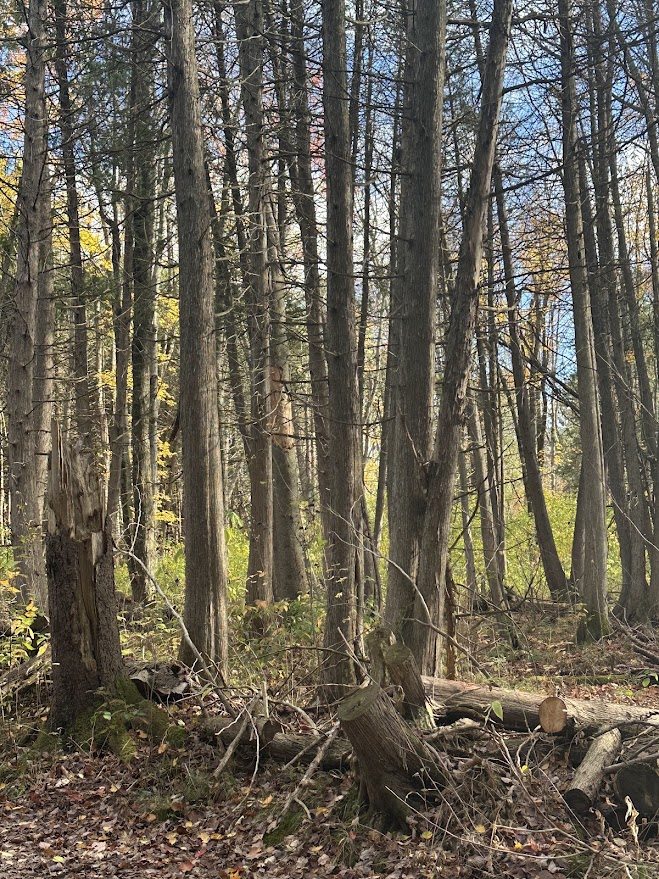
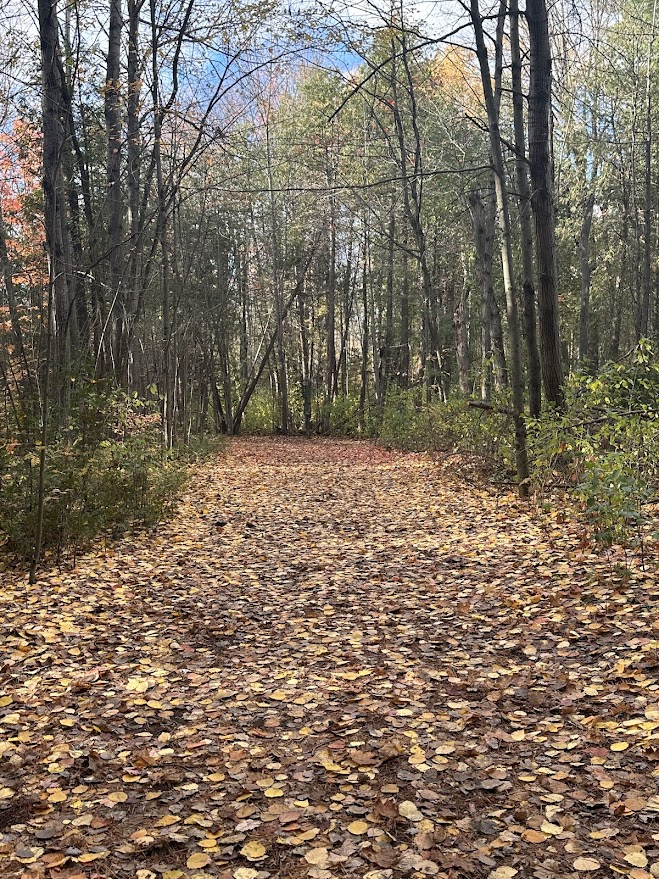
I visited the paths behind Ottawa’s Sportsplex. I strolled at a leisurely pace of three kilometers per hour (about two miles per hour), fully engaging my senses. I could hear airplanes flying overhead and the sounds of traffic from the major roads surrounding the park. The traffic noise was quite noticeable, especially since there were no leaves on the trees to act as a buffer. I did hear leaves falling, but I didn’t hear any birds singing; they must have flown south for the winter, as it is November.
As I looked around, I noticed the attractive tapestry of leaves on the ground. Many trees lay on the ground, some having fallen during windstorms and others cut down to clear pathways. Many fellow walkers, some with their dogs, greeted me and engaged in conversations.
The ground felt soft beneath my feet, and I could feel the wind gently brushing against my face. The bark of the trees felt cold to my touch. Apart from a few dogs licking my hands, I didn’t experience other tactile sensations.
I decided to slow down even more and took a break, sitting on a fallen log. I attempted to meditate but was unsuccessful: as people walked by, they would say hello, and I felt compelled to respond. I could use some guidance on how to engage more deeply with nature and avoid distractions to fully benefit from walking in the forest.
On the internet, I searched for “forest bathing near me.” I found a company advertising a forest bathing walk in Arnprior, a community sixty kilometers from my home, scheduled for next week. The registration cost was $40 for a three-hour guided walk, which was worth it. However, I couldn’t find an online registration page, so I emailed to request a spot.
A few days later, I received a response informing me that the guide was sick, and the walk had been canceled. Another company advertised various activities, such as dancing, meditation, and yoga, in addition to forest bathing. However, their leader was in India and, according to the website, was “locked up” in a happy state.
While browsing online, I came across the Arizona organization that certifies people as forest bathing guides. Lucky for me, they had a scheduled Zoom session just a few days later, so I quickly registered. However, I was disappointed when I listened to the meeting; it wasn’t what I had expected; it was a sales pitch for a course.
On the Zoom call, two forest bathing practitioners presented information about a training course for becoming a certified guide. One practitioner spoke from Boston, and the other from Portugal. The six-month online course is priced at over US$3,000, with an extra US$500 required for a one-week on-site training. Instead of a commercial for a training course, I had hoped for hands-on instruction on how to conduct a forest bathing walk.
I have always enjoyed the outdoors for many activities, including walking. With friends, we walked the Chilkoot Trail, the Camino Santiago, and other trails. Still, I was not aware of forest bathing at that time and paid less attention to sensory experiences. But walking in nature has some challenges. Let me give some examples.
While walking under the foliage of giant maple trees at our cottage a few years ago, I stumbled upon a ball made of leaves and small twigs on the ground. When I picked it up to examine it, an army of wasps came buzzing around my face. I quickly ran back to the cottage to escape them. Subsequently, I received shots for several years to immunize myself.
By some stroke of luck, I’ve attracted ticks at the cottage two years ago. I was treated for Lyme disease with doxycycline for four weeks. This year, I’ve become popular with ticks again and ended up contracting another illness spread by ticks, called anaplasmosis, which put me in a hospital for four days. Again, I was treated with doxycycline.
I’m not suggesting that the outdoors is so dangerous that it should be avoided, but that there are hazards to be aware of. Given the years I’ve spent hiking in the forest and enjoying the outdoors, these misadventures feel like brief moments. So, by all means, go into the forest and enjoy walking.
The literature I’ve read on forest bathing advises disconnecting from urban life, embracing the outdoors, and living in the present moment. The practice of forest bathing encourages slowing down—rather than walking briskly to reach a destination, meander and explore unknown paths, and discover nature through your senses. Although my experience indicates that, depending on the season, one should combine DEET bathing with forest bathing.
I found that forest bathing is more challenging in practice than it is in theory. Letting go of your thoughts on daily life can be difficult, as is avoiding distractions from others you may encounter, or pausing conversations with a companion, while walking. It’s best to go alone at times when there aren’t many dog walkers in the park.
We know our neighbors better on the island where our cottage is, than those where we live. I found that curious and made me think why.
Many people go to their summer homes to relax, to leave the city behind, and to be alone to regenerate their physical and mental health. I thought that cottagers prefer to be left alone. But I found the opposite to be the truth.
Before I go any further, I should explain how we arrived purchasing a cottage that may have relevance to my argument. We camped and tented for our vacations in the beginning until our one-year-old child woke up in an inch of water from a downpour one night. This prompted us to purchase a tent trailer, ensuring we would be above ground in case of a storm.
The tent trailer took us to Florida, the west coast (Vancouver), the east coast (Charlottetown) and many camp grounds in Ontario and New York State. The whole family enjoyed traveling and sightseeing with a tent trailer.
However, as the children grew up, summer camps, sports activities, and jobs made it inconvenient to travel with them, and we sold the tent trailer.
At the time I sold the tent trailer, a friend invited us to visit their cottage, and we canoed to their place on an islad. We had so much fun on the lake that day that we stayed overnight, and I decided I must have a cottage on this island. When I found a cottage for sale, I made a stink bid in the fall, a poor time to sell it. Since the couple owning the property was going through a divorce and the wife wanted her share of the money at once, they agreed to sell it. That property had good “bones”, or structure, but was unfinished and needed a lot of work.
The first task with our newly acquired property was to finish the ceiling with the tiles already stacked in the cottage. When mice dropped from the ceiling onto Kathy while she was sleeping in the bedroom, finishing the ceiling became the number one task. Other projects followed, like building steps going up the hill to the cottage, where there was a dirt path that was slippery when wet.
We also joined the local cottagers’ association, a common group in such communities. The primary function of these groups is to have an annual meeting with a BBQ event, providing the opportunity to meet others. At these AGMs, there are also talks about subjects of interest to all, like water filter systems, and how to avoid mosquitoes and ticks. Once the ice is broken, friendships form. A few years ago, there was an even bridge club on the island.
This weekend’s visit with a few neighbors shaped my views on our cottage community. The next-door neighbor from New Jersey invited us for dinner, and the discussion flowed easily despite our diverse backgrounds and lifestyles. We learned more about the neighbors’ families than we ever knew about our neighbors in town.
Our neighbors from Michigan invited us to their spacious deck that same weekend. During a discussion about where they met, we learned that the man’s Vietnam experience ended with an injury, resulting from a grenade blowing up next to him, with long-term consequences. This neighbor has done a lot of work on his cottage and has accumulated a wide range of construction equipment. I found one of his tools helpful, a heavy-duty jack that I borrowed to lift up my sinking dock.
We paid a visit to another old friend from Pennsylvania. His grandson was there keeping them company. During our visit, another neighbor dropped in and brought a bag of fresh samosas from Toronto. We all had one and admired the new ceiling completed in their large entertainment room.
Never to miss our Canadian friends from Ottawa, we walked over to their immense deck the next day, where they always relax with a book and a glass of wine in the afternoon.
Although socializing is fun, the weekend was also work; Kathy power washed the outside decks, which are substantial, about one thousand square feet, with a wraparound deck extending into steps leading to the waterfront. I used a weed-eater to clear the front and back yards. I shaved the grass to the ground to make sure no ticks would enjoy my yard, ticks thrive in tall grass, and I had some bad experiences with them just a few weeks ago.
Despite seeing these people only during the summer months, I found that we know more about them than we know about our city neighbors. It could be because in town, most people work. In cottage land, people take their time to hang out, relax, and enjoy seeing others doing the same. Vacationing is a good time to make friends, and cottaging offers such an opportunity.
Chapel Hill. The University of North Carolina. Ah! All the memories came rushing back as we drove around, parked the car, and walked along Franklin Street in Chapel Hill, North Carolina.
I recalled meeting the Dean of City Planning, who welcomed me upon my arrival. He greeted me warmly and instilled confidence in me that I could not fail here. After I met my future wife, we listened to Johnny Cash on the quad, frequented local pubs, and eventually got married!
We initially had a civil ceremony in South Carolina without informing our families; it was one of those spur-of-the-moment decisions. The experience of the civil process, alongside that of four other couples, felt rather mundane. Returning to Chapel Hill, my Peugeot 403 broke down on the road, and we had to hitchhike back.
Returning to our dorms after the ceremony was exhilarating. We had a piece of paper that officially declared us married, and we were embarking on a new life together, forever. I wondered if this was the same experience that pioneers felt when loading their wagons on the journey west.
At that moment, no one knew we were married—not even our school friends.
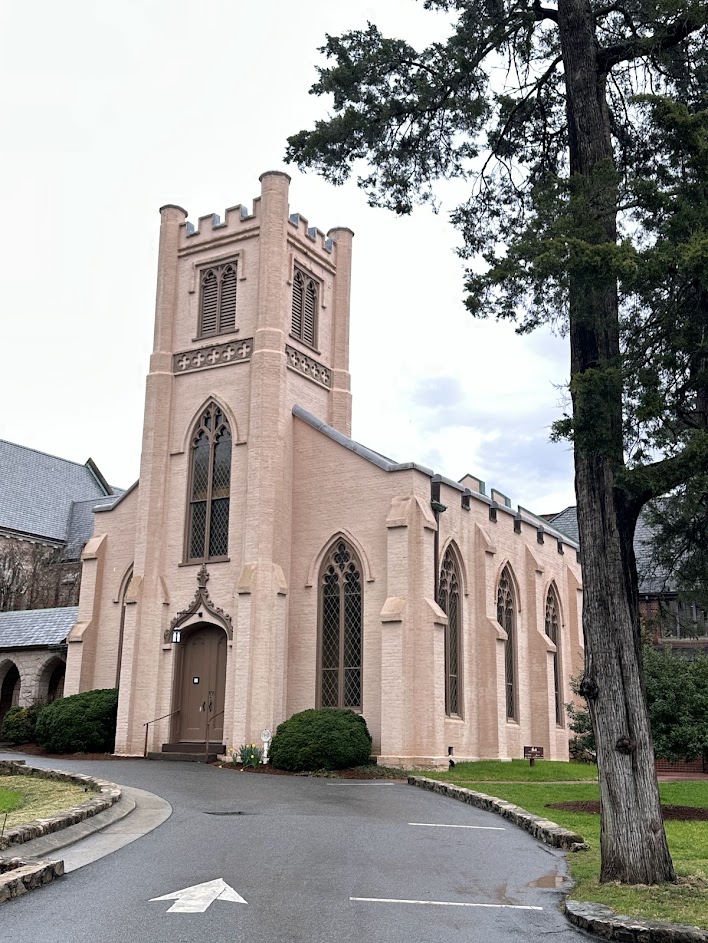
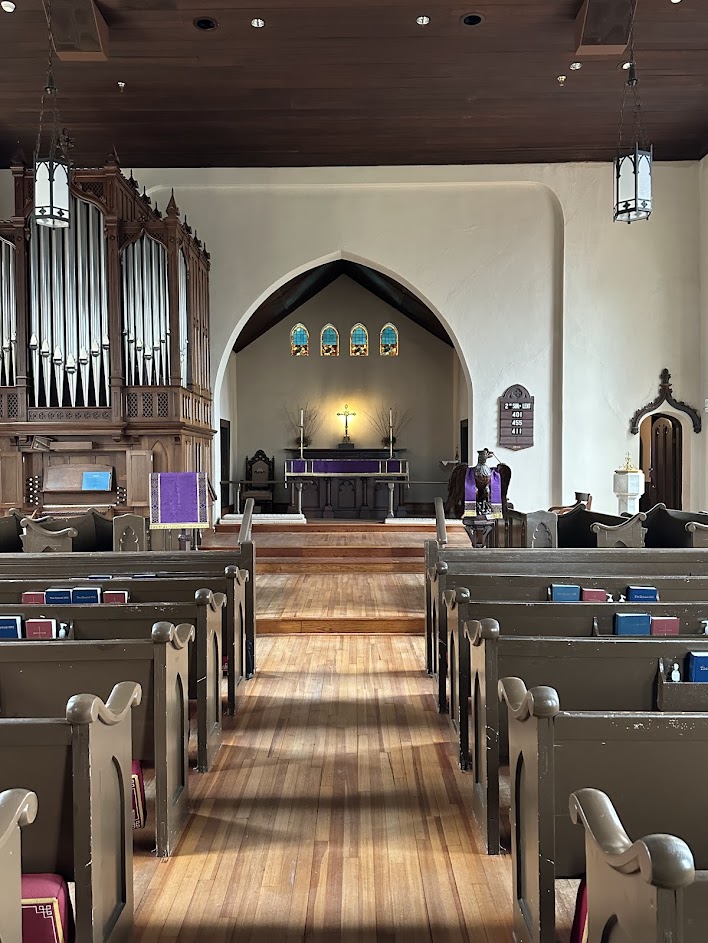
This exhilarating feeling lasted for a few weeks until we had our church wedding in the Episcopal Chapel of the Cross, which was attended by family and my classmates, with whom I had just graduated. In the lead-up to the wedding, the pastor asked us if our differing religious beliefs would ever cause friction between us. It seemed unlikely: I was a non-practicing Roman Catholic, while Kathy was Episcopalian. Having a church wedding was the traditional way to get married, which both our families accepted.
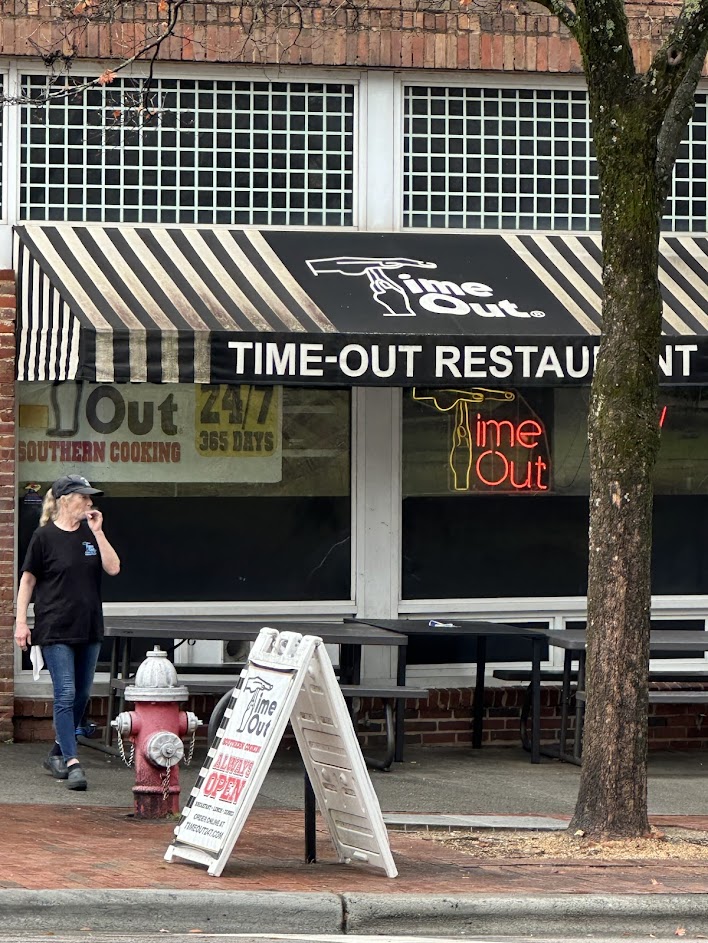
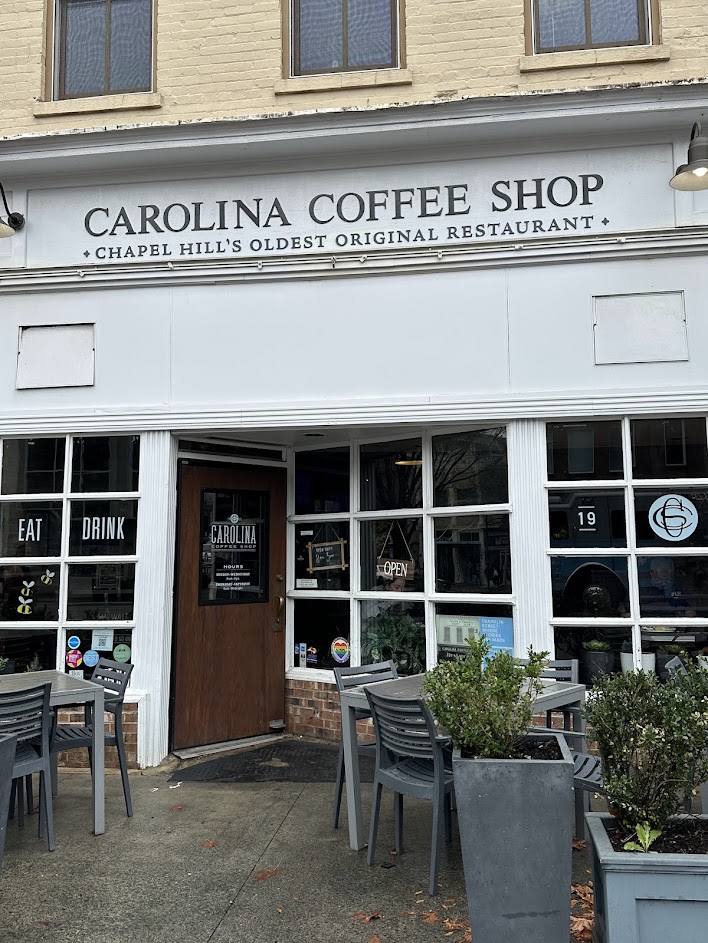
The memories bubbling up were from over fifty years ago. The Town of Chapel Hill has also aged. We walked along Franklin Street starting from Martin Luther King Jr. Boulevard. There were many more restaurants, coffee shops, and fraternity and sorority houses than we could recall from the past, in addition to newer tourist shops, vaping lounges, and art galleries.
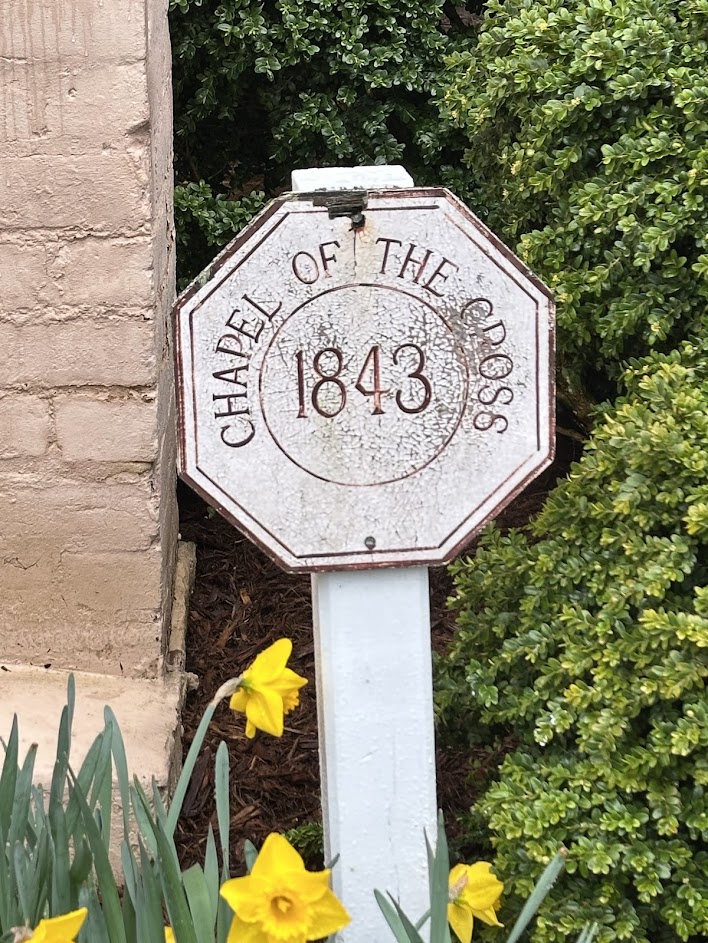
As we crossed Franklin Street, we approached the Chapel of the Cross, where we were married decades ago. I couldn’t remember much about the building except for the circular driveway in front. I remember it well because, after the ceremony, when we tried to drive away in Kathy’s car, my classmates had blocked our tires with rocks. I felt embarrassed as I heard all my friends laughing. I quickly exited the vehicle and moved the stones. However, a loud noise came from the wheels during my next attempt to speed off. I decided to ignore the noise as we drove away, stopping a few blocks later to empty the rocks from the hubcaps.
To my surprise, the Chapel did not evoke any strong emotions within me. I struggled to recall its architecture and viewed the Chapel as if I were seeing it for the first time. However, once we entered the building, the historical information provided in a brochure added to a cultural dimension that was entirely new to me and left a lasting impression.
Mary Ruffin Smith (1814-1885) was an early benefactor of the Chapel, constructed in 1843. Her father, a plantation owner, physician, and congressman, paid $450 for a mulatto slave, a fifteen-year-old girl, for Mary. One of Mary’s brothers took a fancy to the slave girl, Harriet, and stalked and sexually assaulted her. Mary’s other brother, Frank, took exception and pummeled Sidney, ordering him to stay away from Harriet. Sidney stayed away from Harriet after the incident, during which she gave birth to a girl, Cornelia. However, Frank fell in love with the girl and had three daughters with Harriet. Mary cared for Harriet and the four girls, bought them from the plantation, and took them to the Chapel of the Cross every Sunday. All the colored people sat on the balcony of the Chapel, not permitted to sit with the white folks. Mary had all four girls baptized at the Chapel, as well as Harriet.
The story continued with Pauli Murray (1910-1985), the granddaughter of Cornelia, the oldest of Harriet’s daughters. Murray was an author, activist, and writer. In 1938, she attempted to enroll at the University of North Carolina (UNC), but her admission was denied due to her race, despite her close relationship with her great-aunt Mary, who had donated a significant portion of her land to the university. Pauli Murray went on to become a lawyer and practice law. In 1977, she made history as the first African American woman to be ordained as an Episcopal priest in the United States. After her ordination, Rev. Pauli Murray took communion in the Chapel where her enslaved grandmother had been baptized.
This story left a significant impression on me. Perhaps it’s because topics like plantations, slavery, the significance of skin color, and religion are not part of my background. Instead, I could discuss the Iron Curtain, Communism, and the experiences of the Pioneers (the communist equivalent of the Boy Scouts), as I spent my youth in Hungary under Russian domination.
When we crossed the border to Canada from the United States, driving north on Interstate 81, I asked the Canadian border guard: “no ArriveCan?”. He just laughed and let us through with a quick look at our passports. A few months ago we had to fill out the ArriveCan forms to cross the border and even with a correctly filled out form, which was a challenge to do, it still took a substantial amount of time to get through. And we had to have proof of vaccination and a negative Covid test taken within a day of arriving in Canada.
We have traveled to the US five times in 2022 and this trip was our sixth, to visit family for Xmas.
We used the ArriveCan form until the Canadian Government abandoned its use, partially because of public opposition to its use, and partially because it was a bureaucratic nightmare to administer it. And the Government also ditched the required vaccinations, and a negative Covid test, reflecting the low rate of Covid infections. Both barriers disappeared by the second half of 2022.
But it was not the ArriveCan and Covid requirements that stuck in my mind as a significant feature of 2022; it was the freedom to travel and the ease with which we could travel in late 2022. Traveling gives you the freedom to see different venues, meet people and, of course, visit family.
When the barriers disappeared, we were free to travel again.
Why is travel such an important and motivating activity for me? I found that if you stay home and follow your daily routine; which includes taking the garbage out, paying bills, and shoveling snow, you lose the excitement of living. Of discovering new ideas, fresh places, and meeting people, which keep your mind alert and body in physical shape.
By March 2022, we got fed up with being isolated in Ottawa and decided on the spur of the moment to visit family in North Carolina. So, we packed a suitcase and drove south. We followed up with a trip to Baton Rouge, Louisiana, in May, where we attended our grandson’s high school graduation. It was a lively experience in the basketball arena at Louisiana State University, with hooting parents celebrating their children’s graduation.
In July, we took our granddaughter back home to Durham, North Carolina, after her soccer camp at the University of Ottawa. End of August we spent a week in Myrtle Beach, South Carolina. with my brother-in-law and his family. And, of course, we spent Thanksgiving and Xmas with family in North Carolina.
Our Honda CRV accumulated enormous mileage this year, compared to 2021, when we filled the car with gas maybe once every two months.
But our travel this year has been much more than seeing family; we did sightseeing and learned about the Moravians’ arrival in North Carolina. and their historical settlement in Salem; hiked in West Virginia. along abandoned rail lines that served coal mining and learned about mining history. Also enjoyed and walked in a gigantic park in Clemmons, North Carolina, donated to the community by the Reynolds family of tobacco fame. A highlight of one of our trips was attending a Baptist church service – a first for me – in Clemmons. I found these “discovery” trips and experiences stimulating compared to my usual routine at home, which includes taking the garbage out, paying bills, and shoveling snow.
No question in my mind that the trips and the ease with which we took these trips were the highlights of 2022 for me.

 andrasthehun.ca