September 30, 2025
These days, we are looking for flat biking routes and prefer to avoid steep, mountainous areas. The rail-to-trail paths are ideal for us, so we decided to cycle along the Petit Train du Nord linear park in Quebec, just north of Montreal.
The recommended ride is from the northern end of the trail at Mont Laurier to St. Jerome, just outside Montreal, because there is a slight slope in that direction. The distance is approximately 200 kilometers, and it can be covered in a few days.
Typically, the cyclist would drive to St. Jerome, leave the car there, and take a bus that goes once a day to transport them to the northern end. However, by the time I called, there was no room on the bus for the day we had planned to go. Instead, we reserved a room at a hotel along the trail, closer to the northern end, to avoid the busier section near Montreal, and planned to cycle in both directions.
That turn of events was fortuitous, as Kathy had pulled a leg muscle while working out at the gym, limiting her ability to cycle for longer distances. Staying at a hotel provided us the opportunity to take shorter rides with rest in between.
Our trip got off to a great start when we drove into Montebello on our way to the trail and discovered a chocolate factory. We couldn’t resist buying some chocolate bars and truffles, completely forgetting about the prices. For lunch, we chose a bistro—after all, it’s Quebec! The French onion soup we had there was delicious.
With tables arranged closely together and the bistro full, the noise level was high, making conversation difficult unless one spoke loudly. However, the proximity to other diners allowed us to engage with our neighbors, which we did. Surprisingly, we ended up discussing politics without any arguments, likely because we shared similar views.
We attempted to use our French, which was more than rusty. Since we rarely have the opportunity to speak French, we struggled to find the right words when communicating with the service people. But it is always satisfying to express oneself in another language when the locals understand you. My feeling was that the locals appreciated our efforts to communicate in French.
In contrast to the bistro, our dinner at the Club du Golf Nominingue hotel restaurant was a more formal affair. While it was also noisy, the dining room was spacious, with tables dressed in white tablecloths and with elegant wine glasses. The service was prompt and attentive to our questions. Although I didn’t find the menu particularly unique to Quebec cuisine, the presentation of the food we ordered was stunning. I felt compelled to take pictures of our plates, which resembled sculptures, even though the food itself was pretty ordinary.
For example, I ordered saucisse artisanale du Québec, which seemed to me to be regular hot dogs, split in two, served with vegetables, and accompanied by French fries, presented in a wire mesh dish. While I wouldn’t consider any of the ingredients unusual, the presentation was truly remarkable.
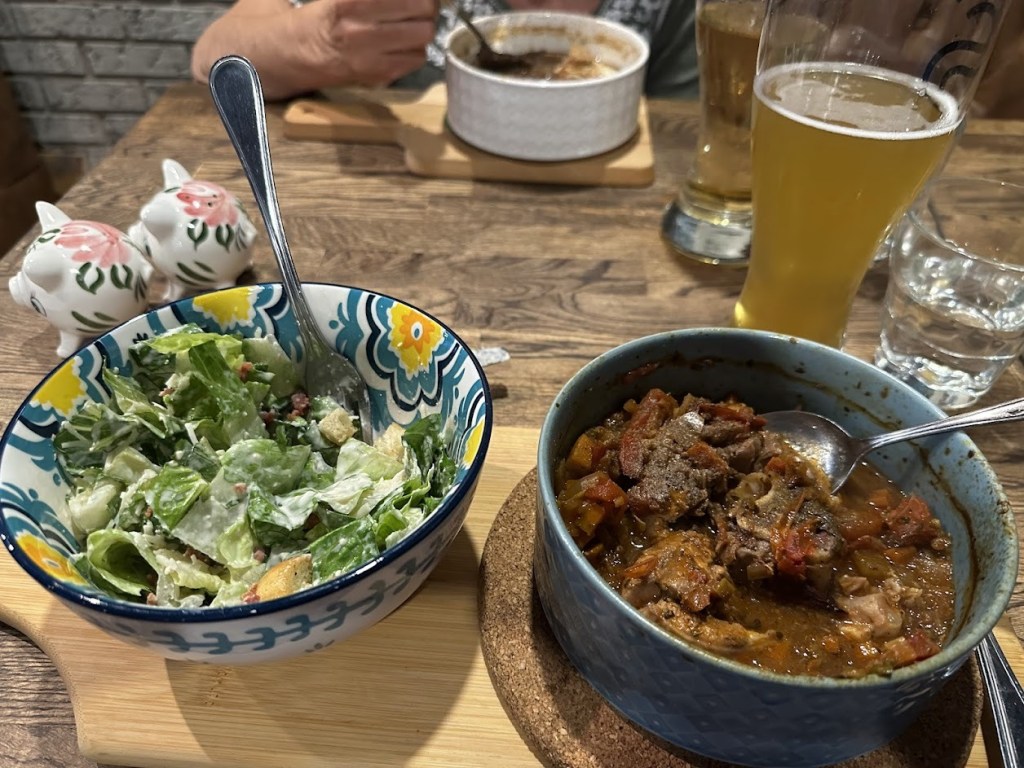
The next day, we discovered a local bistro that was a lot of fun. It was extremely noisy, with people yelling from the bar to the other side of the restaurant, conversing in French, of course. It seemed that all the locals gathered at the bistro in the evening. We enjoyed local beer and cider, and I ordered osso buco, which is pork hocks in English, and it was delicious. For dessert, we had mousse fromage érable, which was delightful.
With all the food we consumed, we needed to burn off some calories, so we rode the Petit Train du Nord with plenty of energy. Like many trails of this nature, there are long, straight sections that can feel relaxing at times, while at other moments, they may become a bit boring. However, the trail was flat, with a grade that never exceeded four percent.

I was surprised by the number of electric bikes we encountered. Although I knew these bikes were popular, I didn’t expect most of the cyclists we saw to be using them, especially since there was no need for supplemental power on such level terrain. It was also interesting to see how many people were dressed in heavy clothing; I wore just a T-shirt and shorts, while others wore winter jackets. I thought riding an electric bike at higher speeds could feel quite chilly.
Although the speed limit on the trail was 22 kilometers per hour, we maintained a leisurely pace of 10 to 15 kilometers per hour, taking breaks to admire the surrounding landscape.
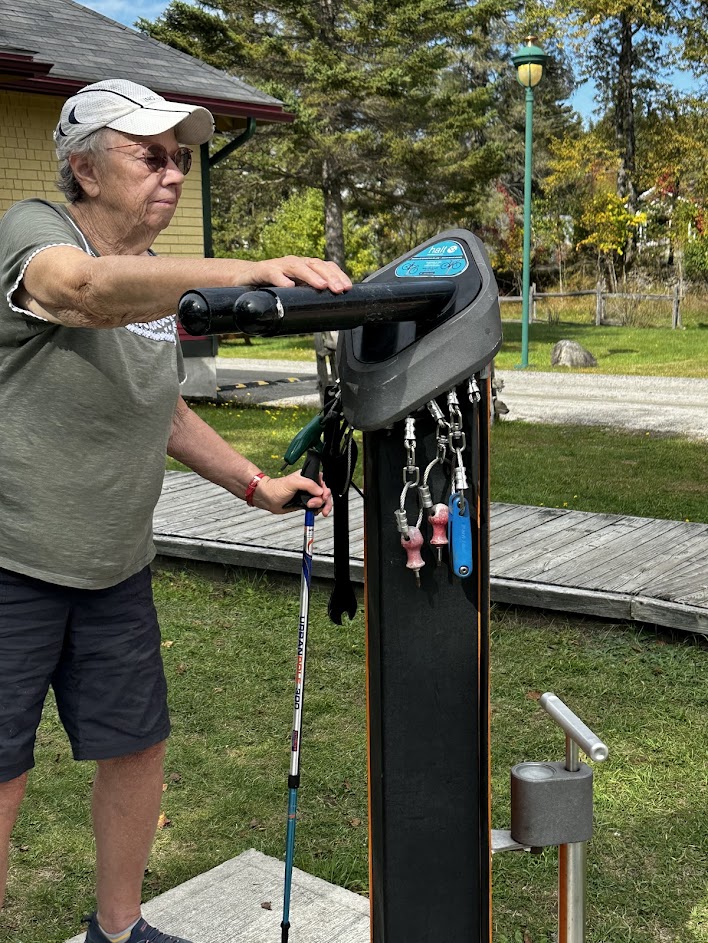
I have to commend the Quebec government for the development and excellent maintenance of this trail. It is entirely paved, and cracks in the pavement are clearly marked with yellow chalk. In areas with a buckling surface, a “danger” sign is placed to alert cyclists. More importantly, there are picnic tables, shelters, water fountains, and even bicycle maintenance pillars equipped with all the necessary tools. This is the most developed trail I have ever experienced. We have cycled on trails in Virginia (the Virginia Creeper), South Carolina (the Spanish Moss Trail), North Carolina (the Tobacco Trail), and many trails in Ontario.
The ambiance at the Le Club et Hotel de Golf Nominingeu, where we stayed, and on the trail, the Quebecois people, the food, and, not least, the cycling trail all contributed to a pleasurable trip. We absolutely have to return for another adventure. We thoroughly enjoyed interacting with the Quebecois people, who, without a doubt, tend to be more expressive, animated, and louder than their English counterparts. One of the highlights of our trip was the opportunity to improve our French language skills. The locals appreciated our efforts, even when our conversations switched to English.
 andrasthehun.ca