Exploring the Ismaili Imamat: A Cultural Landmark in Ottawa

June 13, 2025

The Canadian Headquarters of the Aga Khan, known as the Delegation of the Ismaili Imamat, is situated at 199 Sussex Drive in Ottawa. The Ottawa Imamat itself is a secular building. However, the Aga Khan serves as the spiritual and hereditary leader of the Nizari Ismaili branch of Shia Islam, tracing his ancestry back to Muhammad.

The Delegation of the Ismaili Imamat Building on Sussex Drive

The Aga Khan once noted that, in the West, religion is often viewed separately from social and economic initiatives. In contrast, the Ismaili tradition sees helping the poor and fostering connections between people and cultures as integral to the practice of religion.

Sussex Drive, often referred to as the “ceremonial route,” is also home to the embassies of Kuwait, Saudi Arabia, France, and Japan. The award-winning National Gallery, designed by Moshe Safdie, is located nearby, adjacent to the Canadian Mint and across from the Notre-Dame Cathedral Basilica. Additionally, the Prime Minister’s official residence is located at 24 Sussex Drive, which is currently awaiting renovations.

The arrival of the Ismailis in Canada goes back to Pierre Trudeau, a friend of the Aga Khan IV, invited the Ismaili community to Canada when Idi Amin expelled them from Uganda. Currently, approximately 2,000 Ismailis reside in Ottawa and around 80,000 across Canada, out of a global population of approximately fifteen million.

The architecture of the Imamat left a lasting impression on me during my visit. Designed by the Pritzker Prize-winning Japanese architect Fumihiko Maki, the project originated from a three-page letter from the Aga Khan, in which he requested Maki to design the building. He sought a design concept inspired by the visual qualities of rock crystal, emphasizing its transparency, translucency, and opacity.

Maki and his team carefully analyzed the letter to grasp the Aga Khan’s intentions fully. To gain further insight into the characteristics of a crystal, Maki even brought his wife’s diamond ring into the office to study its reflections from different angles. The Aga Khan’s request was for the building to be mysterious, esoteric, and intriguing, yet aesthetically pleasing, incorporating themes of Islamic architecture.

The Imamat features a large atrium crowned with a multi-faceted dome and includes a courtyard that contains an Islamic garden known as a Char Bagh. Additionally, the building provides office space for the staff of the Aga Khan Development Network (AKDN) and serves as a residence for the Aga Khan when he visits Ottawa.

The AKDN operates numerous educational, conservation, social, and economic programs in Africa and Asia, spending approximately one billion dollars annually. For instance, AKDN founded a university in Karachi, which initially focused on Islamic studies but has since expanded to include liberal arts education. Additionally, the organization has launched a microfinance program designed to support small businesses. This emphasis on helping the less fortunate aligns with the objectives of the Ismaili sect.

Related to the Aga Khan’s interest in architecture, he established a triennial architectural competition for works of Islamic design, including residential, religious, and conservation projects.
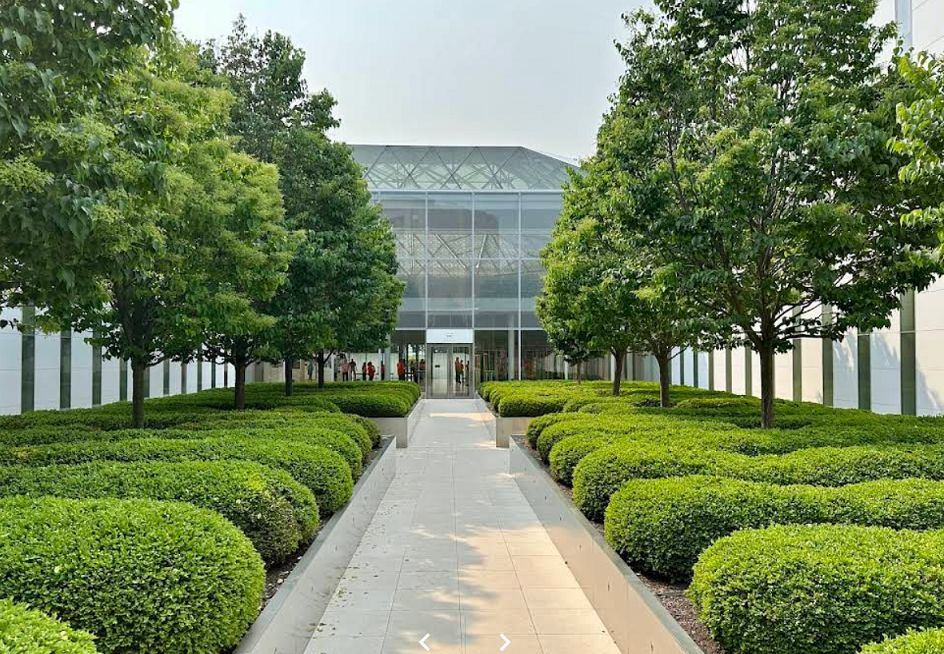
The Char Bagh

The purpose of the atrium is to host conferences, meetings, and study groups that focus on improving the condition of humankind worldwide. It features a patterned screen made of cast aluminum that reflects themes of Muslim architecture. The atrium’s floor is composed of maple wood tiles arranged in a seven-square pattern in both directions, with each square approximately ten feet by ten feet. This configuration results in a total of forty-nine squares, symbolizing that the current Aga Khan IV is the forty-ninth Imam of the Nizari Isma’ili sect. The use of mathematical concepts also serves as a symbol in Islamic architecture, reminiscent of the mathematical ratios seen in the gardens of the Taj Mahal.

The three-layered glass dome, composed of panels in various shapes, illuminates the atrium while diffusing direct light through a patterned layer of glass. The glass panels attach directly to the structural frame without the use of hardware. The design of the dome originated in Toronto, with the glass sourced from Austria, the structural steel from Poland, and the panels fabricated in Germany. The construction was completed in Canada. The multi-sourcing of the dome represents “pluralism,” a core principle of Ismaili Shia philosophy.

When I visited the Imamat, I felt relaxed as if I was at home. The parquet-like maple flooring created a warm ambiance, and the filtered lighting was visually soft. The hexagonal pattern of the cast aluminum screens hanging around the walls added a sense of enclosure and intimacy. People were seated around the perimeter of the atrium on large, comfortable couches, enjoying the peaceful atmosphere.

The acoustics in the atrium were excellent, even with many people conversing. The wood floor, screen wall, and triple glass ceiling effectively absorbed sound. The gentle buzz of conversation in this relaxing environment was pleasant, leading me to reflect on the life of Aga Khan IV, who passed away in February 2025.

I learned from the tour guides on the floor that he was born in Switzerland and held citizenship in that country, as well as in the UK, France, and Portugal. He was also an honorary citizen of Canada. In his youth, he was part of the Iranian Olympic skiing team and later earned a degree in Islamic studies from Harvard University. Throughout his life, he became a prominent horse breeder and achieved significant success in business, with his estimated wealth reaching around $12 billion as of 2024.

If you find yourself in Ottawa, I recommend visiting the Imamat not only to appreciate its stunning architecture but also to gain intellectual insight by learning more about the Ismaili community.
Exploring Point Grey Road: Vancouver’s Luxurious Real Estate

June 2, 2025

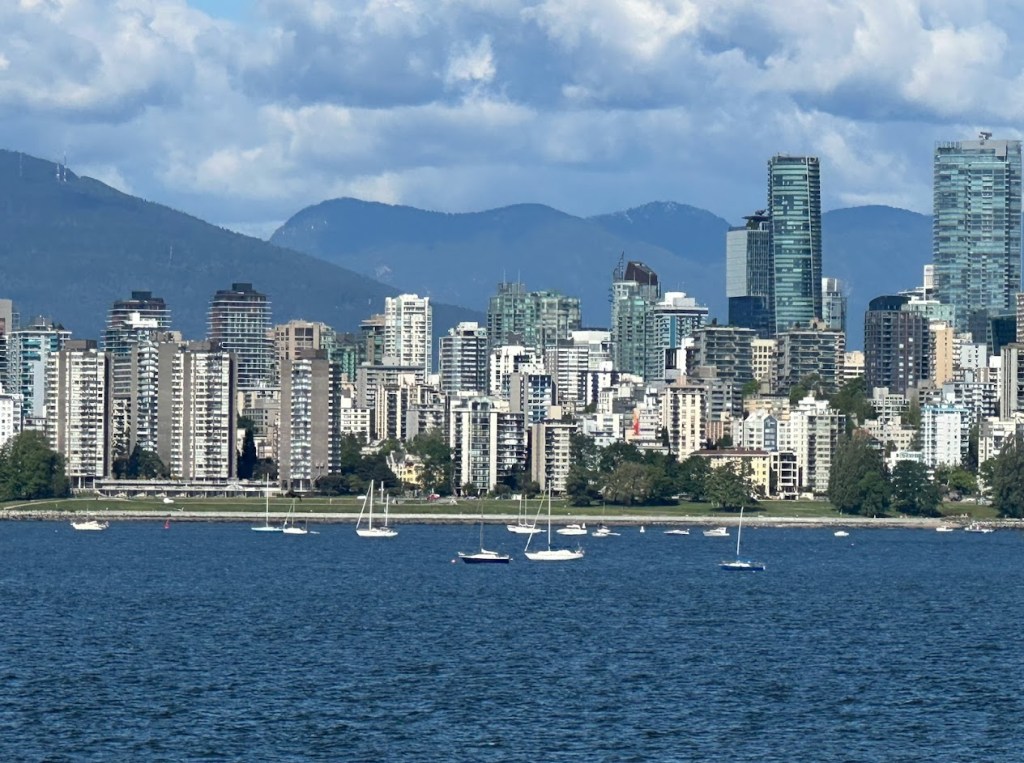
Montreal has Westmount, Toronto has Rosedale, Ottawa has Rockcliffe Village, and Vancouver has Point Grey Road. The north side of Point Grey Road features elegant, architecturally designed residences. This location is attractive due to its expansive ocean views, framed by mountains in the background and Stanley Park across English Bay, highlighting the Vancouver skyline to the east.

Talk about privacy from the road!

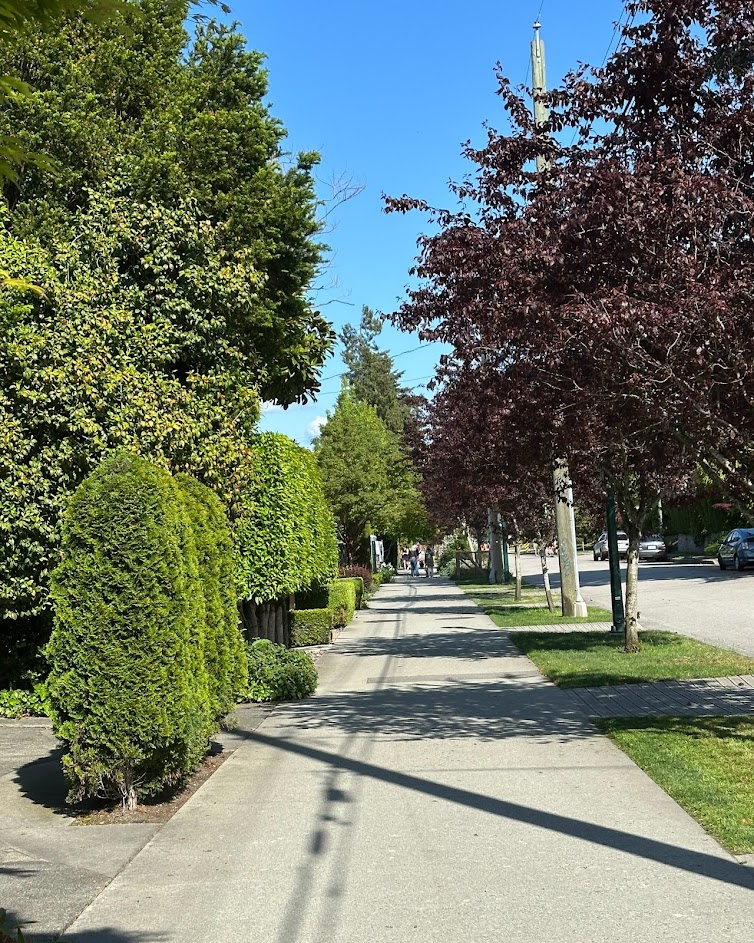
We walked from my brother’s place in Kitsilano to Point Grey Road to explore the area, where the sidewalks were wide, complemented by attractive street furniture, including benches, light posts, and trash cans. The roadway was also spacious, reserved for walkers, joggers, and commuting cyclists traveling from downtown to the University of British Columbia.

   Point Grey Road sidewalk

I understand that Mike Harcourt, a former mayor of Vancouver, envisioned creating a continuous park on the north side of the street. To achieve this, he purchased available residences. He transformed them into parks that front Point Grey Road, extending to the shoreline to provide stunning views of the ocean and the Vancouver skyline. However, homeowners living along Point Grey Road opposed this initiative, and with rising real estate prices, the project ultimately came to a halt.

View from mini-park, the Vancouver skyline

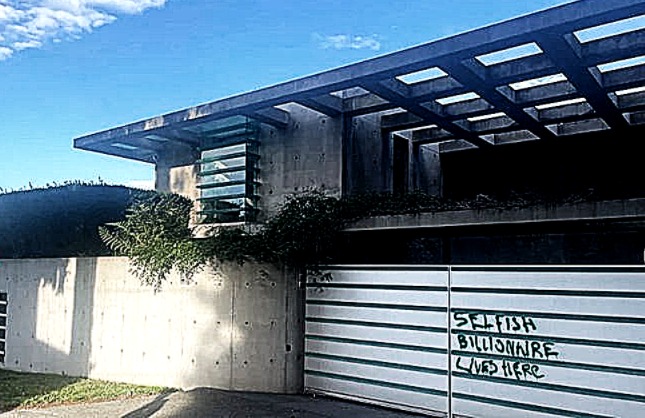
A stroll along the upscale residences made me wonder who owns these homes. I found some online. One notable resident is Chip Wilson, the founder of Lululemon, a popular athleisure clothing brand. His property was valued at over $82 million in 2024, making it one of the most expensive real estate holdings in Canada. While Wilson has gained significant wealth from his clothing line, he has also stirred controversy with some of his comments.

      Chip Wilson’s place, totally private from the road

He faced accusations of racism for the name “Lululemon,” which features three “l’s.” He said he chose this name because he found it amusing to consider how Japanese people would pronounce it, given that there is no “l” in the Japanese alphabet.

Additionally, he was criticized for being “fatphobic” after suggesting that not all women are suited for his designs. He pointed out that women who do not have a gap between their thighs could cause the fabric to become sheer or translucent, leading to backlash for implying that those women were overweight.

People have also slammed him for stating that he has no issue with children working. He mentioned that his children have worked for his company and argued that there is nothing wrong with this. He was specifically referring to Asia, where much of his clothing line is produced by child labor.

His comment reminded me of children we saw in Myanmar, rolling cigarettes, sitting on the floor with inadequate lighting. When I inquired about why children work, I learned that many would starve without their jobs and that, for some, working is preferable to having nothing to do, especially when they are not attending school.

      An architectural home

Dr. David Suzuki is another fascinating figure who lives on Point Grey Road. He had a long-running, popular show on CBC called “The Nature of Things.” As an environmentalist, he advocates for living in harmony with nature. However, I find it hard to reconcile the idea of living in harmony with nature while owning a multimillion-dollar house on Point Grey Road, especially considering that he also possesses two other properties. Nonetheless, his educational broadcasts have been excellent and have been aired in forty countries.

Still, another homeowner on Point Grey Road was Nelson Skalbania, who took a chance on signing the seventeen-year-old Wayne Gretzky to the Indianapolis Racers hockey team and later on starring withe the Edmonton Oilers. As we know today, Gretzky has become arguably the greatest hockey player in history. The team’s owner, Skalbania, was interested in sports franchises; he bought and sold teams and even purchased the Atlanta Flames before relocating them to Calgary.

Continuing with the hockey theme, Trevor Linden owns a house on Point Grey Road. He played for the Vancouver Canucks and served as team captain and General Manager after his playing career ended.

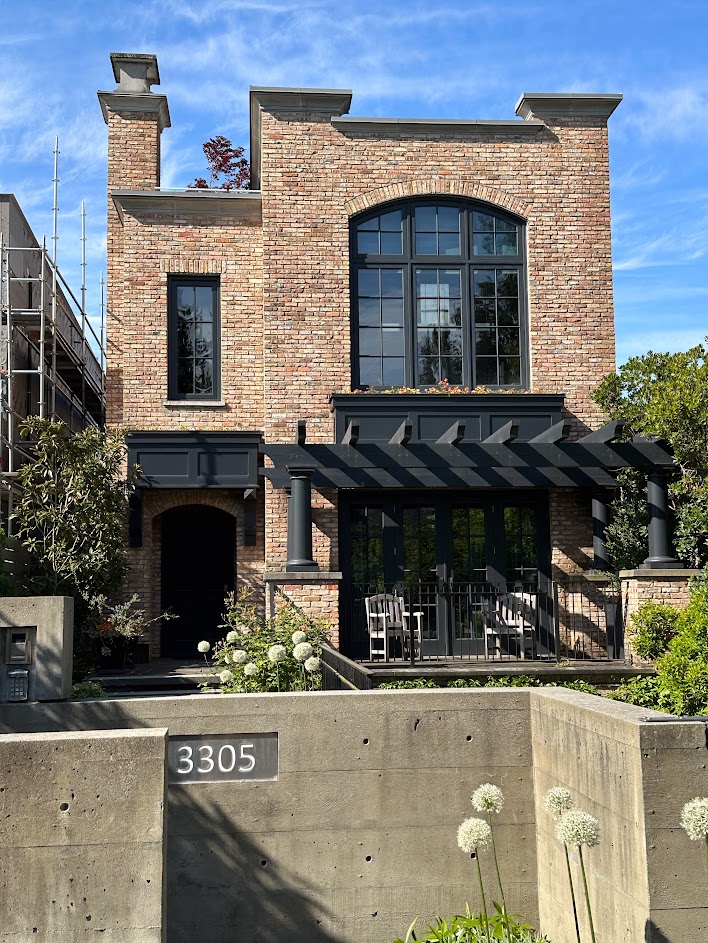
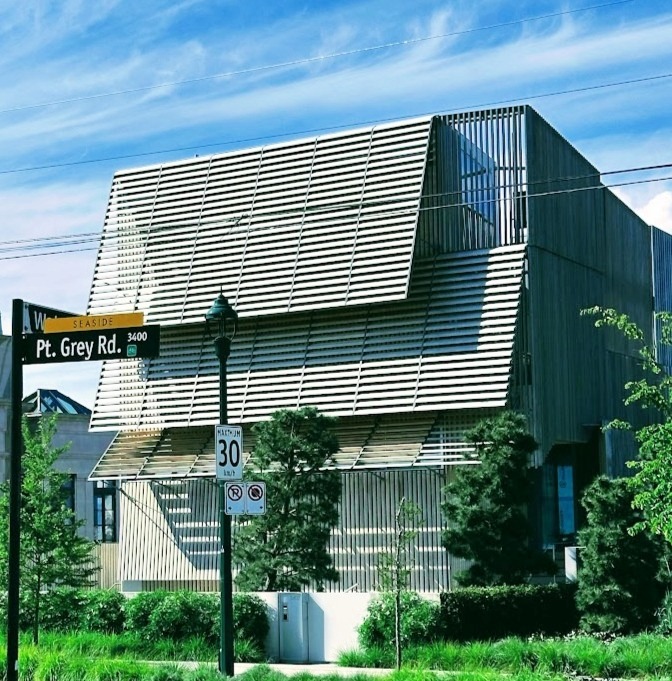
Strolling along, I took a picture of what I thought was a very attractive house. After searching online, I discovered that it was designed by one of my classmates from the School of Architecture at the University of British Columbia in the 1960s. Paul Merrick was an exceptionally talented designer during our time in architecture school, and he established his firm in Vancouver after graduation. The article I read on this residence did not mention the owner’s name.

Designed by Paul Merrick

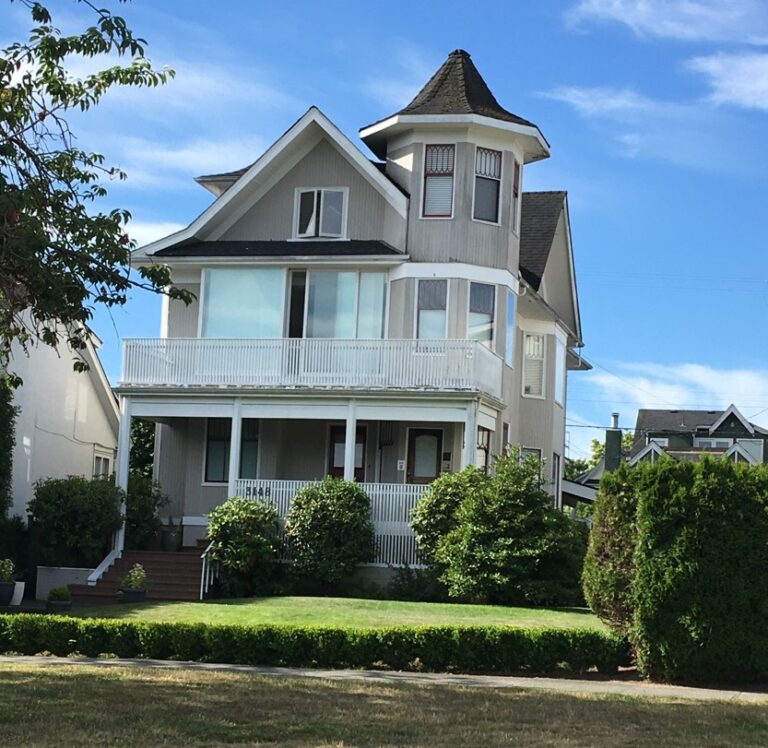
Another renovated old house on the south side of Point Grey Road, at number 3148, is known as the “Peace House.” The name originates from its use during the 1960s by peace activists who lived there and protested against the storage of nuclear weapons at the Comox RCAF base. This house also attracted the wandering hippie crowd of the era, known as the Love-In Generation, including notable figures such as Timothy Leary, the Grateful Dead, who even performed a concert there, Baba Ram Dass, and Allen Ginsberg. Recognizing these names indeed reveals my age!

The “Peace House”

These beautiful, high-value homes are designed by architects and surrounded by meticulously maintained landscaped yards. I thought it would be a great experience to visit these homes inside. Would the homeowners be willing to open their houses for viewing?

Exploring Granville Island: A Vibrant Vancouver Destination

May 29, 2025

Granville Island is a vibrant thirty-five-acre urban district located under the Burrard Bridge in Vancouver. Due to limited parking, we chose to take an Uber to get there. Granville Island is the most visited tourist destination in Canada after Niagara Falls, attracting over ten million visitors each year.


The sandbar that is now Granville Island was a traditional fishing site for the Squamish and Musqueam tribes. The early 1900s saw industry’s expansion into the land, supporting the maritime and lumber industries. Until 1972, hobos lived on the island before the federal government took control. Ron Basford, the minister responsible for the lands, envisioned redeveloping the area while preserving the original buildings and businesses. His vision ultimately grew into a roaring success.

There are no sidewalks here; the planners envisioned a pedestrian district. The streets are narrow, filled with throngs of people moving through the walkways. There are also three thousand people working on the Island. Cars move extremely slowly along the crowded streets. We initially thought a line of vehicles on the main street was a parking lot, but then the cars began to move—it was not a parking lot after all.


The taxi dropped us off at the Public Market, a large, renovated warehouse filled with a variety of merchants. The market features bakeries, fruit and vegetable stands, butchers, as well as specialty cheese and international food vendors. After noticing a lineup at the BC salmon seller, we decided to purchase some in a freeze-dried bag to take home. Of course, we couldn’t resist getting fresh, sweet cinnamon buns from a local bakery, so we hurried over to a roaster for their exceptional coffee to enjoy with the buns. There was a line at the coffee shop as well. We learned that all fifty merchants in the Public Market are local, and no chain stores are allowed.


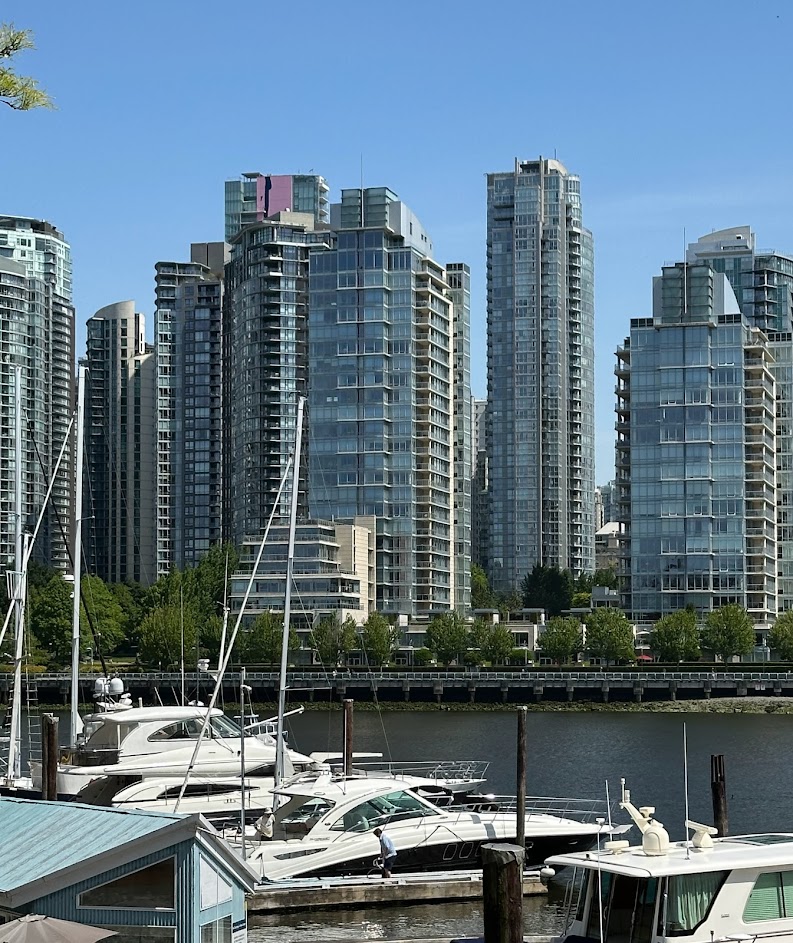
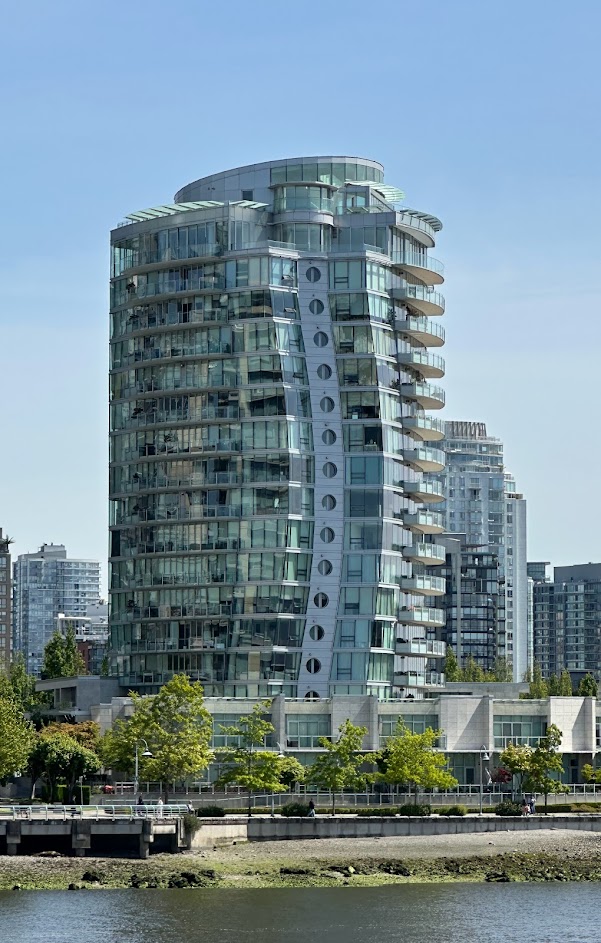
To enjoy our sweets and coffee, we sat in the outdoor plaza outside the Public Market on the waterfront. The skyline of downtown Vancouver stretched before us, resembling a mushroom of high-rise buildings with attractive designs. Each unit appeared to have a balcony, allowing residents to take advantage of the surrounding views. Among them was a distinctive high-rise designed by Arthur Erickson, one of Canada’s most renowned architects. This unique apartment building bulges in the middle, making it an eye-catching sight. Although it may seem unusual, it stands out from the typical apartment towers.

As we walked along the waterfront, we noticed several houseboats tied up at the dock. Interestingly, most of these houseboats are two stories high and seem to be permanently moored to the shore. It makes you wonder what it would be like to live on a houseboat in downtown Vancouver. Would the residents have children? There are no schools or playgrounds on the island, although educational facilities are available on the mainland. Is this lifestyle suited only for adults?


There are two rows of boats tied up—one along the wall and the other tied to the first row of houseboats. I wonder if the first row of houseboats, which is next to the shoreline, is cheaper to dock but lacks a view because the second row of boats is parked in front of them. The density of the boats is so great that they are touching each other! Is there any privacy here? One would assume that good neighborly relations would naturally develop.


As we walked between renovated buildings, we passed restaurants, a community center, and many performing arts theaters. The Emily Carr University of Art and Design is also located there. We walked by the Granville Island Brewery, but it was too early for a beer.


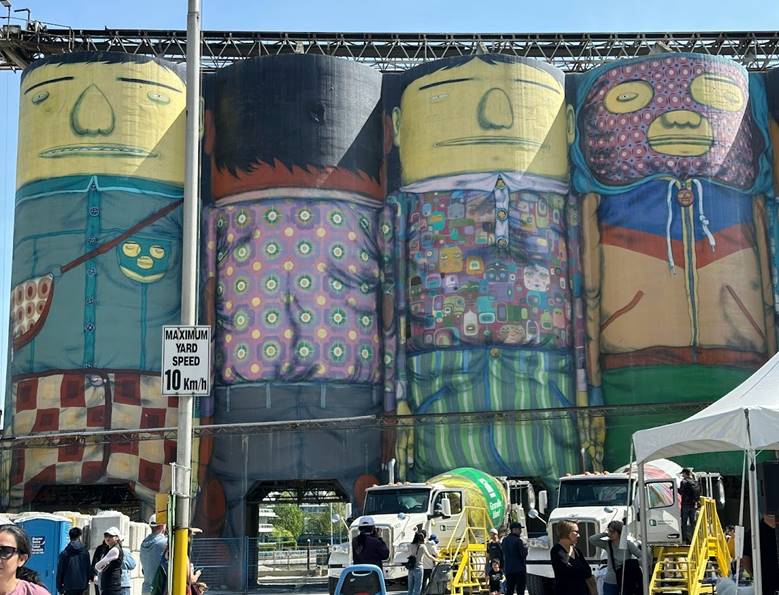
Forties music drew us to a large plaza in front of the Ocean Concrete Company, the longest-established tenant on the Island since 1917. This cement factory features concrete silos decorated with a colorful mural by the Portuguese brothers Pandolfo, titled “Giant.” Despite the huge cement trucks parked in front, the mural made the industrial neighborhood feel more appealing. The music was coming from an outdoor free concert performed by the Firemen’s seventeen-piece band. We stood and listened to my favorite style of music until a few chairs became available in the plaza, allowing us to sit down.


Leaving the music behind, we walked along the waterfront, taking in the views of Vancouver’s skyline and False Creek. The wooden boardwalk felt comfortable under our feet. As we strolled, we passed by an upscale waterfront restaurant that is part of the luxurious Granville Island Hotel, our destination from which we called an Uber to return home.


Although we spent only a few hours on the Island, we could have easily spent the entire day exploring the galleries and studios of local artists, visiting the cement factory that offers tours, and enjoying the brewery.
The mixed land uses, the variety of local shops, the vibrant arts scene, and the bustling crowds reminded me of Jane Jacobs’ ideas about urban environments. Her philosophy is detailed in her bestselling book, “The Death and Life of Great American Cities,” published in 1961. Jacobs advocated for the renovation of old districts by preserving buildings, promoting mixed land uses, and encouraging high-density living with numerous streets to create dynamic urban spaces. She vehemently opposed urban renewal and redevelopment, especially those led by professional planners, favoring instead organic growth guided by local communities. Granville Island serves as a prime example of her principles in action.

Exploring Beaufort: A Cyclist’s Paradise in South Carolina

March 24,2025


We drove south to leave the winter of Ottawa, even though we enjoy snowshoeing. Escaping springtime offers a welcome reprieve from the winter’s cold and snow. Despite my pollen allergies (managed by Claritin), late March in the Carolinas offers ideal cycling weather.

Driving south towards Beaufort, South Carolina, I sighed in relief at leaving the crowded, monotonous, and speedy Interstate 95 behind. Driving for hours had numbed my feet, so I hoped for less, slower traffic on Route 21 East. Although slower, the traffic picked up closer to Beaufort on a four-lane highway.


The expansion of military bases (Parris Island and Beaufort), resort construction (Hilton Head Island), and a Northern retiree influx have driven development along South Carolina’s east coast.
We learned from a hotel employee at check-in that Beaufort’s population has almost doubled since the pandemic, nearing 15,000. It is not only retirees but also people working remotely who have arrived to take advantage of lower housing and living costs.

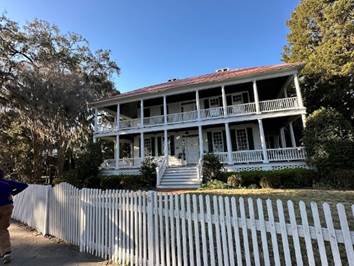
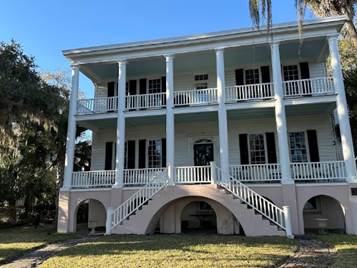
When Kathy stayed here thirty years ago, she stayed in one of the huge antebellum houses on the waterfront, used as a B&B in those days. Today, developers meticulously redeveloped the waterfront, and they restored the antebellum homes along the waterfront to their original designs. The city designated the downtown area a historic district, and we enjoyed a quiet walk admiring the architecture.

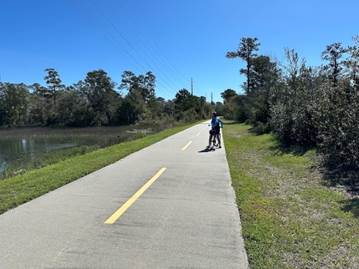
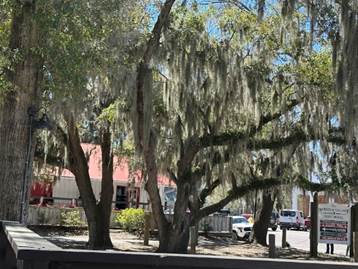
Cycling the Spanish Moss Trail from Beaufort to Port Royal was a smooth ride (it follows the old Magnolia rail line). The paved, twelve-foot-wide trail was flat, crossing marshes with many boardwalks and with the temperature in the mid-twenties (in the seventies in Fahrenheit), was ideal for a bike ride. Much of the Trail crossed areas with oak trees from which Spanish moss hung. I assume the source of the name for the Trail. Although the hanging moss is attractive, avoid touching it because it might contain chiggers.

The paved trail was great for riding, but I knew that falling off the bike would be rough, experiencing injury if going at the maximum allowed speed of 15 mph.

We sped through the twelve-mile trail, pausing to talk with people going in the opposite direction. We avoided talking about politics. We did not know how local people would react to talking to us Canadians, in view of Trump’s desire to annex Canada.

I noticed different organizations took responsibility for maintaining sections of the trail, which included benches at viewing sites, including the military that were in abundance in the area.

In less than a couple of hours, we arrived at Port Royal, at the other end of the trail. We were ready for a cup of coffee and found in the center of Port Royal a home converted to a restaurant with a name Corner Perk that offered fancy coffees. Their muffins were so special we couldn’t resist.

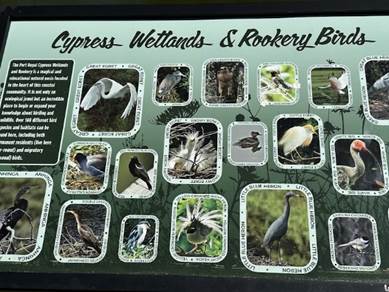
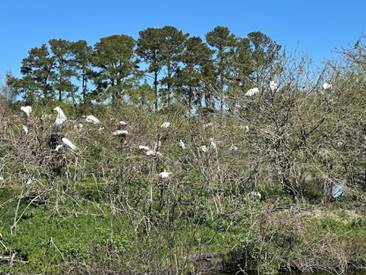
Next, we saw a sign for the Cyprus Wetlands rookery, home to hundreds of local birds (egrets, cormorants, bats, herons, etc.), right by the coffee shop. A boardwalk crosses a lake, going by an island with small trees that provide nesting grounds for birds. We noticed many turtles and alligators also slept on the shore of the island.

Returning to Port Royal, we found a small house converted to a restaurant boasting a sign for Griddle and Grits and the menu included grits with shrimp, with chorizo and grits with different ingredients. I like spicy foods and chose chorizo on grits, which turned out to be excellent. Kathy chose she crab soup, which also turned out to be a good choice.

On the return journey, we paused on a bench and were approached by a man who looked like a bear of an angler, who sat down, smoked a cigarette and started a conversation. He wanted to know all about us and then described his entire life story, including where he was born, where his family members were born and all the ailments they each had. I gathered he has been a floater with jobs in many states before settling in Beaufort. We could not resist listening to him; overall, it was an enjoyable social engagement.

We stopped at a Publix grocery store on the way home to pick up dinner. The Spanish Moss Trail is a nice, paved trail, but it was a bit too tame for us. We like longer and wilder trails with fewer refinements.

Udaipur’s Heritage: Lake Pichola Hotel Experience

March 11, 2025

The Lake Pichola Hotel

Shyaam, our guide, had reserved a room at the Lake Pichola Hotel in Udaipur, Rajasthan. This opulent heritage hotel, formerly Piplia Haveli, was built in the eighteenth century as a private residence for the Jagirdars (nobility) of Thikana Piplia. The hotel’s corridors were adorned with royalty images, illustrating Udaipur’s rich history and property. The owner of the Lake Pichola Hotel is a descendant of the rulers of Udaipur and has taken over the management of this heritage hotel.

Our large, comfortable room faced Lake Pichola and opened onto a balcony with windows all around. The balcony was furnished only with sumptuous pillows, reminiscent of harem rooms we had seen in pictures; it looked incredibly inviting after a long drive. We relaxed on the cushions, enjoying the beautiful views of the lake, the Udaipur Palace across the water, and the Oberoi Hotel, where James Bond’s “Octopussy” was filmed. As we sipped our drinks, we watched women at the lakeside washing laundry, a stark reminder of the contrasts between wealth and poverty in India.

According to Oxfam, seventy-three percent of the wealth generated in 2017 went to the top one percent of the population. The number of billionaires increased from nine in 2000 to over one hundred in 2017. I reflected on these numbers, but seeing poor people washing clothes in the lake opened my eyes.

We met our guide, Shyaam, in the hotel dining room, where authentic Indian food was served. By then, we were running low on rupees, and many of the smaller stores we visited either did not accept dollars or charged exchange rates that seemed exorbitant. We asked Shyaam where we could exchange our U.S. dollars for rupees. Although he did not mention any ATMs or banks, he suggested a contact of his who offered money exchange services. It sounded dubious, but he claimed we would get the best exchange rate from this contact. We decided to take a chance on his offer, partly because we trusted Shyaam, who worked with the travel company Intrepid, and partly because we didn’t see any other options.).

The next day, we walked up the street to an office address and entered a small room on the main floor. Some people were working in the back office. We sat in the waiting room, hoping that Shyaam had indeed arranged a meeting with his contact, the money changer. We waited, uncertain of what to expect, until a dapper, well-dressed gentleman in a suit and tie, carrying a briefcase, entered the room. He asked if we were Shyaam’s clients, and when we confirmed that we were, he set down his briefcase. He then inquired how much money we wanted to convert and informed us of the exchange rate he offered. It was a better rate than the banks charged, and our only concern was whether his money was legitimate or counterfeit.

The money changer seemed honest, so we decided to exchange some currency, although not as much as we had initially planned, to be cautious in case the bills were counterfeit. He examined our dollars individually, selecting only the ones in excellent condition without tears. After calculating the equivalent amount in rupees, he opened his briefcase filled with rupees, counted out a stack for us, and handed it over. There was no official receipt, and he left immediately after the transaction. I remain uncertain about whether this market activity was legitimate in Udaipur. I wondered if it might have been part of a black market; India likely has various money exchange options. Another thought that crossed my mind was whether Shyaam was involved in this exchange—whether he was assisting clients as a tour guide for a major travel company or if he was part of the transaction and receiving payoffs. However, we had no issues with the money the money changer provided us.

With our newly acquired rupees, we walked toward the center of Udaipur, climbing a hill in search of the famous miniature paintings, sized 4″ x 12″. This art form originated in the sixteenth century, with artists creating these paintings as memoirs for kings, capturing important historical events. The paintings depict vignettes of a king’s life from the past, and even today, they are created and sold as decorative art.

The artists use a meticulous process to manufacture pigments and colors from scratch. We stopped at several stores to admire these paintings. Unable to resist, we decided to purchase a few as souvenirs. They were beautiful and unique to Udaipur and easy to transport due to their small size. Although we could have bought them unframed for easier transport, we opted for framed pieces, which cost much less than a frame at home. 

As we left the store, we spotted an elephant coming up the hill toward us. A mahout was riding on the elephant, sitting more than ten feet off the ground. I quickly grabbed my camera to take a picture. However, as soon as the mahout noticed me, he began protesting and waved both hands, trying to stop me from taking the shot. He made the international gesture of asking for money by rubbing his fingers together with his palm facing upwards. Even if I had wanted to give him money, I couldn’t have reached him, and it was clear he wasn’t planning to stop the elephant or dismount.

Suddenly, the elephant started to pee, creating a river streaming down the asphalt. I couldn’t believe the volume that came out! I felt grateful to be wearing closed-toe sandals at that moment. I noticed some tourists walking behind the elephant, trying to capture the scene on camera, but maintaining a safe distance to avoid the chaos. All of them were wearing open-toed sandals. I felt sorry for them but was reminded once again why open-toed footwear isn’t the best choice for sightseeing.

Our wanderings in Udaipur took us to the City Palace, an imposing structure with a 250-meter frontage and several entrances. This multi-level complex stands 30 meters high and is beautifully situated on a hilltop. The upper floors overlook Lake Pichola, providing excellent views.

The palace was constructed entirely from marble and granite, with construction beginning in 1576 and continuing for four centuries. It is an interconnected complex made up of various palaces built by successive dynasties.

I remember how we had to navigate many staircases to explore the building, which left us feeling quite exhausted. However, it was a remarkable historical and cultural journey. We admired stunning wall paintings, intricate murals, exquisite marble work, detailed inlay work, and remarkable architectural features, including cupolas, domes, towers, and balconies.

After a few weeks on the tour, I felt overwhelmed by the many palaces and forts I had seen. By this point, I preferred conversing with local people rather than admiring centuries-old artifacts, no matter how beautiful or historically significant they were. I found discussions with tuk-tuk drivers about their families fascinating, even though many did not speak English. While I still appreciated history, I realized traveling became much more fulfilling when interacting with the local residents.

The Lake Pichola Hotel.