Udaipur’s Heritage: Lake Pichola Hotel Experience


March 11, 2025

The Lake Pichola Hotel

Shyaam, our guide, had reserved a room at the Lake Pichola Hotel in Udaipur, Rajasthan. This opulent heritage hotel, formerly Piplia Haveli, was built in the eighteenth century as a private residence for the Jagirdars (nobility) of Thikana Piplia. The hotel’s corridors were adorned with royalty images, illustrating Udaipur’s rich history and property. The owner of the Lake Pichola Hotel is a descendant of the rulers of Udaipur and has taken over the management of this heritage hotel.

Our large, comfortable room faced Lake Pichola and opened onto a balcony with windows all around. The balcony was furnished only with sumptuous pillows, reminiscent of harem rooms we had seen in pictures; it looked incredibly inviting after a long drive. We relaxed on the cushions, enjoying the beautiful views of the lake, the Udaipur Palace across the water, and the Oberoi Hotel, where James Bond’s “Octopussy” was filmed. As we sipped our drinks, we watched women at the lakeside washing laundry, a stark reminder of the contrasts between wealth and poverty in India.

According to Oxfam, seventy-three percent of the wealth generated in 2017 went to the top one percent of the population. The number of billionaires increased from nine in 2000 to over one hundred in 2017. I reflected on these numbers, but seeing poor people washing clothes in the lake opened my eyes.

We met our guide, Shyaam, in the hotel dining room, where authentic Indian food was served. By then, we were running low on rupees, and many of the smaller stores we visited either did not accept dollars or charged exchange rates that seemed exorbitant. We asked Shyaam where we could exchange our U.S. dollars for rupees. Although he did not mention any ATMs or banks, he suggested a contact of his who offered money exchange services. It sounded dubious, but he claimed we would get the best exchange rate from this contact. We decided to take a chance on his offer, partly because we trusted Shyaam, who worked with the travel company Intrepid, and partly because we didn’t see any other options.).

The next day, we walked up the street to an office address and entered a small room on the main floor. Some people were working in the back office. We sat in the waiting room, hoping that Shyaam had indeed arranged a meeting with his contact, the money changer. We waited, uncertain of what to expect, until a dapper, well-dressed gentleman in a suit and tie, carrying a briefcase, entered the room. He asked if we were Shyaam’s clients, and when we confirmed that we were, he set down his briefcase. He then inquired how much money we wanted to convert and informed us of the exchange rate he offered. It was a better rate than the banks charged, and our only concern was whether his money was legitimate or counterfeit.

The money changer seemed honest, so we decided to exchange some currency, although not as much as we had initially planned, to be cautious in case the bills were counterfeit. He examined our dollars individually, selecting only the ones in excellent condition without tears. After calculating the equivalent amount in rupees, he opened his briefcase filled with rupees, counted out a stack for us, and handed it over. There was no official receipt, and he left immediately after the transaction. I remain uncertain about whether this market activity was legitimate in Udaipur. I wondered if it might have been part of a black market; India likely has various money exchange options. Another thought that crossed my mind was whether Shyaam was involved in this exchange—whether he was assisting clients as a tour guide for a major travel company or if he was part of the transaction and receiving payoffs. However, we had no issues with the money the money changer provided us.

With our newly acquired rupees, we walked toward the center of Udaipur, climbing a hill in search of the famous miniature paintings, sized 4″ x 12″. This art form originated in the sixteenth century, with artists creating these paintings as memoirs for kings, capturing important historical events. The paintings depict vignettes of a king’s life from the past, and even today, they are created and sold as decorative art.

The artists use a meticulous process to manufacture pigments and colors from scratch. We stopped at several stores to admire these paintings. Unable to resist, we decided to purchase a few as souvenirs. They were beautiful and unique to Udaipur and easy to transport due to their small size. Although we could have bought them unframed for easier transport, we opted for framed pieces, which cost much less than a frame at home. 

As we left the store, we spotted an elephant coming up the hill toward us. A mahout was riding on the elephant, sitting more than ten feet off the ground. I quickly grabbed my camera to take a picture. However, as soon as the mahout noticed me, he began protesting and waved both hands, trying to stop me from taking the shot. He made the international gesture of asking for money by rubbing his fingers together with his palm facing upwards. Even if I had wanted to give him money, I couldn’t have reached him, and it was clear he wasn’t planning to stop the elephant or dismount.

Suddenly, the elephant started to pee, creating a river streaming down the asphalt. I couldn’t believe the volume that came out! I felt grateful to be wearing closed-toe sandals at that moment. I noticed some tourists walking behind the elephant, trying to capture the scene on camera, but maintaining a safe distance to avoid the chaos. All of them were wearing open-toed sandals. I felt sorry for them but was reminded once again why open-toed footwear isn’t the best choice for sightseeing.

Our wanderings in Udaipur took us to the City Palace, an imposing structure with a 250-meter frontage and several entrances. This multi-level complex stands 30 meters high and is beautifully situated on a hilltop. The upper floors overlook Lake Pichola, providing excellent views.

The palace was constructed entirely from marble and granite, with construction beginning in 1576 and continuing for four centuries. It is an interconnected complex made up of various palaces built by successive dynasties.

I remember how we had to navigate many staircases to explore the building, which left us feeling quite exhausted. However, it was a remarkable historical and cultural journey. We admired stunning wall paintings, intricate murals, exquisite marble work, detailed inlay work, and remarkable architectural features, including cupolas, domes, towers, and balconies.

After a few weeks on the tour, I felt overwhelmed by the many palaces and forts I had seen. By this point, I preferred conversing with local people rather than admiring centuries-old artifacts, no matter how beautiful or historically significant they were. I found discussions with tuk-tuk drivers about their families fascinating, even though many did not speak English. While I still appreciated history, I realized traveling became much more fulfilling when interacting with the local residents.

The Lake Pichola Hotel.
Jainism and the Ranakpur Temple: Understanding the Principles


March 7, 2025


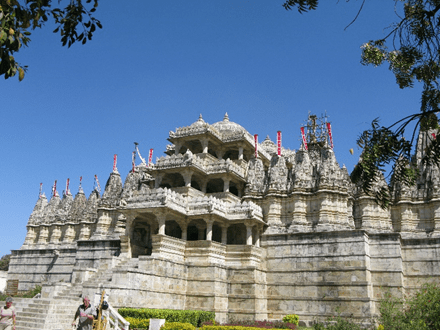
During our journey from Jaisalmer to Udaipur in Rajasthan, India, we stopped to visit a Jain temple in Ranakpur. After a long walk, we arrived at the temple’s entrance. Upon entry, the building’s dress code mandated covered knees and shoulders. Despite the temperature being in the upper 30s Celsius outside, the dress code prohibited sleeveless shirts. Fortunately, we were well-prepared to meet this requirement since we always wore long-sleeved shirts and pants while traveling.


Temple entry required removing all leather items, such as wallets and belts. Jain temples prohibit leather because producing it involves killing animals, directly contradicting the core Jain principle of “Ahimsa,” or non-violence. The temple provided lockers for visitors to store their items, and we had to improvise to keep our pants up after removing our belts.


At the entrance, we saw a sign advising women not to visit the temple while menstruating. This caught my attention, so I decided to research the source of this custom online. A social media comment explained, “In India, people are not allowed to visit a temple unbathed or in dirty or unwashed clothes.” Similarly, temple authorities prohibit any bleeding man or woman from entering, to maintain the temple’s purity and hygiene.


People have practiced Jainism, an ancient religion with more than five million followers for over five thousand years. It is based on the principle of peaceful coexistence and offers guidelines for living harmoniously with others. I was ready to become a follower. Unlike many other religions, Jainism does not worship a God; its followers revere the Tirthankaras. Jainism admires the 24 Tirthankaras—enlightened teachers or saints—for their teachings and wisdom, but does not worship them. They have achieved liberation from the endless cycle of birth and death.

A vegetarian diet is essential for all Jains, reflecting the core principle of non-violence or non-injury. Jains are very conscientious about their food choices. For example, they avoid root vegetables, such as potatoes, because harvesting them results in the death of the entire plant. Many Jains also operate animal shelters throughout India, showcasing their commitment to this principle.


We learned that the Ranakpur Temple is one of the largest and most significant temples in Jain culture, recognized as one of the five most sacred sites for Jains. Remarkably, a dream inspired Darna Shah, a local Jain businessman, to build the temple in the fifteenth century. Of the renowned artists and sculptors he invited to submit designs for the temple, architect Deepak presented a plan that profoundly impressed Darna. Deepak promised to create a temple based on Darna’s vision. The king of the province provided land for the temple and suggested building a town near the temple, which has become Ranakpur.

The temple covers an area of nearly 48,000 square feet. It includes 29 halls and 80 domes, all supported by 1,444 intricately carved marble pillars, each uniquely designed. Four distinct doorways lead into its chambers. These chambers ultimately guide visitors to the main hall, where the statue of Adinath, the first spiritual leader of the Jains, is located. Remarkably, you will arrive in the central courtyard regardless of which of the four entranceways you choose.


The temple’s architecture is so well-designed that artificial lighting is unnecessary; natural sunlight illuminates the entire building. Construction began in 1389 and finished in 1458. The numerous openings and high ceilings kept the air inside significantly cooler than the scorching temperatures outside during our visit.

Navigating US-Canada Border Crossings: Personal Insights


February 7, 2025

Trump’s views on birthright citizenship, deportations, and immigration are concerning, bringing back memories of our past border crossings from Canada. As a naturalized Canadian coming from a previously communist country, facing border guards used to make me nervous. But with time, that apprehension has passed.

Over the past few decades, we’ve made an average of four to five trips to the U.S. each year. I am now adept at being polite and cooperative when questioned by border officers. Aside from some amusing incidents, most of our crossings were pleasant.

On one recent trip, an officer checked my passport, grinned, and inquired if I was a “freedom fighter.” My passport shows I was born in Hungary, and I found his question surprising; he was aware of the 1956 Hungarian Revolution. The Revolution started in Budapest, two hundred kilometers from where we lived. The revolution’s westward expansion arrived days later, allowing my escape to Austria when the border was unexpectedly opened. No, I was not a “freedom fighter”, but could have been.

However, his comment made me feel good. He believed I was anti-Russian, which signaled to him that I was a friend of the U.S., so I felt welcomed.

Once, while crossing the border, the officer inquired, “Is this a new car? I then realized that our license plate had been scanned near the gate and entered into their system. Passport checks reveal information about your car’s license plate when you drive.

Canadians also monitor car movements into Canada. The U.S. and Canadian computer systems may work together!

I had a more challenging time driving to Chapel Hill, NC, where my son lived. He had just bought a house, and I offered to build a deck in his backyard. My carpentry tools in the car triggered detailed questioning. The guards accused me of taking jobs from Americans. I reassured them, saying, “No, no. Look at the color of my hair—I am retired! I’m just building a deck for my son.”

Despite my explanations, they remained unsatisfied and told me to park the car and go inside. They searched my vehicle, including the hood, trunk, and undercarriage. Convincing them I wasn’t working in the U.S. took hours.

Another memorable crossing occurred when the border guard requested identification plus my passport. I’m unsure what brought that question up, but I provided my picture IDs: my Canadian driver’s license and health card. I also included my old draft card, which was a mistake! 

“What is this?” they asked. That question seemed unusual; I thought Americans would know what the draft card was. The guards conferred, and I observed from beyond the counter. I explained I had worked in Norfolk, VA, years ago, during the Vietnam War, and that everyone living and working in the U.S. had to register for the draft. Draft cards were something the young officers had never seen before.

The commotion drew the supervisor in, who, upon investigation, burst into laughter. He explained the history of the draft, which was abolished in 1973, to his colleagues. Afterward, they let me go but kept my cherished draft card.

From experience at border crossings, we discovered the standard questions asked by border guards: your destination and planned duration. Plus, declare all items you are bringing across the border: gifts, food, alcohol, and cannabis (while legal in Canada, it is illegal in many states). We carry food only for ourselves and try to remember which fruits are not allowed in the U.S.

The government’s current focus and political relations influence border guards’ behavior. For example, during the COVID-19 pandemic, vaccinations were required. At other times, they might ask about our destination only and wave us on.

What’s the border guard situation this spring? Trump has expressed a desire to make Canada the fifty-first state of the U.S., but Canada has stated its strong opposition to being absorbed. Would the border guards welcome us, or would they be more questioning?

Trump also accused Canada of allowing huge amounts of fentanyl and large numbers of terrorists to cross into the U.S. The facts, however, paint a different picture; only one percent of fentanyl and terrorists arrive in the US from Canada. Can rhetoric influence the border guards? How do these accusations affect them?

We will assess the current situation at the border soon. In a few weeks, we’ll visit family and enjoy the warm sunshine in North Carolina.

Exploring Panjim and Old Goa’s World Heritage Sites


January 2, 2025


Arriving in Panjim, the capital of Goa, we made our way to our small hotel in the downtown area. Our contact there arranged a driver to go sightseeing.


The next day, the driver took us to Old Goa, where UNESCO declared a large area as a World Heritage Site in 1986. Sultanates ruled old Goa, founded in the fifteenth century on the banks of the Mandavi River until the Portuguese captured it in 1510. The Portuguese ran their colony from Old Goa until they moved the viceroy’s residence to Panjim in 1759. During their stay, the Portuguese had built several Catholic churches in and around Old Goa. With the viceroy’s departure, Old Goa’s religious significance diminished.

We walked over to the UNESCO World Heritage Site, which contains seven historical churches, one in ruins and the others in different stages of renovation. The builders constructed the churches in the Baroque architectural style. Although we found this site significant, it is less interesting architecturally. We have seen several more interesting World Heritage Sites in India (thirty-eight such sites in India).


Half a day spent wandering the buildings was adequate for us. It was a hot day with temperatures in the thirties (over 100 degrees Fahrenheit). We walked with our water bottles in the sun on the heritage site’s grassy field.

I recommend seeing the Basilica of Born Jesus on this World Heritage Site. It is famous for containing the remains of St. Francis Xavier, founder of the Jesuit Order, and associated artifacts, including his casket.


The other edifice we enjoyed was the Chapel of St. Catherine, a small building needing renovations but uncrowded and surrounded by vegetation providing welcome shade. Alfonso de Albuquerque built this chapel when he took possession of Goa in 1510 on Saint Catherine’s Day (November 25th). We took a hydration break at a small kiosk and called our driver for the return trip.


While heading back to Panjim, approximately ten kilometers down the road, the driver paused to grab a jacket upon getting a phone call. He said the police were monitoring taxi drivers further up the road, and the law required drivers to wear a formal dress or pay a hefty fine. I thought this regulation concerned creating a professional image for tourists.

According to the driver, in Goa, people view being a police officer as rewarding due to their ability to stop and search individuals for any reason. And people will negotiate and pay cash to avoid being fined. Applicants to the police force will pay bribes to get an interview. Families join to raise money for a family member who, if successful in becoming a police officer, supports the entire family

We walked around Panjim, which has a population of about 100,000. It has a European feel, with low-rise buildings and curvy streets. We enjoyed the many small stores lining the streets and stopped by an optometrist whose prices were low compared to prices in Canada. They offered us a plan whereby we gave them our prescriptions, and they would fill them at any time at a low cost for an annual fee. We considered it but decided against it, thinking of the time it would take to get glasses mailed to us. Shoppers and passersby were helpful with directions to the Bishop’s Palace; however, the impressive, two-story building was closed on our arrival.

The next day, we visited a beach, a major tourist attraction in Goa. Thinking an hour would get the smell and atmosphere of the beach; we told the driver to wait. Upon stepping onto the sandy beach, hawkers surrounded us, trying to rent umbrellas, sell refreshments, and offer massages. I struggled to shake them off without resorting to discourtesy. It was not a pleasant experience. Their presence stemmed from business opportunities.

Understanding the language, I listened to the Russian tourists on the beach availing themselves of the full range of services. Also noticeable were the women in long sarees, which they wore into the water with their children. An early bedtime preceded our 4:30 AM flight. My anxiety grew with each passing moment as the cab failed to arrive. I called the driver several times and was told he was on the way. He explained his tardiness one hour late: the airport was only 30 minutes away, and a few flights meant no rush. He was right, and we boarded Qatar Airways to Doha and Washington, DC, connecting with a United Airways flight to Ottawa. We arrived on the same day as the day we left, even though we had twenty hours of flying time with five hours’ waiting time in between flights.

Cultural Insights from a Kerala Tour Guide


December 27, 2024

Heavyset, with an average height and a dark face, Dinesh was our guide in Kerala. He grew up in Kochin, his birthplace. Malayalam, the official language of Kerala, was his mother tongue, although he spoke English but with an Indian accent. Over a couple of weeks, we had gotten to know him. Married with two small children; his family surely missed him while he traveled constantly for work. We found him easy-going, affable, personable, and eager to please us.

Everything about him was clean; he wore a clean shirt daily, befitting a professional chauffeur and guide. Although I never asked him, it impressed me how he got his impeccably starched shirts every day. He must have carried many shirts or had them cleaned overnight. Similarly, his car was shiny and always impeccably clean, and the interior was spotless. No objects, like the newspapers we read on the road, were ever left behind. His company’s car was like a jewel to him, and he hoped to buy it soon. Years later, I saw him showing off “his” car on Facebook.

Proud of his country, he showed and described it to us in glowing terms. His work was very important to him, and he related his experience with the English chef Gordon Ramsey collecting recipes for a book on Indian cooking. Dinesh showed us a photograph of Ramsey, his crew, and himself for emphasis. Impressed, Kathy bought a copy of that book in Kerala.


I noticed he was conscious of his class, a reality in some countries, including India. He deferred to others, whom I assumed he considered high-class people. It always happened when we invited him to eat lunch with us. He excused himself by claiming to be busy.


But once, we asked him to take us to a local Indian restaurant, a highway stop. There, we had thali food on grape leaves filled with curries. Looking around, I noticed that most of the people looked like laborers. He did not hesitate to sit with us and explain our food. After we ate with our fingers, local style, we washed our hands in the sink at the end of the dining hall.

At another time, we invited him to dinner to discuss the next day’s plans. He did not want to join us, perhaps because it was a more expensive restaurant. We were forceful and did not take no for an answer. He obliged us. When the waiter came, he gave Kathy and me menus, but not Dinesh. Even the local people knew and discriminated according to what class they were serving.

I requested an extra menu for Dinesh, which the waiter provided. We were all served, but I knew Dinesh was uncomfortable throughout the dinner. He remained silent, avoiding eye contact. Later, I realized we may have asked too much of him by insisting he eat with us. What we thought was normal was not for him.

 After days of traveling with Dinesh, I noticed he did not come into the hotels with us; he dropped us off. I remember the Tharawad Homestay, where he left us with the details of when he would pick us up the following day. Drivers were not permitted to park in high-end residential areas or obstruct driveways. We learned he slept in the car every night.

We were on a tour, and the tour operator paid for all our hotels but provided no accommodation for our guide. He had to find a place to park and sleep overnight. I do not know how he looked so fresh every morning, drove us around Kerala, and provided knowledgeable comments. I follow him on Facebook.