Going to School in Hungary in the 1950s


April13,2026

The first memory that came to mind when I thought about attending elementary school in the early 1950s was getting hit on the knuckles with a ruler by a nun because I wrote with my left hand, and the nuns trained me to use my right hand for writing. I was eight years old.

While searching for a Catholic school in Sopron, Hungary on Google Maps, I found the St. Orsolya Roman Catholic School (run by the Ursulines, established in 1757), and the road I took to go to this school came back to me. I used to walk alone about a kilometer from our apartment, a reflection of a time when it was once safe for children.

The nuns were strict at St. Orsolya. Homework was checked every day, and the class stayed quiet, or punishment followed. This could involve not only hitting your knuckles but also being slapped. Complaining to my parents was useless. They always sided with the teachers and thought I deserved punishment for whatever I did. Corporal punishment was accepted in those days.

One day, a classmate spat on me. I do not remember why. I did not get into a fight beyond pushing. When I came home, I told my father about the incident. He just listened. Then he told me to go to the boy’s house and tell his father what happened. My older brother came with me. I was flabbergasted at what happened. As soon as I told my classmate’s father that his son spat on me, he flew into a rage and started yelling that no son of his spits on people and began slapping his son with such vehemence that my brother and I just left their place in a rush. I did not think the punishment was fair. I did not think too much about the incident, nor did I understand the apparent significance of spitting on people. My father just listened when I told him what happened and said nothing.

After a year at the Catholic school, my parents transferred me to a public school on Deak Ter (Square), possibly because it was closer to where we lived. The building was old, with long hallways and a single bathroom at the end of each floor, with one toilet serving ten classrooms. I recall once waiting so long for someone using the toilet that I was late for class, earning harsh words from the teacher and a note to my parents. Despite this, discipline was less strict than at the Catholic school, and there was no physical punishment.

Continuing my education, I attended high school at the Berzsenyi Gymnasium (established in 1557) on Széchenyi Ter, about a kilometer from our apartment (until October 23, 1956 when I walked to Vienna). We stayed in our classroom all day, and the different teachers came to our room to teach the usual courses such as Hungarian language, Russian language, science, and history, except for physical education, which was in the gym. I think the school was for boys only, I cannot recall any girls in my class.
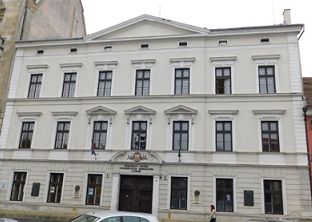
We had 50-minute classes and a ten-minute break every hour, from 8 am to 1 pm, six days a week. The ten minutes between classes gave students time to release energy, and we rushed into the courtyard behind the school, a dirt-and-gravel area bounded by buildings on all sides. Our favorite entertainment was playing soccer, kicking rocks around the courtyard.

Among the teachers, I especially enjoyed listening to the history teacher, who would leave his desk at the front of the room, sit on a school desk with us, and share stories about kings and emperors. I remember  his habit of sliding his glasses down his nose to review his notes, then pushing them back up before recounting gory events from medieval history.

Homework was assigned daily, and teachers often called students to the front at the start of class to answer questions from the previous lecture. The first ten minutes were tense as we waited to see who would be chosen, typically two or three students each session. Teachers kept an alphabetical list of the class, and we watched anxiously as the teacher leafed through the pages, trying to guess who was next.

Discipline consisted of teachers raising their voices. If that did not work, they sent the student to the corner and made him do squats. Sometimes this could go on for half an hour before he was excused, although the squatters took a break when the teacher turned away and did not see them standing around. Doing squats for any length of time can be strenuous. I felt like I was going to collapse when I was sent to the corner once. The squatting took place at the front of the classroom, so all the classmates watched and snickered.

High school teachers had a great reputation and were held in high esteem in Hungary. In the 1950s, most young people did not go to university, and high school was the highest level of education most people achieved.

I had respect for all my teachers except for one, who taught Russian. We had Russian language classes every year in high school, but they were taught by someone who had just learned Russian and was not very good at teaching it. My teacher spent much time on Russian grammar and made us memorize vocabulary, paying scant attention to speaking, since she was not fluent herself. And we did not like learning Russian; the Russians occupied Hungary at that time and were not welcome at all.

Looking back, my education was of pretty good quality. I learned discipline in doing homework, and all the memorization, poems, historical dates, events, and even Russian vocabulary helped me later when learning other languages. And I was always good in maths and the sciences, when I entered university in Canada with only a grade ten education, I performed well.

Exploring North Carolina: Vineyards, Memories, and Family


May 15, 2024

Sitting in the sun, shaded partly by an umbrella at Shelton’s vineyard in North Carolina, was hugely relaxing. Helping the relaxation was the Cabernet Sauvignon that we sipped. The food was average: pulled pork on an open sandwich base, or perhaps it was a pizza. I am not sure, but it tasted like pub food, appropriate in the setting.

Driving away from the lush meadows of the Yadkin Valley where Shelton’s grows its grapes, my thoughts turned towards the many times we visited North Carolina over the last few decades, and my memory lane took me back to the first time I drove to Chapel Hill, NC.

That was when the Dean of the Graduate School of City Planning welcomed me with an open smile; Jack Parker welcomed each planning student. His intimate reception touched me, and he generated a feeling that I’d succeed in my studies. It was a competitive program, but I have known no one who failed. The UNC Planning School admitted me for the January session; I applied to many other Ivy League schools, but UNC took me mid-year, and I accepted the offer, not waiting for the other schools to respond. But let me explain how I decided to attend planning school.

After graduating from the School of Architecture at the University of British Columbia in Vancouver, Canada, I worked with a small architectural firm in Vancouver. I lasted six months before getting bored with mundane designs of lobbies for high-rise buildings put up by developers. Another job with an even smaller firm was more interesting: designing a recreation center for a specific location in Vancouver. This project came about as a request for proposals for a competition our firm did not win.

After my brief experience with two architectural firms, I decided that I did not fit the mold of an architect. Architecture envisions plenty of attractive and well-appointed living spaces unavailable for most people worldwide. Architecture is irrelevant to people who have no choice but to tolerate less attractive environments. So, that was the impetus for me to search for a new field of endeavor. City planning appeared to be a related field, so I started applying to graduate planning schools in the fall, which is how I ended up in Chapel Hill in January.

When I arrived, I felt I was in paradise, experiencing southern hospitality and the positive energy generated by, and friendships made with, the planning students. Living at a campus-type university was another positive for me; UBC was a city university where moststudents lived off-campus. In contrast, campus life at UNC was rich with lectures and performances I could attend. For example, at the annual Jubilee Music Festival in the spring, I listened to Johnny Cash while sitting with thousands of students on the ground of the quadrangle. It was a memorable concert. 

Another primary reason North Carolina holds deep memories is that I spent considerable time with my future wife during our second year there. Although we met in Washington, DC, where we both had summer jobs, upon returning to UNC for our second year, we saw each other daily, starting with breakfast in thestudent dining room,Lenoir Hall, when it cost forty cents. And we spent many evenings talking late into the night at the Rathskeller, a student pub in Chapel Hill. We married at year’s end at the Anglican Church on the campus with family and all my classmates in attendance. The audience had a big laugh when the newlyweds left in the car with a colossal ruckus created by the rocks my friends put into the hubcaps of our vehicle.

A career launch and meeting my lifelong partner provide deep roots in North Carolina. But there is more to it. Our three children applied to US universities after finishing high school in Ontario. Although they did get into Canadian universities, they thought going to American schools would be more adventurous, perhaps influenced by their parent’s experience there. The upshot of their leaving Canada was that Tony and David attended UNC in Chapel Hill, while Megan graduated from Duke University in Durham.

They married after graduating from university; the two boys married North Carolina girls and settled in Charlotte and Durham. Further, Kathy’s brother, Huw, retired from Washington, DC to Winston-Salem, near where his wife had grown up. Our recent visits to North Carolina span from Charlotte to Winston-Salem to Durham, all of these locations along Interstate 40, within three hours of driving time.

Innumerable opportunities have existed to visit our children and their growing families in North Carolina, share a vacation, help them move, or see them. Over the years, I wore out several car tires along Interstate 81, driving from Ottawa to North Carolina. However, the visits have also provided opportunities to see the state and enjoy what it offers.

Huw and Judy introduced us to vineyards while driving around Wiinston-Salem. With the decay of the tobacco industry, growing grapes had taken over the rich agricultural soil. My attraction to visiting vineyards goes beyond sipping wines; they happen in areas with lush vegetation on rolling hills, with a lake and a fountain facing the tasting room.

Having visited Shelton’s vineyard, where the wine was tasty, but the food was not the best, we decided to visit Shadow Springs Vineyards with Huw and Judy on our last visit before returning to Ottawa. They do not have a restaurant, and since we do not sip wine without some food at lunchtime, we stopped at the Shiloh General Store in Hammondville to pick up a sandwich.

Amish people run the store, and the owner, Phil Graber, was on cash. I learned from him that the area has over fifty Amish families. Phil and his wife Mary established the store in the early 2000s and expanded it to over thirty-five hundred square feet. The store sells homemade products with fresh ingredients, such as pickled vegetables, dry soup mixes, Amish noodles, pretzels, and crackers.

They made a tasty sandwich for us. I found their order-taking fascinating. You choose on a piece of paper the type of bread, meat, spread, vegetables, and sides you want and place it in a window. Then, they prepare the sandwich and call your name. There was no limit on what you could ask for, and I thought, why not order pulled pork and chicken under meats? And low and behold, my sandwich had both meats!

Armed with our sandwich, we entered Shadow Springs’ tasting room. Judy selected a 2022 Seyval Blancand a2022 Chardonnay while we settled at a table on the lakefront, cranking up the umbrella to provide shade from the sun’s heat at midday. The chatty hostess in the tasting room described how Chuck Johnson, the owner, decided to retire from his corporate job to his home state and look for another career opportunity after missing too many of his son’s ball games. Chuck and his wife Mary went winetasting upon their return to NC and decided that winemaking might be an excellent opportunity for starting a new life. They looked at dozens of farms for sale until they found this piece of land with the proper orientation and soil qualities to make wine. They started making wine in 2005.

And we were not disappointed with their wines. We spent the two-hour lunch sipping wine in sunny weather, sitting outside with a huge fountain making a bubbling sound in the middle of the lake next to us. What a way to spend our last day in North Carolina before returning to Ottawa, where the trees were getting leafy.  

Chance Encounter Triggers Memories of Life in Natuashish, Labrador, Canada


October 17, 2022

I walked into Costco wondering how long it would take to find “natural vanilla extract”. Kathy told me it costs upwards of $40 and is located with the spices. I searched all around the spices unsuccessfully and looked for someone working there to help me. I noticed a woman loading a flatbed trolley with boxes of goods and thought she may be a worker, but she proved to be a buyer for a grocery store in Iqaluit, near the arctic circle of Canada (Iqaluit is the capital of the Canadian Territory of Nunavut).

That encounter triggered my memory of the volunteer work I had done for the Innu tribe in Natuashish, at the north tip of Labrador and Newfoundland, in 2009.

After I retired from the government in 1995, I volunteered with the Canadian Executive Service Overseas (CESO). My first project was to assist the Mushuau Innu First Nation. We took a small single-engine Otter from Goose Bay, Labrador, to Natuashish, with two stops (a distance of 300 kilometers or 160 miles). The pilot opened the door for the half dozen passengers, including myself, to get in, and we took off. That is how my adventure began with the tribe.

The Mushuau Innu lived in Davis Inlet in Labrador until 2002, when they moved with government assistance ten miles away into Natuashish. In Davis Inlet, the tribe members abused drugs, and the children sniffed glue. This dire situation led to many requests for help, and when help was slow in coming, the tribe escalated their demands via protests to the United Nations. The resulting embarrassment for Canada led to moving the entire tribe into a newly designed community in Natuashish.

The new community was inland, with a population of under a thousand people, and there were no job opportunities except hunting and fishing in the surrounding lakes. The government built a few hundred houses and three miles of roadway. The only access year-round was by air, or by water, during the summer months. I, along with a small team of experts in different fields, would assist the tribal council with governing. My field was public works: roads, hydro, and water/sewer systems.

The tribe housed me in a trailer and advised me to lease a truck from one of the tribal councilors. They also told me to park it alongside the trailer in such a fashion that the gas-tank cap would be inches from the trailer wall so that nobody could siphon the gas out of the tank; either for their use or for sniffing, I thought.

They brought in all the food from the south; the climate and soil would not permit any agriculture. And we could eat at the central dining hall that typically provided prepackaged food. There were no vegetables, and even after one week, I found the food repetitious and boring.

The government built a repair garage and brought in qualified car mechanics to teach the Innu how to service the Ford 150s they brought in by ship during the summers. I helped them set up a financial system for charging for repairs so that the locals could earn some money. Trouble was that they spoke a local Innu language, and I needed a translator to develop simple forms in their language. Another problem was that they were not used to working in a nine-to-five Western economy depriving the garage of steady, continuous employment.

Each Innu received a mining royalty of CD$5000, in 2009, because they had ownership of the land on which the mining company was located. Besides, the Innu received free services from the RCMP (policing), Health and Welfare Canada (health provision), and the government also built a school (kindergarten to grade twelve). They recruited all the teachers from the South with an interpreter in every class. There was only one high school graduate in the entire community.

The motivation for work was low; why work when housing, schooling, healthcare, and policing are provided free and cash payments given to all residents by the mining company?

Alcoholism was still a problem (brought in by air) despite the council’s outlawing the use of alcohol in the community. I heard stories of men who used to beat the women who retaliated by beating the men when the latter were drunk.

And many Innu destroyed the houses that the government built for them by cutting down the walls for firewood. Nobody took pride in their homes, given freely to them; they wanted money from the government for cleaning up their yards.

 The Innu lived by straddling two cultures. One was their fishing and hunting way of life, and the other was a Western culture with snowmobiles, trucks, guns, and modern homes, not being in either of these cultures fully.

The experience in Natuashish firmed up my opinion that the government should take away the subsidies. I believe that the government should assist with their assimilation into western culture. Let them be entrepreneurs and let them move to cities where jobs are more available. Some of the native tribes have done well economically.

These memories of mine snapped back vividly, talking with the buyer for the grocery store in Iqaluit. And she knew exactly where the vanilla extract was.