April13,2026
The first memory that came to mind when I thought about attending elementary school in the early 1950s was getting hit on the knuckles with a ruler by a nun because I wrote with my left hand, and the nuns trained me to use my right hand for writing. I was eight years old.
While searching for a Catholic school in Sopron, Hungary on Google Maps, I found the St. Orsolya Roman Catholic School (run by the Ursulines, established in 1757), and the road I took to go to this school came back to me. I used to walk alone about a kilometer from our apartment, a reflection of a time when it was once safe for children.
The nuns were strict at St. Orsolya. Homework was checked every day, and the class stayed quiet, or punishment followed. This could involve not only hitting your knuckles but also being slapped. Complaining to my parents was useless. They always sided with the teachers and thought I deserved punishment for whatever I did. Corporal punishment was accepted in those days.
One day, a classmate spat on me. I do not remember why. I did not get into a fight beyond pushing. When I came home, I told my father about the incident. He just listened. Then he told me to go to the boy’s house and tell his father what happened. My older brother came with me. I was flabbergasted at what happened. As soon as I told my classmate’s father that his son spat on me, he flew into a rage and started yelling that no son of his spits on people and began slapping his son with such vehemence that my brother and I just left their place in a rush. I did not think the punishment was fair. I did not think too much about the incident, nor did I understand the apparent significance of spitting on people. My father just listened when I told him what happened and said nothing.
After a year at the Catholic school, my parents transferred me to a public school on Deak Ter (Square), possibly because it was closer to where we lived. The building was old, with long hallways and a single bathroom at the end of each floor, with one toilet serving ten classrooms. I recall once waiting so long for someone using the toilet that I was late for class, earning harsh words from the teacher and a note to my parents. Despite this, discipline was less strict than at the Catholic school, and there was no physical punishment.
Continuing my education, I attended high school at the Berzsenyi Gymnasium (established in 1557) on Széchenyi Ter, about a kilometer from our apartment (until October 23, 1956 when I walked to Vienna). We stayed in our classroom all day, and the different teachers came to our room to teach the usual courses such as Hungarian language, Russian language, science, and history, except for physical education, which was in the gym. I think the school was for boys only, I cannot recall any girls in my class.
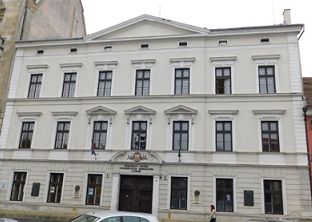
We had 50-minute classes and a ten-minute break every hour, from 8 am to 1 pm, six days a week. The ten minutes between classes gave students time to release energy, and we rushed into the courtyard behind the school, a dirt-and-gravel area bounded by buildings on all sides. Our favorite entertainment was playing soccer, kicking rocks around the courtyard.
Among the teachers, I especially enjoyed listening to the history teacher, who would leave his desk at the front of the room, sit on a school desk with us, and share stories about kings and emperors. I remember his habit of sliding his glasses down his nose to review his notes, then pushing them back up before recounting gory events from medieval history.
Homework was assigned daily, and teachers often called students to the front at the start of class to answer questions from the previous lecture. The first ten minutes were tense as we waited to see who would be chosen, typically two or three students each session. Teachers kept an alphabetical list of the class, and we watched anxiously as the teacher leafed through the pages, trying to guess who was next.
Discipline consisted of teachers raising their voices. If that did not work, they sent the student to the corner and made him do squats. Sometimes this could go on for half an hour before he was excused, although the squatters took a break when the teacher turned away and did not see them standing around. Doing squats for any length of time can be strenuous. I felt like I was going to collapse when I was sent to the corner once. The squatting took place at the front of the classroom, so all the classmates watched and snickered.
High school teachers had a great reputation and were held in high esteem in Hungary. In the 1950s, most young people did not go to university, and high school was the highest level of education most people achieved.
I had respect for all my teachers except for one, who taught Russian. We had Russian language classes every year in high school, but they were taught by someone who had just learned Russian and was not very good at teaching it. My teacher spent much time on Russian grammar and made us memorize vocabulary, paying scant attention to speaking, since she was not fluent herself. And we did not like learning Russian; the Russians occupied Hungary at that time and were not welcome at all.
Looking back, my education was of pretty good quality. I learned discipline in doing homework, and all the memorization, poems, historical dates, events, and even Russian vocabulary helped me later when learning other languages. And I was always good in maths and the sciences, when I entered university in Canada with only a grade ten education, I performed well.
 andrasthehun.ca