Cultural Insights on Icebreaker Introductions

December 18, 2025

Our group of twenty people sat down for our first night’s dinner at our Road Scholar program. Many of us were tired from a long drive or flight to the southwest corner of Florida, to the Everglades. As an icebreaker, our leader asked us to stand and introduce ourselves: our name, where we are from, and what we were looking for in the kayaking program for the coming week.

I looked around with curiosity; what kind of characters indulge in kayaking for hours each day? There were mostly grey hairs, with more women than men. Seniors, although some looked youngish. Later, I discovered that the “youngish” people were 60 or older.  

Although it is useful to know everybody’s name, I could not remember them ten minutes later. But it was interesting to learn about where they came from: many from Florida, but others were from Washington, Wisconsin, Pennsylvania, Indiana, and Maryland. We were the only ones from Canada.

One talkative person at our table gave us a blow-by-blow account of his life without prompting. He described his career from studying microbiology, to serving in the air force, and then using the GI bill to become a Physician’s Assistant. I thought it was useful to have a medical person on hand should anyone get hurt kayaking.

Then this extrovert asked another fellow at our table what he had done before retirement. Surprisingly to me, the answer was “test pilot”. Wow, I thought, that must have been an interesting career. When I talked with the “test pilot” later, I learned that he participated in 16 Road Scholar programs, which was an eye opener for me about its popularity.

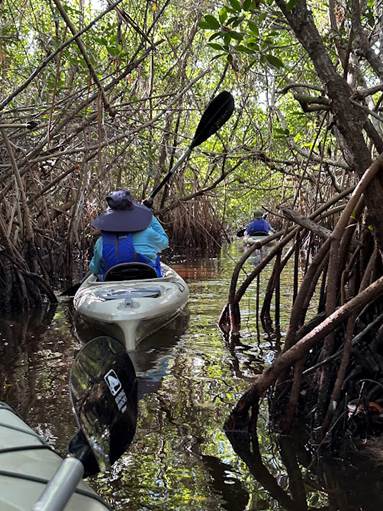
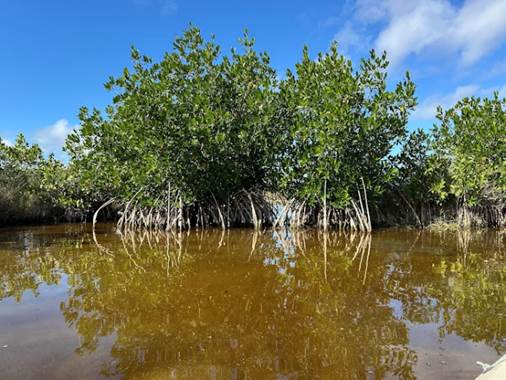
We discussed the Everglades’ fauna and flora during kayaking. For example, we spent time discussing gators, their growth, and the danger they pose to humans: I learned humans are not in their food chain. And we learned about the Brazilian pepper tree, an invasive species that harms mangrove growth but very difficult to contain.

A genuinely fascinating surprise was discovering one participant, who taught maths before, but now was a Road Scholar leader for walking/hiking tours out west. In conversation with him, he mentioned that his icebreaker includes, in addition to the three questions we responded to the first night, the age of the participants, their middle name, and something unique they accomplished or special about them. That made me think how I would have responded if we were asked these questions.

Why would I volunteer to reveal my age to a group of kayakers I just met? What would that add to their impression of me? If they found out how old I am, would they think I would slow them down? And if I appear younger, would they accept me? Would that make any difference? I am already a participant. So, what purpose would it serve to reveal my age?

The other icebreaker, mentioning one’s middle name, was also curious. What do middle names signify? My middle name is my godfather’s first name, and that was the tradition in my family, coming fron a central European culture. Kathy’s middle name is her grandmother’s family name to show family lineage; that is part of Celtic culture. She comes from Wales. Is the goal to offer extra details, possibly about ethnicity? I am not sure that this information is valuable to a kayaking group. And what would happen if someone had no middle name?

 Others may not want to reveal their middle name for religious reasons. For example, my good friend, Zane, used his middle name all the time instead of his first name. I had known him for years, before I discovered that his first name was Mohamed. I think he used his middle name to avoid being stereotyped as a Muslim with all he complications North Americans have today with the religion. I also think asking for middle name is a mild incursion into privacy matters.

In conclusion, icebreakers should be simple; a name, the location where one lives, and perhaps one detail about you, such as your hobby, favorite music, or author. Or the question the leader asked the first night: what do you want to get out of this program. Then let people talk to each other to discover additional information about each other, should they so desire.

Unplanned Adventures: Kayaking the Everglades

December 13, 2025

It was not on our bucket list. We had never thought of visiting it before; in fact, I knew of it by name only. What happened was that I looked for something to do in early December, and a Road Scholar trip fit the bill. So, why did I search for an activity in early December? Let me explain.

In July, we reserved a B&B for a family get-together in December, just before Christmas. Our children live in Durham and Charlotte, NC, and Baton Rouge, LA, and I tried to rent a place central to all three. Just north of Chattanooga, TN, I found a place large enough to accommodate all the family.

Then in November, we told our children we would attend Thanksgiving dinner, assuming one of them would organize it.

The availability of three weeks – the time between Thanksgiving and the family get-together – prompted me to look for something to do during that period; we had no desire to drive from Ottawa south twice, a distance of a thousand miles each way.

I remembered my son’s mother-in-law enjoyed Road Scholar trips and looked up what trips were available in early December. A yoga class in North Carolina sounded interesting, but it was fully booked. Sightseeing trips to New York City and St Augustine did not appeal to us, but a kayaking trip in the Everglades did.

One concern was that the Everglades are another thousand miles further from our children’s homes where we would have our Thanksgiving dinner. But it would take us to a warm place and include a physical activity, kayaking, that we are fond of.

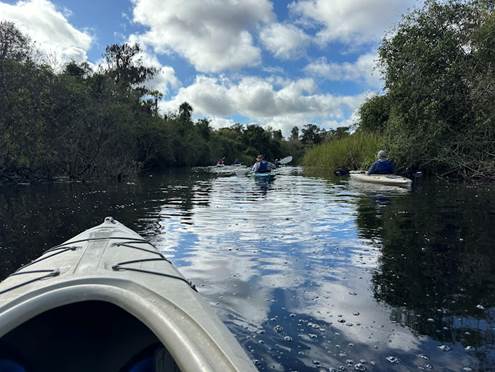
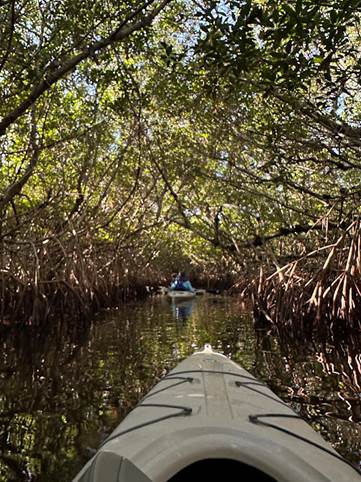
Reviewing the kayaking program, I had another concern: Road Scholar rates this trip hard on a scale they use to alert people of the physical difficulty of their trips. They advise that to participate, one should be able to kayak for 6 miles and walk 2 miles a day. The walking component was not a concern, but paddling six miles was. On balance, we decided we could do it since we kayak every summer, often for hours. So, I reserved the last two spots available.

With Thanksgiving Day approaching, I learned that my older son, Tony, was renovating his kitchen and not ready to prepare for a family dinner, which he has done for many years. Daughter Megan decided to take a job in Williamsburg, VA, and planned her move from Baton Rouge in early December, clearly not ready for entertainment. And David’s children and wife planned to visit family in Beaufort, SC, for Thanksgiving. Well, that was that, and instead of traveling south, we stayed in Ottawa and celebrated US Thanksgiving at home. We left for Everglade City the following Monday, on December 1.

Upon reflection, if we had not planned to have Thanksgiving dinner with family, I would not have reserved the Road Scholar trip because we would have just travelled to Tennessee for the family get-together. So, the real trigger to kayak in the Everglades was our intention to have Thanksgiving dinner with family. Funny how plans can have unintended consequences.

What’s David Szalay’s book “Flesh” about

December 5, 2025

The Booker prize for 2025 went to David Szalay for his book Flesh. Szalay’s father is Hungarian, and his mother is Canadian. He was born in Montreal, but the family moved to London when he was one year old. Szalay studied at Oxford and lived in Hungary before settling in Vienna.

As a Canadian of Hungarian origin, I felt an ethnic kinship with Szalay and decided to read his book. And the book did not disappoint; I could not put it down and finished it in one day.

The book is the story of a hapless Hungarian, Istvan, who goes with the flow, lacks agency, and shows no emotion. He is someone whose life is shaped more by unexpected, random events than by himself.

For example, Istvan is seduced by a woman his mother’s age when he is fifteen years old. The woman ends the affair when Istvan falls in love with her. Istvan does not want to end the relationship, and while pursuing the woman, he ends up knocking down the woman’s husband, resulting in his death. As a consequence, Istvan is sent to a juvenile detention facility for three years.

Not knowing what to do when coming out of the detention center, a friend asks him to help import drugs from Croatia. When that adventure dries up, he joins the military and serves in Iraq. Coming home from the war with PTSD for which he receives treatment, he is only able to secure a job as a bouncer at a nightclub.

And random events continue to buffet him and shape his life. At the pub he frequents after work, he becomes friendly with the bartender and ends up in a relationship with her. She is married and stopped the affair in a year, afraid that her husband might discover the relationship. Istvan takes the end of the relationship nonchalantly; he seems unmoved by the experience.

In the next phase of his life, Istvan moves to London and becomes a driver for a wealthy family. The pattern of married women taking up with Istvan follows him wherever he goes. The industrialist’s young wife starts an affair with the obliging Istvan. When the industrialist, conveniently, gets cancer and dies, Istvan marries the widow, whose son dislikes him, for having an affair with his mother and subsequently marrying her.

Following the industrialist’s death, I thought the storyline became a bit unrealistic when Istvan takes over the company and starts making real estate deals with no education or experience in the field.

 But then the plot begins to close: when Istvan’s son and his mother have a car accident that takes the boy’s life and cripples his mother. The mother dies later without ever regaining consciousness.

Istvan becomes lonely but continues to lead the life of the moneyed class until the industrialist’s son, Istvan’s stepson, inherits control of the family company at age 25 and ousts Istvan. Losing his upper-crust existence in England, Istvan returns to Hungary and moves back in with his mother, living in the same apartment where he grew up. The story ends with his mother dying.

I thought the author could have added some essential details. For example, is Istvan a handsome, athletic individual attractive to women? I do not know, since the author never describes him in terms of his physical appearance.

Or perhaps Istvan is a charming conversationalist? No, the conversations are monosyllabic, with “yeah,” “what do you mean,” and “yeah, OK.” Istvan is unable to put together a sentence, an expression, or an opinion. The conversations are in the third-person present tense, which propels the action quickly and that is why I kept reading the book until I finished it.

Instead of describing Istvan’s physical appearance, however, the author does describe his behavior in detail: he smokes incessantly and uses alcohol and drugs for relaxation, habits he shares with his numerous women friends. And the sex encounters are described graphicslly.

There are also gaps in the story; for example, there is no description of Istvan’s tour in Iraq or of his stay in the juvenile detention center. The reader learns about Istvan’s experiences during those periods in subsequent chapters.

I also wondered what the message is in the story. Is it about Istvan’s masculinity in bedding numerous women? Is it about the emotionally detached life that Istvan leads, perhaps resulting from his PTSD? Is it about the quality of current life, focusing on sex, smoking, alcohol and drugs?

Some reviewers found the book boring, others exciting. The plot and the sparse writing style appealed to me, but I did not find the protagonist appealing. Is Istvan a typical Hungarian, and does his lifestyle reflect everyday life today? The book did not provide an answer for me. But the jurors for the Booker prize clearly thought that the book is a meaningful reflection of life today.