A Culinary Journey on Two Wheels: Cycling and Cuisine

September 30, 2025

These days, we are looking for flat biking routes and prefer to avoid steep, mountainous areas. The rail-to-trail paths are ideal for us, so we decided to cycle along the Petit Train du Nord linear park in Quebec, just north of Montreal.

The recommended ride is from the northern end of the trail at Mont Laurier to St. Jerome, just outside Montreal, because there is a slight slope in that direction. The distance is approximately 200 kilometers, and it can be covered in a few days.

Typically, the cyclist would drive to St. Jerome, leave the car there, and take a bus that goes once a day to transport them to the northern end. However, by the time I called, there was no room on the bus for the day we had planned to go. Instead, we reserved a room at a hotel along the trail, closer to the northern end, to avoid the busier section near Montreal, and planned to cycle in both directions.

That turn of events was fortuitous, as Kathy had pulled a leg muscle while working out at the gym, limiting her ability to cycle for longer distances. Staying at a hotel provided us the opportunity to take shorter rides with rest in between.

Our trip got off to a great start when we drove into Montebello on our way to the trail and discovered a chocolate factory. We couldn’t resist buying some chocolate bars and truffles, completely forgetting about the prices. For lunch, we chose a bistro—after all, it’s Quebec! The French onion soup we had there was delicious.

With tables arranged closely together and the bistro full, the noise level was high, making conversation difficult unless one spoke loudly. However, the proximity to other diners allowed us to engage with our neighbors, which we did. Surprisingly, we ended up discussing politics without any arguments, likely because we shared similar views.

We attempted to use our French, which was more than rusty. Since we rarely have the opportunity to speak French, we struggled to find the right words when communicating with the service people. But it is always satisfying to express oneself in another language when the locals understand you. My feeling was that the locals appreciated our efforts to communicate in French.

In contrast to the bistro, our dinner at the Club du Golf Nominingue hotel restaurant was a more formal affair. While it was also noisy, the dining room was spacious, with tables dressed in white tablecloths and with elegant wine glasses. The service was prompt and attentive to our questions. Although I didn’t find the menu particularly unique to Quebec cuisine, the presentation of the food we ordered was stunning. I felt compelled to take pictures of our plates, which resembled sculptures, even though the food itself was pretty ordinary.

For example, I ordered saucisse artisanale du Québec, which seemed to me to be regular hot dogs, split in two, served with vegetables, and accompanied by French fries, presented in a wire mesh dish. While I wouldn’t consider any of the ingredients unusual, the presentation was truly remarkable.

The next day, we discovered a local bistro that was a lot of fun. It was extremely noisy, with people yelling from the bar to the other side of the restaurant, conversing in French, of course. It seemed that all the locals gathered at the bistro in the evening. We enjoyed local beer and cider, and I ordered osso buco, which is pork hocks in English, and it was delicious. For dessert, we had mousse fromage érable, which was delightful.

Beef bourgignon with ceasar salad

With all the food we consumed, we needed to burn off some calories, so we rode the Petit Train du Nord with plenty of energy. Like many trails of this nature, there are long, straight sections that can feel relaxing at times, while at other moments, they may become a bit boring. However, the trail was flat, with a grade that never exceeded four percent.

I was surprised by the number of electric bikes we encountered. Although I knew these bikes were popular, I didn’t expect most of the cyclists we saw to be using them, especially since there was no need for supplemental power on such level terrain. It was also interesting to see how many people were dressed in heavy clothing; I wore just a T-shirt and shorts, while others wore winter jackets. I thought riding an electric bike at higher speeds could feel quite chilly.

Although the speed limit on the trail was 22 kilometers per hour, we maintained a leisurely pace of 10 to 15 kilometers per hour, taking breaks to admire the surrounding landscape.

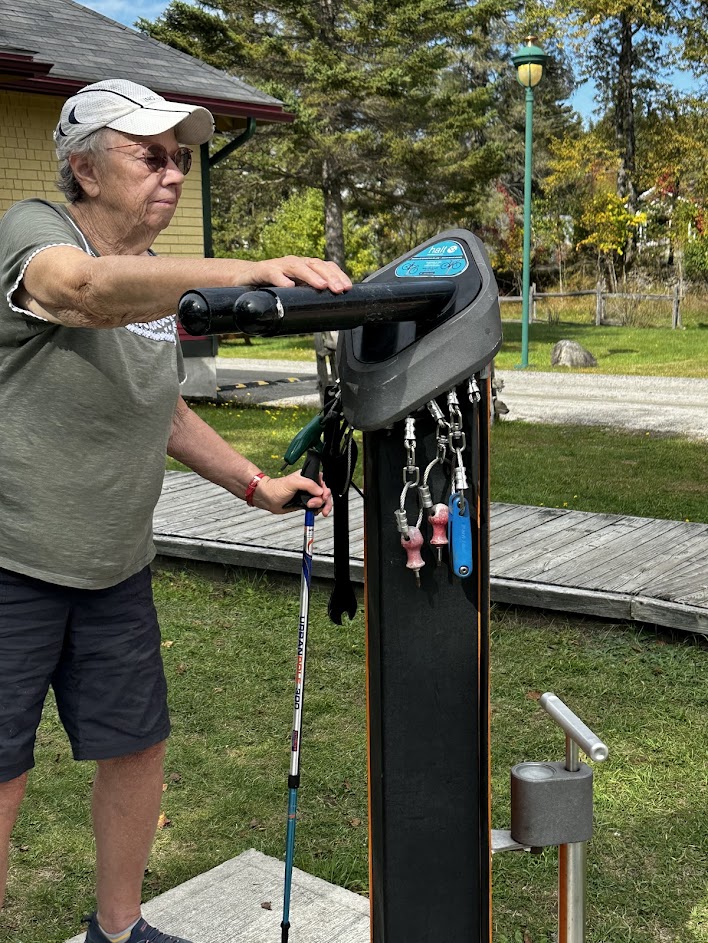
I have to commend the Quebec government for the development and excellent maintenance of this trail. It is entirely paved, and cracks in the pavement are clearly marked with yellow chalk. In areas with a buckling surface, a “danger” sign is placed to alert cyclists. More importantly, there are picnic tables, shelters, water fountains, and even bicycle maintenance pillars equipped with all the necessary tools. This is the most developed trail I have ever experienced. We have cycled on trails in Virginia (the Virginia Creeper), South Carolina (the Spanish Moss Trail), North Carolina (the Tobacco Trail), and many trails in Ontario.
The ambiance at the Le Club et Hotel de Golf Nominingeu, where we stayed, and on the trail, the Quebecois people, the food, and, not least, the cycling trail all contributed to a pleasurable trip. We absolutely have to return for another adventure. We thoroughly enjoyed interacting with the Quebecois people, who, without a doubt, tend to be more expressive, animated, and louder than their English counterparts. One of the highlights of our trip was the opportunity to improve our French language skills. The locals appreciated our efforts, even when our conversations switched to English.

Discovering Rajasthan: Bollywood and Traditional Thali Experiences

September, 23, 2025

He said Rajasthan. A young man from Rajasthan offered landscaping services at my door.  A wonderful place that we visited a few years ago with a guide, Shyaam. The memories that popped up overwhelmed me and I engaged in a discussion with the fellow at the door about the desert and the havelis in his home state. One highlight of our trip was Jaipur.

Jaipur, the capital of Rajasthan, is a city with a population exceeding two million. The drive from Agra took more than six hours. On the way, we stopped to have a thali lunch. They served it on a large metal plate (they also call the plate a thali), on which they arranged many small dishes around the edge, filled with ingredients such as yogurt, dal, vegetables, and chutney. Rice and chapati went in the middle of the thali dish. Eating was done with your fingers; these highway restaurants had a sink at one end of the room where you washed your hands before and after eating. Shyaam explained that the idea behind thali was to offer six different flavors: sweet, salt, bitter, sour, astringent, and spicy on one plate. According to Indian food customs, a proper meal should perfectly balance all these flavors. I was unsure what perfect balance meant among flavors, but we enjoyed the meal and improved our eating skills with our fingers.

The highlight of our stay in Jaipur was seeing and experiencing a Bollywood movie at the Raj Mandir Cinema. The movie house was a large circular building similar to an opera house, where there must have been at least one thousand seats, all occupied, quite a contrast to the smaller theaters we are used to in Canada, which are hardly ever filled.

The film had a cute and typical storyline: a boy falls in love with a girl who rejects him. Both the boy’s and the girl’s families reject romance, and the boy loses sleep, his job, and upsets his family. There are fights between the boy and the girl’s friends in various locations where the boy gets beaten up, but his disheveled hair and clothing are still picture-worthy. The girl’s and the boy’s relatives try to stop the relationship. Then the girl makes a telephone call, after which she disappears. Boy tracks down the baddies and rescues the girl who cries. There were singing and dancing events in various locations, but ultimately, the girl falls for the boy, and the relatives decide the boy is not so bad. The story ends with a large wedding with lots of singing and dancing. This storyline is, apparently, quite typical of Bollywood movies.

What I found more interesting than the movie was how the audience reacted to the scenes with clapping, singing, approving comments, and a loud reception. There was cheering when the boy enticed the girl and booing when the villains lost fistfights. At the wedding at the movie’s end, the entire audience was on their feet, cheering. It was a genuine experience in audience participation and quite a contrast with what I am familiar with, where even people with a cough are shushed by the other moviegoers.

We stayed at the Bissau Palace. The descendants of the royal family ran the hotel/palace (and lived on-site), and the hotel was one of the very few in Jaipur recognized by Indian authorities as a genuine Heritage Hotel. Set back from the iron gates within a village-like compound, it featured a temple, shops and a sizeable pool. The exterior of this century-old building needed some paint and maintenance, but the ramshackle look added to the charm; in fact, renovations would ruin the vibe. But our room was faultless and spotless, featuring hand-painted ceilings, lead-light windows (decorative glass supported by lead cames), and old-fashioned wooden furniture. And the food was native Indian to our liking.

Immigrant Experiences: Inspiring Stories Amidst Challenges in Canada

Septermber 21, 2025

Many Canadians believe that the significant influx of immigrants in recent years has contributed to a shortage of housing units and overwhelmed healthcare services in the country. Since 2021, four million people have arrived in Canada, mostly temporary workers, students, but also refugees, economic migrants, and family members of Canadians.

I understand why many Canadians’ views on immigration have turned negative. However, I enjoy interacting with recent immigrants and discussing their reasons, as well as their plans, for coming to Canada. Let me provide some examples.

When I dropped my car off at the garage, a Lyft driver came to take me home. In a cheerful voice, he asked about my day and engaged me in a friendly conversation, inquiring about what I did. Listening to his accent, I asked him where he was from. He told me he came from Somalia eight years ago and now has a family with young children. His ambition is to establish a business here. He is the kind of person we need in Canada; in fact, all countries would benefit from having young and ambitious individuals like him.

When my car was ready, the garage sent another Lyft driver to pick up my car. Not surprisingly, he was also an immigrant, this time from Rwanda. He came to Canada a year ago and proudly drove a brand-new vehicle, which he mentioned he had bought for cash. He was able to do that by working seven days a week, an astounding achievement in my opinion.

I learned from the driver, Olivier, that he preferred Lyft over Uber, where he had previously worked. Although he had a French name, he did not speak French. He explained that Rwanda was a Belgian colony before gaining independence, which is why many people in the country have French names. After completing his university studies, he went to Belgium to pursue a master’s degree. He ended up staying in Europe for five years, living in England and later obtaining a second master’s degree in Poland. I was surprised to hear this and asked him if he spoke Polish. He clarified that the university program he attended was conducted in English.

From our conversation, Olivier appeared to be a loner, with only a high school friend in Ottawa. He confided in me that he is 33 years old, hopes to start a family, but working seven days a week leaves him little time for socializing and meeting potential partners. In addition to his driving job, he also works part-time at night for a Belgian company, another ambitious immigrant who would be welcomed in most countries.

I should also mention the young man from India who came to fertilize my lawn. He was busy working his Weedman route in the neighborhood but took a few minutes to chat with me when I asked how he liked his job. Although fertilizing keeps him occupied during the summer, he mentioned that he needs employment during the winter months. He plans to enter sales with the company, but he finds the challenge of sales to be significant, as he needs to make at least ten sales or identify leads each day. That’s not an easy task these days, especially when people tend to prefer a do-it-yourself approach.

Engaging in conversations with recent immigrants is both inspiring and motivating, and it has led me to reflect on the richness of the immigrant experience —a perspective I hold dear, having been an immigrant myself.

The sense of satisfaction that comes from adapting successfully to a new country is immense. During the phase of acculturation, individuals face challenges that feel overwhelming. I arrived in Canada with no language skills, no material possessions, and a total lack of knowledge of Canadian culture. To adapt to my new country, I grabbed any available jobs to improve my language skills, earn some money, and learn local customs.

In my first job, I carried furs at an auction for furriers, where they bid on various furs. A memorable moment arrived when the furriers tipped me, and I responded by telling them I only did my job and didn’t accept tips. This response earned me some strange looks. It didn’t take long for me to realize that tipping for good service is standard practice in North America, while it was nonexistent in communist countries like Hungary.

Other jobs followed. I washed dishes at a hospital and later traveled with a survey crew, doing machete work and drafting. On my last day with the survey crew, I overheard my team’s plan to pull down my pants and stick me in an anthill. Fortunately, I managed to escape before they could grab me; my language skills had improved to the extent that I could understand whispering.

To further improve my language skills, I accepted a job with a California company selling Collier’s encyclopedia. It involved knocking on doors and presenting the value of having the encyclopedia in the small towns around Vancouver, BC. I did not last long. I appreciated meeting those who welcomed me, but many older attendees, perhaps lonely, saw my presentation as an opportunity to socialize without planning to make a purchase.  

My early job experiences have significantly contributed to the development of my language skills and self-confidence over time, leading me to pursue a university education.

In summary, the sudden increase in immigration overwhelmed healthcare services and contributed to a housing shortage. And it made immigrants less welcome. But talking with recent immigrants is usually uplifting and inspiring. Before forming an opinion on the pros and cons of immigration, I strongly encourage you to engage in conversations with them.

Retirement Reflections: Stories and Lessons Learned

September 6, 2025

Standing on our dock by the lake, we engaged in conversation with a woman paddling in a kayak. She introduced herself by sharing that she had just retired at the age of fifty-six after teaching for thirty-two years at the high school level. She expressed that the energy to get up in the morning and face her students was no longer there. Although she didn’t have a specific plan for her retirement yet, she was enjoying exploring the lake by boat and getting involved in her community’s social activities. She hoped she had made the right decision to retire and not work longer.

In contrast, when I had a tooth extracted the next day, the technician said she enjoyed her job and has yet to consider retiring after spending forty-two years in the office.

I compared the experiences of these two people with the retirement of some family members. My cousin secured a job right after graduating from university and spent decades enjoying his work without giving retirement a thought. However, he lost his job at age 76 due to organizational downsizing. He sought similar positions elsewhere but was unable to find one, even with the help of a job hunter. So, he turned to podcasting about making drinks with his dog as an observer and taster, keeping him engaged. Another example was my mathematician brother, who dedicated his life to teaching and writing papers until his passing. He never pursued hobbies; to him, mathematics was his passion.

These examples prompted me to reflect on whether there is an ideal age to retire. I thought of a couple of friends who retired in their early fifties.

One friend started a business after retirement, at age fifty, inspired by his passion for photography. The company closed within a year, likely because the goals he set were difficult to attain. After that experience, he took on a volunteer responsibility of leading the local photo club for several years. Eventually, he and his wife purchased timeshares in the Caribbean and began cruising around the world. His interest in photography, cruising, and staying at timeshares has ebbed recently.

Another friend retired at age fifty-four. During the summer season, he cycled and became the leader of the local bicycling club. During the winter season, he and his wife traveled internationally until they decided to stay in Mexico during the winter to escape the cold Canadian winters. His cycling days are over, but they still go to Mexico for the winter.

Both friends retired thirty-two years ago, which, in one case, is longer than the length of his working life.

Interestingly, both individuals tend to express conservative views on topics such as politics, crime, and the environment. In particular, I am surprised to hear from one that climate change is not real and from the other that environmental studies are a waste of money. Were my friends consistently conservative, or have they become so after a long period of retirement?

It is also noteworthy that both of these friends had employment with one organization from their college graduation to their retirement. And they did not seek out another job after leaving their first and only job in their career. They retired relatively early, possibly because their roles within their workplace no longer provided sufficient challenges, or there may have been incentives for them to leave.

My experience has been different. I moved from working in the public sector to the private sector and then to my own consulting business. I enjoyed all of my jobs, public and private, and continued working until much later in life than many people.

In my last career as a consultant, the work was very exciting and interesting until I acquired some clients whom I found unpleasant to work with. I also started traveling, and other hobbies gradually took priority, making the consulting work less appealing. No question, changing jobs and facing new challenges made work enjoyable and satisfying.

I have always sought something meaningful in my retirement, such as international charity work and writing a memoir, which prompted me to take writing courses to improve my writing skills. The most boring time for me is when I have no projects on the go. Paradoxically, that is also the time for dreaming up new projects.

My conclusion on the subject of retirement is that if you are happy with your work, keep on working.