Forest Bathing 101: How to Connect with Nature

November 7, 2025

Dana Milbank’s recent Washington Post article about forest bathing caught my attention. Forest bathing is like a walk in the park, but with a focus on the forest’s sights, sounds, and smells. Forest bathing, a trend originating in Japan in the late 1800s known as shinrin-yoku, is spreading in the U.S. The Harvard Medical School even offers a course on it for its overworked residents, highlighting its significance.

Forest bathing involves taking a leisurely walk in a forest while disconnecting from digital devices and focusing on sensory experiences. It includes stopping to contemplate your surroundings and even taking off your shoes to feel the ground beneath you. Engaging in conversations with trees and plants is also part of the experience. The walk can last anywhere from an hour to a few hours, and the beneficial effects can last for days or weeks.

According to enthusiasts, the benefits include improving the immune system, lowering blood pressure, promoting relaxation, and enhancing sleep. Walking among trees allows you to breathe in tree oils known as phytoncides and plant compounds called terpenes. Studies suggest that these chemicals may help prevent cancer and protect against dementia. While I’m not entirely convinced of all the claims, this information has inspired me to give forest bathing a try.

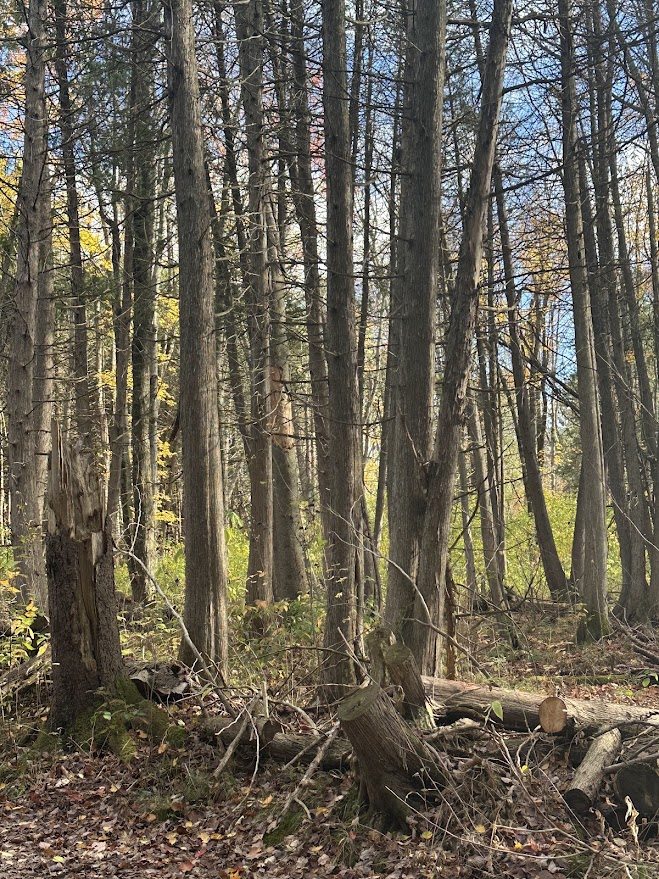
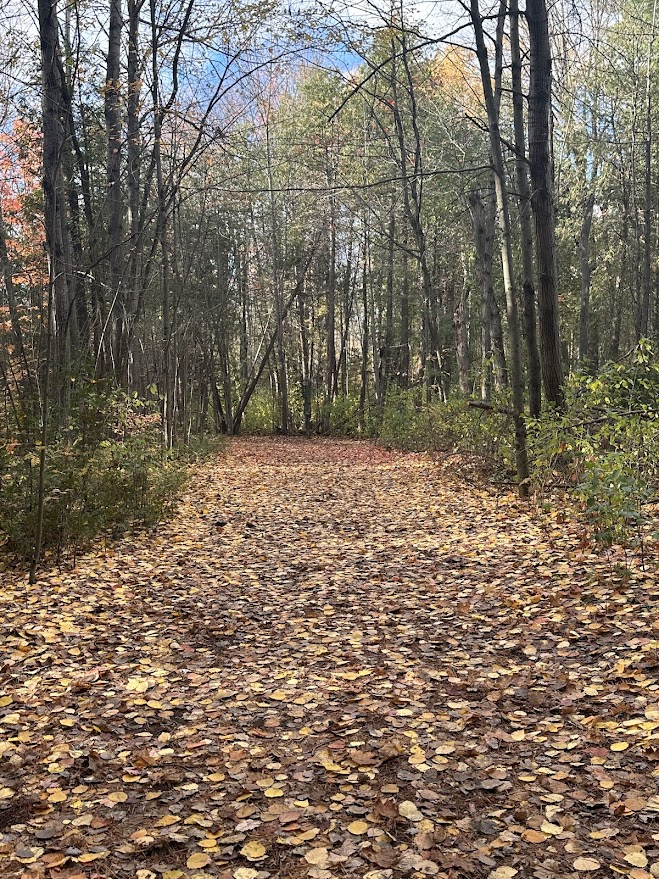
I visited the paths behind Ottawa’s Sportsplex. I strolled at a leisurely pace of three kilometers per hour (about two miles per hour), fully engaging my senses. I could hear airplanes flying overhead and the sounds of traffic from the major roads surrounding the park. The traffic noise was quite noticeable, especially since there were no leaves on the trees to act as a buffer. I did hear leaves falling, but I didn’t hear any birds singing; they must have flown south for the winter, as it is November.

As I looked around, I noticed the attractive tapestry of leaves on the ground. Many trees lay on the ground, some having fallen during windstorms and others cut down to clear pathways. Many fellow walkers, some with their dogs, greeted me and engaged in conversations.

The ground felt soft beneath my feet, and I could feel the wind gently brushing against my face. The bark of the trees felt cold to my touch. Apart from a few dogs licking my hands, I didn’t experience other tactile sensations.
I decided to slow down even more and took a break, sitting on a fallen log. I attempted to meditate but was unsuccessful: as people walked by, they would say hello, and I felt compelled to respond. I could use some guidance on how to engage more deeply with nature and avoid distractions to fully benefit from walking in the forest.

On the internet, I searched for “forest bathing near me.” I found a company advertising a forest bathing walk in Arnprior, a community sixty kilometers from my home, scheduled for next week. The registration cost was $40 for a three-hour guided walk, which was worth it. However, I couldn’t find an online registration page, so I emailed to request a spot.

A few days later, I received a response informing me that the guide was sick, and the walk had been canceled. Another company advertised various activities, such as dancing, meditation, and yoga, in addition to forest bathing. However, their leader was in India and, according to the website, was “locked up” in a happy state.

While browsing online, I came across the Arizona organization that certifies people as forest bathing guides. Lucky for me, they had a scheduled Zoom session just a few days later, so I quickly registered. However, I was disappointed when I listened to the meeting; it wasn’t what I had expected; it was a sales pitch for a course.

On the Zoom call, two forest bathing practitioners presented information about a training course for becoming a certified guide. One practitioner spoke from Boston, and the other from Portugal. The six-month online course is priced at over US$3,000, with an extra US$500 required for a one-week on-site training.  Instead of a commercial for a training course, I had hoped for hands-on instruction on how to conduct a forest bathing walk.

I have always enjoyed the outdoors for many activities, including walking. With friends, we walked the Chilkoot Trail, the Camino Santiago, and other trails. Still, I was not aware of forest bathing at that time and paid less attention to sensory experiences. But walking in nature has some challenges. Let me give some examples.

While walking under the foliage of giant maple trees at our cottage a few years ago, I stumbled upon a ball made of leaves and small twigs on the ground. When I picked it up to examine it, an army of wasps came buzzing around my face. I quickly ran back to the cottage to escape them. Subsequently, I received shots for several years to immunize myself.

By some stroke of luck, I’ve attracted ticks at the cottage two years ago. I was treated for Lyme disease with doxycycline for four weeks. This year, I’ve become popular with ticks again and ended up contracting another illness spread by ticks, called anaplasmosis, which put me in a hospital for four days. Again, I was treated with doxycycline.

I’m not suggesting that the outdoors is so dangerous that it should be avoided, but that there are hazards to be aware of. Given the years I’ve spent hiking in the forest and enjoying the outdoors, these misadventures feel like brief moments. So, by all means, go into the forest and enjoy walking.

The literature I’ve read on forest bathing advises disconnecting from urban life, embracing the outdoors, and living in the present moment. The practice of forest bathing encourages slowing down—rather than walking briskly to reach a destination, meander and explore unknown paths, and discover nature through your senses. Although my experience indicates that, depending on the season, one should combine DEET bathing with forest bathing.

I found that forest bathing is more challenging in practice than it is in theory. Letting go of your thoughts on daily life can be difficult, as is avoiding distractions from others you may encounter, or pausing conversations with a companion, while walking. It’s best to go alone at times when there aren’t many dog walkers in the park.
Summer Reflections: Closing the Cottage Experience

October 8, 2025

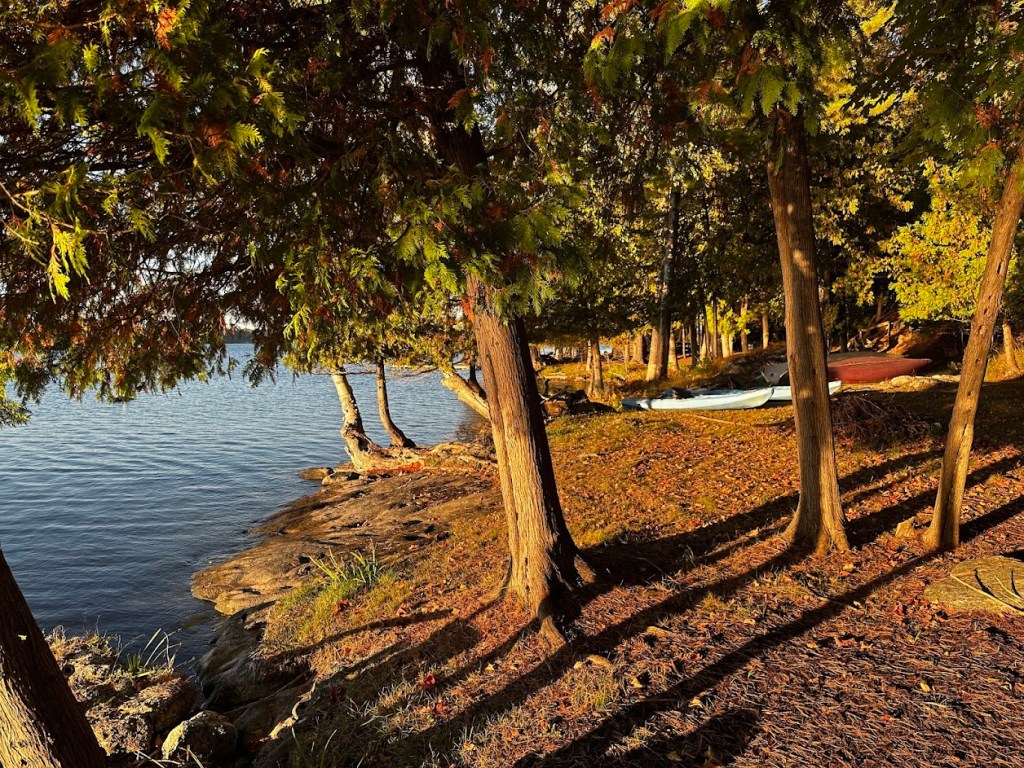
It is a bittersweet event. This past summer experienced record-high temperatures, resulting in lake conditions suitable for extended periods of comfortable swimming. Family visited, and friends came, to enjoy the water activities. As we near the end of the summer, the forecast indicates colder weather next week. Although we swam with our short wetsuits on this weekend, the water cooled us off, and our stay in the water was brief. But we kayaked every day when the lake was smooth as ice and went for walks in the back.

With the leaves falling, we saw much more sky than during the summer. We have giant maple trees around us. But now with much of the foliage falling, the ground was bathed in sunlight, and the leaves formed a thick, carpet-like cover. And there were no bugs, no mosquitoes, no ticks. Nevertheless, I still wore my tick-proof jacket and long pants for protection from nasty bugs, just in case.

I saw a massive fungus on an old and diseased tree; the fungus must be over a foot in diameter, with a yellowish color and parallel lines across its surface, making it artsy. While walking through the forest after leaf fall, we observed prominent burls, mushrooms, and lichens on the trees, which were readily apparent.  And I recognized the sounds of many birds, such as the black-capped chickadee, Canada geese, American crows, blue jays, and an app on my iPhone identified the yellow-rumped warbler. The loudest, of course, were the loons on the lake.

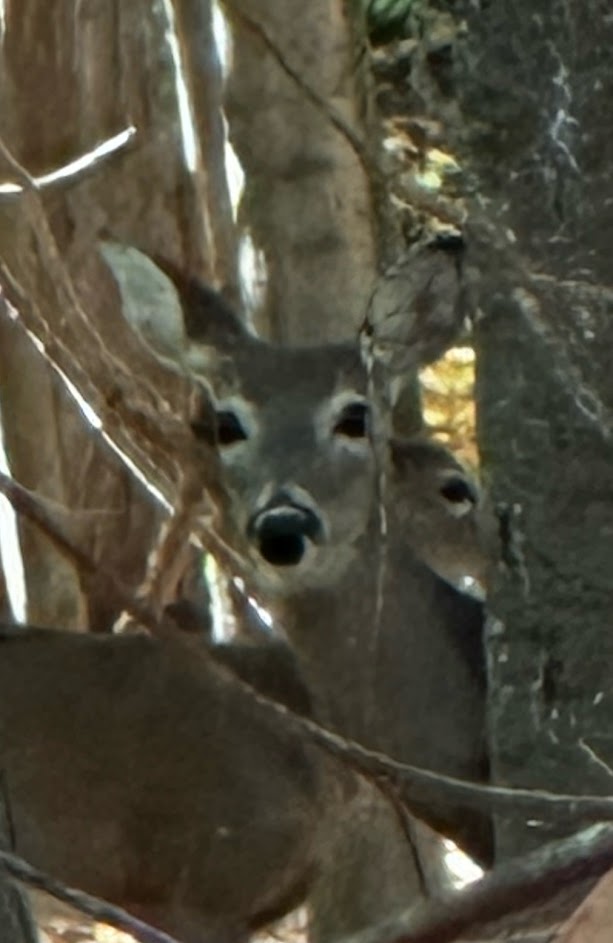
Crossing the large green pasture, we met three deer, looking at us. They always notice you before you see them. They hear the crunch of the leaves under our feet, while they remain quiet in their movements in the forest, avoiding attention from people passing by. And they always stand sideways with their heads turned, looking at us, waiting to see if we’re going to chase them or feed them. We stopped and took some pictures of them facing us sideways. I know the fellow who lives next to the pasture most of the year and feeds the deer. That is why they are friendly towards people.

Kayaking around the lake is a friendly affair; we always chat with people sitting on their decks. And there are the fishermen who talk about the number of fish caught that day. Yesterday, the surprising social event on the water was meeting three women standing in the water. They proudly announced that that day was a record for them in terms of being in the water this late in the season. I admired them for cheerfully chattering, but surely they were suffering the pain of standing in the cold water

But it was time to close the cottage despite the summer-like weather. All the neighbors were gone except a handful of fishermen on the lake.

Closing the cottage is a process that we have done many times, and it follows a routine. I unhooked the seats in the kayaks and pulled them up onto the shore, storing them upside down along with the windsurfers and canoes. I stored the seats and paddles in the storage hut. Covering the outdoor furniture with tarps was next, while Kathy cleared out the main fridge.

The final closing steps are moving all the stuff we take home to the boat and turning off the hot water tank and pump. My friend Jeff drains the water lines and adds antifreeze to the plumbing for winter.  And a local contractor pulls my floating dock around into quiet waters to protect it from breaking from the harsh winter ice.

The last activity is to place mouse poison around the cottage. Every ten years, there is a mouse invasion. We experienced it once and try to avoid it.

We drove the boat slowly to the marina, feeling the sun on our backs and watching the shore, one final enjoyment on the lake this year. Oh, and we’ll have to let the marina know that our propeller needs straightening; we had the misfortune of hitting a rock a week ago in the extremely shallow water resulting from the hot and dry summer.

A Day at the Cottage. Idle Thoughts.

August 28, 2022

The lake was smooth, and I was sipping my first cup of coffee on the deck early in the morning. The grumble of a starting boat engine woke me from my meditation, which is usually to think of nothing. How inconsiderate, waking everybody up at 7 am. The large inboard/outboard ambled out of the bay and slowly coasted down close to the shore in front of me. I was having my second cup when I saw the boat coming back and then turning direction again, with a young male standing at the wheel but not fishing. That was surprising. What was he doing? Then an aluminum boat appeared and circled the other one and the two boaters talked with each other. I thought that was strange, a meeting early morning on the lake. It appeared to me the first boater was waiting for the other and just coasted on the lake until the other one arrived. The Ozark episodes on Netflix came to my mind where drugs were distributed to boats on a lake while a preacher gave a sermon to the anchored boaters. Oh, shut up. Your imagination is running wild. Probably just two friends from Toronto discovered that both have a place on the same lake and arranged to meet.

We came up to the cottage on Birch Island the night before, to relax after family visits and to eat up the leftovers. We did not have anything to carry over to the cottage and did not use the carts at the marina for moving stuff to the boat. But we saw the weekenders had begun to arrive and fill the parking lot. Disturbing was a couple of young people bringing, what looked like a huge sound system. Sound travels far on the lake and we do not cherish late-night parties. A worse scenario is when we see cases of beer carried onto the boats.

But it was a quiet night, and the morning was relaxing on the deck, punctuated by the two motorboats trolling now along the lake in front of me, with the two young people fishing. I decided to go for a walk on the island.

Walking, I came upon one nice cottage and was confronted by its owner standing on the path and bemoaning the loss of shade trees, providing privacy to her cottage.  She told me: “Ontario Hydro cut down my cedars that I planted fifty years ago”. I looked at the cuts that showed tree trunks of over a foot in diameter. Ontario Hydro maintains the right-of-way of the power line paralleling the path by cutting down vegetation along it. I empathized with her but remarked that at least we have electricity here.

With the heat rising by now, the lake beckoned me, and I returned to ponder a swim. My son-in-law brought me a swimming buddy, a red balloon that you tie onto your waist, so the boats can see you in the water. I blew up the swimming buddy, attached it to my waist, and jumped into the water, avoiding the wannabe water skiers.

Life on the water is, to me, the essence of cottage life on a lake. Kathy grew up in Wales on the waterfront close to Porthmadog in Caernarfonshire and I grew up in Hungary, where we spent our summers on the Danube. We both enjoy water-related activities and getting the cottage was a joint venture.

Another favorite activity is dinners with the family on the deck after a day of playing on and in the water. With long daylight and no mosquitoes until sundown, the deck provides the ideal space for freewheeling discussions on career choices for our grandchildren or how much our healthcare system sucks: wait a minute, we discuss both sides of the healthcare challenges we face today.

Tonight, the grandchildren prepared the meal and the third choice was tacos and burritos. It is interesting to me that although I do not cook much, all my children and grandchildren can and some even enjoy cooking. Quite a change from the old days. After the meal, the grandchildren washed the dishes, and under the threat of missing dessert, it is not democratic at the cottage. Sundown and the arrival of mosquitoes pushed us into the cottage. And we heard the loons on our lake providing the background music before the crickets took over.

One needs money and time for a cottage: cottagers are people, in my experience, with an established career and a family. Limited by the seasons and vacation time, people have cottages on our island that stay vacant most of the time. When I survey all this vacant real estate, I think that this is extravagant or perhaps indecent from a societal point of view. I really enjoy it though.