May 20, 2023
Our arrival in Damascus, to ride the Virginia Creeper Trail was exciting. We struggled with the lock on the Vacation Rental by Owner’s (VRBO) door with no success until we turned the knob counterclockwise. With the door open, we faced a large, young woman, staring at us along with two crawling babies on the floor. I am not sure who was more surprised; us or the woman. When we got our breath back, we tried to explain that we had reserved this house and showed the documentation. She was speechless and yelled for her husband who appeared in shorts. He was a huge specimen and we got worried about guns in the house, having read recently people being shot just by driving onto a driveway. The husband explained that he rented this unit for six months and provided us with the name of his contact. We concluded that we had no choice but to leave and find another place to stay. It was seven o’clock by that time, but fortunately, still light.
My daughter Megan, who had made the reservation through VRBO for a “premier” host called VRBO on the phone to find answers. After an hour and a half, VRBO offered money to rent accommodation in the vicinity because they were unable to find accommodations in Damascus for us; we were also told that the unit we had rented had been sold six months earlier, We drove and called around Damascus, searching for vacant units and found the River Trail Cabins had a couple of vacant units which we immediately occupied. These log cabins were exceptionally well appointed with a small kitchen where we cooked our supper and ate it on the verandah, overlooking the trail and the river. A large hot tub was next to the bed, but it was way too late to fill it up to use it.
We had come to Damascus to meet up with our daughter and husband who were on their way to Blacksburg, Virginia to pick up their youngest son from Virginia Tech where he finished his first year of college, and to ride the Virginia Creeper Trail. The Trail starts in Abington, VA, and stretches to Whitetop Mountain in the Rogers National Recreation Area, close to the North Carolina border. It is thirty-four miles long. Damascus is halfway along the trail, from where it climbs 2000 feet.
The right-of-way for the trail goes back to the 1880s when a railroad line was built to haul iron and coal. When the mines were depleted and it became uneconomic, the line was shut down. In 1977, the Norfolk and Western Railroad Company, owner of the rail line, asked the Interstate Commerce Commission to allow the abandonment of the rail line. Soon after the ICC’s approval, the removal of the tracks began, and the right-of-way was turned into a recreation area by the US National Forest Service and the National Park Service. A caboose at the center of Damascus commemorates, and reminds people of, the original purpose of the trail. The trail now accommodates hikers, cyclists, and equestrians, crosses a National Park and the Appalachian trail, as well as many rebuilt trestle bridges.
On our first morning, we walked our bikes down the steep embankment on which the log cabins were built, to find the trail, eager to try it out. We found the trail surface smooth, often with small gravel that was easy to ride. The trail wound its way through Damascus, passing by the SunDog Shuttle service where we inquired about their $25 shuttle service to the end of the line on Whitetop Mountain. We told them we’d be back the next day to experience the 17-mile downhill ride from Whitetop Mountain to Damascus. In the meantime, we decided to cycle up the trail to experience the ride.
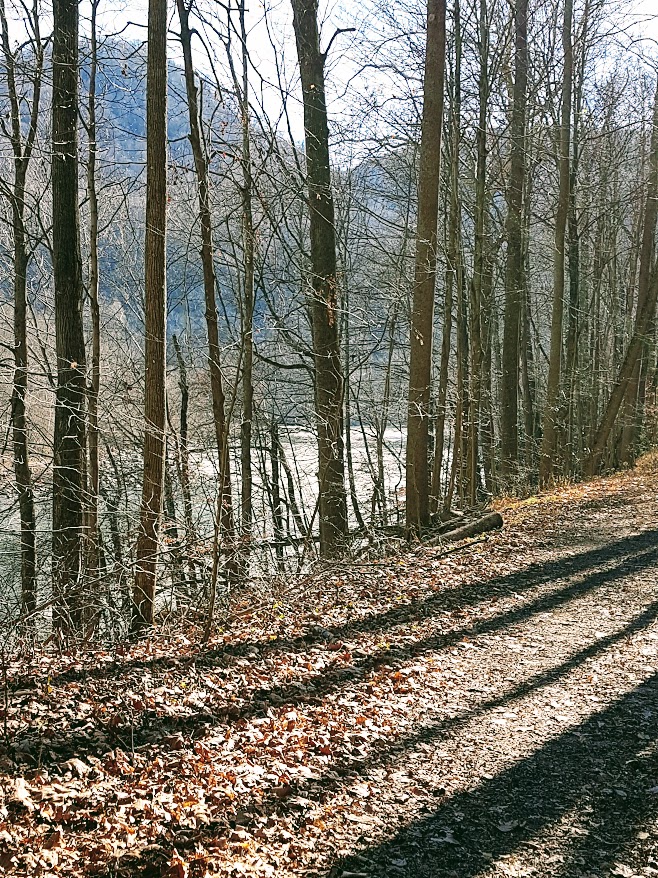
Once we left the town, we rode in a bushy, leafy valley, next to the Laurel River that was maybe fifty feet across, and which looked like whitewater kayaking territory although too shallow for my taste. The river flowed fast over large rocks creating a crashing but relaxing sound. We met some cyclists coming down the trail; it looked like easy riding with the low gradient.
The sun was up creating a dapple effect on the trail that bothered my vision, but also made me sweat although I had only a t-shirt on. We rode for a couple of hours, covered maybe ten miles, and decided to stop and have our lunch on a bench. There was also an outdoor toilet and a parking lot behind us. We realized that it was possible to drive to several points along the trail, park the car and start riding from there.
Turning back towards Damascus, we cranked the pedal of our bikes a few times and rode for considerable distances, coasting much of the way with a slight downhill gradient; the going was easy and provided an opportunity for observing the forest around us. The return trip was fast, we arrived back at our home in less than an hour.
The next day we drove to SunDog Shuttle service and got on the bus with a dozen other passengers with a trailer behind us loaded with our bikes. The friendly driver related stories of cyclists along the trail; one story was funny in that some wild pigs chased one of the cyclists for a quarter of a mile before going back into the forest. The story did not give us a comfortable feeling, hoping we would not meet a wild pig on our ride down the Creeper Trail.
The driver also said that during the once-a-year Appalachian Trail days, up to a hundred thousand people converge in Damascus. The people attending these days are current and past hikers of the Appalachian Trail. The Appalachian Trail days this year are from May 19 to 21; it was a good thing that we did not come at that time; it would have been overly crowded.
On the forty-minute ride to our starting point on Whitetop Mountain we, of course, conversed with our fellow riders, who came from Michigan, Ohio, and North Carolina. One cyclist shared his experience in doing the Trail this last winter that he described as a somewhat freezy trail with icy spots that he had to navigate.
And we were all white-haired! I expected more young people, but I found our fellow cyclists close to our age, and that made me feel very good; this was a mature, recreational cycling crowd. Many people rented bikes at SunDog indicating that they may not have been serious cyclists but came for the experience.
After the requisite photo at the trailhead, in front of the billboard identifying the Trail and distances along the trail, we jumped on our bikes, and we were flying down the slope that had a gradient of five percent. There were some rocky spots and I had to grab tightly the handlebar that almost jumped out of my hands a few times. The first few miles went fast and after half an hour we stopped for a break to catch our breath.
Eleven miles down the trail we found the Creeper’s Trail Café and enjoyed a morning coffee where we met with a group of cyclists from Tennessee; they were part of a walking club in Knoxville and came for a different experience. I engaged with one of the riders who surprised me by showing me his electric bike. I asked him why he would need an e-bike when this trail was all sloping down, would his bike start rolling down too fast? He agreed that he did not need such a bike but back home he rode on hilly terrain.
Further down we stopped for our lunch sitting on a bench and watched the other cyclists go by, waving to them. When passing a cyclist, the typical protocol was to call out “on your left”, when approaching from behind. Everybody followed this routine. We arrived back at the shuttle place in three hours, a seventeen-mile ride with stops. I was not tired, since we rode downhill almost all the time, but my butt was sore from all the bouncing on some rocky parts, and where we crossed the numerous trestle bridges where their beginning and end was a jump up and then down, with our bikes.
SunDog shuttle service has a well-equipped store for cycle equipment and clothing, and I could not resist buying a t-shirt with the Creeper Trail logo, and with text on the back: “You do not stop riding because you get old, you get old because you stop riding”. That was apropos. Good advice!
I would recommend the Virginia Creeper Trail for cyclists of all kinds with a stay at the River Trail Cabins. And have a chat with the people at the SunDog Shuttle service for local color.
 andrasthehun.ca