Building Friendships at the Cottage: A New Perspective

August 1, 2025

We know our neighbors better on the island where our cottage is, than those where we live. I found that curious and made me think why.

Many people go to their summer homes to relax, to leave the city behind, and to be alone to regenerate their physical and mental health. I thought that cottagers prefer to be left alone. But I found the opposite to be the truth.

Before I go any further, I should explain how we arrived purchasing a cottage that may have relevance to my argument. We camped and tented for our vacations in the beginning until our one-year-old child woke up in an inch of water from a downpour one night. This prompted us to purchase a tent trailer, ensuring we would be above ground in case of a storm.

The tent trailer took us to Florida, the west coast (Vancouver), the east coast (Charlottetown) and many camp grounds in Ontario and New York State. The whole family enjoyed traveling and sightseeing with a tent trailer.

However, as the children grew up, summer camps, sports activities, and jobs made it inconvenient to travel with them, and we sold the tent trailer.

At the time I sold the tent trailer, a friend invited us to visit their cottage, and we canoed to their place on an islad. We had so much fun on the lake that day that we stayed overnight, and I decided I must have a cottage on this island. When I found a cottage for sale, I made a stink bid in the fall, a poor time to sell it. Since the couple owning the property was going through a divorce and the wife wanted her share of the money at once, they agreed to sell it. That property had good “bones”, or structure, but was unfinished and needed a lot of work.

The first task with our newly acquired property was to finish the ceiling with the tiles already stacked in the cottage. When mice dropped from the ceiling onto Kathy while she was sleeping in the bedroom, finishing the ceiling became the number one task. Other projects followed, like building steps going up the hill to the cottage, where there was a dirt path that was slippery when wet.

We also joined the local cottagers’ association, a common group in such communities. The primary function of these groups is to have an annual meeting with a BBQ event, providing the opportunity to meet others. At these AGMs, there are also talks about subjects of interest to all, like water filter systems, and how to avoid mosquitoes and ticks. Once the ice is broken, friendships form. A few years ago, there was an even bridge club on the island.

This weekend’s visit with a few neighbors shaped my views on our cottage community. The next-door neighbor from New Jersey invited us for dinner, and the discussion flowed easily despite our diverse backgrounds and lifestyles. We learned more about the neighbors’ families than we ever knew about our neighbors in town.  

Our neighbors from Michigan invited us to their spacious deck that same weekend. During a discussion about where they met, we learned that the man’s Vietnam experience ended with an injury, resulting from a grenade blowing up next to him, with long-term consequences. This neighbor has done a lot of work on his cottage and has accumulated a wide range of construction equipment. I found one of his tools helpful, a heavy-duty jack that I borrowed to lift up my sinking dock.

We paid a visit to another old friend from Pennsylvania. His grandson was there keeping them company. During our visit, another neighbor dropped in and brought a bag of fresh samosas from Toronto. We all had one and admired the new ceiling completed in their large entertainment room.

Never to miss our Canadian friends from Ottawa, we walked over to their immense deck the next day, where they always relax with a book and a glass of wine in the afternoon.

Although socializing is fun, the weekend was also work; Kathy power washed the outside decks, which are substantial, about one thousand square feet, with a wraparound deck extending into steps leading to the waterfront. I used a weed-eater to clear the front and back yards. I shaved the grass to the ground to make sure no ticks would enjoy my yard, ticks thrive in tall grass, and I had some bad experiences with them just a few weeks ago.

Despite seeing these people only during the summer months, I found that we know more about them than we know about our city neighbors. It could be because in town, most people work. In cottage land, people take their time to hang out, relax, and enjoy seeing others doing the same. Vacationing is a good time to make friends, and cottaging offers such an opportunity.
Exploring Point Grey Road: Vancouver’s Luxurious Real Estate

June 2, 2025

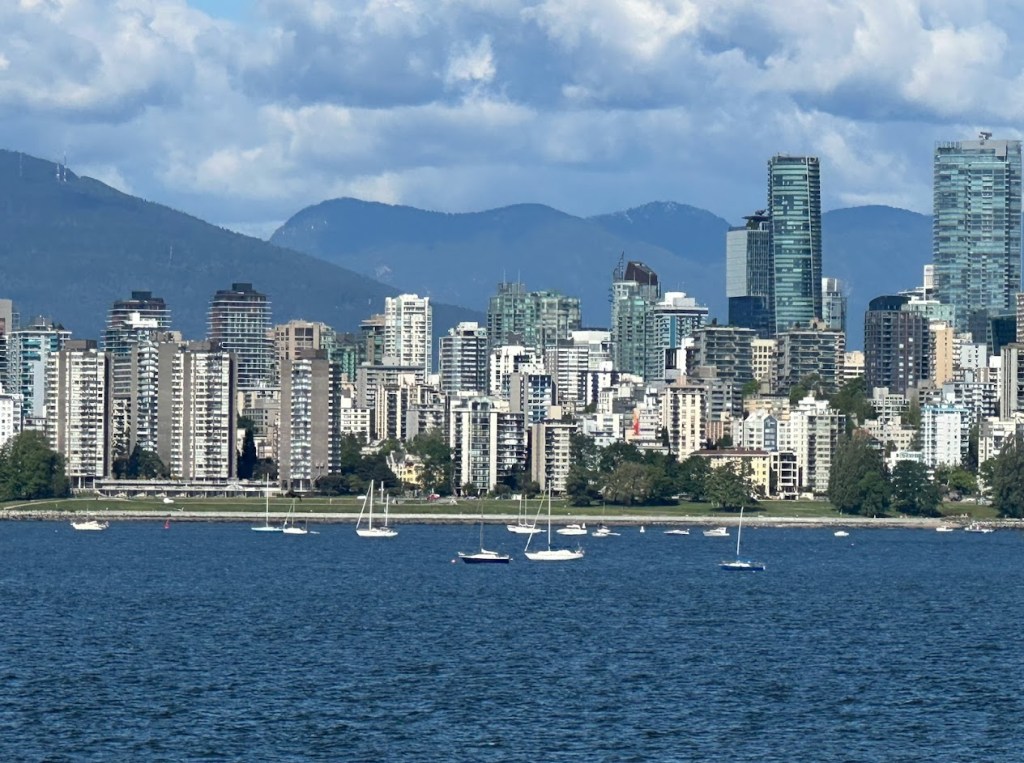
Montreal has Westmount, Toronto has Rosedale, Ottawa has Rockcliffe Village, and Vancouver has Point Grey Road. The north side of Point Grey Road features elegant, architecturally designed residences. This location is attractive due to its expansive ocean views, framed by mountains in the background and Stanley Park across English Bay, highlighting the Vancouver skyline to the east.

Talk about privacy from the road!

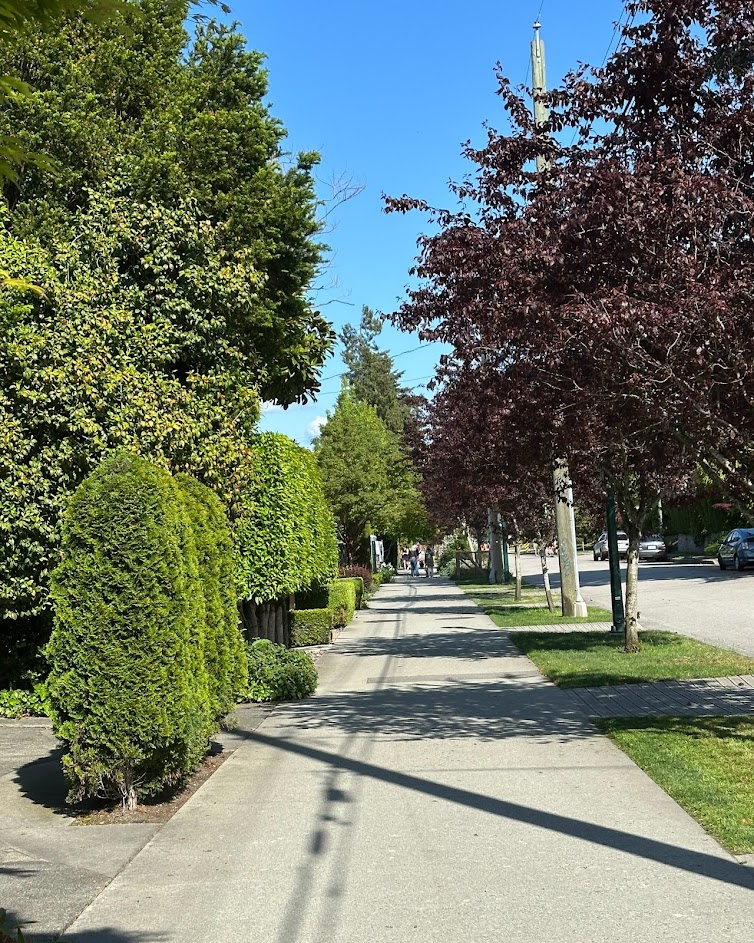
We walked from my brother’s place in Kitsilano to Point Grey Road to explore the area, where the sidewalks were wide, complemented by attractive street furniture, including benches, light posts, and trash cans. The roadway was also spacious, reserved for walkers, joggers, and commuting cyclists traveling from downtown to the University of British Columbia.

   Point Grey Road sidewalk

I understand that Mike Harcourt, a former mayor of Vancouver, envisioned creating a continuous park on the north side of the street. To achieve this, he purchased available residences. He transformed them into parks that front Point Grey Road, extending to the shoreline to provide stunning views of the ocean and the Vancouver skyline. However, homeowners living along Point Grey Road opposed this initiative, and with rising real estate prices, the project ultimately came to a halt.

View from mini-park, the Vancouver skyline

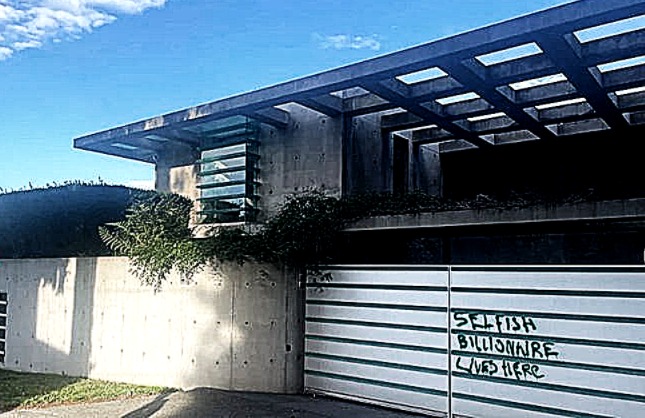
A stroll along the upscale residences made me wonder who owns these homes. I found some online. One notable resident is Chip Wilson, the founder of Lululemon, a popular athleisure clothing brand. His property was valued at over $82 million in 2024, making it one of the most expensive real estate holdings in Canada. While Wilson has gained significant wealth from his clothing line, he has also stirred controversy with some of his comments.

      Chip Wilson’s place, totally private from the road

He faced accusations of racism for the name “Lululemon,” which features three “l’s.” He said he chose this name because he found it amusing to consider how Japanese people would pronounce it, given that there is no “l” in the Japanese alphabet.

Additionally, he was criticized for being “fatphobic” after suggesting that not all women are suited for his designs. He pointed out that women who do not have a gap between their thighs could cause the fabric to become sheer or translucent, leading to backlash for implying that those women were overweight.

People have also slammed him for stating that he has no issue with children working. He mentioned that his children have worked for his company and argued that there is nothing wrong with this. He was specifically referring to Asia, where much of his clothing line is produced by child labor.

His comment reminded me of children we saw in Myanmar, rolling cigarettes, sitting on the floor with inadequate lighting. When I inquired about why children work, I learned that many would starve without their jobs and that, for some, working is preferable to having nothing to do, especially when they are not attending school.

      An architectural home

Dr. David Suzuki is another fascinating figure who lives on Point Grey Road. He had a long-running, popular show on CBC called “The Nature of Things.” As an environmentalist, he advocates for living in harmony with nature. However, I find it hard to reconcile the idea of living in harmony with nature while owning a multimillion-dollar house on Point Grey Road, especially considering that he also possesses two other properties. Nonetheless, his educational broadcasts have been excellent and have been aired in forty countries.

Still, another homeowner on Point Grey Road was Nelson Skalbania, who took a chance on signing the seventeen-year-old Wayne Gretzky to the Indianapolis Racers hockey team and later on starring withe the Edmonton Oilers. As we know today, Gretzky has become arguably the greatest hockey player in history. The team’s owner, Skalbania, was interested in sports franchises; he bought and sold teams and even purchased the Atlanta Flames before relocating them to Calgary.

Continuing with the hockey theme, Trevor Linden owns a house on Point Grey Road. He played for the Vancouver Canucks and served as team captain and General Manager after his playing career ended.

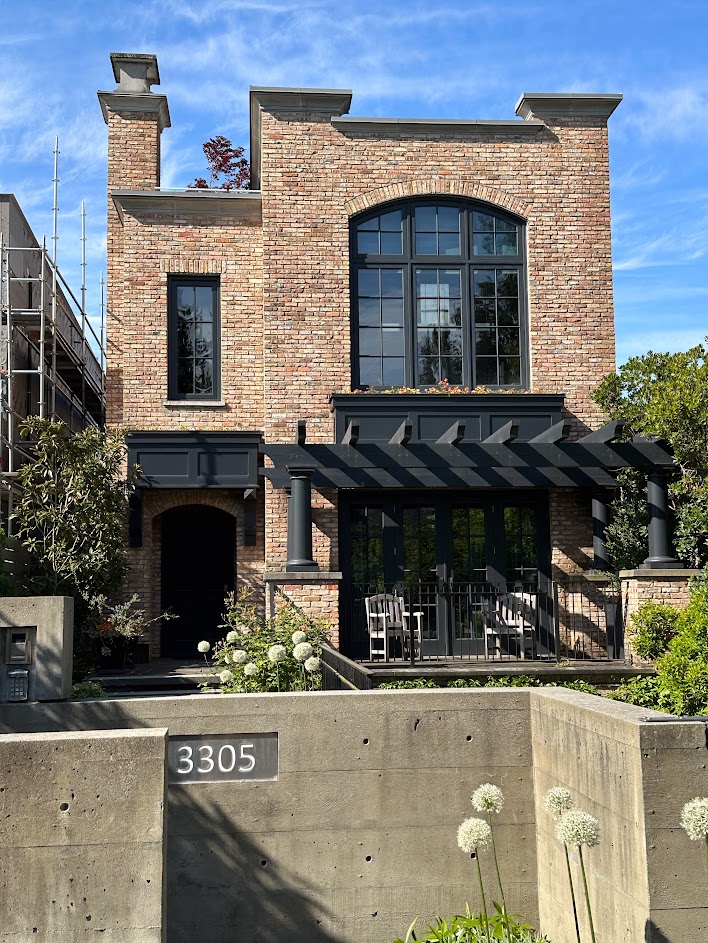
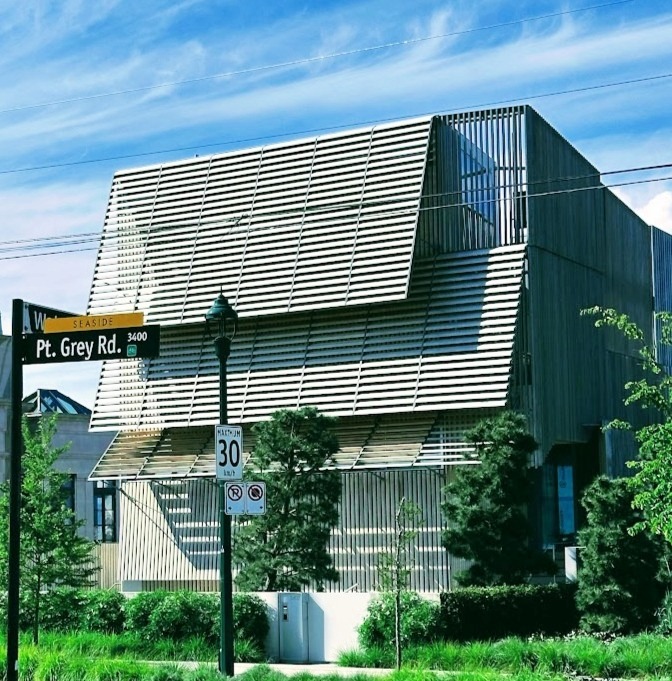
Strolling along, I took a picture of what I thought was a very attractive house. After searching online, I discovered that it was designed by one of my classmates from the School of Architecture at the University of British Columbia in the 1960s. Paul Merrick was an exceptionally talented designer during our time in architecture school, and he established his firm in Vancouver after graduation. The article I read on this residence did not mention the owner’s name.

Designed by Paul Merrick

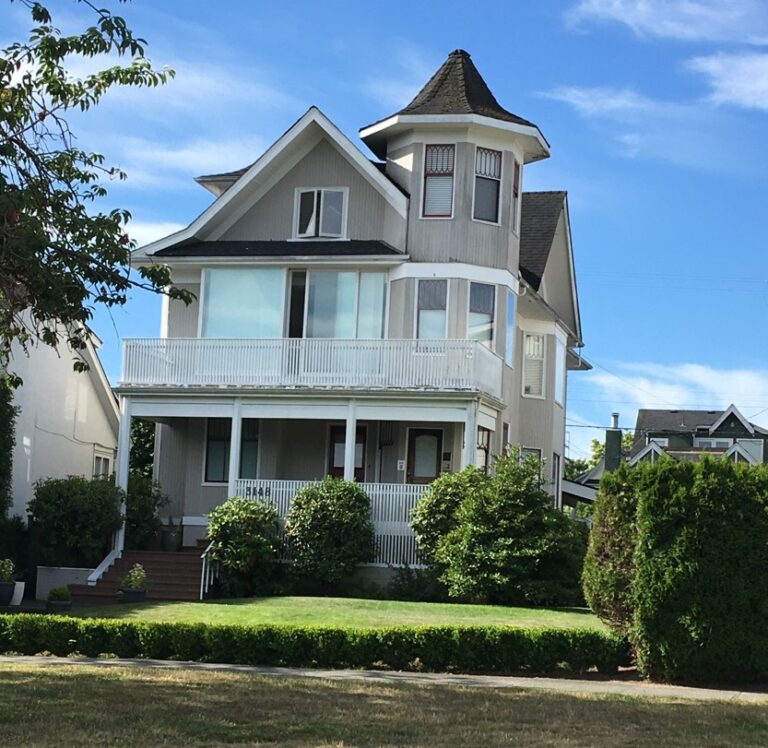
Another renovated old house on the south side of Point Grey Road, at number 3148, is known as the “Peace House.” The name originates from its use during the 1960s by peace activists who lived there and protested against the storage of nuclear weapons at the Comox RCAF base. This house also attracted the wandering hippie crowd of the era, known as the Love-In Generation, including notable figures such as Timothy Leary, the Grateful Dead, who even performed a concert there, Baba Ram Dass, and Allen Ginsberg. Recognizing these names indeed reveals my age!

The “Peace House”

These beautiful, high-value homes are designed by architects and surrounded by meticulously maintained landscaped yards. I thought it would be a great experience to visit these homes inside. Would the homeowners be willing to open their houses for viewing?

Exploring Granville Island: A Vibrant Vancouver Destination

May 29, 2025

Granville Island is a vibrant thirty-five-acre urban district located under the Burrard Bridge in Vancouver. Due to limited parking, we chose to take an Uber to get there. Granville Island is the most visited tourist destination in Canada after Niagara Falls, attracting over ten million visitors each year.


The sandbar that is now Granville Island was a traditional fishing site for the Squamish and Musqueam tribes. The early 1900s saw industry’s expansion into the land, supporting the maritime and lumber industries. Until 1972, hobos lived on the island before the federal government took control. Ron Basford, the minister responsible for the lands, envisioned redeveloping the area while preserving the original buildings and businesses. His vision ultimately grew into a roaring success.

There are no sidewalks here; the planners envisioned a pedestrian district. The streets are narrow, filled with throngs of people moving through the walkways. There are also three thousand people working on the Island. Cars move extremely slowly along the crowded streets. We initially thought a line of vehicles on the main street was a parking lot, but then the cars began to move—it was not a parking lot after all.


The taxi dropped us off at the Public Market, a large, renovated warehouse filled with a variety of merchants. The market features bakeries, fruit and vegetable stands, butchers, as well as specialty cheese and international food vendors. After noticing a lineup at the BC salmon seller, we decided to purchase some in a freeze-dried bag to take home. Of course, we couldn’t resist getting fresh, sweet cinnamon buns from a local bakery, so we hurried over to a roaster for their exceptional coffee to enjoy with the buns. There was a line at the coffee shop as well. We learned that all fifty merchants in the Public Market are local, and no chain stores are allowed.


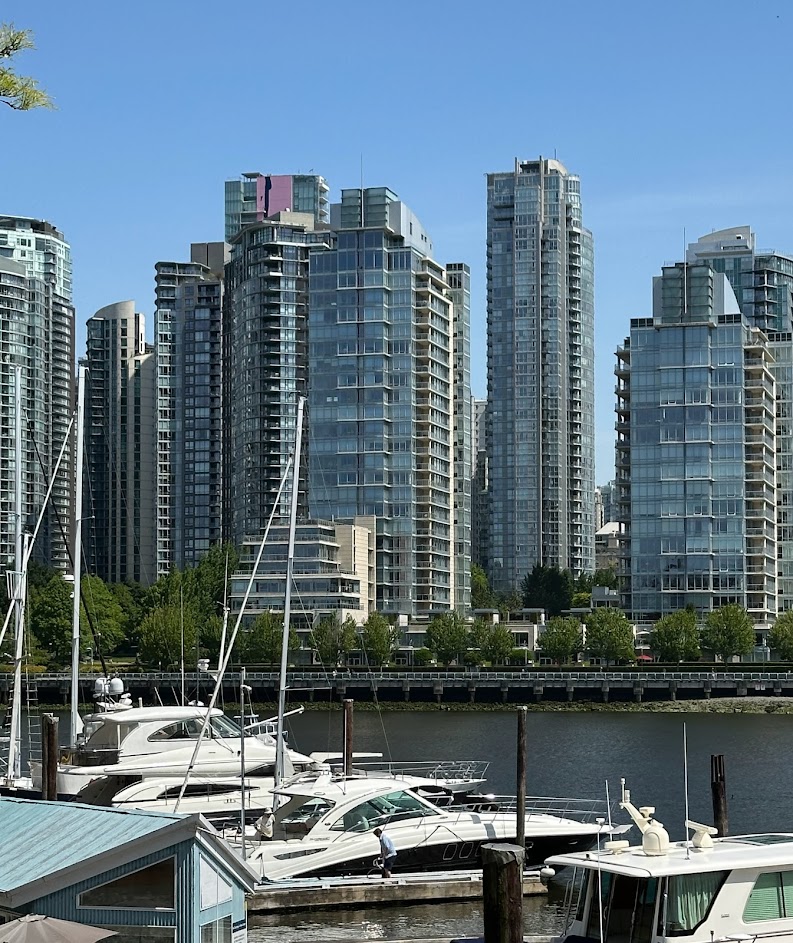
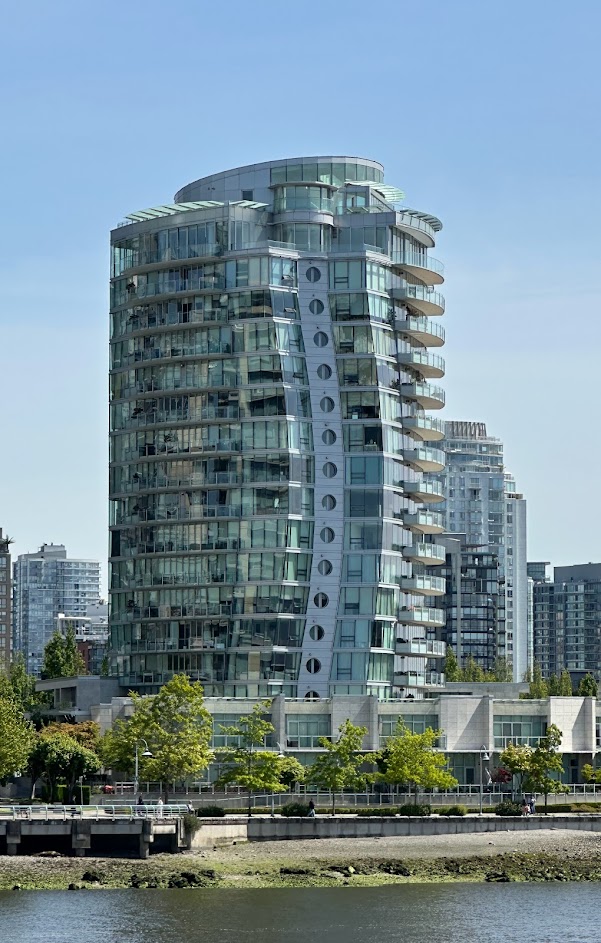
To enjoy our sweets and coffee, we sat in the outdoor plaza outside the Public Market on the waterfront. The skyline of downtown Vancouver stretched before us, resembling a mushroom of high-rise buildings with attractive designs. Each unit appeared to have a balcony, allowing residents to take advantage of the surrounding views. Among them was a distinctive high-rise designed by Arthur Erickson, one of Canada’s most renowned architects. This unique apartment building bulges in the middle, making it an eye-catching sight. Although it may seem unusual, it stands out from the typical apartment towers.

As we walked along the waterfront, we noticed several houseboats tied up at the dock. Interestingly, most of these houseboats are two stories high and seem to be permanently moored to the shore. It makes you wonder what it would be like to live on a houseboat in downtown Vancouver. Would the residents have children? There are no schools or playgrounds on the island, although educational facilities are available on the mainland. Is this lifestyle suited only for adults?


There are two rows of boats tied up—one along the wall and the other tied to the first row of houseboats. I wonder if the first row of houseboats, which is next to the shoreline, is cheaper to dock but lacks a view because the second row of boats is parked in front of them. The density of the boats is so great that they are touching each other! Is there any privacy here? One would assume that good neighborly relations would naturally develop.


As we walked between renovated buildings, we passed restaurants, a community center, and many performing arts theaters. The Emily Carr University of Art and Design is also located there. We walked by the Granville Island Brewery, but it was too early for a beer.


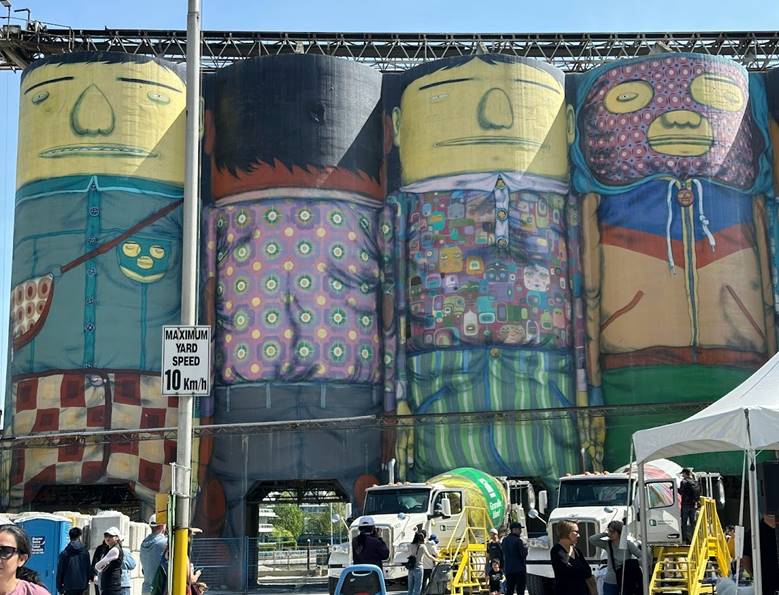
Forties music drew us to a large plaza in front of the Ocean Concrete Company, the longest-established tenant on the Island since 1917. This cement factory features concrete silos decorated with a colorful mural by the Portuguese brothers Pandolfo, titled “Giant.” Despite the huge cement trucks parked in front, the mural made the industrial neighborhood feel more appealing. The music was coming from an outdoor free concert performed by the Firemen’s seventeen-piece band. We stood and listened to my favorite style of music until a few chairs became available in the plaza, allowing us to sit down.


Leaving the music behind, we walked along the waterfront, taking in the views of Vancouver’s skyline and False Creek. The wooden boardwalk felt comfortable under our feet. As we strolled, we passed by an upscale waterfront restaurant that is part of the luxurious Granville Island Hotel, our destination from which we called an Uber to return home.


Although we spent only a few hours on the Island, we could have easily spent the entire day exploring the galleries and studios of local artists, visiting the cement factory that offers tours, and enjoying the brewery.
The mixed land uses, the variety of local shops, the vibrant arts scene, and the bustling crowds reminded me of Jane Jacobs’ ideas about urban environments. Her philosophy is detailed in her bestselling book, “The Death and Life of Great American Cities,” published in 1961. Jacobs advocated for the renovation of old districts by preserving buildings, promoting mixed land uses, and encouraging high-density living with numerous streets to create dynamic urban spaces. She vehemently opposed urban renewal and redevelopment, especially those led by professional planners, favoring instead organic growth guided by local communities. Granville Island serves as a prime example of her principles in action.

Traveling on the Boeing 737 Max: A Passenger’s Perspective

July 9, 2024

The travel agent booked us a flight from Ottawa to Vancouver. It was a non-stop flight. That is what I like. However, I discovered the plane was a Boeing 737 Max when I received the itinerary. The infamous one. You remember? That model crashed twice, once in 2018 (Lion Air Indonesian Airline) and once in 2019 (Ethiopian Airlines), where 346 people died. After the crashes, all flying authorities banned the plane; all airlines grounded the 737 Max aircraft, and a whole set of studies began to identify the causes.

All 737 Max’s sat on the ground for almost two years; after substantial changes and modifications to these planes, some authorities and airlines eased up, and the aircraft flew again. The studies indicated that the company rushed the plane’s production to compete with other similarly designed planes and indulged in cost-cutting measures without attention to safety. Subsequently, the company changed its executive suite, the CEO left, and the company paid over $2.5 billion to the victims, to the airlines inconvenienced by the grounding of the planes and a penalty. The 737 Max was back in production and flying again by 2021.

The travel agent assured me that the plane was safe. She said the 737 Max was probably the most studied and safest plane today. She did not mention that a 737 Max lost a panel (a door plug) off the fuselage on an Alaska Airlines flight in January, forcing the plane to an emergency landing.

Did her opinion make me feel good about the safety of the aircraft? I am not sure, but we had tickets on it. At any rate, what options did we have? Should we look for another flight, airline, or route that avoids the 737 Max? Should we cancel our trip?

My thoughts raced around flying on this airplane, including the possibility of crashing. But why worry if all authorities and airlines are comfortable with this plane? In the end, we boarded the plane.

The Boeing 737 Max is a narrow-bodied plane with a three-plus-three-seat configuration. The seats are 18 inches wide, while the aisle is twenty inches wide. Up front, there are sixteen first-class seats in four rows, followed by 159 economy seats, separated by a bulkhead from the premier seats.

The travel agent booked us on an aisle and a window seat behind the bulkhead, explaining that middle seats are the least popular and that we may find additional space between us should the middle seat stay unoccupied. The idea did not work out this time; the plane was packed, and we had a pleasant gentleman watching adventure movies during the flight to Vancouver.

The toilet up front, only five rows ahead from the bulkhead where we sat, was strictly for first-class passengers. Economy-class passengers had toilets in the back of the plane, meaning we had to walk back twenty-five rows. To add insult to injury, the sixteen first-class people had one toilet while we, economy-class people, while 159 economy-class passengers had two.

You can draw any number of conclusions, but most people use a washroom at least once during a five-hour flight. When I visited the toilet, there was a lineup at the back of the plane along the narrow aisle. I thought I would never reserve a seat at the end of this plane.

What was interesting and disturbing was that the two toilets in the back of the airplane were adjacent to the food trucks. I thought this layout would not pass food inspectors in our city. I assume the reason for putting the service area next to the toilets was an efficient and tight layout design.

But wait a minute; I am not finished with the toilets yet. Let me say that while waiting my turn, I noticed some people turning sideways to enter the toilet. The door to the bathroom was narrow. Someone entered the toilet, backing into it, figuring there may not be enough room to turn around inside!

I also intuitively thought there was something unfair about first-class ticket holders receiving quick access to toilets while others, sitting in the back of the bus—sorry, back of the plane—line up for a toilet visit. We are people with similar natural needs, and the waiting time for a toilet should be identical.  

On the other hand, the service was excellent except for the slowdowns when the food trucks had to back up, letting people attend to their toilet needs in the narrow aisle of the economy class. The narrow aisles also made it difficult to pass each other.

I read that the Boeing 737 Max has been a commercial success. Air Canada has forty aircraft, and many more are on order. I wish, though, that the designers rethink the airplane’s layout to provide better access to toilets for all classes of passengers.

I also read today that Boeing admitted to mismanagement, resulting in a couple of crashes to avoid being sued in court (July 8, 2024).

Flying from Ottawa to Portland: My Travel Experience

July 3, 2024

Although some people are used to flying and to the hurly-burly of moving through airports, I found it a pain in the butt flying from Ottawa, ON, to Vancouver, BC, and then to Portland, OR, and back. The entire experience, especially clearing security, which I found a bracing experience, only reinforced my dislike for flying.

Preparations for our flight started a few days before departure. I set the alarm clock for four a.m. to get used to an early start. I wanted to make sure the alarm clock worked, and it did. Such an early morning start is not my typical schedule.

I reserved a taxi to take us to the airport the night before but was worried about what would happen if it did not come. In that case, I thought of taking our car to the long-term parking lot and hauling our suitcases a mile to the airport. But the taxi came and messaged me fifteen minutes before the reserved time that it was on the way and again when parked on our driveway. Impressive.

Leaving our house involves shutting off the water main in case of a leak that may flood the basement and installing the alarm system. Since I did not want to carry my heavy keychain on the trip, I left a key hidden in the garage but also put a house key in my wallet in case the electricity would be off coming home, making the garage door inoperable, in which case I would use the key in my wallet to open the front door of the house. I think of all the situations that could go wrong; maybe I am paranoid.

Arriving at the departure lounge, I showed the airline attendant our boarding passes, printed at home, and asked what we needed to do next. She asked if we wanted to use the self-serve kiosks or talk to someone to get our luggage tags. I found her question strange: why would she not just help us? She seemed as if she did not want to be bothered by passengers before six am. However, hearing our conversation, a colleague quickly came forward and offered help with a smile.

After this rude welcome, though, the airline attendants were excellent during the rest of the trip, including subsequent legs with the same airline. For example, when paying for a sandwich on the plane, the stewardess noticed my Aeroplan card in my wallet and recorded the card number for the purchase, adding points to my account.

Next came the security check. I hate putting my wallet and passport on the long conveyor belt, afraid of losing or someone stealing them, which could happen when they pat me down looking for the metal in my body. I usually point to my hips, where I had joint replacements, to help security staff locate the metal. I know there is no need to do that since they use a wand to pat down my entire body, but I feel better by trying to help them. I walked through the x-ray machine, and an agent patted me down with a wand for fifteen minutes. Then, he asked me to lean against the wall and lift my shoes’ soles for visual inspection.

In contrast, the security check was more detailed on the trip’s second leg from Vancouver to Portland. The inspectors opened my carry-on suitcase, and my “Kindle” enjoyed a second trip through the X-ray machine. I always place my laptop in a basket, but they told me at the Ottawa airport that I did not have to take out my Kindle and put it in a basket since it only has a virtual keyboard! Then, they also removed my toiletry case, extracted a Swiss knife and a brand-new shaving foam container, and confiscated both items; I should have known not to carry them in the carry-on. They also asked me to remove my shoes and belt.

Instead of the walk-through X-ray machine at the Vancouver airport, I stepped into a surround X-ray machine that showed all the metal inside me to security so the inspectors did not pat me down. That saved over fifteen minutes. The only uncomfortable feeling I had was my pants were sliding off without the belt; I had to pull them up every few minutes.

The two experiences made me consider whether the security procedure is the same at every airport. I would bet that it is a standard procedure, except that its administration was different: the security was sloppy in Ottawa.

Do not get me wrong; I understand the need for security, but how it is delivered seems to invade your privacy. The inspectors see your meds and toiletries, which I may not want to share with anyone. It also takes time, and I am nervous about having my wallet and passport on the conveyor belt for a considerable amount of time while they x-ray me.

Having gone through security, we walked into the waiting room, the next phase of air travel that often brings unpleasant surprises, such as an announcement of a delay on one of our flights on our return trip. The uncertainty and waiting can be frustrating, adding to my dislike of flying.

On arrival, we had to find the baggage claim area. For some reason, the baggage claim area was the farthest from the landing gates at both the Vancouver and Portland airports.

Reflecting on our recent experience of how long it takes to get to the airport, go through security, experience delayed departures, wait for baggage pickup at the destination, and then grab a cab to where we stay, I would rather drive for shorter trips. The convenience and control of driving often outweigh the hassles of flying unless it is a cross-country trip.