Reflections on the 1956 Hungarian Uprising Remembrance

October 28, 2025

This week, I attended a flag-raising ceremony commemorating the sixty-ninth anniversary of the Hungarian uprising of October 23, 1956, at Ottawa City Hall. I looked forward to meeting some grey-haired Hungarian refugees, with whom I could make contact, talk about the old country, and share our experiences in Canada.

About fifty people showed up for the ceremony. I did hear a few people speaking Hungarian, chatting in small groups. They seemed happy to talk with each other. I went by myself, looking for some social interaction and discussion. Still, nobody seemed interested in making contact, even though I walked around and tried to break into conversations.  

When I found a young fellow standing by himself, I asked him if he was Hungarian. To my surprise, he said he was an RCMP officer. I wondered if he was on an assignment to ensure security at the event, requested because staff from the Hungarian Embassy and other diplomats were in attendance. the event organizers.

Another person I approached was a black woman who, with a friendly smile, explained  with a friendly smile that she was with the Nigerian Embassy and had been invited to this event. I found myself confused; while I understood the logic behind inviting certain European nations, I questioned the inclusion of African countries. Nevertheless, she was charming, and we talked about Africa and my trip to Tanzania.  

Although the flag-raising was outside, due to inclement weather, the group moved to City Hall first to listen to the speeches by the dignitaries. The small conference room inside was insufficient to seat everyone, so I stood in the hallway listening to the speakers.

The Deputy Mayor, Sean Devine, who, by the way, is my local City Councilor, opened the ceremony. He paid tribute to the courageous Hungarians who perished during the 1956 uprising and commented on the contributions the refugees made to Canada. Although Sean did not mention it, well-known people such as Anna Porter, a writer and publisher, and Robert Lantos, a film director, were fifty-sixers, among others.

Ms. Katalin Haas, Charge d’Affaires at the Hungarian Embassy, spoke about the significance of the 1956 rebellion and invited representatives of the Canada-Hungary Parliamentary Friendship Group and a representative of Global Affairs Canada to speak.

Many speakers mentioned the 38,000 people who arrived in Canada after the uprising looking for freedom and dignity and the over 300,000 people of Hungarian descent now residing here. All the speakers emphasized the Hungarian people’s desire for freedom and dignity.  

Adam van Koeverdan, Co-Chair of the Canada-Hungary Friendship Group, spoke about his mother, who escaped Hungary during the uprising. That made me feel old. I was sixteen years old when I fled Hungary, and he was talking about his mother! Further indicating my age was a group of young people talking about being fourth-generation Hungarians. I felt ancient by that time.

The speeches were well delivered but seemed hollow to me, as the speakers lacked a fundamental understanding of the nature of life in Hungary in the 1950s that sparked the rebellion. None of the speakers had firsthand experience of life in Hungary at the time of the rebellion. The speakers’ comments were sincere but lacked the emotional gravity that people with direct experience could have brought.

For example, I remember when our neighbor in the apartment house where we lived disappeared one night, and nobody said anything about it. Nobody raised any questions. Or when my father, a medical doctor, was called many nights to patch up people caught trying to break through the Iron Curtain or swim across Lake Ferto. Or when my brother, a student in Budapest, walked home to Sopron, a distance of 200 kilometers, when the revolution broke out. During the uprising, the absence of cell phones or live communication made it difficult to receive updates from him for several days. This lack of information caused considerable concern among our family about his safety. The family feared the worst. After coming home from school one day, our mother told Peter and me to set off along the highway to Vienna, each of us carrying a sandwich in our backpacks, a memory that has stayed with me ever since.  

I thought that a few refugees talking about their escape, or a film showing the tanks in Budapet crawling with students during the uprising, would have been relevant and impactful. However, I recognise that the objective of the ceremony was to honour those who lost their lives, rather than revisit the events of the uprising. Those people attending who were old enough to witness the rebellion personally may not have felt completely satisfied. I wondered, how many of us oldtimers attended?
The Advent Worship in Clemmons, North Carolina

December 4, 2022

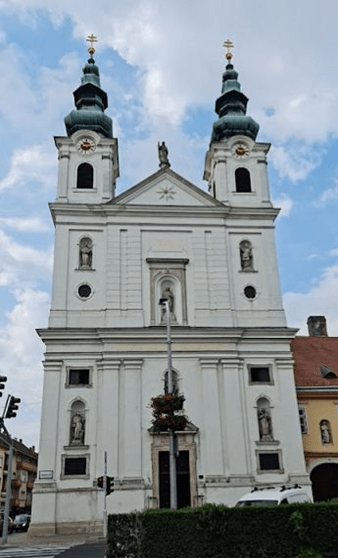
St. Judas Thaddeus Church in Sopron, Hungary

I have never been a church-going person except in my youth when my father, who went to a Jesuit school, made us go to church on holy days like Xmas and Easter.

My memory of going to the old baroque church in Sopron, Hungary – St. Judas Thaddeus, built by the Dominicans in 1715 – is not pleasant (see picture on left). The huge nave of the church was a forbidding, gloomy space for a small kid. It was cold inside with a stone floor.

Nobody received us at the entrance lobby; nobody led us inside. I stood for the service at the back of the church, listening to the sermon; that gave me a quick getaway if I got too cold or bored by the service.

The sermon and the entire mass were in Latin, which I could not understand. (The Catholic Church required that Mass be carried out in Latin until the Second Vatican Council of 1962–1965, which permitted the use of the vernacular.)

And the priest dressed in ecclesiastical clothing for delivering the sermon, giving him – and it was always a “him” – a formal appearance, talking down to us from the pulpit ten feet above us.

And, of course, we had the confessionals in little cubicles on the side of the nave of the church, where it was dark and I had to kneel in front of a wire screen behind which was the priest listening to your sins which were related to disobeying your parents and swearing using religious imagery.

 The salvation for my “mortal” sins, prescribed by the priest, was always saying a prayer fifty times or more, depending on the gravity and length of the list of my sins. I always thought the confessional was a good bargain to repent your “mortal” sins; it never took longer than a half hour to get back on the good side of the Lord.

Once I repented my sins, I lined up for communion wafers, the “sacramental bread”, that tasted good. Then we were free to leave the church.

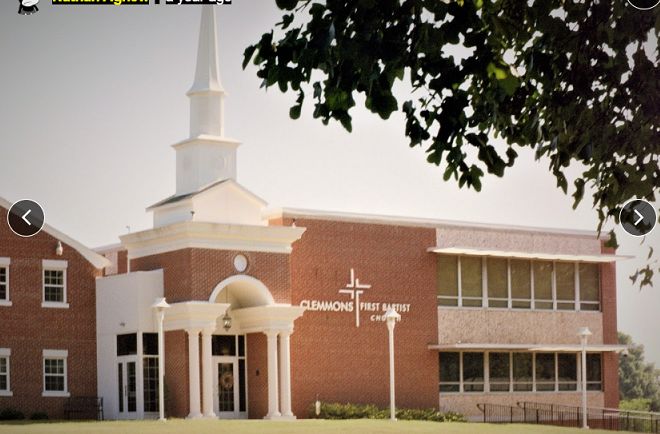
Clemmons First Baptist Church, Clemmons, North Carolina

I encountered a huge contrast to my experience with my baroque church when we visited our family at the end of November in Winston-Salem NC, and joined them for Sunday service at Clemmons First Baptist Church (see picture on left), on the last Sunday of the month, the beginning of Advent.

We entered the modern building with a red-brick façade, where smiling people welcomed us into the well-lighted and comfortable lobby and ushered us into the nave of the church to padded pews.

I felt like I was in a large living room entering the lobby and once we sat down, lively conversation filled the church until the service started. The Pastor welcomed the attending children, and the organist played hymns with the text shown on two gigantic video screens over the stage so that we did not have to pick up the hymn books to follow the songs.

All the people were informally dressed. The Pastor showed up in slacks and a sweater and gave a sermon from notes, speaking freely most of the time.

The Pastor addressed the meaning of Advent by asking us to look at our state in life to make sure we are ready for the second coming of Jesus. He illustrated his point by talking about himself getting old, although he said he is 44 years old; to me, he is a young man. But he said he feels his age when getting up “from a toilet seat”, eliciting laughter from the audience. He added that now one can install higher toilet seats to help with that. This type of informal sermonizing made me feel quite comfortable.

Then the Pastor, in a more serious vein, talked about embracing silence, meditation, and the healing power of nature. I felt quite at home by now: we just came from the New River National Park in West Virginia, where we spent a few days hiking and enjoying nature in silence.

He said there is no need to push yourself to get ready for the second coming by reading the scriptures. Instead, he said, wait until the desire to do so comes from within yourself. I liked his low-key approach to religion; embrace religion when you are ready for it. I was ready to join the church!

At the end of the worship, we followed the Pastor, who walked into the lobby to welcome the audience. I told him how much I enjoyed his sermon, shaking hands with him.

I noticed a board in the lobby with pictures of a dozen deacons (members of the church); I learned that all the families frequenting this church have a deacon who follows their well-being and provides help when needed. For example, should someone get sick and not be able to cook, the deacon would organize members of the church to bring over food. My brother-in-law is a deacon here. I thought the deacons performed an important and valuable role.

If we had had churches like the Clemmons First Baptist Church when I was growing up, I may have been a lifelong churchgoer.