Exploring the Ismaili Imamat: A Cultural Landmark in Ottawa

June 13, 2025

The Canadian Headquarters of the Aga Khan, known as the Delegation of the Ismaili Imamat, is situated at 199 Sussex Drive in Ottawa. The Ottawa Imamat itself is a secular building. However, the Aga Khan serves as the spiritual and hereditary leader of the Nizari Ismaili branch of Shia Islam, tracing his ancestry back to Muhammad.

The Delegation of the Ismaili Imamat Building on Sussex Drive

The Aga Khan once noted that, in the West, religion is often viewed separately from social and economic initiatives. In contrast, the Ismaili tradition sees helping the poor and fostering connections between people and cultures as integral to the practice of religion.

Sussex Drive, often referred to as the “ceremonial route,” is also home to the embassies of Kuwait, Saudi Arabia, France, and Japan. The award-winning National Gallery, designed by Moshe Safdie, is located nearby, adjacent to the Canadian Mint and across from the Notre-Dame Cathedral Basilica. Additionally, the Prime Minister’s official residence is located at 24 Sussex Drive, which is currently awaiting renovations.

The arrival of the Ismailis in Canada goes back to Pierre Trudeau, a friend of the Aga Khan IV, invited the Ismaili community to Canada when Idi Amin expelled them from Uganda. Currently, approximately 2,000 Ismailis reside in Ottawa and around 80,000 across Canada, out of a global population of approximately fifteen million.

The architecture of the Imamat left a lasting impression on me during my visit. Designed by the Pritzker Prize-winning Japanese architect Fumihiko Maki, the project originated from a three-page letter from the Aga Khan, in which he requested Maki to design the building. He sought a design concept inspired by the visual qualities of rock crystal, emphasizing its transparency, translucency, and opacity.

Maki and his team carefully analyzed the letter to grasp the Aga Khan’s intentions fully. To gain further insight into the characteristics of a crystal, Maki even brought his wife’s diamond ring into the office to study its reflections from different angles. The Aga Khan’s request was for the building to be mysterious, esoteric, and intriguing, yet aesthetically pleasing, incorporating themes of Islamic architecture.

The Imamat features a large atrium crowned with a multi-faceted dome and includes a courtyard that contains an Islamic garden known as a Char Bagh. Additionally, the building provides office space for the staff of the Aga Khan Development Network (AKDN) and serves as a residence for the Aga Khan when he visits Ottawa.

The AKDN operates numerous educational, conservation, social, and economic programs in Africa and Asia, spending approximately one billion dollars annually. For instance, AKDN founded a university in Karachi, which initially focused on Islamic studies but has since expanded to include liberal arts education. Additionally, the organization has launched a microfinance program designed to support small businesses. This emphasis on helping the less fortunate aligns with the objectives of the Ismaili sect.

Related to the Aga Khan’s interest in architecture, he established a triennial architectural competition for works of Islamic design, including residential, religious, and conservation projects.
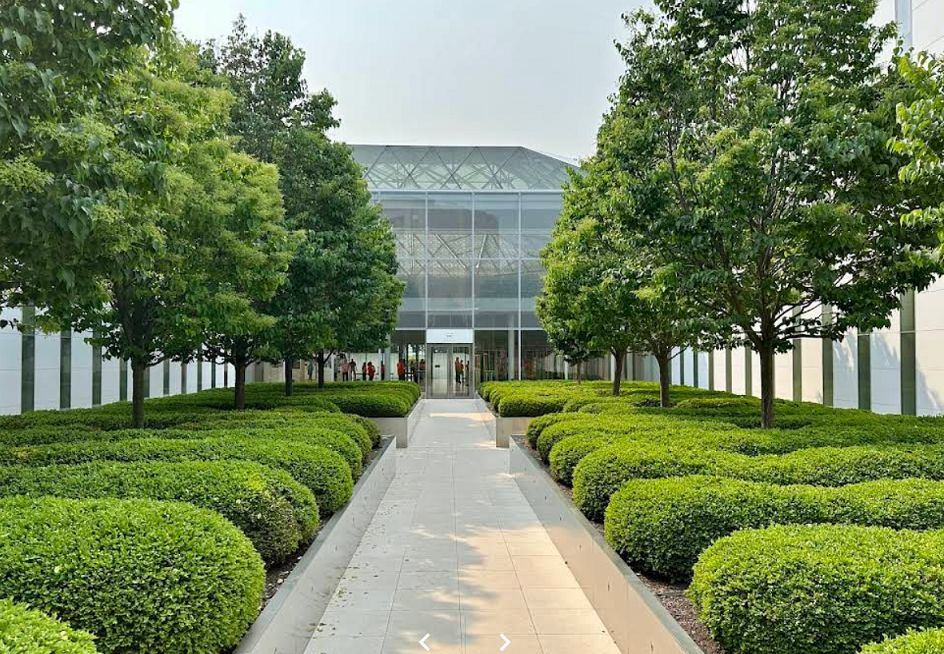
The Char Bagh

The purpose of the atrium is to host conferences, meetings, and study groups that focus on improving the condition of humankind worldwide. It features a patterned screen made of cast aluminum that reflects themes of Muslim architecture. The atrium’s floor is composed of maple wood tiles arranged in a seven-square pattern in both directions, with each square approximately ten feet by ten feet. This configuration results in a total of forty-nine squares, symbolizing that the current Aga Khan IV is the forty-ninth Imam of the Nizari Isma’ili sect. The use of mathematical concepts also serves as a symbol in Islamic architecture, reminiscent of the mathematical ratios seen in the gardens of the Taj Mahal.

The three-layered glass dome, composed of panels in various shapes, illuminates the atrium while diffusing direct light through a patterned layer of glass. The glass panels attach directly to the structural frame without the use of hardware. The design of the dome originated in Toronto, with the glass sourced from Austria, the structural steel from Poland, and the panels fabricated in Germany. The construction was completed in Canada. The multi-sourcing of the dome represents “pluralism,” a core principle of Ismaili Shia philosophy.

When I visited the Imamat, I felt relaxed as if I was at home. The parquet-like maple flooring created a warm ambiance, and the filtered lighting was visually soft. The hexagonal pattern of the cast aluminum screens hanging around the walls added a sense of enclosure and intimacy. People were seated around the perimeter of the atrium on large, comfortable couches, enjoying the peaceful atmosphere.

The acoustics in the atrium were excellent, even with many people conversing. The wood floor, screen wall, and triple glass ceiling effectively absorbed sound. The gentle buzz of conversation in this relaxing environment was pleasant, leading me to reflect on the life of Aga Khan IV, who passed away in February 2025.

I learned from the tour guides on the floor that he was born in Switzerland and held citizenship in that country, as well as in the UK, France, and Portugal. He was also an honorary citizen of Canada. In his youth, he was part of the Iranian Olympic skiing team and later earned a degree in Islamic studies from Harvard University. Throughout his life, he became a prominent horse breeder and achieved significant success in business, with his estimated wealth reaching around $12 billion as of 2024.

If you find yourself in Ottawa, I recommend visiting the Imamat not only to appreciate its stunning architecture but also to gain intellectual insight by learning more about the Ismaili community.

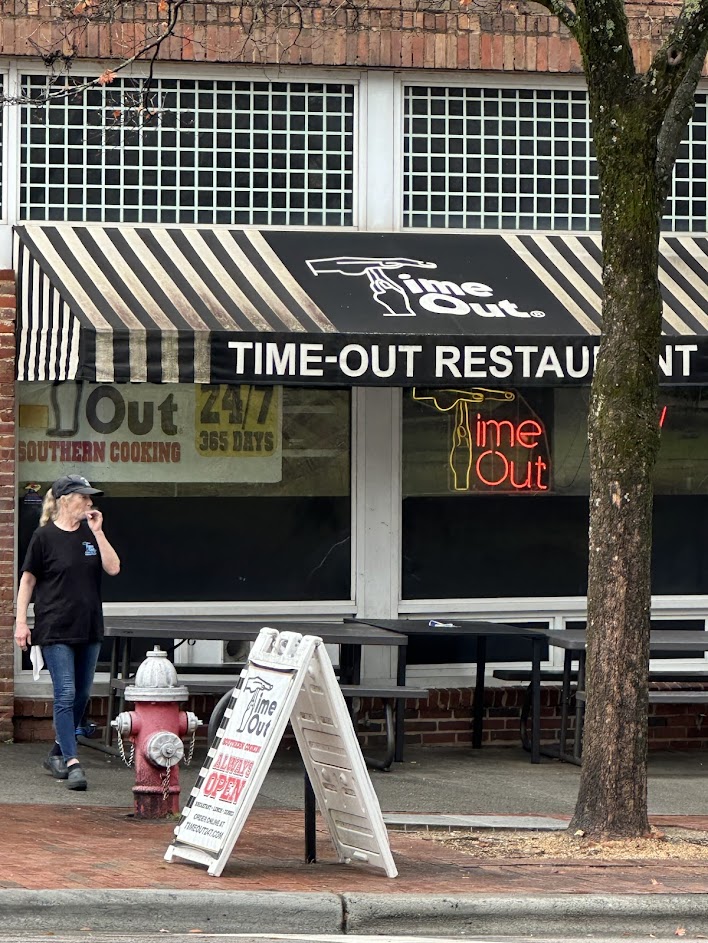
Memories of Chapel Hill: Love, Weddings, and History

April 1, 2025

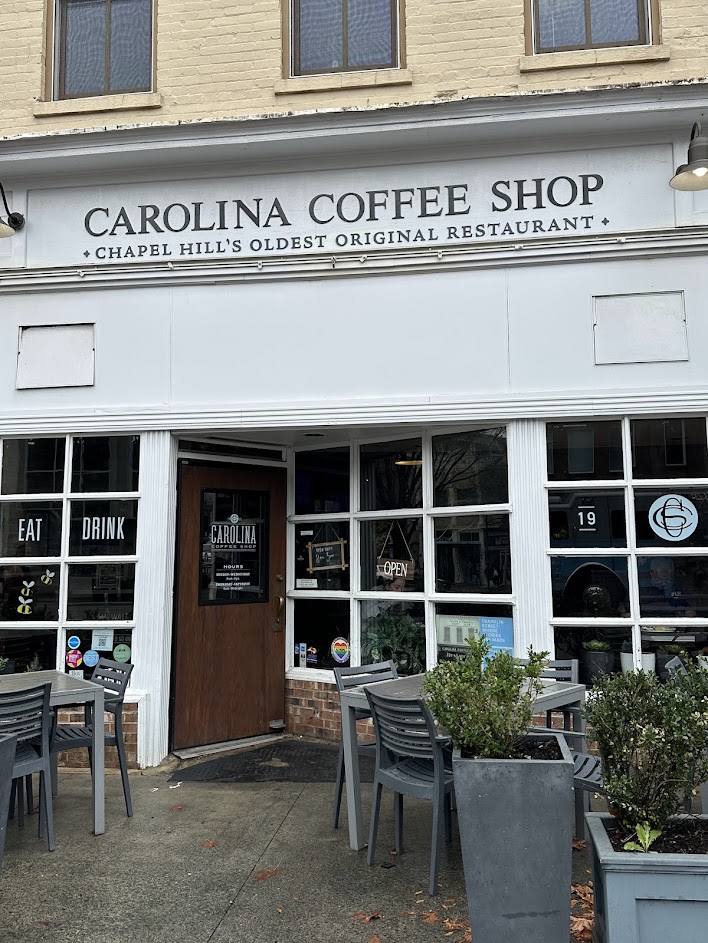
Chapel Hill. The University of North Carolina. Ah! All the memories came rushing back as we drove around, parked the car, and walked along Franklin Street in Chapel Hill, North Carolina.

I recalled meeting the Dean of City Planning, who welcomed me upon my arrival. He greeted me warmly and instilled confidence in me that I could not fail here. After I met my future wife, we listened to Johnny Cash on the quad, frequented local pubs, and eventually got married!

We initially had a civil ceremony in South Carolina without informing our families; it was one of those spur-of-the-moment decisions. The experience of the civil process, alongside that of four other couples, felt rather mundane. Returning to Chapel Hill, my Peugeot 403 broke down on the road, and we had to hitchhike back.

Returning to our dorms after the ceremony was exhilarating. We had a piece of paper that officially declared us married, and we were embarking on a new life together, forever. I wondered if this was the same experience that pioneers felt when loading their wagons on the journey west.

At that moment, no one knew we were married—not even our school friends.

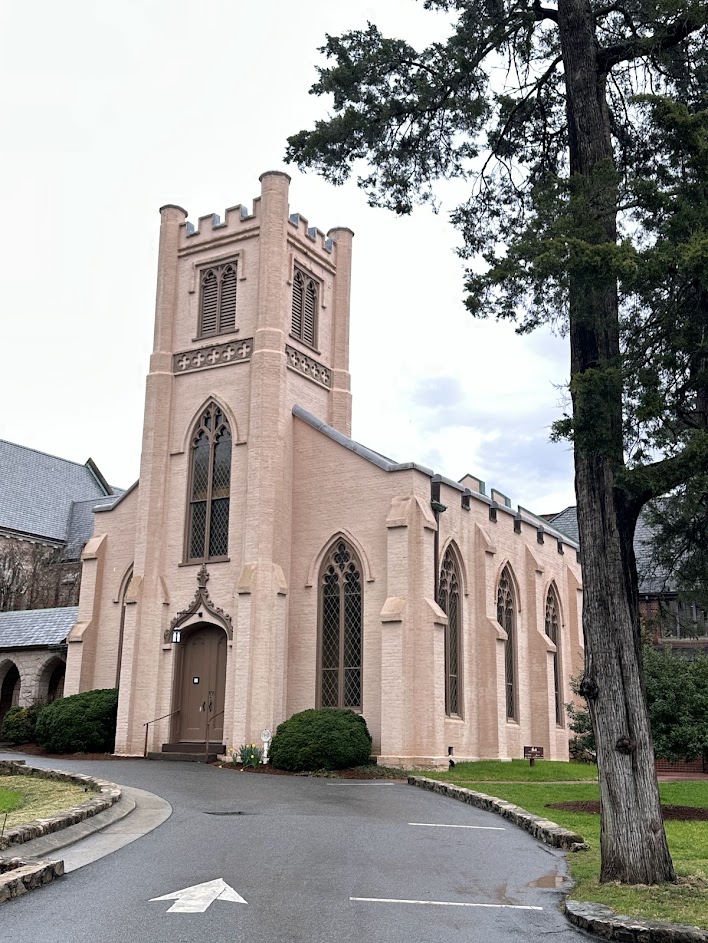
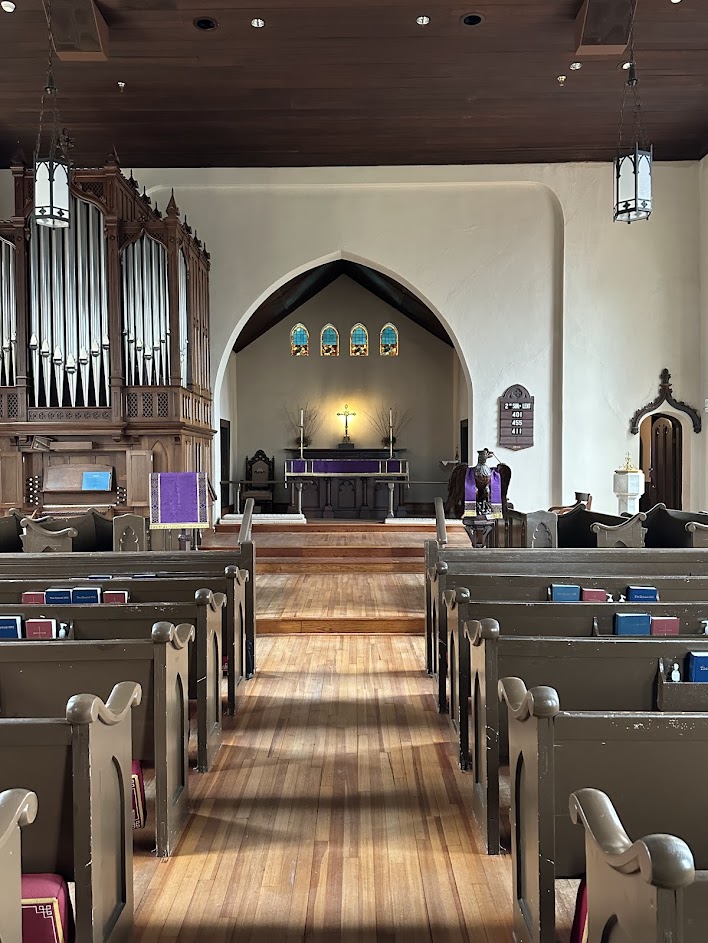
This exhilarating feeling lasted for a few weeks until we had our church wedding in the Episcopal Chapel of the Cross, which was attended by family and my classmates, with whom I had just graduated. In the lead-up to the wedding, the pastor asked us if our differing religious beliefs would ever cause friction between us. It seemed unlikely: I was a non-practicing Roman Catholic, while Kathy was Episcopalian. Having a church wedding was the traditional way to get married, which both our families accepted.

The memories bubbling up were from over fifty years ago. The Town of Chapel Hill has also aged. We walked along Franklin Street starting from Martin Luther King Jr. Boulevard. There were many more restaurants, coffee shops, and fraternity and sorority houses than we could recall from the past, in addition to newer tourist shops, vaping lounges, and art galleries.

As we crossed Franklin Street, we approached the Chapel of the Cross, where we were married decades ago. I couldn’t remember much about the building except for the circular driveway in front. I remember it well because, after the ceremony, when we tried to drive away in Kathy’s car, my classmates had blocked our tires with rocks. I felt embarrassed as I heard all my friends laughing. I quickly exited the vehicle and moved the stones. However, a loud noise came from the wheels during my next attempt to speed off. I decided to ignore the noise as we drove away, stopping a few blocks later to empty the rocks from the hubcaps.

To my surprise, the Chapel did not evoke any strong emotions within me. I struggled to recall its architecture and viewed the Chapel as if I were seeing it for the first time. However, once we entered the building, the historical information provided in a brochure added to a cultural dimension that was entirely new to me and left a lasting impression.

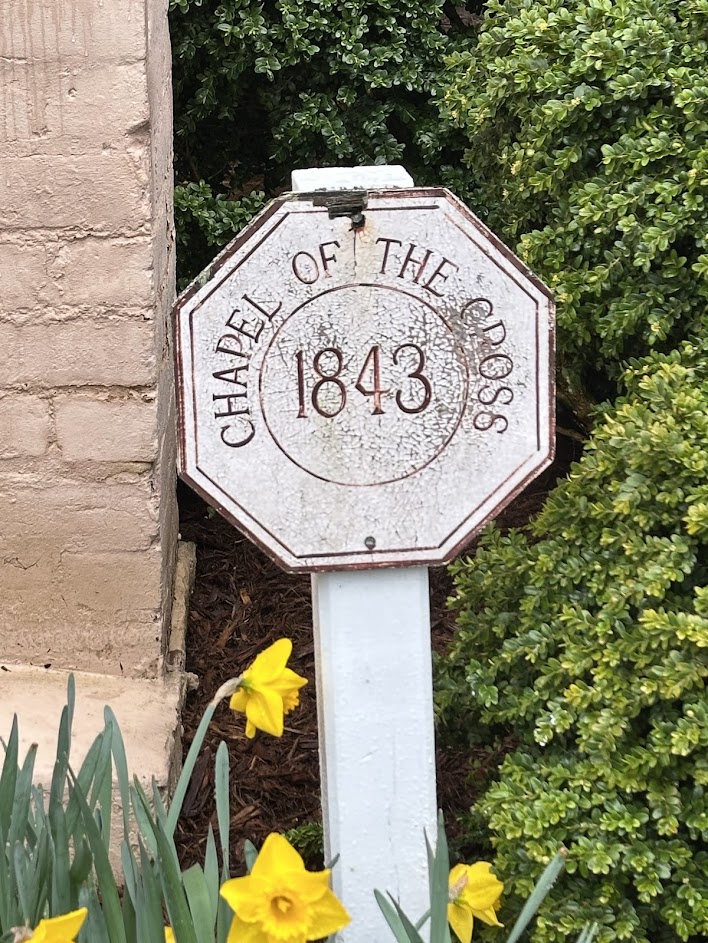
Mary Ruffin Smith (1814-1885) was an early benefactor of the Chapel, constructed in 1843. Her father, a plantation owner, physician, and congressman, paid $450 for a mulatto slave, a fifteen-year-old girl, for Mary. One of Mary’s brothers took a fancy to the slave girl, Harriet, and stalked and sexually assaulted her. Mary’s other brother, Frank, took exception and pummeled Sidney, ordering him to stay away from Harriet. Sidney stayed away from Harriet after the incident, during which she gave birth to a girl, Cornelia. However, Frank fell in love with the girl and had three daughters with Harriet. Mary cared for Harriet and the four girls, bought them from the plantation, and took them to the Chapel of the Cross every Sunday. All the colored people sat on the balcony of the Chapel, not permitted to sit with the white folks. Mary had all four girls baptized at the Chapel, as well as Harriet.

The story continued with Pauli Murray (1910-1985), the granddaughter of Cornelia, the oldest of Harriet’s daughters. Murray was an author, activist, and writer. In 1938, she attempted to enroll at the University of North Carolina (UNC), but her admission was denied due to her race, despite her close relationship with her great-aunt Mary, who had donated a significant portion of her land to the university. Pauli Murray went on to become a lawyer and practice law. In 1977, she made history as the first African American woman to be ordained as an Episcopal priest in the United States. After her ordination, Rev. Pauli Murray took communion in the Chapel where her enslaved grandmother had been baptized.

This story left a significant impression on me. Perhaps it’s because topics like plantations, slavery, the significance of skin color, and religion are not part of my background. Instead, I could discuss the Iron Curtain, Communism, and the experiences of the Pioneers (the communist equivalent of the Boy Scouts), as I spent my youth in Hungary under Russian domination.

Exploring Delhi: A Day in India’s Bustling Capital

January 19, 2025


We flew to Delhi, where we spent one day—quite an introduction to India! Our hotel was outside of Delhi’s center, accessible by subway. Shyaam, our guide, led us on a subway journey to Old Delhi’s historical sites and bustling market. We followed Shyaam through the crowded streets. The heat made me wipe the sweat from my face. It felt as if we walked a long way, only to discover that the distance covered was only a few blocks.

Rubbernecking to see the small stores and fighting the jostle of people was tiresome. After a while, we were ready for a snack and looked longingly at the street vendors with their steaming foods. Shyaam cautioned us about buying from a street vendor and suggested that we wait for the next round of freshly cooked food to be ready to eat rather than take the already prepared food in bowls on a counter along the street full of flies munching on the food. So we waited ten minutes for the next round of cooking. It was worth the wait—it was delicious; I think we had chunks of lamb with spices I was unfamiliar with.


The atmosphere in that part of town differed from what I have ever experienced. Besides the teeming crowds, with the temperature hovering in the upper thirties Celsius, the smell of spices permeating the air was powerful. In this district, spice store after spice store with hundreds of spices competed for attention with fancy exhibit boxes containing almost every spice imaginable: mustard seeds, coriander, garam masala, and others. A dispute unexpectedly flared up outside a spice stand between a customer and the store owner. Almost immediately, a large crowd gathered, and yelling started. We were made acutely aware of our vulnerability and the potential for sudden violence by the crowd’s sudden outburst and rapid gathering. I told Kathy we should just move on and leave the crowded sidewalk before violence broke out.

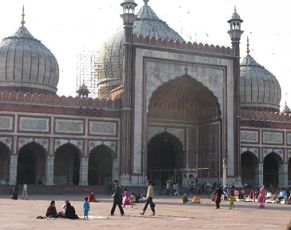
Among the sites Shyaam took us was the Jama Masjid, the oldest mosque in India. A wall surrounded the entire mosque complex, with a football-field-sized plaza in front of the mosque, large enough to hold 25,000 people. At the entrance gate, they directed us to take off our shoes and leave them on the steps leading up to the mosque, next to hundreds of others’ shoes on the steps. I was wearing my good walking shoes and was nervous about leaving them on the steps, but we had no choice; I thought of someone just coming out of the mosque and taking my shoes by accident.

Jama Masjid

But taking off our shoes was only part of what they required. They also gave us a gown to wear over our street clothes. Inside the complex, children played and ran around in the plaza, and adults walked around in gowns. The courtyard seemed like a vast, paved urban park without trees and greenery. Aside from the gowns, it could have been anywhere.

The Jama Masjid is like other mosques we have seen; it is a large space with the women’s quarter separated upstairs. The mosque was completed in the sixteenth century in the old city. The huge mosque in Casablanca, the Hassan II, is like this one, except it has no walls around the large plaza outside and was built recently (finished in 1993). I did not get the religious vibes here that I felt visiting the Cathedral in Santiago de Compostela, perhaps because I am a Catholic and not a Muslim. We left the mosque, and I found my shoes, which I had left outside.


Following our visit to Jama Masjid, Shyaam guided us to Sheeshganj Gurudwara, one of Delhi’s nine historic Sikh temples (the name means “gateway to the guru” in Punjabi). Unlike the mosque, worshippers, women, and men gathered together on the floor in the principal room. As part of the temple’s mission, a women’s auxiliary made naan bread in a small side room to feed people experiencing poverty. They were working quietly, without speaking, a welcome respite from the hustle and bustle outside. They invited Kathy to sit on the floor and join them in making naan. She did it for a while to learn how to make naan, which was more challenging than it looked.


Leaving the Gurudwara, we took Delhi’s spotless subway to Connaught Place, the center of New Delhi. Shyaam escorted us onto the subway train, gave us directions on how to return to our hotel using the subway, and left us to explore. Connaught Place differed from Old Delhi. It was a large circular park with benches on a grassy field. Seven major roads radiated from the perimeter into the urban fabric of New Delhi. Its street-level stores and mid-rise office buildings around the circle reminded me of North American cities. Unlike in Old Delhi, the streets were uncrowded, and the stores were spacious.


Feeling confident in our navigational abilities, we took the subway back to our hotel. I found the subway extremely clean, although crowded. Upon entering a station, all passengers underwent a security check similar to those in airports: a metal detector check and a baggage check. They allowed no food or drink. This rule and its enforcement ensured cleanliness. It was impressive. We got off at the right subway stop; however, with no idea of the geography and, I guess, not having paid enough attention to our surroundings when Shyaam had accompanied us downtown, we had no idea whether to go left or right when we got off and stood there like the lost tourists we were. Luckily, many Delhi residents speak English, and a very kind man helped us find our hotel. This gentleman’s helpfulness, in retrospect, did not surprise us, as we have found in our travels that Indians are friendly people.

Reflections on Christmas Brunch Conversations

December 31, 2024

While others watched football on Christmas Day, we relaxed with friends over brunch. Years ago, we used to start these special days with mimosas, but that’s become a thing of the past as we’ve gotten older. Instead, this year, I started the fireplace, brewed coffee, turned on the Christmas tree lights, and scanned the news on my iPhone. A headline claiming Assad’s responsibility for 150,000 deaths caught my attention—an expert called it the worst massacre since the Nazis. That news was a real downer, and I looked forward to socializing with friends to uplift my mood.

Perhaps because of Christmas, my friends and I casually discussed religion during brunch. I inquired if anyone attended church. No one did, and neither did their families. We are not church-going people, although one of our guests volunteers vacuuming in one.

Remembering the headline news I read this morning, I could not help but ask: “If God created this world, how could he tolerate Assad’s killing spree?” God gave us “free will,” someone responded. I did not find this comment enlightening, but I continued to delve into our religious background. Surprising was the realization that some of our children had not been baptized, or we could not remember whether they were.

During our conversation on religion, one claimed that religion had triggered most wars, while others believed religion’s relevance had diminished. The spread of science has contributed to religion’s lessening role in today’s world, as it is based on facts rather than beliefs. All I have to do to confirm this is talk to my daughter and son-in-law, both scientists. Contrasting this latter view, some recounted friends whose marriages followed religious conversion by one spouse.

While serving coffee, I overheard someone mention that she missed the King’s Christmas address last night. That comment stopped me cold. Who were we talking about? A King? But a few seconds later, my brain switched gears, and I realized it was the British King. Since Canada is in the Commonwealth, we often discuss the Royal Family.

Thinking about heads of government addressing the public, I asked if anyone had listened to our Prime Minister addressing Canadians on Christmas Eve. We saw him on TV, but no one else did. That surprised me because, to some of our guests, a Christmas speech by the King of England apparently took priority over the one our Prime Minister gave. Where is our loyalty? But I remember our Prime Minister said our country is beyond a multicultural state and we live in some international order. What he meant wasn’t clear to me, and it still is not.  

Most families watch a movie on Christmas Eve, and I brought up the movie we watched, “Hot Frosty.” One friend mentioned it as a “cute” one, while another thought it was horrible. The film, about a snowman’s transformation into a human, was unrealistic but enjoyable and heartwarming. I thought this was a children’s film, but others saw it as simple entertainment for adults. It was relaxing, although I prefer movies with some messaging and reality.

However, the tasty brunch included cinnamon muffins, quiche, coffee, tea, and cider. The fact that we were all friends enabled open communication, calmly sharing our views on potentially divisive issues.

Sistine Chapel Exhibit Review: A Mixed Experience

Janury 27, 2023

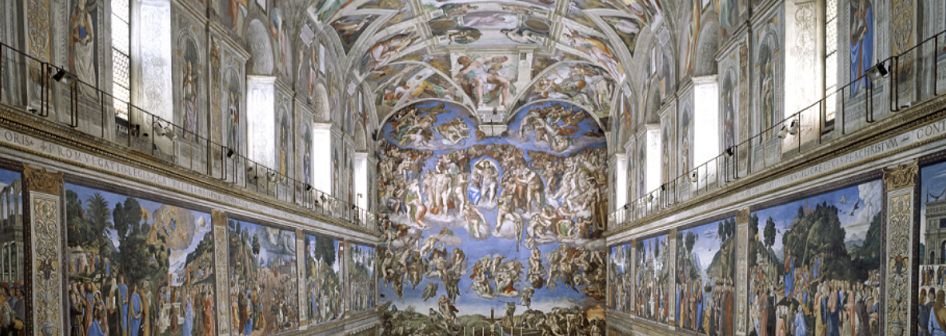
Three Views of the Sistine Chapel

I was underwhelmed viewing the Sistine Chapel touring exhibit, produced by Entertainment Events Inc. (EEI) of Hollywood (showing only the ceiling frescoes painted by Michelangelo). The first showing of this exhibition was in Montreal in 2015, after which it toured the world and arrived in Ottawa in December 2022.

 In Ottawa, EEI presented the exhibition at the EY Convention Center, in a large, industrial type of space, like an airplane hangar. It just did not have the aura for showing biblical scenes painted by Michelangelo on the ceiling of the Chapel. What frosted me was the advertising for yoga classes at high prices, taught in front of the paintings. I found the combination of appreciating renaissance paintings with concurrent yoga exercises jarring. But the receptionist told us the yoga classes were fully subscribed; I could not see myself putting my body in yoga poses with great effort and appreciating the artwork simultaneously.

There were no brochures or handouts to describe and explain the paintings, this was Covid times. Instead, you had to bring your cell phone, to which you could download, via a QR code, the explanatory comments. Once we figured out the technical challenges, we found the commentary useful.

Before looking at the pictures, we listened to an introduction to how Michelangelo accepted a commission from Pope Julius II and built a scaffold to paint the ceiling at a height of sixty feet in the Chapel. Michelangelo used vivid and colorful paints on wet gypsum and completed the work between 1508 and 1514. EEI used high-definition photographs to reproduce the paintings in full size.

The full-size biblical scenes were twenty feet above the floor at the EY center, enabling viewers to see the pictures, including brush strokes, in granular detail; that was a major benefit of this show according to EES, compared to seeing the same pictures sixty feet above the ground in the Sistine Chapel.

This exhibition was attractive to art buffs and religious historians, especially those familiar with the Bible; but to me, it does not compete with seeing the real Sistine Chapel in the Vatican, which we visited in 2015. The comparison is like watching a football game on TV versus attending in person. It is hard to describe the excitement of walking through the Sistine Chapel with hundreds of people, all sighing with wonder at the pictures, even though they are sixty feet above you, and seeing not only the ceiling but also the walls, painted by other renaissance artists. But at the touring exhibition, one could take time to study the Michelangelo painted frescoes at a close distance without a crowd.

Although the excitement was tangible within the Sistine Chapel, there were detractions: some people took photos despite being warned not to do so. And the guards kept hushing people to be quiet. As well, when we went, the crowd filled the Chapel wall to wall, and the guards nudged us to move on to let the other visitors come in.

I found the best way to see the Sistine Chapel (if you have internet access and a computer), is to log in to https://www.museivaticani.va/content/museivaticani/en/collezioni/musei/cappella-sistina/tour-virtuale.html This site provides a virtual tour. You can look at all sides, plus the floor and the ceiling of the Chapel. If you want to see more details, you can enlarge the pictures. You may miss the excitement of being in the Chapel, but you do not have to travel to Italy, line up with hundreds of tourists at the entrance and have a limited amount of time to look at the paintings.

Walking through the Sistine Chapel in the Vatican, and looking at stories told by the colorful frescoes, made an everlasting impression on me. I found this quote that reflects my sentiments: “Without having seen the Sistine Chapel, one can form no appreciable idea of what one man is capable of achieving” (Johann Goethe, August 23, 1787).

 Having seen the original work, the touring exhibition was disappointing for me but would be attractive to people where the touring exhibition goes. If your city is not on the touring exhibition schedule and you do not have the time and money to visit the Vatican, the website above provides an excellent way to see the inside of the Sistine Chapel.