Residents Voice Concerns at Fisher Heights Community Meeting

October 12, 2025

The Annual General Meeting of the Fisher Heights and Area Community Association turned into a session filled with complaints. Though the term “bitch session” might seem harsh, it accurately described the atmosphere.

The President began the meeting by summarizing the association’s events from the past year and spent about ten minutes reviewing the financial statements. After that, he opened the floor for discussion, with the local City Councilor present at the head table.

The first concern raised by a resident, amid the mostly grey-haired and entirely white attendees, was the rat population thriving in his home. Many others joined in, revealing that the area is facing a significant rat problem. I recalled that this same issue was discussed last year, with residents blaming the increase in rats on the construction of the Light Rail Transit (LRT) system downtown. The excavation for the underground rail disturbed the rats, causing them to migrate into the suburbs—specifically, into our neighborhood. No solutions were proposed last year, and using poison was deemed not an option since children lived in the rat-infested area.

 Our councilor addressed the discussion by explaining that the city is taking the rat issue seriously and has started mapping the geographic areas where rats thrive. Residents are encouraged to report any rat sightings in their homes to the city. The councilor also mentioned that a rat committee has been established, and a dedicated section about this issue has been created on the city’s website.

Additionally, the councilor advised us that rats tend to flourish in “messy woodpiles,” “overgrown grass,” and “compost bins.” He urged residents to clean up their woodpiles, maintain their lawns, and consider limiting or discontinuing composting altogether. While this advice is practical, it may not be well-received by those who enjoy composting. Although the information provided was helpful, it remains unclear how these measures will effectively improve the situation in our community.

The discussion then shifted to parking problems in the community. Residents voiced strong objections to having parked cars in front of their homes, even when those vehicles were on public streets. Their concerns appeared to arise from a desire to prevent strangers from parking near their houses. This situation raised questions about whether their objections were related to safety, the aesthetic appeal of the neighborhood, or simply a feeling of ownership over the street in front of their homes.

In response, our councilor suggested that larger households in our area were contributing to this issue. This statement was surprising, as our community has been aging, resulting in fewer children. So, where are all these new residents coming from? One possibility is that the rental complex in our area has begun charging for visitor parking, which forces guests to park on public streets. Others pointed out that many young adults are staying at home with their parents because they cannot afford to buy their own homes. The councilor also noted that redevelopment in the area has led to higher housing densities, resulting in more households in the community and, consequently, more cars on the streets.

Many audience members asked why the city cannot install more no-parking signs. The councilor explained that no-parking signs are placed only in areas where intersections create dangerous driving conditions. In these instances, people often find alternative parking spots elsewhere in the neighborhood, which means the identified parking issue is simply shifted to another location. This approach hardly resolves the problem!

Additionally, parking is becoming a bigger issue due to the new zoning bylaw, which reflects the city’s growing population. The city council views densification as the only solution, aside from an unlikely massive investment in public transit. Ultimately, higher population densities will lead to more cars on the streets.

Another topic discussed was the overflowing garbage bins in city parks. Since we have curbside garbage pickup, someone asked why the garbage truck doesn’t also empty the garbage containers in the parks when it passes by. The councilor explained that this is more complicated because the public works and parks departments use different contractors for garbage collection. Could better coordination between the two departments improve efficiency and reduce costs? I wondered if the councilor would consider taking this suggestion back to the city for further discussion.

Continuing on the topic of our parks, someone raised a concern about the absence of no-smoking signs in these areas. This individual observed people smoking cannabis in public spaces—likely due to the smell—where young school children walk. I thought we had already implemented a bylaw regarding this. The councilor responded by discussing the challenges of enforcing a no-smoking bylaw in city parks. He mentioned a shortage of bylaw enforcement officers and indicated that enforcing such a bylaw was not a top priority. Additionally, the potential revenue from this bylaw would be minimal compared to the significantly more profitable option of ticketing for illegal parking.

Another individual complained about loud construction noises at night. A construction company working on a high-rise building accidentally damaged a water pipe, necessitating emergency repairs overnight. The infrastructure maps provided by the city to the company failed to mark the location of this major water pipe, which supplied water to a nearby dialysis clinic. Restoring the water supply became urgent.

The person who raised the noise complaint stated that she was not concerned about the work at the dialysis clinic; rather, she objected to the nighttime noise, which deprived her of sleep. This comment troubled me, not only because of her lack of understanding of the situations that can arise on construction sites, but also due to her apparent lack of compassion for the patients at the dialysis clinic. To compound her complaint, she asked if the contractor was fined for breaking the water pipe. My goodness! It was an accident! Moreover, it was the city that provided an outdated map. Should the city fine itself for that?Continuing on the topic of our parks, someone asked why there are no no-smoking signs in these areas. This individual observed people smoking cannabis in public spaces (I assume he noticed it by the smell) where young school children walk. I thought we already had such a bylaw. The councilor addressed the topic by discussing the challenges of enforcing a no-smoking bylaw in city parks. He mentioned the shortage of bylaw enforcement officers. He indicated that enforcing such a bylaw would not be a top priority. Additionally, the potential revenue generated from implementing this bylaw would be minimal compared to the significantly more profitable option of ticketing people for parking illegally.

Still another person complained about loud construction noises at night. A construction company working on a high-rise building accidentally damaged a water pipe, necessitating emergency repairs overnight. The infrastructure maps provided by the city to the company failed to mark the location of a major water pipe. Since this pipe supplied water to a nearby dialysis clinic, restoring the water supply became an urgent matter.

The person who raised the noise issue stated that she was not concerned about the work at the dialysis clinic; instead, she objected to the nighttime noise, which deprived her of sleep. This comment troubled me not only because of the lack of understanding for a situation that is likely to occur on construction sites, but also due to her apparent lack of compassion for the patients at the dialysis clinic. To compound her complaint, she asked if the contractor was fined for breaking the water pipe. My goodness! It was an accident! Moreover, it was the city that provided an outdated map. Should the city fine itself for that?

At that point, I had reached my limit with the complaints and decided to leave the meeting. I found myself questioning the positive actions the association had taken over the past year. I heard that they had painted some lines on a basketball court, replaced the flooring in the community center, and allocated funds for a bicycle repair station in one of the parks. They also organized several community events, including this meeting, where residents could voice their concerns and speak with our councilor. While these are positive steps, I wondered if they were sufficient to justify the existence of a community association.

As I drove home, I realized that the meeting did not address the various clubs the association sponsors, such as a bridge club and fitness classes in the community center. Including presentations from these clubs could have been beneficial, as it might have encouraged more people to participate in the association’s activities. I also questioned the absence of a proposed budget outlining the association’s priorities for the upcoming year. I left the meeting feeling that it was a missed opportunity to make the association more relevant to the community. Overall, I don’t think our community has any significant issues at this time.
Exploring Point Grey Road: Vancouver’s Luxurious Real Estate

June 2, 2025

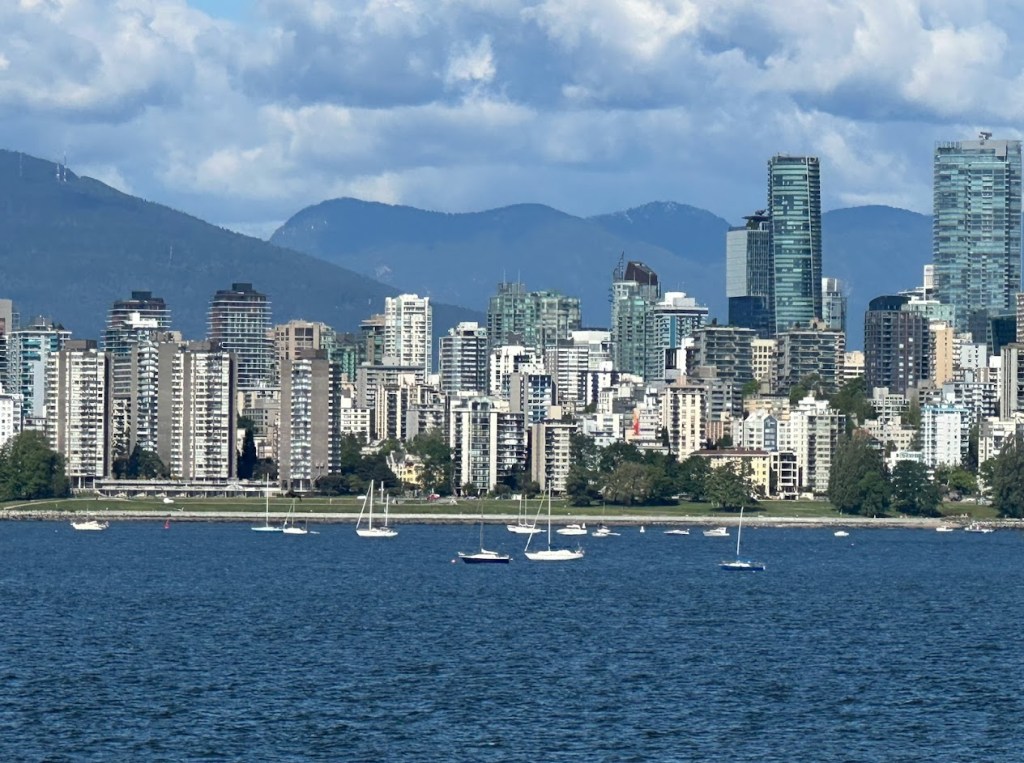
Montreal has Westmount, Toronto has Rosedale, Ottawa has Rockcliffe Village, and Vancouver has Point Grey Road. The north side of Point Grey Road features elegant, architecturally designed residences. This location is attractive due to its expansive ocean views, framed by mountains in the background and Stanley Park across English Bay, highlighting the Vancouver skyline to the east.

Talk about privacy from the road!

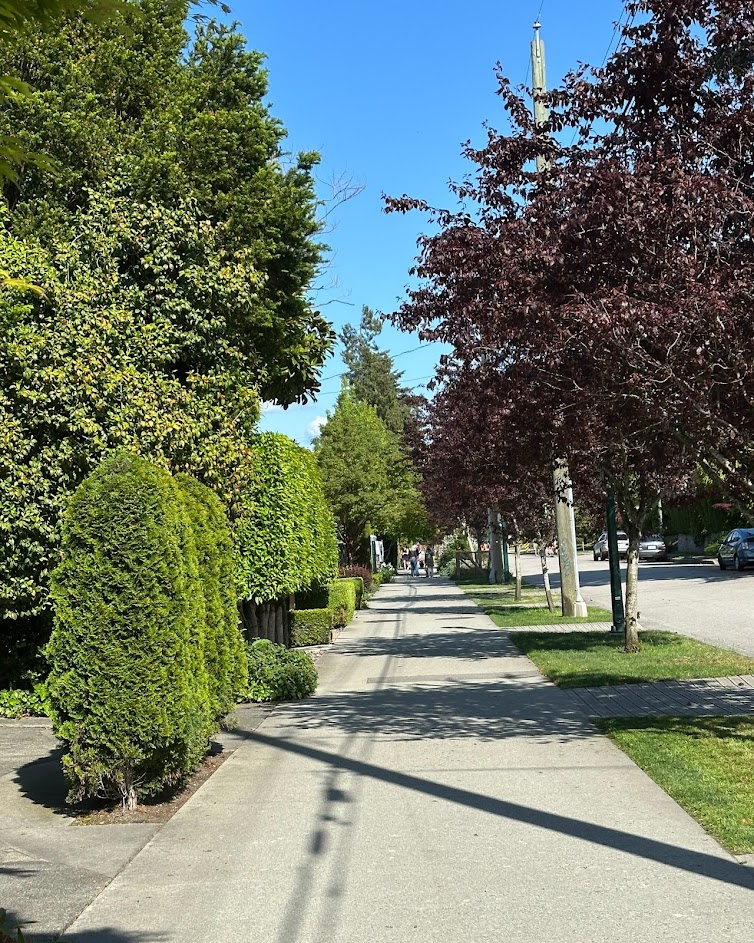
We walked from my brother’s place in Kitsilano to Point Grey Road to explore the area, where the sidewalks were wide, complemented by attractive street furniture, including benches, light posts, and trash cans. The roadway was also spacious, reserved for walkers, joggers, and commuting cyclists traveling from downtown to the University of British Columbia.

   Point Grey Road sidewalk

I understand that Mike Harcourt, a former mayor of Vancouver, envisioned creating a continuous park on the north side of the street. To achieve this, he purchased available residences. He transformed them into parks that front Point Grey Road, extending to the shoreline to provide stunning views of the ocean and the Vancouver skyline. However, homeowners living along Point Grey Road opposed this initiative, and with rising real estate prices, the project ultimately came to a halt.

View from mini-park, the Vancouver skyline

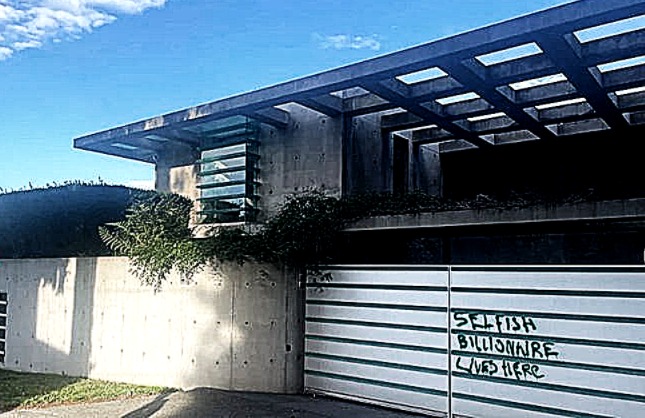
A stroll along the upscale residences made me wonder who owns these homes. I found some online. One notable resident is Chip Wilson, the founder of Lululemon, a popular athleisure clothing brand. His property was valued at over $82 million in 2024, making it one of the most expensive real estate holdings in Canada. While Wilson has gained significant wealth from his clothing line, he has also stirred controversy with some of his comments.

      Chip Wilson’s place, totally private from the road

He faced accusations of racism for the name “Lululemon,” which features three “l’s.” He said he chose this name because he found it amusing to consider how Japanese people would pronounce it, given that there is no “l” in the Japanese alphabet.

Additionally, he was criticized for being “fatphobic” after suggesting that not all women are suited for his designs. He pointed out that women who do not have a gap between their thighs could cause the fabric to become sheer or translucent, leading to backlash for implying that those women were overweight.

People have also slammed him for stating that he has no issue with children working. He mentioned that his children have worked for his company and argued that there is nothing wrong with this. He was specifically referring to Asia, where much of his clothing line is produced by child labor.

His comment reminded me of children we saw in Myanmar, rolling cigarettes, sitting on the floor with inadequate lighting. When I inquired about why children work, I learned that many would starve without their jobs and that, for some, working is preferable to having nothing to do, especially when they are not attending school.

      An architectural home

Dr. David Suzuki is another fascinating figure who lives on Point Grey Road. He had a long-running, popular show on CBC called “The Nature of Things.” As an environmentalist, he advocates for living in harmony with nature. However, I find it hard to reconcile the idea of living in harmony with nature while owning a multimillion-dollar house on Point Grey Road, especially considering that he also possesses two other properties. Nonetheless, his educational broadcasts have been excellent and have been aired in forty countries.

Still, another homeowner on Point Grey Road was Nelson Skalbania, who took a chance on signing the seventeen-year-old Wayne Gretzky to the Indianapolis Racers hockey team and later on starring withe the Edmonton Oilers. As we know today, Gretzky has become arguably the greatest hockey player in history. The team’s owner, Skalbania, was interested in sports franchises; he bought and sold teams and even purchased the Atlanta Flames before relocating them to Calgary.

Continuing with the hockey theme, Trevor Linden owns a house on Point Grey Road. He played for the Vancouver Canucks and served as team captain and General Manager after his playing career ended.

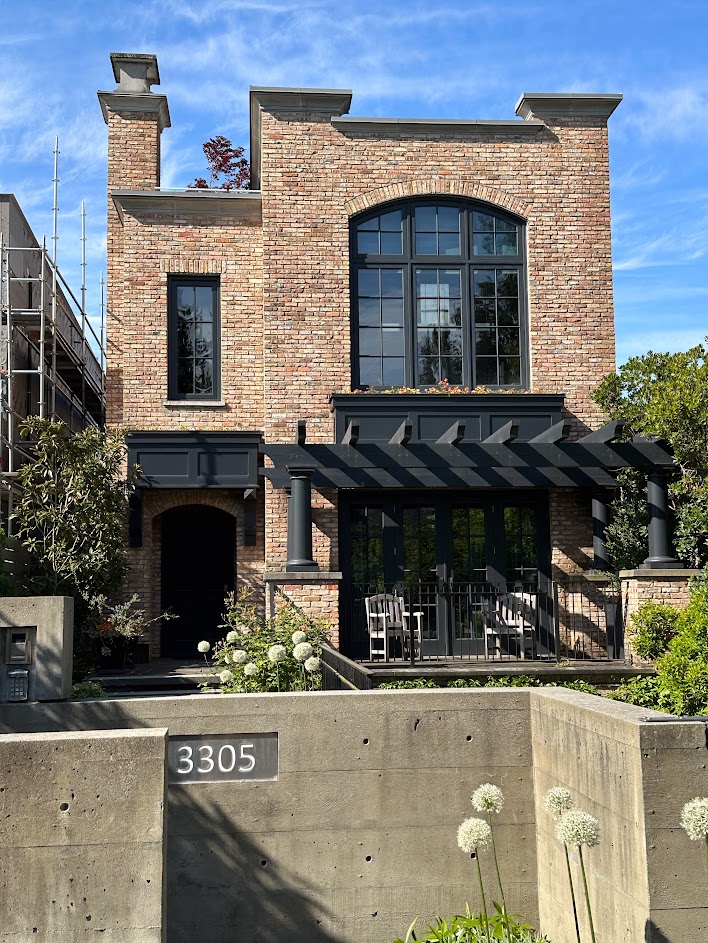
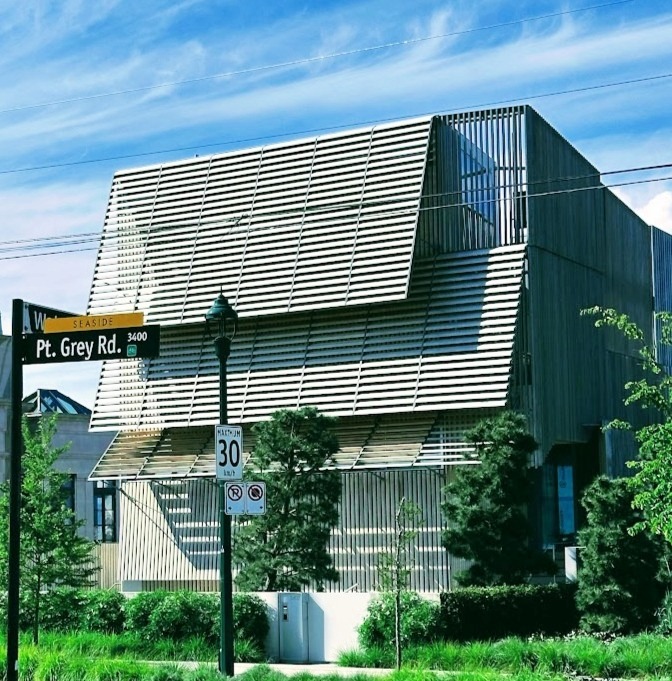
Strolling along, I took a picture of what I thought was a very attractive house. After searching online, I discovered that it was designed by one of my classmates from the School of Architecture at the University of British Columbia in the 1960s. Paul Merrick was an exceptionally talented designer during our time in architecture school, and he established his firm in Vancouver after graduation. The article I read on this residence did not mention the owner’s name.

Designed by Paul Merrick

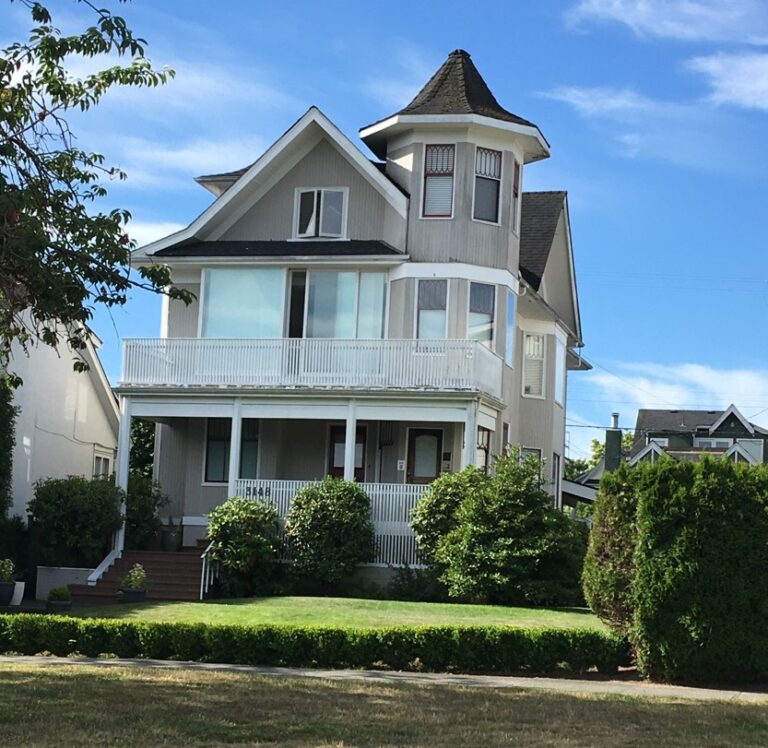
Another renovated old house on the south side of Point Grey Road, at number 3148, is known as the “Peace House.” The name originates from its use during the 1960s by peace activists who lived there and protested against the storage of nuclear weapons at the Comox RCAF base. This house also attracted the wandering hippie crowd of the era, known as the Love-In Generation, including notable figures such as Timothy Leary, the Grateful Dead, who even performed a concert there, Baba Ram Dass, and Allen Ginsberg. Recognizing these names indeed reveals my age!

The “Peace House”

These beautiful, high-value homes are designed by architects and surrounded by meticulously maintained landscaped yards. I thought it would be a great experience to visit these homes inside. Would the homeowners be willing to open their houses for viewing?

Opening the Cottage

May 24, 2024

When I started walking to the boat, the president of the cottagers’ association stood at the edge of the marina parking lot with his huge dog, a malamut. He said they missed us at the pancake breakfast the day before. Instead of saying we never intended to attend, I said we were busy. He and the association have been advocating for a revised constitution, a subject with no interest to me but likely to be brought up during breakfast. The president is an earnest fellow working hard at being president, and I did not want to hurt his feelings. It takes a lot of work to revise a constitution. Preparing a pancake breakfast is also an ambitious undertaking for a group, giving him credit.

When the president’s boat arrived to return him to his cottage on the island, we went to our boat. The starting engine sputtered for a while, warming up. The battery in the boat usually runs down in a few weeks unless it starts up every few days, and our boat must have been in the water for weeks without running. The ride to the cottage was relaxing on the quiet water, allowing us to reacquaint ourselves with the cottages and the small islands along the way.

Arriving at the cottage dock, I did a quick double-take, seeing the floating dock paralleling the shoreline instead of being perpendicular to it. Docks are usually positioned like fingers reaching out into the lake, where the water is deeper than at the shore. There was no question in my mind that the dock floated sideways, moved by some storm, losing its anchors at the deep end. I knew then that my first task would be to fix the dock after landing.

 But surprises never come in single doses; inside the cottage, we came upon stacks of mice poo in the kitchen and storage areas where we leave cans and dry goods over the winter. We do not usually get mice over the winter at our cottage; we leave mice poison in the Fall. But one year out of ten, we get a mouse invasion.

Cleaning up mice poo called for a hand-held vacuum. Although we had one, we remembered that it died last year. So instead of sweeping the poo off the counters, we decided to wait until the next time we came out with a new vacuum. This is an example of the disadvantages of island property; one has to boat back to the mainland for items missing on an island.

While Kathy took the covers off the beds and chairs, I put on my bathing suit and goggles and went down to fix the dock. I paid a local handyman to take the floating dock to a quiet bay for the winter and return it in the spring. Whoever brought the dock back this time tied it up with one concrete block at the deep end, which did not have enough weight in our lake, protecting against the three-foot waves rolling against the shoreline in stormy weather.

 I dove into the fresh but bearable water to look for the tires that I filled with concrete to serve as weights, but I had no success. I’ll have to look again next time; there is no way the current would have pushed the two-hundred-pound weights far away. In the meantime, I pulled the single concrete block out to the deeper water, hoping no storm would materialize for a week, pushing the dock back to the shore.

After my swim fixing the dock, I joined Kathy at the cottage, and beyond the mice invasion, the cottage was clean. It was time to relax and eat or drink something, but there was nothing for lunch since we had just come up for a day to do some reconnaissance. Then I remembered the alcoholic beverages that we left there for the winter. Our American neighbor from New Jersey left me his special edition bourbon he made in Kentucky with his friends in 2022. It is a bottle of Maker’s Mark, Private Selection, called “Bobby’s Garage.” The name is from his garage, where he and his friends exercise every morning. It was the best ounce of bourbon I had ever tasted, especially after diving into the lake and fixing the dock.

While enjoying the drink, I called my neighbor two lots away to find out how the pancake breakfast went; I knew they had attended. Instead of answering me, she invited us for a glass of wine. An offer too good to pass up, but before visiting, I decided to sweep the decks clear of leaves and take the covers off the Adirondack chairs outside.

While I worked outside, Kathy grilled some chicken for a light dinner later. By five o’clock, we were ready to see our neighbors. They said perhaps fifteen people attended the breakfast; I thought that represented less than ten cottages out of the one hundred on the island. I felt sorry for the organizers for doing so much work for so few people.

It was time to leave, and armed with a list of items to bring back next time, we started the boat, and it sputtered again. I made a mental note to call the marina next week and ask if something is wrong with the fuel line.

Zooming with Cottage Neighbors

April 2, 2024

I push the join button on Zoom and face 18 somber people on the screen, members of our cottagers’ association. Nobody speaks. With a look of expectation on their faces, they appear serious. I ask: can you hear me? Some say yes. I grab my glass of wine while Kathy brings our dinner at 7 pm. We decided to eat our dinner during the Zoom call.

Looking at the Zoom participants, I ask who is from Ottawa. A woman says she is 100 km from Ottawa in Madoc. Then I recognize Kit joining us from Florida, Ry, who lives in New Hampshire, and a few from Toronto. The association’s President lives in Toronto and called the Zoom meeting to discuss issues concerning the group.

A revised constitution and the transfer of land used as pathways from the island’s original owners to our cottagers’ association are on the agenda. These topics leave me cold; I have never been interested in constitutions, and the land transfer has no impact on our enjoyment of the island. We already have legal access to walk on the pathways with all other cottagers, so who owns it is irrelevant.

I would have been more interested in the Zoom call if the agenda had proposed some new activities and developments for the upcoming summer. Bureaucratic matters, especially constitutions, leave me cold, but I looked forward to seeing some cottage neighbors.

After tent camping and trailering, we bought the cottage a few decades ago, envisioning a permanent summer venue we could visit every weekend. It never involved Robert’s Rules and land transfers. It was “getting away” from urbanization and work. It had to do with living on a lakefront with all the lake’s benefits, like swimming, canoeing, kayaking, sailboarding, and even walking on the pathways in the back.

But here we are, having dinner with a glass of wine when the President puts the revised constitution on the screen and explains proposed changes. What a bore, except for a few quirky items. He says we could have more than the current membership class, consisting of property owners on the island.

Less than half of the current cottage owners belong to the association, and the President suggests we could have the non-paying cottagers become another class of members. Huh? What does that mean? Why should you be a member if you do not pay the membership fee and cannot vote? Some people on the island may not even be aware of the association, but we make them members?

But wait. The President also suggests another member class: people who do not even live on the island. Who could these people be? Relatives, potential cottage property buyers? I think we do not need these artificial membership classes.

Another peculiar suggestion the President makes to include in the constitution is that only people with no history of bankruptcy can serve on the association’s executive. Someone asks how we can filter these individuals out of consideration. How can we ascertain that the individual volunteering to serve on the Executive Committee has no bankruptcy history?

Concerning the pathways, I ask: Why transfer the land to the association when we have the legal right to walk on them? What are the benefits? I do not get a response to my question or to the other question, whether owning the land would require liability insurance, which would cost dearly and increase the membership fee.  

However, there seems to be momentum to proceed with the land transfer, mainly from the executive members. There appears to be wind in their sails; I am unsure what drives their motivation. They promise to follow up on suggestions from the 19 members of the association logging in.

I leave the Zoom meeting with mixed feelings. When we bought a cottage on an island, we thought we had left bureaucracy behind in the city. But bureaucracy follows us today and is burgeoning, with big-city people coming to our island and developing big-city organizations with rules and regulations. I may have to reconsider joining the association for next year.

How I Accumulated a Lifetime of Pictures and What to do with Them

February 28, 2024

I am sitting in front of three boxes full of a lifetime collection of pictures, trying to figure out what to do with them. But wait! What about the albums on the shelves? There are twenty-four albums chock-full of photos. But there is more: I inherited my father’s twenty-five albums, including duplicates of the images I gave him. His albums also have pictures he brought out from Hungary, containing photographs of my mom when she was young when they married and then of his three boys and grandchildren growing up. Before I forget, there are also hundreds of slides. What should I do with thousands of photographs and slides of family, travel, and events?

I digitized slides and photos that I considered memorable. Those taken with a digital camera are on my computer, on Google Cloud, with duplicates on an external storage device. I even bought a “photostick” that sucked up all my pictures from the computer to have a portable copy, but it did not have enough storage space. And I produced picture books of our travels using Shutterfly software.

So, should I dump the three boxes? When I looked at some of the old pictures in the boxes, I found some that I could not place in my digital collection. We should go through the boxes to make sure we do not dump some memorable pictures!

Although I initially used film cameras with everybody else, I started shooting exponentially more pictures when digital cameras arrived, making it easy and fast to click, edit, and store images. I bought my first digital camera, an Olympus, at Carleton Place, a small town near Ottawa. I paid over C$1500! That camera sold for half this price a year later, but I wanted to buy a digicam for our trip to Asia in 2004.

The Canon G9 was my next digital camera; it looked like a small brick and fit into my hand with a comfortable hold but was a bit larger than fitting easily into a pocket. It was light enough to carry it in my hand or backpack.

Then I moved to what I considered a professional camera, buying a Sony SLT-A55V sold as a special deal one Xmas with many filters, lenses, and other photographic equipment. I thought it was a value deal for C$1000. I used that camera on many travel trips by adding another lens that photographers call the “traveling lens,” combining short and long-distance shooting without changing the lenses. This camera came with its bag, which I had to carry in addition to other suitcases on our travels.

The Sony camera was heavy when we hiked the Camino Santiago in Spain. I was also paranoid about being robbed carrying such fancy equipment (I also took the G9 in my backpack as a backup).

An Epson Multi-Media Storage Viewer added to the weight of the camera gear I carried on our travels. I was trigger-happy snapping pictures, and I thought I needed this device to download and edit the images I snapped daily.

But technology never stops, and I began using my cell phone camera, a Samsung Galaxy, for our trip to Pune, India, in 2018. Taking pictures with the cell phone was just too easy and comfortable. As a backup to my cellphone, I replaced the G9 with a Canon G7X Markll, a tiny “pocket” camera with excellent features. It took fantastic pictures and could wirelessly transmit photos to my cellphone. The cellphone and the pocket camera were light and easily concealed, significantly improving on previous travel with the Sony and the G9.

I remember arriving in Pune and discovering that my Galaxy did not work due to getting wet from my leaking water bottle. It was scary. But I read that if you put rice in a Ziplock bag with the camera, the rice will soak up the liquid. The camera worked after twelve hours.

On our trip to Pune, I took all my pictures with my cellphone, a multi-purpose device with many benefits. For example, when someone wanted to know how much a store item cost in Canadian dollars in Pune, I just looked up the exchange rate on the cellphone (I had internet access) and converted the local price into Canadian dollars in between taking pictures. In the Fall of 2023, I upgraded my cellphone to an iPhone 14, going to Corsica, France.

 This cellphone takes excellent pictures with three lenses, making me wonder whether I would use the Sony or the G9 again. Kathy tells me the Sony Digicam still takes better images than cell phones. That may be true. But how good should pictures be? The underlying question is why do we take photographs, and how often do we look at them? I take pictures to provide memories. But after showing them to interested family and a few friends, the images lose currency. They were uninterested when we visited with family and offered to show them some travel pictures from Africa using my projector and screen.

To me, there is historical and personal value in pictures. When I take a picture, I look for a person, a building, or a landscape, and that process sharpens my mind and renders the image memorable. Storing them for the long run has value primarily for me, the picture-taker, while its value diminishes exponentially for others, in my experience.

Thinking about keeping pictures reminded me of my father’s diplomas, which I have. When he passed away, I was the only one of three sons interested in retaining them and dubious if anyone would keep them after me. The same goes for the pictures I took.

Returning to what to do with all the pictures, the digital ones on Google are always available online without storage problems at home. The ones in the albums and boxes take up space and could be pruned and offered to our family, although I do not think they would be interested. They are snapping their own pictures. It is doubtful that we would take them should we downsize. Let me know if you have encountered the same issues and how you dealt with them.