Disappointing Impressions on my Return to Ottawa from Charlotte, North Carolina

January 5, 2023

Driving along Merivale Road, in Ottawa, my neighborhood looked run down and dirty at the end of December. Yes, the melted snow was dirty gray bordering Merivale. And the road was full of potholes. As well, it was overcast and gray and the designless and helter-skelter development that has sprung up over the years along

Merivale showed its age and need for updates.

I felt depressed and found the contrast with sunny Charlotte with its clean, well-maintained streets and shiny new shopping centers dispiriting. I left Charlotte the day before.

Ottawa’s infrastructure has deteriorated, and maintenance declined over the years. For example, the snowplows cleaned a wide swath of roadbed years ago compared to the narrow lane left today after the snowplows drive by.

Has the quality of my neighborhood gone down? You be the judge. I’ll just describe what has been happening in my neighborhood, along with my biases.

First off, we have “cash marts” stores just around us, stores I consider cater to people who are hard up and must cash cheques to survive on a day-to-day basis. Sure, there are people like that, but I thought my neighborhood was a more stable, middle-income area with expensive homes.

A block from us, a cannabis store opened and there are a few more of them, less than a mile away. Again, there must be a market for such outlets, but I did not think my neighbors were into drugs. Maybe I am getting old and out of phase with today’s reality.

I do not cotton to cash marts and cannabis outlets in my neighborhood, especially when we also have bottom-feeder consumer outlets like “dollaramas” and used clothing establishments like “value village”. Should I go further?

There is nothing wrong with cash marts, cannabis outlets, and hand-me-down clothing stores. There is a market for those. But coming back from well-maintained Charlotte where I did not see any of these (cannabis stores are not allowed in North Carolina), driving along Merivale Road, with the dirty snow along the road and navigating around potholes on a rainy, gray day, was a downer for me.

But wait, are there any bright spots? I drove by a plethora of ethnic food establishments, which I like, including Chinese, Japanese, Korean, Indian, Mexican, and Italian, besides traditional English fare. The neighborhood also boasts two sports pubs and takeout places for pizza and chicken. And we have several food store chains near us, three in walking distance (Walmart, Loblaws, and Food Basics). These are great conveniences, along with a Starbucks and a couple of fast food/hamburger places (A&W and Harveys). None of these outlets are fancy; they are run-of-the commercial chains. Maybe I should not say that these are bright spots, but I cannot complain about the lack of eateries or grocery stores in my neighborhood.

But beyond the food scene and the usual gas stations, banks, and a couple of gyms, there are no upscale retail stores or cultural/entertainment facilities at all. The area just does not, or could not, attract fashion, electronics, furniture, or other upscale stores over the years. I am not sure why.

Is my neighborhood on the downslide? Maybe not. Maybe it is in transition; the low-slung, decaying buildings are probably rented at reasonable rates, therefore many family-run ethnic outlets can thrive.

But we also have a sea of parking lots and with the growth of the city, further development via densification will happen. We’ll be looking at mixed highrise buildings, with commercial establishments on the lower levels topped by residential units above.

Last fall, I joined zoom meetings with developers and Ottawa city planning staff, reviewing development proposals. In this process called “public engagement”, the City attempted to draw out public opinion on private proposals. In the proposals we reviewed, there were thousands of residential units in highrise buildings, within walking distance from my place, all containing commercial uses at the lower levels.

I drove home and after thinking about the planned developments I saw in Charlotte; I decided I much prefer those to the haphazard, aging, and messy character of my neighborhood. Unfortunately, my area will change, and I am not sure it will be for the better. I am afraid unaffordable rents in the future may squeeze out my favorite small mom-and-pop food operations, unique in my neighborhood. On that gray day after my return from sunny Charlotte, I felt in the dumps driving along Merivale Road.
2022: from Covid Lockdowns to Travel Freedom

January 1, 2023

When we crossed the border to Canada from the United States, driving north on Interstate 81, I asked the Canadian border guard: “no ArriveCan?”. He just laughed and let us through with a quick look at our passports. A few months ago we had to fill out the ArriveCan forms to cross the border and even with a correctly filled out form, which was a challenge to do, it still took a substantial amount of time to get through. And we had to have proof of vaccination and a negative Covid test taken within a day of arriving in Canada.

We have traveled to the US five times in 2022 and this trip was our sixth, to visit family for Xmas.

We used the ArriveCan form until the Canadian Government abandoned its use, partially because of public opposition to its use, and partially because it was a bureaucratic nightmare to administer it. And the Government also ditched the required vaccinations, and a negative Covid test, reflecting the low rate of Covid infections. Both barriers disappeared by the second half of 2022.

But it was not the ArriveCan and Covid requirements that stuck in my mind as a significant feature of 2022; it was the freedom to travel and the ease with which we could travel in late 2022. Traveling gives you the freedom to see different venues, meet people and, of course, visit family.

When the barriers disappeared, we were free to travel again.

Why is travel such an important and motivating activity for me? I found that if you stay home and follow your daily routine; which includes taking the garbage out, paying bills, and shoveling snow, you lose the excitement of living. Of discovering new ideas, fresh places, and meeting people, which keep your mind alert and body in physical shape.

By March 2022, we got fed up with being isolated in Ottawa and decided on the spur of the moment to visit family in North Carolina. So, we packed a suitcase and drove south. We followed up with a trip to Baton Rouge, Louisiana, in May, where we attended our grandson’s high school graduation. It was a lively experience in the basketball arena at Louisiana State University, with hooting parents celebrating their children’s graduation.

In July, we took our granddaughter back home to Durham, North Carolina, after her soccer camp at the University of Ottawa. End of August we spent a week in Myrtle Beach, South Carolina. with my brother-in-law and his family. And, of course, we spent Thanksgiving and Xmas with family in North Carolina.

Our Honda CRV accumulated enormous mileage this year, compared to 2021, when we filled the car with gas maybe once every two months.

But our travel this year has been much more than seeing family; we did sightseeing and learned about the Moravians’ arrival in North Carolina. and their historical settlement in Salem; hiked in West Virginia. along abandoned rail lines that served coal mining and learned about mining history. Also enjoyed and walked in a gigantic park in Clemmons, North Carolina, donated to the community by the Reynolds family of tobacco fame. A highlight of one of our trips was attending a Baptist church service  – a first for me – in Clemmons. I found these “discovery” trips and experiences stimulating compared to my usual routine at home, which includes taking the garbage out, paying bills, and shoveling snow.

No question in my mind that the trips and the ease with which we took these trips were the highlights of 2022 for me.

The Advent Worship in Clemmons, North Carolina

December 4, 2022

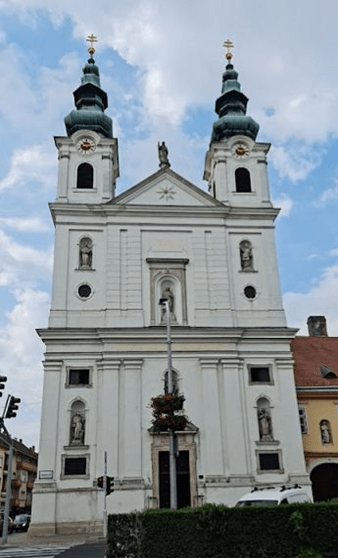
St. Judas Thaddeus Church in Sopron, Hungary

I have never been a church-going person except in my youth when my father, who went to a Jesuit school, made us go to church on holy days like Xmas and Easter.

My memory of going to the old baroque church in Sopron, Hungary – St. Judas Thaddeus, built by the Dominicans in 1715 – is not pleasant (see picture on left). The huge nave of the church was a forbidding, gloomy space for a small kid. It was cold inside with a stone floor.

Nobody received us at the entrance lobby; nobody led us inside. I stood for the service at the back of the church, listening to the sermon; that gave me a quick getaway if I got too cold or bored by the service.

The sermon and the entire mass were in Latin, which I could not understand. (The Catholic Church required that Mass be carried out in Latin until the Second Vatican Council of 1962–1965, which permitted the use of the vernacular.)

And the priest dressed in ecclesiastical clothing for delivering the sermon, giving him – and it was always a “him” – a formal appearance, talking down to us from the pulpit ten feet above us.

And, of course, we had the confessionals in little cubicles on the side of the nave of the church, where it was dark and I had to kneel in front of a wire screen behind which was the priest listening to your sins which were related to disobeying your parents and swearing using religious imagery.

 The salvation for my “mortal” sins, prescribed by the priest, was always saying a prayer fifty times or more, depending on the gravity and length of the list of my sins. I always thought the confessional was a good bargain to repent your “mortal” sins; it never took longer than a half hour to get back on the good side of the Lord.

Once I repented my sins, I lined up for communion wafers, the “sacramental bread”, that tasted good. Then we were free to leave the church.

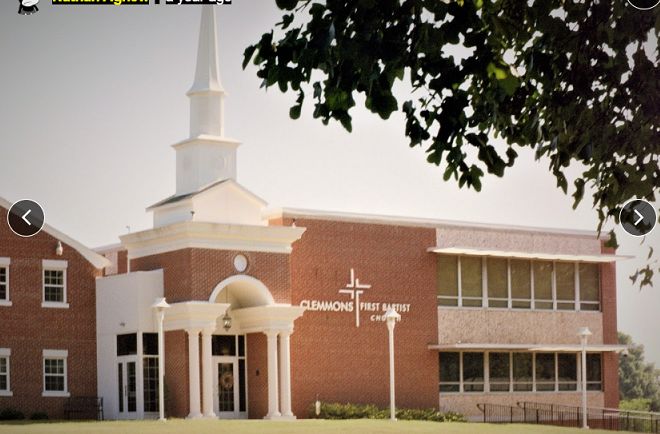
Clemmons First Baptist Church, Clemmons, North Carolina

I encountered a huge contrast to my experience with my baroque church when we visited our family at the end of November in Winston-Salem NC, and joined them for Sunday service at Clemmons First Baptist Church (see picture on left), on the last Sunday of the month, the beginning of Advent.

We entered the modern building with a red-brick façade, where smiling people welcomed us into the well-lighted and comfortable lobby and ushered us into the nave of the church to padded pews.

I felt like I was in a large living room entering the lobby and once we sat down, lively conversation filled the church until the service started. The Pastor welcomed the attending children, and the organist played hymns with the text shown on two gigantic video screens over the stage so that we did not have to pick up the hymn books to follow the songs.

All the people were informally dressed. The Pastor showed up in slacks and a sweater and gave a sermon from notes, speaking freely most of the time.

The Pastor addressed the meaning of Advent by asking us to look at our state in life to make sure we are ready for the second coming of Jesus. He illustrated his point by talking about himself getting old, although he said he is 44 years old; to me, he is a young man. But he said he feels his age when getting up “from a toilet seat”, eliciting laughter from the audience. He added that now one can install higher toilet seats to help with that. This type of informal sermonizing made me feel quite comfortable.

Then the Pastor, in a more serious vein, talked about embracing silence, meditation, and the healing power of nature. I felt quite at home by now: we just came from the New River National Park in West Virginia, where we spent a few days hiking and enjoying nature in silence.

He said there is no need to push yourself to get ready for the second coming by reading the scriptures. Instead, he said, wait until the desire to do so comes from within yourself. I liked his low-key approach to religion; embrace religion when you are ready for it. I was ready to join the church!

At the end of the worship, we followed the Pastor, who walked into the lobby to welcome the audience. I told him how much I enjoyed his sermon, shaking hands with him.

I noticed a board in the lobby with pictures of a dozen deacons (members of the church); I learned that all the families frequenting this church have a deacon who follows their well-being and provides help when needed. For example, should someone get sick and not be able to cook, the deacon would organize members of the church to bring over food. My brother-in-law is a deacon here. I thought the deacons performed an important and valuable role.

If we had had churches like the Clemmons First Baptist Church when I was growing up, I may have been a lifelong churchgoer.

How Did You Meet Your Spouse

November 12, 2022

That was the question at a celebration of a friend’s sixtieth wedding anniversary. We were looking at pictures of the couple’s past activities going back decades when someone popped the question. After the wife related how a “blind date” experience in Montreal led to an amazing sixty years of marriage, somebody spoke up and wanted to know how others, present at the celebration, met. I had no chance to relate my story; the conversation turned to how long it took from meeting your spouse to the wedding.

So here is my story. It started with my first car: a Peugeot 403 that I bought in Vancouver, in the early 1960s. I drove my car to North Carolina to attend graduate school in January 1965.

During the summer of 1965, I, along with two other graduate students studying city planning at the University of North Carolina (UNC) at Chapel Hill, had summer jobs in Washington, DC.

Ray rented a cheap apartment painted all black; it was unbearably hot with no AC. Another classmate, Alvaro, and I rented a room at Hartnett House off Dupont Circle. It was a bit of a flophouse. Our room had a window facing inwards onto a courtyard, with no air-conditioning and no fans.

If you know Washington’s weather during the summer, you know how steamy and hot it can be. Going to the beach one weekend was a wonderful idea, and since I was the only one with a car, I drove all of us to the beach in my Peugeot.

Alvaro invited Kathy to come with us to the beach. Kathy was a graduate student as well, studying economics and political science at UNC.

As soon as we arrived at the beach, Ray and Alvaro went to play the slot machines in the arcade. Kathy and I started talking about school life and hit it off immediately; we discovered we were both newcomers to North America and shared details of our growing up here. In those days we called stealing your friend’s date “birddogging”.

During the summer, Kathy and I got to know each other while discovering Rock Creek Park, going to nightclubs with blaring music, and eating at fish bistros along the Potomac. Our relationship hit a high point when her mother invited me for dinner. She was an experienced cook; the chicken meat just fell off the bones. I enjoyed the dinner and told her so. That pleased her. I was in.

I asked her to marry me three weeks after meeting her and bought her a skinny ring that I could afford from my meagre earnings that summer. But promised that I would replace the ring with a much larger ring as soon as I could buy one; I did so later when my job took me to the Yukon, where I bought her a wide gold ring.

The summer ended, and we had to go back to university. I suddenly got worried that if I spend so much time with Kathy, my studies will suffer. But as soon as we were back at school, we saw each other every day, starting with breakfast at Lenoir Hall, the student cafeteria.

We planned the church wedding for June 7, 1966, right after graduation, in Chapel Hill. But I had a suggestion; let us get married in a civil ceremony before the church wedding. We hustled off to South Carolina so that no one would know of our marriage and got married in the courthouse by a Justice of the Peace. I did not think the props in the courthouse measured up to the significance of the event; a couple of flowerpots did not provide the right background for taking a vow for life. But it was a marriage, and we had the certificate to prove it.

Our courthouse marriage burned an unforgettable memory in my mind; two grad students in a small South Carolina town, far from family, getting married, with nobody around who knew us, casually dressed, and making a contract for life. I thought it was surrealistic but deeply emotional and tremendously exciting.

This unique experience overwhelmed us, and nothing could break our spirits, not even when my faithful old car, the Peugeot 403, broke down on the drive back to Chapel Hill and we had to hitchhike back home. We just left the car on the highway; I took the license plates off it so people could not trace the car back to me. Disposal of the car was the last thing on my mind right after our union.

I cannot describe in words how excited and happy I felt being married, nobody knowing about it, not even my family, and going back to my dorm and Kathy going back to her dorm where she was a student councilor (her dorm students would have been flabbergasted to know what their advisor/councilor just did. This was in the sixties!).

The preparations for the church wedding took some other interesting turns; the pastor at the  Chapel of the Cross Episcopal Church who was to perform the wedding ceremony asked if religion would cause a problem for us. Kathy is Episcopal and I am Catholic. I assured the pastor that religion would not be an issue; I was a non-practicing Catholic and could not see myself launching into heavy arguments over religious doctrines.

Kathy’s brother Huw, whom I just met the day before the wedding, and my friend Ray, took me out for a few drinks; explaining that it was a custom to do so. On the day of the wedding, I got up a bit groggy and searched around for my formal clothing only to find I did not have a tie. I walked down the dorm corridor hall knocking on doors until I found a classmate happy to lend me one. I was ready to marry the second time.

My entire city planning class showed up for the wedding and had a great laugh when I tried to drive off in Kathy’s car. They put rocks in front and back of the tires, and I could not drive off until I got out of the car and cleared the rocks to the laughter of all. And when I drove off, a terrible racket came from the hubcaps; my friends put rocks into them as well. I drove off and stopped a block away to take the hubcaps off to get rid of the stones before driving off to our honeymoon.

Although I did not have the opportunity at the celebration to relate my story, I reflected on a marriage that lasted over sixty years. What I found more significant is that only one percent of couples in the U.S. can celebrate 60 years of marriage. I could not find similar statistics for Canada. I also found that an average marriage lasts fifteen years in Canada. So, a sixty-year marriage is an incredible achievement. Congratulations.

The Friendly Americans

May 19, 2022  

We were driving along highway 37 in upstate New York when there was a beep and the dashboard in the car flashed a message that our tire pressure was low. A few weeks ago, I had the regular tires installed replacing the winter tires, and thought the mechanics checked tire pressure automatically. Our destination was a thousand miles south, and we had to fix the tires.  

We stopped at the next gas station and looked for an air pump. Not seeing one, I asked a couple of fellows working on a truck if they knew whether the station had an air pump. They pointed to the back of the station but warned that the pump had no pressure gauge built into it and asked whether I had a pressure gauge. I said I did not have one. But I backed up to the pump and thought of putting some air into all the tires anyway. To get the warning light off. 

As I backed my car to the air pump, one fellow I talked with came over and handed me a new pressure gauge, still in a paper package. I opened the package, and, using the gauge, discovered that the right rear tire had less pressure than the other three tires, so I put some air into it.  

When I finished pumping the tire, I went to return the gauge, only to find the two fellows had left. At the gas station, I inquired whether the gauge came from there and if so, I wanted to pay for it. But the clerk said the fellow purchased the gauge costing over five dollars. So, a total stranger bought the gauge for me! What a friendly and helpful gesture that was.  

Why would someone purchase a tire pressure gauge for a total stranger? If he had one, he would have let me use it. But buying one? Perhaps I looked totally inept, and he tried to help me by buying it. But maybe he was just being friendly and trying to help a stranger who needed help? I was totally taken by this friendly gesture. And that friendliness extended to the clerk at the station who chatted with us and went out of her way to check the price of the gauge.  

This was not the first time someone stopped on the highway to help us. We were driving north on I40 a hundred miles south of Durham, North Carolina when I blew a tire and stopped on an off-ramp. Before I finished calling the AAA, a friendly person stopped at our side and in less than ten minutes, changed the tire expertly, loosening the lugs; cranking up the car on the side and putting on the spare.  

Not only on the highways but elsewhere too, helpful experiences await you in the US. At the local grocery chain store in Baton Rouge, Louisiana, comparable to our Loblaws chain in Ontario, store people asked me how they could help find items without prompting. It is often difficult to find a store clerk at Loblaws in Ottawa and I have never been approached by a clerk offering help.  

I found the same walking on the streets of Baton Rouge this morning; people said hello and how are you, meeting you. Back home, people are more reserved and often pass you without even acknowledgment.  

I think that friendliness is baked into the DNA of Americans. It may be a historical, cultural trait, borne out of hardships in occupying the country and building communities. Whatever is the root of this characteristic, it triggers a warm feeling inside of you.