Exploring Beaufort: A Cyclist’s Paradise in South Carolina

March 24,2025


We drove south to leave the winter of Ottawa, even though we enjoy snowshoeing. Escaping springtime offers a welcome reprieve from the winter’s cold and snow. Despite my pollen allergies (managed by Claritin), late March in the Carolinas offers ideal cycling weather.

Driving south towards Beaufort, South Carolina, I sighed in relief at leaving the crowded, monotonous, and speedy Interstate 95 behind. Driving for hours had numbed my feet, so I hoped for less, slower traffic on Route 21 East. Although slower, the traffic picked up closer to Beaufort on a four-lane highway.


The expansion of military bases (Parris Island and Beaufort), resort construction (Hilton Head Island), and a Northern retiree influx have driven development along South Carolina’s east coast.
We learned from a hotel employee at check-in that Beaufort’s population has almost doubled since the pandemic, nearing 15,000. It is not only retirees but also people working remotely who have arrived to take advantage of lower housing and living costs.

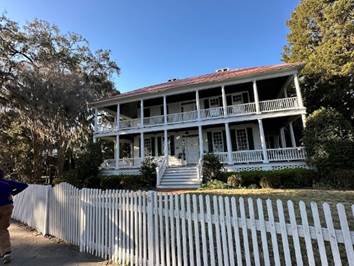
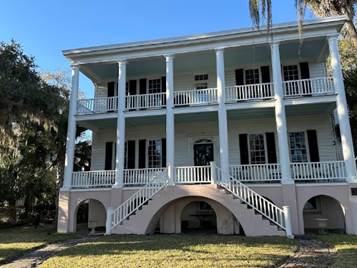
When Kathy stayed here thirty years ago, she stayed in one of the huge antebellum houses on the waterfront, used as a B&B in those days. Today, developers meticulously redeveloped the waterfront, and they restored the antebellum homes along the waterfront to their original designs. The city designated the downtown area a historic district, and we enjoyed a quiet walk admiring the architecture.
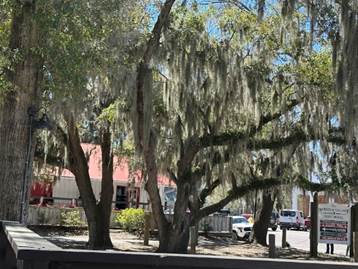
Cycling the Spanish Moss Trail from Beaufort to Port Royal was a smooth ride (it follows the old Magnolia rail line). The paved, twelve-foot-wide trail was flat, crossing marshes with many boardwalks and with the temperature in the mid-twenties (in the seventies in Fahrenheit), was ideal for a bike ride. Much of the Trail crossed areas with oak trees from which Spanish moss hung. I assume the source of the name for the Trail. Although the hanging moss is attractive, avoid touching it because it might contain chiggers.
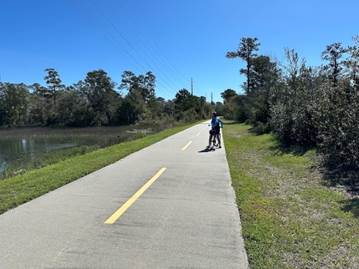
The paved trail was great for riding, but I knew that falling off the bike would be rough, experiencing injury if going at the maximum allowed speed of 15 mph.

We sped through the twelve-mile trail, pausing to talk with people going in the opposite direction. We avoided talking about politics. We did not know how local people would react to talking to us Canadians, in view of Trump’s desire to annex Canada.

I noticed different organizations took responsibility for maintaining sections of the trail, which included benches at viewing sites, including the military that were in abundance in the area.

In less than a couple of hours, we arrived at Port Royal, at the other end of the trail. We were ready for a cup of coffee and found in the center of Port Royal a home converted to a restaurant with a name Corner Perk that offered fancy coffees. Their muffins were so special we couldn’t resist.

Next, we saw a sign for the Cyprus Wetlands rookery, home to hundreds of local birds (egrets, cormorants, bats, herons, etc.), right by the coffee shop. A boardwalk crosses a lake, going by an island with small trees that provide nesting grounds for birds. We noticed many turtles and alligators also slept on the shore of the island.


Returning to Port Royal, we found a small house converted to a restaurant boasting a sign for Griddle and Grits and the menu included grits with shrimp, with chorizo and grits with different ingredients. I like spicy foods and chose chorizo on grits, which turned out to be excellent. Kathy chose she crab soup, which also turned out to be a good choice.

On the return journey, we paused on a bench and were approached by a man who looked like a bear of an angler, who sat down, smoked a cigarette and started a conversation. He wanted to know all about us and then described his entire life story, including where he was born, where his family members were born and all the ailments they each had. I gathered he has been a floater with jobs in many states before settling in Beaufort. We could not resist listening to him; overall, it was an enjoyable social engagement.

We stopped at a Publix grocery store on the way home to pick up dinner. The Spanish Moss Trail is a nice, paved trail, but it was a bit too tame for us. We like longer and wilder trails with fewer refinements.

The Surge of Asylum Seekers: Impact on Canadian Society

November 19, 2024

Dueling demonstrations took place yesterday. At the old Nepean City Hall, a small crowd celebrated the proposed construction of a “temporary” welcome center for asylum seekers. Another group protested against the welcome center at its proposed location, the Nepean Sportsplex. Of the one thousand asylum seekers in Ottawa, six hundred find shelter in community centers, like hockey arenas, while others find refuge with volunteer social organizations.

With expectations of a further surge in asylum seekers, the city hired consultants to evaluate the suitability of over a hundred sites for constructing the welcome center. One site in Barrhaven met vociferous opposition, although nobody owned up to NIMBY. The Sportsplex site is a mile from the nearest shopping center and has an infrequent bus service.


I took some time to gain a deeper understanding of the proposal; I discovered that the city plans to erect “Sprung” buildings, a design from the Sprung family company. The company erected over a thousand such buildings globally. I checked out one built on the Embarcadero in San Francisco and found it is an unappealing tent-like building. But it requires simple construction and is economical and fast to erect.

According to city officials, asylum seekers are mostly young single people. The current arrangement is for these people to stay for three months in these welcome centers, receiving help from officials in finding jobs and housing in addition to filling out papers to become residents of Canada.

How did we reach this point with the number of asylum seekers surging during the past couple of years? And would there be more in the future, given President-elect Trump’s intention to deport millions of illegals just south of our border?

Politicians often create and resolve crises to boost their public image. Prime Minister Trudeau has created an immigration crisis in Canada by increasing the inflow of immigration substantially subsequent to the pandemic and is now trying to solve it by reducing the number of arrivals. Naturally, he denies creating a crisis and blames private interests for misusing immigration policies. 

The surge in immigration has triggered a housing shortage, a healthcare problem, and a challenge to the education system. The capacity for housing construction in Canada is no more than 250,000 units per year. Over the past couple of years alone, the rate of a million people a year arriving in Canada would require the entire annual production of housing units, assuming four people per unit. Hospital emergency rooms boast a waiting time of over ten hours; people without family doctors visit emergency rooms for consultations. Teachers have struggled with teaching children who speak dozens of different languages at home and bringing with them their cultures.

Statistics indicate there are eight million “permanent residents’ in Canada, waiting to become citizens (it takes three years of residency to qualify for citizenship). Furthermore, there are three million “temporary residents,” which include foreign students, seasonal workers, and immigrants. Asylum seekers are immigrants, numbering 250,000 across Canada today.

Interestingly, eleven million of the forty-one million Canadians—temporary and permanent residents combined—cannot vote; one must be a citizen to vote. It is also noteworthy that although the federal government created the asylum seekers crisis, local levels of government shoulder the burden of welcoming and assisting newcomers to fit into Canadian society.

A ninety-day stay in a shelter for a young newcomer to Canada can be a cheerful affair, especially during the cold Canadian winters. I assume that clothing and food are also provided. But what is most important for a newcomer to Canada? I suggest speaking English is vital unless the newcomer already knows the language. I speak from my lived experience. As a genuine refugee arriving in Canada, learning English was crucial for navigating life, securing employment, and resuming my education.

Now, language training takes more than ninety days. I’m wondering, what experience do government officials have dealing with the current wave of asylum seekers? Are they turfing out people in ninety days from their shelters now? Or do the newcomers stay longer, and how much longer? This thought takes me back to the original concept of city officials claiming that the proposed welcome center would be temporary.

The stated temporariness of the “Sprung” structures energized many people who doubted the buildings would ever be demolished. When not required any further for asylum seekers, the public imagined these buildings would be repurposed to house the homeless. Couple with the challenge of sheltering asylum seekers, Ottawa is facing a significant rise in its homeless population. It has become quite unpleasant to walk in central parts of the city at night, with homeless people sleeping in doorways and on the streets.

The government’s recent announcement lowering immigration targets will reduce the number of asylum seekers, freeing up welcome centers to house the homeless. The most significant impact of this issue for me was that I noticed a shifting public attitude towards immigrants in the news media, questioning immigration’s worth to Canada. I blame the federal government for this snafu for acting without a proper impact study of what a significant increase in immigration to Canada would entail.

Policy Born Out of Panic

April 26, 2024

It is astonishing how the federal and Ontario governments announced a fifteen billion dollar incentive to Honda to set up a car battery plant in Ontario yesterday while they encouraged the municipalities last week to eliminate the requirement for parking for multiple unit developments. So, the message is to make more cars but provide no parking! Let me describe what happened.

Camada’s three levels of government hastily introduced a cobbled together housing policy this month, a move that could have significant repercussions. Upon learning that our City Council, under pressure from senior government levels, is considering approving quadruplexes or four units on a residential lot and eliminating parking requirements for highrise or multiple-unit buildings, I couldn’t help but worry. These are just a couple of the many proposals aimed at addressing the severe housing shortage that has led to the emergence of tent cities in all metropolitan areas.

With all the recent announcements, the federal government promises to double housing starts for the next seven years from the current pace of 250,000 units per year, by pouring billions of dollars into municipal budgets, providing local city councils agree to change zoning codes, including the above two proposals.

While this could alleviate the housing shortage and provide more affordable housing options, it raises concerns about the quality of these new units and the impact on existing neighborhoods.

Yes, the recent surge in international migration created the housing shortage; statistics show that the Canadian fertility rate is way below the replacement rate, and the increase in population and the consequent surge in housing demand can be attributed directly and totally to immigration.

But wouldn’t it be more prudent for the federal government to address the demand for housing as well instead of focusing solely on the supply side? Would it not be faster and easier to restrict immigration in the short term than build housing that takes years to complete? A more balanced approach would be advisable in considering both supply and demand for housing.

A panic reaction is not a good incubator for developing thoughtful housing policy. For example, consider the proposal for building four housing units on a residential lot. A quarter-acre lot measures seventy by one hundred feet (excluding space for roads). Yes, one can build four units on such a lot; it could be two side by side units on the main level and the same upstairs, or one unit per floor in a four-storey building. It would be a dense development, especially considering the parking space for each unit.   But, oops! Are parking spots still required?

However, more recent developments have much smaller lot sizes; some are thirty-five by one hundred feet. To put four units in such a small lot would be a design challenge. And where would the parking be? On the neithborhood streets? As much as good public transit, which we do not have, may negate the need for cars, most individuals and families like to have a car to get around on weekends and at nights when public transit is sporadic at best.

In the suburbs, there are one-acre and larger lots where four units per residential lot are reasonably achievable, but would people desire it? They moved to the suburbs because they wanted bigger lots so why would they now build three additional units on their land? Not likely.

Although four units per residential lot is an attractive slogan, it behooves the government to specify what a “residential lot” means. For example, it would be helpful to identify a minimum lot size to utilize this concept fully.

While the first proposal for densification relates to the efficient use of an urban lot (four units on a lot), the second proposal to eliminate parking refers to cost; by not building garages, the government claims the cost savings would benefit renters/buyers. However, consider the potential impact of this idea on different demographic groups. For instance, families with children, the disabled or elderly individuals may still require parking spaces, and the lack of these amenities could disproportionately affect them.

Before believing government claims that eliminating parking spaces will reduce the cost to the buyer/renter, consider vacancy rates. With vacancy rates so low today that people immediately take up any vacant rental unit, why would developers not charge market rates even though their costs would be lower by not providing parking? And when people buy condominiums, they buy garage spaces in addition to the unit’s price. As a consequence, I do not see why multiple unit residential buildings with no parking would save money for renters/buyers.

To implement the no parking proposal, the City Council proposes to do away with the current policy of requiring parking as a ratio of the number of units in the building and let developers decide on the number of stalls provided based on market forces. While in some areas of the city, developers may choose to skimp on parking spaces, assuming that people could park on neighboring streets, it may not be the case downtown, where office towers dominate, and street parking is not available. I am concerned that not providing parking would exacerbate congestion on the streets and create a huge problem during the winter months when parking is prohibited on the streets for snow clearing.

What further concerns me and find astonishing is when I see that the two higher levels of government are actively pursuing car manufacturers to set up shop in Ontario.  They announced yesterday a multi-billion-dollar incentives package for Honda, after providing incentives for Volkswagen and Stellantis, last year. Is this not a huge contradiction: do not provide parking but encourage the manufacture of cars?

Quadruplexes on quarter-acre lots and highrise buildings without parking do not reflect what people want today; to me, it appears that governments are attempting to modify behavior to solve a housing shortage, without dealing with any of the basic issues that contributed to the problem – that is, an unprecedented increase in immigration levels, and the capacity of the country in both labor and supplies to accelerate any construction. Despite all good intentions and even beyond the questionable objectives of these ideas, the pace of housing construction cannot and will not double for the next few years due to the lack of skilled labor.

Awkward Facts

April 17, 2024

The Covid crisis brought to my attention the Canadian Government’s recent flood of announcements to address the ‘housing crisis.’ To contextualize this ”crisis,” I delved into statistics. I discovered that sixty-five percent of Canadians own their homes (and therefore experience no housing crisis), and the income-to-house price ratio has skyrocketed over the last decade. This has created significant hurdles for young people, making stepping onto the property ladder increasingly tricky.

However, the billions of dollars announced to encourage home construction seem overkill. The demand for housing, which many studies concluded resulted from the recent surge in international migration, may be reduced by government policy, limiting future immigration flows. Mortgage rates may also come down soon, alleviating the need to solve a “crisis.” However, throwing vast amounts of money at a sudden “crisis,” which has evolved recently, reminded me of the pandemic’s beginning. Let me describe.

The Canadian Minister of Procurement ordered 419 million Covid vaccines at the pandemic’s onset, costing nine billion dollars. The experience of Italy and New York State with Covid was a stark reminder of the potential devastation without vaccines. However, with a population of 38 million people in 2020, Canadians would receive ten vaccines each. The Public Health Agency of Canada recommended two doses for vaccination and boosters every six months. So, the vaccines purchased would suffice for five years for all Canadians.

As a result of publicizing the dangers of Covid, over 80 percent of the population raced to get the first two shots. Although the vaccines kept coming, and booster shots were widely available, people decided that two vaccines were sufficient, and fewer and fewer people took a third or fourth dose. By the time the sixth shot, the XBB.1.5 Omicron subvariant designed to shore up protection against the SARS-COV-2 descendants came about in late 2023, only fifteen percent of the population decided to receive the dose.

By late 2023, people considered Covid more of a nuisance than a dangerous sickness, similar to having a cold. With all the vaccines ordered but not used, the British Medical Journal called Canada one of the most vaccine-hoarding countries in the world. The Director General of the World Health Organization, in 2022, remarked that Canada was hoarding vaccines at the expense of poorer nations. Of the over 400 million vaccines contracted, only 105 million were used by December 2023 in Canada.

It’s disheartening to note that policymakers seemed to overlook the fact that vaccines have expiration dates. They also seemed to disregard the reality that the virus mutates, necessitating the development of updated vaccines to maintain effectiveness. As a result, millions of doses expired and were unusable   However, the contracts for the original orders still have to be honored. For instance, Canada still owes C$350 million to Novavax, one of the vaccine manufacturers, for vaccines ordered. 

So, was Canada successful in avoiding Covid? Can we put some metrics to success? The Canadian experience with Covid indicates that Canada fared well among the G7 countries in handling the pandemic, with less than a thousand deaths per million people, second best after Japan. However, we did spend a significant amount of money, and much of it was wasted. It is astounding that Canada used only 25 percent of the vaccines purchased. I wonder if we could have been more agile and intelligent in our decision-making, considering people’s willingness to receive periodic shots over the years and the expiry dates of the millions of vaccines ordered.

I also wonder if the Government has learned anything from throwing so much money at the Covid issue that could be applied to their new “housing crisis ” so that Canada can avoid throwing good money away with minimal results.

Housing and Homelessness

February 4, 2024

My local city Councilor jolted me with the following statement in his late January 2024 newsletter: “The issue that I want to focus on for this newsletter is Housing & Homelessness. If ever there was a time in recent memory when this issue was front and centre in the minds of pretty much everyone, this is it. Whether you’re homeless yourself, whether you can’t afford to buy a home, refinance your home, or rent an apartment, or whether you’re worried about challenges that will be faced by the next generation, our current crisis is affecting a majority of Ottawa residents”. Sixty-four percent of Ottawa households own a home! So, how could these issues affect the majority of residents? This statement did not resonate with me on several levels!

On one level, it is not front and center in my mind or my friends’ or neighbors’ minds. It is in the newspapers, on TV channels, and on the radio, but people I know do not discuss and are not interested in those subjects. It is infrequent if they talk about it, and when they do, they mention parts of downtown where people experiencing homelessness congregate. But people I know avoid downtown for lack of parking or the cost, especially since we find all our needs met in the suburbs. In our neighborhood, I have yet to see homeless people. I go out daily, know my neighborhood well, and have not seen homeless people to date. I believe it is a non-issue in my community.

When I talk with my friends, subjects of our discussions relate to the amazingly mild climate this year, the current popularity of hybrid cars, how they function, and whether we should get one, a hip replacement facing a neighbor, a trip by a friend visiting the Abu Simbel Temple in Egypt, and when Trudeau may resign. When nine men met to form a book club, we discussed the need for a men’s book club, the schools we attended, and how we should run our new-fangled book club; for example, should we have lunch before discussing books? Homelessness was never mentioned.

On another level, if my local city Councilor were serious about doing something about homelessness, he should have had some statistics on how many homeless are in our community. All I hear today is “evidence-based” policymaking. So, how about some numbers to substantiate the homelessness issue in general terms and as it exists in our community?

The other subject the Councilor mentions is housing and its affordability. These are current political challenges to satisfying the massive demand for housing created by the influx of newcomers to Canada. The various levels of government blame each other for the housing shortage. One reads that local governments take too long to approve applications for development proposals and charge hefty development fees. Both are disincentives for speedy housing construction. Recent federal government policy let too many students, refugees, and immigrants into Canada, which combined to create a high demand for housing that the construction industry has been unable to cope with. Beyond general curiosity, my friends and I ignore this subject; we all have a house, mortgage-free.

Unless the Councilor can identify homelessness as an issue in our community, I would suggest he focus on our local problems, such as poor road conditions, through traffic, and traffic congestion on surrounding major roads. Many streets are in an abysmal state with potholes. People traversing our community to avoid traffic tie-ups at major intersections endanger our walkers on the streets. The construction of sidewalks and additional streetlights would enhance safety. I believe road maintenance, safety, and traffic control are the real issues in our community. The Councilor could survey residents on what they perceive to be the problems in setting his priorities.