An Evening at the Harvest Ball: Food, Music, and Memories

November 13, 2025

The challenge was figuring out what to wear to the Harvest Ball. I thought I had a sports jacket, but it wasn’t in the closet; then I remembered I’d given it to the charity store years ago. I have collared shirts and some fancy T-shirts, but the only formal wear I have is a black suit I haven’t worn in decades, and I was not sure if it still fits. The question was: What do people wear to a Ball today?

The Ball, organized by the Ottawa Hungarian House, was held at the Hungarian community hall, an informal space in an industrial building. I decided the safest thing to wear was the formal suit. But I could take off the jacket in the beginning, and with no tie and an open shirt, I would match the space’s informality.

We arrived 30 minutes early: the dinner was at 6pm. The hall was almost empty except for the organizers. There were no seating arrangements, so we picked a table on the side, next to a well-dressed woman sitting alone at the table next to us. By way of introduction, she said she was Clara and that she and her husband had come from Hungary in 1967. She spoke in Hungarian. When I said that Kathy does not speak Hungarian, she asked if she spoke English or French. When we settled on English, she said that she and her husband started a fur-making business and moved to Baie-Comeau, Quebec, in the early seventies, where the demand for furs was strong. When the local mining industry died and demand for fur declined, they moved to Ottawa. They continued making furs in their basement factory.

I went to the bar to buy a couple of glasses of wine. When I returned, a  Hungarian couple sat down at our table. His name was Zoltan, and I remarked that it was a good Hungarian name. I did not catch the wife’s name; it was getting noisy. Nokia hired Zoltan when he finished university in Hungary. After a couple of decades, Nokia transferred him to Seattle for two years, and then to Ottawa. They have been in Ottawa for a couple of years and like it here.

Zoltan’s wife was talkative and said that life is much easier here with all the appliances available, than in Hungary. I gathered they would like to stay on after their four-year work visa expires.

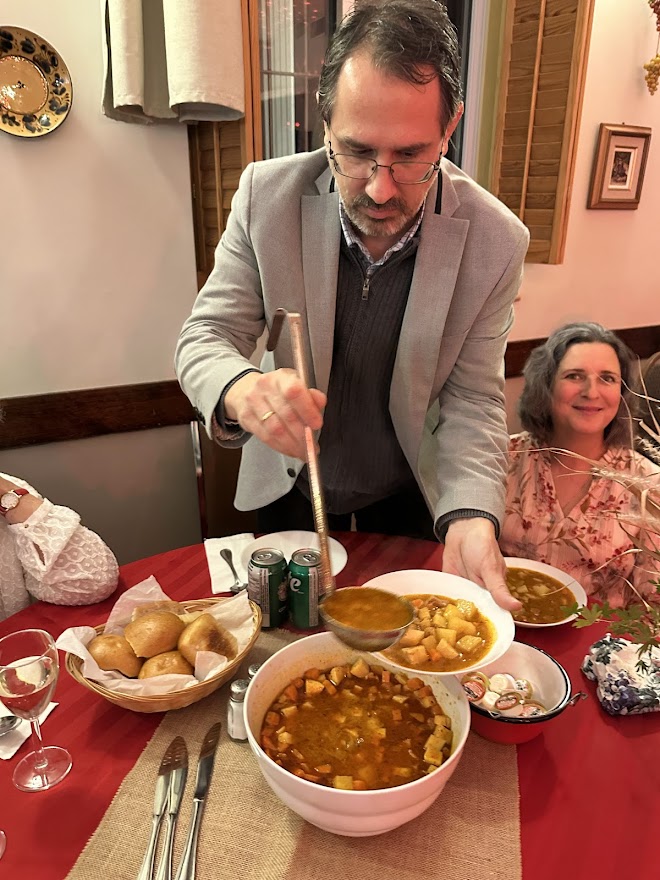
A huge bowl arrived at our table, filled with porkolt (pork stew). Although there were only four of us, the bowl could have served twice as many people. We served ourselves in family style. I enjoyed the porkolt, which was liquid and felt more like soup than stew. After tasting the porkolt, Zoltan’s wife thought that no real Hungarian paprika was used and that the porkolt could have been spicier. I agreed, but I enjoyed it with chunks of pork, carrots, and potatoes.

Oue Hungarian table companion serving “porkolt” family style

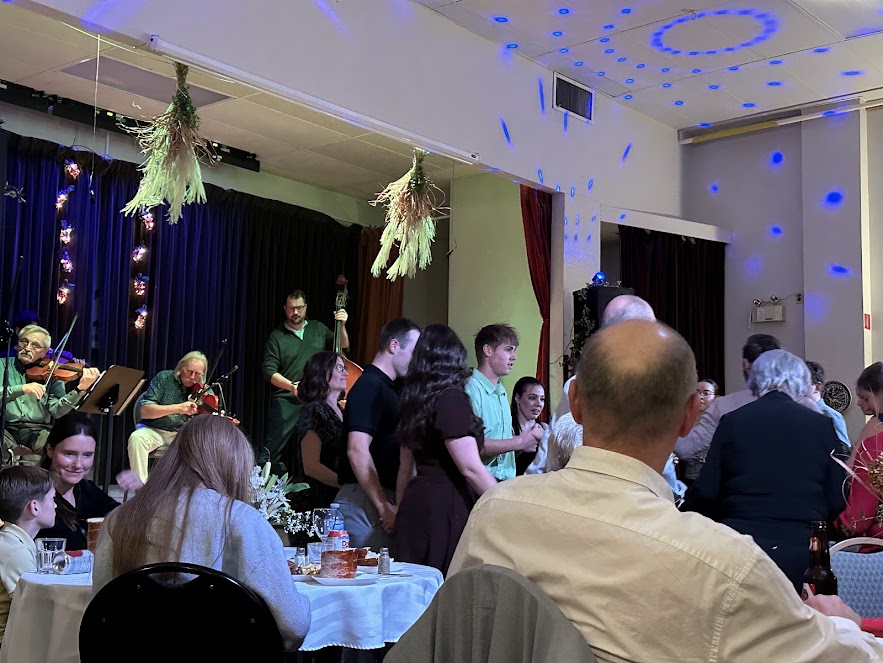
A couple of violinists and a bassist started playing Hungarian folk songs during the meal. The instruments reminded me of the music of Django Reinhardt – gypsy music with a swing – but these musicians played chardas, for Hungarian folk dance. People got up to dance, and soon the dance floor was packed. By now, the community hall had become extremely noisy, with over a hundred people talking, and dancing to the music. It was hard to speak and listen to our table companions.

As I have recently joined the Ottawa Hungarian House, I did not know anyone there. I have never been ethnically oriented. When we came to Canada, we were the type of immigrants who wanted to amalgamate into Canadian society. We did not live the life of the old country. And I married an American girl I met in graduate school at the University of North Carolina. We always spoke English at home, and the children grew up as native Canadians. I came to this event to hear some Hungarian spoken; I may be getting sentimental.

However, I knew some people from my high school in Hungary who studied with me at the University of British Columbia in Vancouver. I heard they came to Ottawa and approached the bartender if he knew any of my old friends, the twins Kalman and Peter Roller.  

He said, “Of course, Pista Roller is sitting back there,” and he took me to him, who was not Kalman or Peter but looked like their spitting image. Pista told me there were four brothers in the family. I was shocked to hear that the twins were dead: one had brain cancer and the other dementia. One was a pharmacist doing research in China and the other worked for the National Institutes of Health in Washington, DC. I wanted to follow up on this information and asked for his phone number to arrange for a get together.

Dessert came when I got back to my table. It was a caramelized pastry in the shape of a tube, four inches in diameter, and eight inches tall. I looked inside, thinking that there was some cream or fruit there. No, there was nothing inside; you ate the tube. The Hungarian couple explained that you tear a piece off with your hand, eat it, then keep tearing it apart and eating it. It is called kurtoskalach (chimney cake) and is a popular Hungarian dessert.

Chimney cake

It was an enjoyable evening of contrasts, combining ethnic foods, music, and dancing with people reading their iPhones and speaking English. The evening brought up memories. I described to our tablemates how we escaped from Hungary during the Hungarian Uprising of 1956. Our table companions who came to Canada two years ago acted like Canadians their age. And the Hungarians who came out decades ago enjoyed reliving the music and food of the time they left Hungary.

Reflections on the 1956 Hungarian Uprising Remembrance

October 28, 2025

This week, I attended a flag-raising ceremony commemorating the sixty-ninth anniversary of the Hungarian uprising of October 23, 1956, at Ottawa City Hall. I looked forward to meeting some grey-haired Hungarian refugees, with whom I could make contact, talk about the old country, and share our experiences in Canada.

About fifty people showed up for the ceremony. I did hear a few people speaking Hungarian, chatting in small groups. They seemed happy to talk with each other. I went by myself, looking for some social interaction and discussion. Still, nobody seemed interested in making contact, even though I walked around and tried to break into conversations.  

When I found a young fellow standing by himself, I asked him if he was Hungarian. To my surprise, he said he was an RCMP officer. I wondered if he was on an assignment to ensure security at the event, requested because staff from the Hungarian Embassy and other diplomats were in attendance. the event organizers.

Another person I approached was a black woman who, with a friendly smile, explained  with a friendly smile that she was with the Nigerian Embassy and had been invited to this event. I found myself confused; while I understood the logic behind inviting certain European nations, I questioned the inclusion of African countries. Nevertheless, she was charming, and we talked about Africa and my trip to Tanzania.  

Although the flag-raising was outside, due to inclement weather, the group moved to City Hall first to listen to the speeches by the dignitaries. The small conference room inside was insufficient to seat everyone, so I stood in the hallway listening to the speakers.

The Deputy Mayor, Sean Devine, who, by the way, is my local City Councilor, opened the ceremony. He paid tribute to the courageous Hungarians who perished during the 1956 uprising and commented on the contributions the refugees made to Canada. Although Sean did not mention it, well-known people such as Anna Porter, a writer and publisher, and Robert Lantos, a film director, were fifty-sixers, among others.

Ms. Katalin Haas, Charge d’Affaires at the Hungarian Embassy, spoke about the significance of the 1956 rebellion and invited representatives of the Canada-Hungary Parliamentary Friendship Group and a representative of Global Affairs Canada to speak.

Many speakers mentioned the 38,000 people who arrived in Canada after the uprising looking for freedom and dignity and the over 300,000 people of Hungarian descent now residing here. All the speakers emphasized the Hungarian people’s desire for freedom and dignity.  

Adam van Koeverdan, Co-Chair of the Canada-Hungary Friendship Group, spoke about his mother, who escaped Hungary during the uprising. That made me feel old. I was sixteen years old when I fled Hungary, and he was talking about his mother! Further indicating my age was a group of young people talking about being fourth-generation Hungarians. I felt ancient by that time.

The speeches were well delivered but seemed hollow to me, as the speakers lacked a fundamental understanding of the nature of life in Hungary in the 1950s that sparked the rebellion. None of the speakers had firsthand experience of life in Hungary at the time of the rebellion. The speakers’ comments were sincere but lacked the emotional gravity that people with direct experience could have brought.

For example, I remember when our neighbor in the apartment house where we lived disappeared one night, and nobody said anything about it. Nobody raised any questions. Or when my father, a medical doctor, was called many nights to patch up people caught trying to break through the Iron Curtain or swim across Lake Ferto. Or when my brother, a student in Budapest, walked home to Sopron, a distance of 200 kilometers, when the revolution broke out. During the uprising, the absence of cell phones or live communication made it difficult to receive updates from him for several days. This lack of information caused considerable concern among our family about his safety. The family feared the worst. After coming home from school one day, our mother told Peter and me to set off along the highway to Vienna, each of us carrying a sandwich in our backpacks, a memory that has stayed with me ever since.  

I thought that a few refugees talking about their escape, or a film showing the tanks in Budapet crawling with students during the uprising, would have been relevant and impactful. However, I recognise that the objective of the ceremony was to honour those who lost their lives, rather than revisit the events of the uprising. Those people attending who were old enough to witness the rebellion personally may not have felt completely satisfied. I wondered, how many of us oldtimers attended?

Boldt Castle Visit: History and Architecture Unveiled

October 22, 2025

October 11. We played tourists today. Although we live just an hour and a half’s drive from Boldt Castle, we had never visited it until now. I’ve heard of the castle, of course, but it’s located on Heart Island, in the Thousand Islands region of New York State, on the St. Lawrence River. Visiting from Canada requires a passport, and since we don’t carry our passports with us every day, we never thought about making the trip.

One can visit the castle from Alexandria Bay in New York State or from Canada, with ferries departing from Gananoque and Rockport, Ontario. We decided to go from Rockport to save time, as driving to Alexandria Bay takes longer.

Upon arriving in Rockport, we noticed eight large tour buses. To my surprise, many tourists from China started disembarking. A local who was familiar with the area explained that Chinese workers are often rewarded with tours to Canada, and many of them visit Montreal, or Toronto, making a side trip to Rockport on their way to Niagara Falls. We also encountered other visitors in the parking area, including a couple from Toronto who were making the long drive back home the same day. We met another couple from Pennsylvania, who decided to sightsee in Canada before visiting the castle. I hadn’t realized how popular the castle is as a tourist attraction. A guide told me that five hundred to two thousand people visit the castle each day.

The boat trip to Heart Island takes about half an hour and passes by some extravagant cottages that resemble large houses more than typical summer homes. Upon landing on Heart Island, we went through U.S. border control, which took a while due to the long lineup of visitors. After we cleared the U.S. border, where they took a photo of us without hats and with our glasses off, we had a couple of hours to explore the island and the castle. Then, we returned to the dock for our trip back.

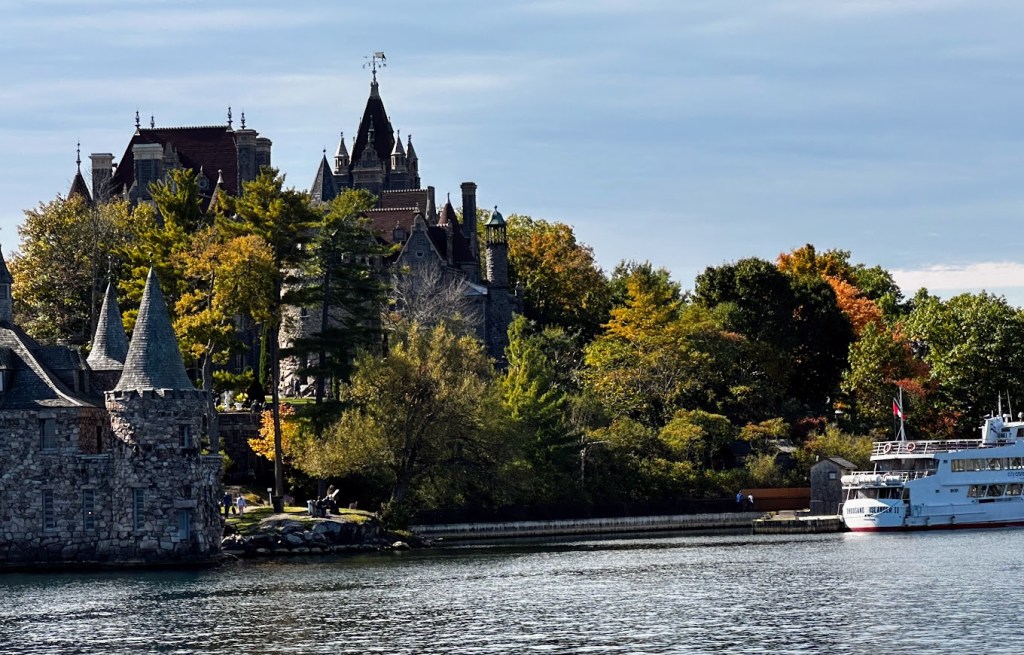
The view from the ferry

As we approached the castle, we saw a wedding on the front lawn and were asked to leave by the organizers. Fortunately, the castle was open, so we explored the large central hall and the enormous dining room before heading upstairs to see the bedrooms. The castle has a total of one hundred and twenty rooms.

The main hall

On the second floor, we watched a short film about the history of George Boldt and the castle. George Boldt emigrated from Prussia to the US at the age of thirteen. He started working in the kitchen of a hotel in Philadelphia and quickly rose through the ranks to manage the hotel at a young age. He became the manager of New York’s Waldorf Hotel and merged it with the Astoria Hotel across the street, becoming the well-known Waldorf Astoria Hotel.

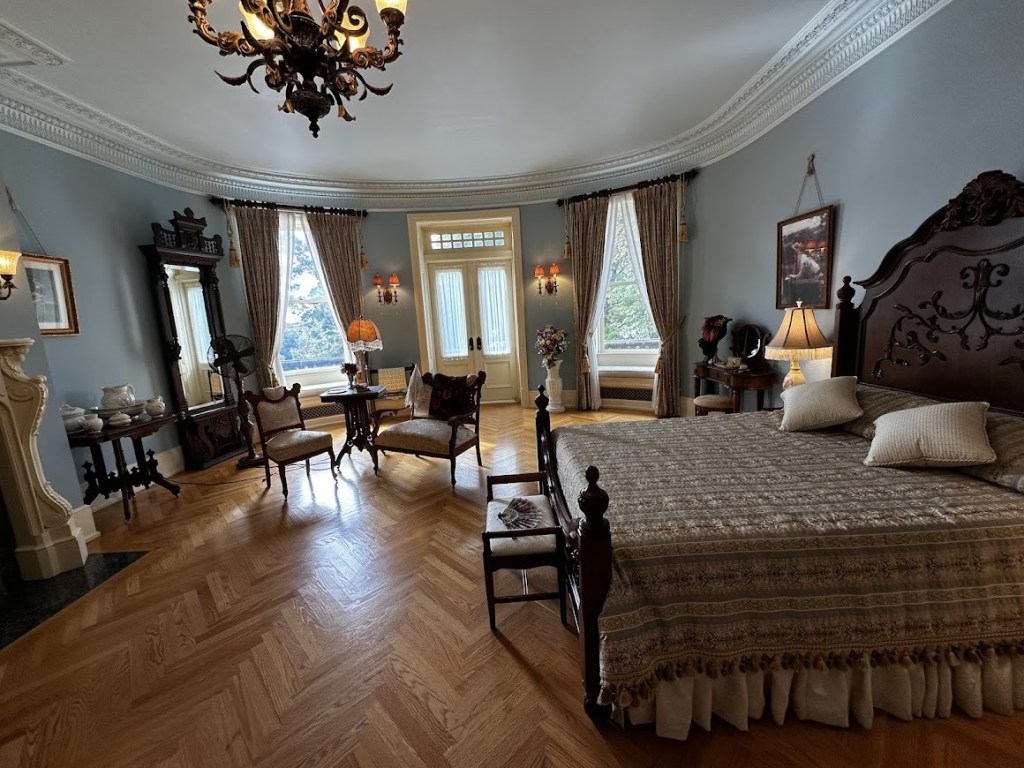
The dining room and a bedroom

As part of his heritage, Boldt is credited with popularizing the “Thousand Island” salad dressing in his hotel. The name originated in the Thousand Islands region of upstate New York, and its original version was made with mayonnaise, ketchup, and pickles. He also created the Waldorf salad, a classic American dish made with diced apples, celery, and mayonnaise.

The Boldt family spent their summers in upstate New York, where George Boldt decided to build a castle on Heart Island for his wife. He was going to give the castle to her on Valentine’s Day. The architecture resembles a Rhineland castle. Construction began at the turn of the century. However, in 1904, tragedy struck when George’s wife passed away unexpectedly. He called off the construction and laid off the three hundred workers who had been building the castle. George never returned to the island, and the castle remained untouched for seventy-three years, falling into a ramshackle state. In 1977, the Thousand Islands Bridge Authority took over the property and invested millions of dollars in its rehabilitation, preserving it for public enjoyment.

Also on the second floor, we saw the rehabilitated bedrooms decorated in period style, belonging to George, his wife, and their children. The floors above have not yet been fully renovated; they currently hold architectural drawings and additional information about the castle.

The garden is also worth visiting, featuring an Italian garden and professionally landscaped grounds with benches. We sat on one of the benches to enjoy our lunch, grateful for a moment of rest after climbing the stairs. It’s important to note that the ceiling heights in the castle are much higher than the typical eight-foot ceilings found in residential homes; climbing four floors felt more like going up six to eight floors in a standard building today.

On the return ferry trip, I bought a cold drink from the bar, which was refreshing and helped me process everything I had seen. If you have visited castles in Europe, this one may not impress you much. However, North America has very few buildings like this one, the Biltmore Estate in Asheville, NC, or Hearst Castle in San Simeon, CA. Visiting this Castle is certainly educational, especially for children. It is also steeped in history and serves as an essential example of the architectural style built during the Gilded Age. I recommend it as a great family outing on a sunny day.

Exploring the Ismaili Imamat: A Cultural Landmark in Ottawa

June 13, 2025

The Canadian Headquarters of the Aga Khan, known as the Delegation of the Ismaili Imamat, is situated at 199 Sussex Drive in Ottawa. The Ottawa Imamat itself is a secular building. However, the Aga Khan serves as the spiritual and hereditary leader of the Nizari Ismaili branch of Shia Islam, tracing his ancestry back to Muhammad.

The Delegation of the Ismaili Imamat Building on Sussex Drive

The Aga Khan once noted that, in the West, religion is often viewed separately from social and economic initiatives. In contrast, the Ismaili tradition sees helping the poor and fostering connections between people and cultures as integral to the practice of religion.

Sussex Drive, often referred to as the “ceremonial route,” is also home to the embassies of Kuwait, Saudi Arabia, France, and Japan. The award-winning National Gallery, designed by Moshe Safdie, is located nearby, adjacent to the Canadian Mint and across from the Notre-Dame Cathedral Basilica. Additionally, the Prime Minister’s official residence is located at 24 Sussex Drive, which is currently awaiting renovations.

The arrival of the Ismailis in Canada goes back to Pierre Trudeau, a friend of the Aga Khan IV, invited the Ismaili community to Canada when Idi Amin expelled them from Uganda. Currently, approximately 2,000 Ismailis reside in Ottawa and around 80,000 across Canada, out of a global population of approximately fifteen million.

The architecture of the Imamat left a lasting impression on me during my visit. Designed by the Pritzker Prize-winning Japanese architect Fumihiko Maki, the project originated from a three-page letter from the Aga Khan, in which he requested Maki to design the building. He sought a design concept inspired by the visual qualities of rock crystal, emphasizing its transparency, translucency, and opacity.

Maki and his team carefully analyzed the letter to grasp the Aga Khan’s intentions fully. To gain further insight into the characteristics of a crystal, Maki even brought his wife’s diamond ring into the office to study its reflections from different angles. The Aga Khan’s request was for the building to be mysterious, esoteric, and intriguing, yet aesthetically pleasing, incorporating themes of Islamic architecture.

The Imamat features a large atrium crowned with a multi-faceted dome and includes a courtyard that contains an Islamic garden known as a Char Bagh. Additionally, the building provides office space for the staff of the Aga Khan Development Network (AKDN) and serves as a residence for the Aga Khan when he visits Ottawa.

The AKDN operates numerous educational, conservation, social, and economic programs in Africa and Asia, spending approximately one billion dollars annually. For instance, AKDN founded a university in Karachi, which initially focused on Islamic studies but has since expanded to include liberal arts education. Additionally, the organization has launched a microfinance program designed to support small businesses. This emphasis on helping the less fortunate aligns with the objectives of the Ismaili sect.

Related to the Aga Khan’s interest in architecture, he established a triennial architectural competition for works of Islamic design, including residential, religious, and conservation projects.

The Char Bagh

The purpose of the atrium is to host conferences, meetings, and study groups that focus on improving the condition of humankind worldwide. It features a patterned screen made of cast aluminum that reflects themes of Muslim architecture. The atrium’s floor is composed of maple wood tiles arranged in a seven-square pattern in both directions, with each square approximately ten feet by ten feet. This configuration results in a total of forty-nine squares, symbolizing that the current Aga Khan IV is the forty-ninth Imam of the Nizari Isma’ili sect. The use of mathematical concepts also serves as a symbol in Islamic architecture, reminiscent of the mathematical ratios seen in the gardens of the Taj Mahal.

The three-layered glass dome, composed of panels in various shapes, illuminates the atrium while diffusing direct light through a patterned layer of glass. The glass panels attach directly to the structural frame without the use of hardware. The design of the dome originated in Toronto, with the glass sourced from Austria, the structural steel from Poland, and the panels fabricated in Germany. The construction was completed in Canada. The multi-sourcing of the dome represents “pluralism,” a core principle of Ismaili Shia philosophy.

When I visited the Imamat, I felt relaxed as if I was at home. The parquet-like maple flooring created a warm ambiance, and the filtered lighting was visually soft. The hexagonal pattern of the cast aluminum screens hanging around the walls added a sense of enclosure and intimacy. People were seated around the perimeter of the atrium on large, comfortable couches, enjoying the peaceful atmosphere.

The acoustics in the atrium were excellent, even with many people conversing. The wood floor, screen wall, and triple glass ceiling effectively absorbed sound. The gentle buzz of conversation in this relaxing environment was pleasant, leading me to reflect on the life of Aga Khan IV, who passed away in February 2025.

I learned from the tour guides on the floor that he was born in Switzerland and held citizenship in that country, as well as in the UK, France, and Portugal. He was also an honorary citizen of Canada. In his youth, he was part of the Iranian Olympic skiing team and later earned a degree in Islamic studies from Harvard University. Throughout his life, he became a prominent horse breeder and achieved significant success in business, with his estimated wealth reaching around $12 billion as of 2024.

If you find yourself in Ottawa, I recommend visiting the Imamat not only to appreciate its stunning architecture but also to gain intellectual insight by learning more about the Ismaili community.

Exploring Point Grey Road: Vancouver’s Luxurious Real Estate

June 2, 2025

Montreal has Westmount, Toronto has Rosedale, Ottawa has Rockcliffe Village, and Vancouver has Point Grey Road. The north side of Point Grey Road features elegant, architecturally designed residences. This location is attractive due to its expansive ocean views, framed by mountains in the background and Stanley Park across English Bay, highlighting the Vancouver skyline to the east.

Talk about privacy from the road!

We walked from my brother’s place in Kitsilano to Point Grey Road to explore the area, where the sidewalks were wide, complemented by attractive street furniture, including benches, light posts, and trash cans. The roadway was also spacious, reserved for walkers, joggers, and commuting cyclists traveling from downtown to the University of British Columbia.

   Point Grey Road sidewalk

I understand that Mike Harcourt, a former mayor of Vancouver, envisioned creating a continuous park on the north side of the street. To achieve this, he purchased available residences. He transformed them into parks that front Point Grey Road, extending to the shoreline to provide stunning views of the ocean and the Vancouver skyline. However, homeowners living along Point Grey Road opposed this initiative, and with rising real estate prices, the project ultimately came to a halt.

View from mini-park, the Vancouver skyline

A stroll along the upscale residences made me wonder who owns these homes. I found some online. One notable resident is Chip Wilson, the founder of Lululemon, a popular athleisure clothing brand. His property was valued at over $82 million in 2024, making it one of the most expensive real estate holdings in Canada. While Wilson has gained significant wealth from his clothing line, he has also stirred controversy with some of his comments.

      Chip Wilson’s place, totally private from the road

He faced accusations of racism for the name “Lululemon,” which features three “l’s.” He said he chose this name because he found it amusing to consider how Japanese people would pronounce it, given that there is no “l” in the Japanese alphabet.

Additionally, he was criticized for being “fatphobic” after suggesting that not all women are suited for his designs. He pointed out that women who do not have a gap between their thighs could cause the fabric to become sheer or translucent, leading to backlash for implying that those women were overweight.

People have also slammed him for stating that he has no issue with children working. He mentioned that his children have worked for his company and argued that there is nothing wrong with this. He was specifically referring to Asia, where much of his clothing line is produced by child labor.

His comment reminded me of children we saw in Myanmar, rolling cigarettes, sitting on the floor with inadequate lighting. When I inquired about why children work, I learned that many would starve without their jobs and that, for some, working is preferable to having nothing to do, especially when they are not attending school.

      An architectural home

Dr. David Suzuki is another fascinating figure who lives on Point Grey Road. He had a long-running, popular show on CBC called “The Nature of Things.” As an environmentalist, he advocates for living in harmony with nature. However, I find it hard to reconcile the idea of living in harmony with nature while owning a multimillion-dollar house on Point Grey Road, especially considering that he also possesses two other properties. Nonetheless, his educational broadcasts have been excellent and have been aired in forty countries.

Still, another homeowner on Point Grey Road was Nelson Skalbania, who took a chance on signing the seventeen-year-old Wayne Gretzky to the Indianapolis Racers hockey team and later on starring withe the Edmonton Oilers. As we know today, Gretzky has become arguably the greatest hockey player in history. The team’s owner, Skalbania, was interested in sports franchises; he bought and sold teams and even purchased the Atlanta Flames before relocating them to Calgary.

Continuing with the hockey theme, Trevor Linden owns a house on Point Grey Road. He played for the Vancouver Canucks and served as team captain and General Manager after his playing career ended.

Strolling along, I took a picture of what I thought was a very attractive house. After searching online, I discovered that it was designed by one of my classmates from the School of Architecture at the University of British Columbia in the 1960s. Paul Merrick was an exceptionally talented designer during our time in architecture school, and he established his firm in Vancouver after graduation. The article I read on this residence did not mention the owner’s name.

Designed by Paul Merrick

Another renovated old house on the south side of Point Grey Road, at number 3148, is known as the “Peace House.” The name originates from its use during the 1960s by peace activists who lived there and protested against the storage of nuclear weapons at the Comox RCAF base. This house also attracted the wandering hippie crowd of the era, known as the Love-In Generation, including notable figures such as Timothy Leary, the Grateful Dead, who even performed a concert there, Baba Ram Dass, and Allen Ginsberg. Recognizing these names indeed reveals my age!

The “Peace House”

These beautiful, high-value homes are designed by architects and surrounded by meticulously maintained landscaped yards. I thought it would be a great experience to visit these homes inside. Would the homeowners be willing to open their houses for viewing?