December 23, 2025
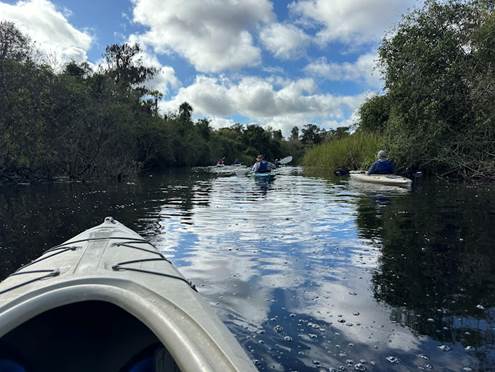
The trip started innocently enough. Ten of us in single kayaks, equipped with two-way radio communication with our guide, paddled up a narrow waterway in the Everglades in Florida. We observed ospreys, ibises, and gators, taking a leisurely pace, enjoying the scenery until we entered the mangrove forest.
The leader’s voice came on in my earbud, telling us to follow him as he disappeared into a mangrove bush. I paddled into the narrow opening, struggling with my paddle; the passage was too narrow. There were three options for paddling in the tunnel, the leader advised: we can try to use the paddle and fight the mangrove bushes, we can take apart the paddle and use the canoe J-stroke with the half paddle, or we can follow the Tarzan method by grabbing the branches and pushing ourselves ahead. I took apart my kayak paddle using it as if I were in a canoe.
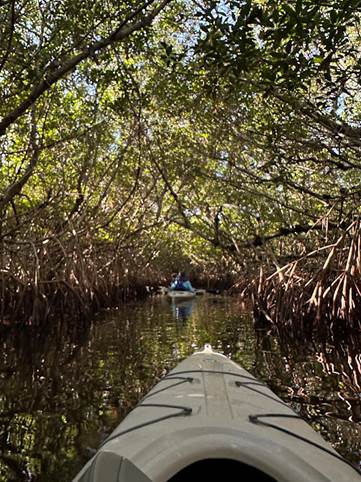
It was rough going, navigating the mangrove branches protruding in all directions, while the waterway was only a few feet wide. And I did not expect to be swatting mosquitoes at this time of year. I tried to anticipate the quick turns in the tunnel while grabbing my hat, which was caught by the branches above. My initial frustration with our progress gave way to a sense of challenge. I began to enjoy the challenge of avoiding the branches, using my skills to navigate the narrow, winding passageway. The overhanging branches provided shade. When we exited the tunnel, the hot, bright sun felt like a sudden climate shift.
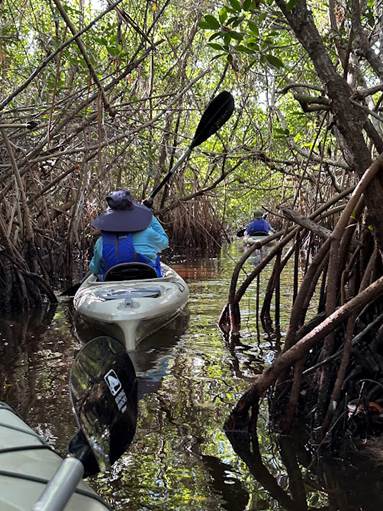
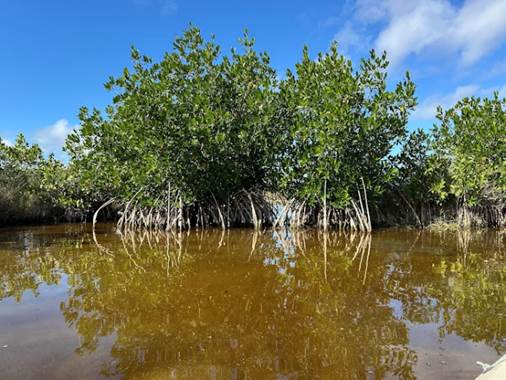
But our relaxation was short-lived; we approached a second mangrove tunnel, followed by a third, before the leader announced that our trip was not a loop. We were returning through the three mangrove tunnels. By now, I enjoyed the fight my paddle was having with the mangrove forest as we went through the tunnels.
I should not have been so sanguine. If you ever paddled in lake country, you probably experienced the feeling of seeing shorelines that look identical. Getting lost is easy. When I emerged from a tunnel in a lake and looked for a way forward, I did not see any opening. I took the largest gap in the mangrove forest and got tangled up in the forest, paddling only a hundred yards forward with no exit. I was lost. I tried to back up, but the 3-foot wide waterway did not allow a 180-degree turnaround for a 12-foot kayak. So, I paddled backward with great difficulty, not seeing the mangrove branches behind me even though I turned as much as I could. Two other kayakers followed me into the mangrove branches, and seeing that I was stuck, they tried to back out as well.
Once we all escaped from the jungle-like forest back into the lake, the leader spoke to us via the earbuds when he discovered that three kayakers were missing and described where the next tunnel began.
The other challenge occurred when we met another group of kayakers coming our way; we had to move to the side and grab a branch to let them pass. They were passing us within the narrow waterway, with less than a foot separating our kayaks. Surprising to me were some of the sea kayaks the other party had, which were 14 feet long; it must have been challenging to paddle those through the narrow, curvy tunnels.
This trip was not for beginner kayakers. First of all, one had to be in shape to sit in the kayak and paddle for five hours. Second, there is only so much liquid a bladder can hold: I cut back on my coffee in the morning and limited my water intake despite the hot weather. Third, one had to have had some experience kayaking; this was not the time to learn how to use a kayak paddle. I also found it extremely useful to know how to use a canoe paddle when I took apart my kayak paddle and used it as if I were canoeing.
Although paddling the mangrove tunnels seemed challenging and frustrating at first, I came to enjoy it over time. I would certainly recommend it for adventurous people.
 andrasthehun.ca