An Evening at the Harvest Ball: Food, Music, and Memories

November 13, 2025

The challenge was figuring out what to wear to the Harvest Ball. I thought I had a sports jacket, but it wasn’t in the closet; then I remembered I’d given it to the charity store years ago. I have collared shirts and some fancy T-shirts, but the only formal wear I have is a black suit I haven’t worn in decades, and I was not sure if it still fits. The question was: What do people wear to a Ball today?

The Ball, organized by the Ottawa Hungarian House, was held at the Hungarian community hall, an informal space in an industrial building. I decided the safest thing to wear was the formal suit. But I could take off the jacket in the beginning, and with no tie and an open shirt, I would match the space’s informality.

We arrived 30 minutes early: the dinner was at 6pm. The hall was almost empty except for the organizers. There were no seating arrangements, so we picked a table on the side, next to a well-dressed woman sitting alone at the table next to us. By way of introduction, she said she was Clara and that she and her husband had come from Hungary in 1967. She spoke in Hungarian. When I said that Kathy does not speak Hungarian, she asked if she spoke English or French. When we settled on English, she said that she and her husband started a fur-making business and moved to Baie-Comeau, Quebec, in the early seventies, where the demand for furs was strong. When the local mining industry died and demand for fur declined, they moved to Ottawa. They continued making furs in their basement factory.

I went to the bar to buy a couple of glasses of wine. When I returned, a  Hungarian couple sat down at our table. His name was Zoltan, and I remarked that it was a good Hungarian name. I did not catch the wife’s name; it was getting noisy. Nokia hired Zoltan when he finished university in Hungary. After a couple of decades, Nokia transferred him to Seattle for two years, and then to Ottawa. They have been in Ottawa for a couple of years and like it here.

Zoltan’s wife was talkative and said that life is much easier here with all the appliances available, than in Hungary. I gathered they would like to stay on after their four-year work visa expires.

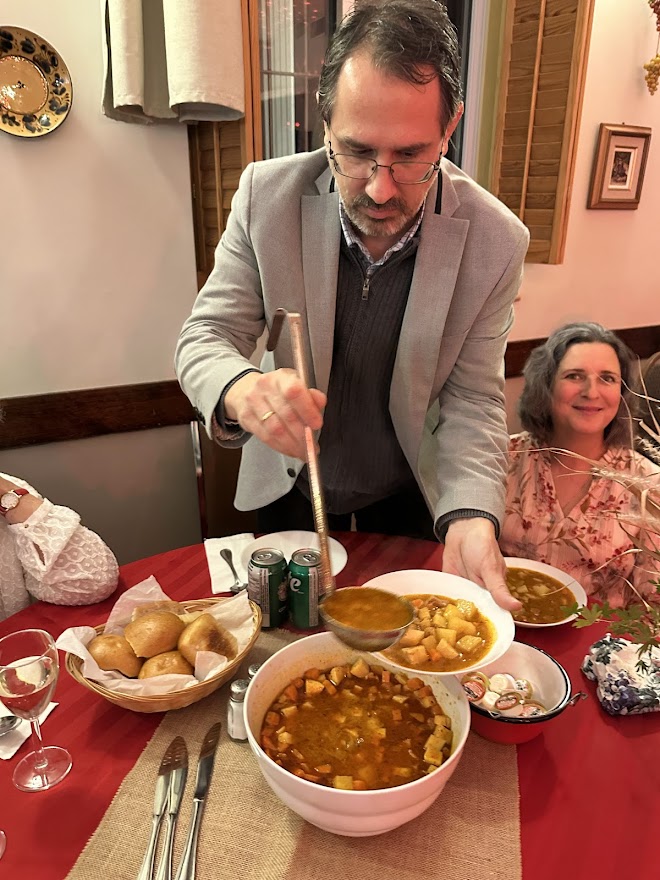
A huge bowl arrived at our table, filled with porkolt (pork stew). Although there were only four of us, the bowl could have served twice as many people. We served ourselves in family style. I enjoyed the porkolt, which was liquid and felt more like soup than stew. After tasting the porkolt, Zoltan’s wife thought that no real Hungarian paprika was used and that the porkolt could have been spicier. I agreed, but I enjoyed it with chunks of pork, carrots, and potatoes.

Oue Hungarian table companion serving “porkolt” family style

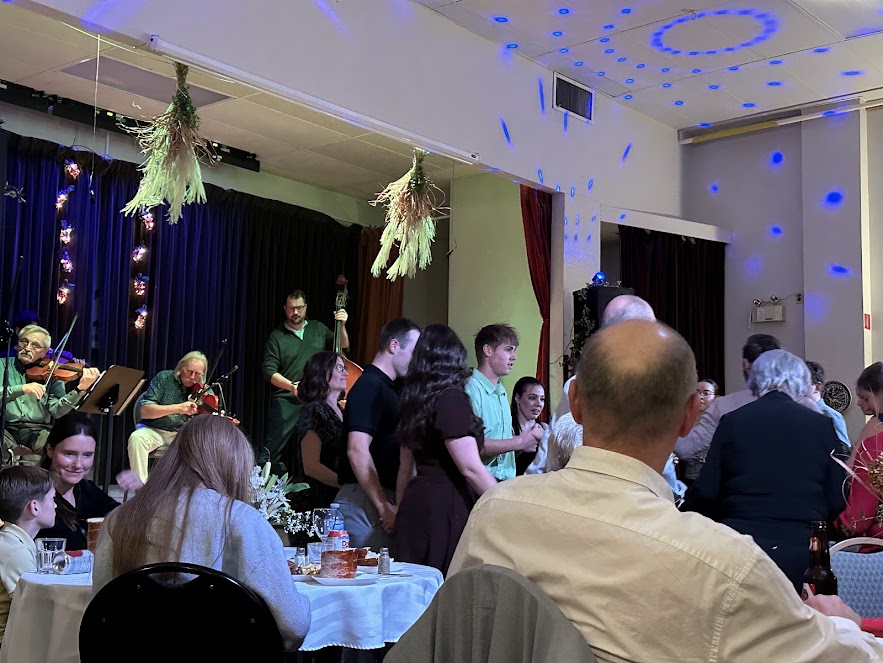
A couple of violinists and a bassist started playing Hungarian folk songs during the meal. The instruments reminded me of the music of Django Reinhardt – gypsy music with a swing – but these musicians played chardas, for Hungarian folk dance. People got up to dance, and soon the dance floor was packed. By now, the community hall had become extremely noisy, with over a hundred people talking, and dancing to the music. It was hard to speak and listen to our table companions.

As I have recently joined the Ottawa Hungarian House, I did not know anyone there. I have never been ethnically oriented. When we came to Canada, we were the type of immigrants who wanted to amalgamate into Canadian society. We did not live the life of the old country. And I married an American girl I met in graduate school at the University of North Carolina. We always spoke English at home, and the children grew up as native Canadians. I came to this event to hear some Hungarian spoken; I may be getting sentimental.

However, I knew some people from my high school in Hungary who studied with me at the University of British Columbia in Vancouver. I heard they came to Ottawa and approached the bartender if he knew any of my old friends, the twins Kalman and Peter Roller.  

He said, “Of course, Pista Roller is sitting back there,” and he took me to him, who was not Kalman or Peter but looked like their spitting image. Pista told me there were four brothers in the family. I was shocked to hear that the twins were dead: one had brain cancer and the other dementia. One was a pharmacist doing research in China and the other worked for the National Institutes of Health in Washington, DC. I wanted to follow up on this information and asked for his phone number to arrange for a get together.

Dessert came when I got back to my table. It was a caramelized pastry in the shape of a tube, four inches in diameter, and eight inches tall. I looked inside, thinking that there was some cream or fruit there. No, there was nothing inside; you ate the tube. The Hungarian couple explained that you tear a piece off with your hand, eat it, then keep tearing it apart and eating it. It is called kurtoskalach (chimney cake) and is a popular Hungarian dessert.

Chimney cake

It was an enjoyable evening of contrasts, combining ethnic foods, music, and dancing with people reading their iPhones and speaking English. The evening brought up memories. I described to our tablemates how we escaped from Hungary during the Hungarian Uprising of 1956. Our table companions who came to Canada two years ago acted like Canadians their age. And the Hungarians who came out decades ago enjoyed reliving the music and food of the time they left Hungary.

Reflections on the 1956 Hungarian Uprising Remembrance

October 28, 2025

This week, I attended a flag-raising ceremony commemorating the sixty-ninth anniversary of the Hungarian uprising of October 23, 1956, at Ottawa City Hall. I looked forward to meeting some grey-haired Hungarian refugees, with whom I could make contact, talk about the old country, and share our experiences in Canada.

About fifty people showed up for the ceremony. I did hear a few people speaking Hungarian, chatting in small groups. They seemed happy to talk with each other. I went by myself, looking for some social interaction and discussion. Still, nobody seemed interested in making contact, even though I walked around and tried to break into conversations.  

When I found a young fellow standing by himself, I asked him if he was Hungarian. To my surprise, he said he was an RCMP officer. I wondered if he was on an assignment to ensure security at the event, requested because staff from the Hungarian Embassy and other diplomats were in attendance. the event organizers.

Another person I approached was a black woman who, with a friendly smile, explained  with a friendly smile that she was with the Nigerian Embassy and had been invited to this event. I found myself confused; while I understood the logic behind inviting certain European nations, I questioned the inclusion of African countries. Nevertheless, she was charming, and we talked about Africa and my trip to Tanzania.  

Although the flag-raising was outside, due to inclement weather, the group moved to City Hall first to listen to the speeches by the dignitaries. The small conference room inside was insufficient to seat everyone, so I stood in the hallway listening to the speakers.

The Deputy Mayor, Sean Devine, who, by the way, is my local City Councilor, opened the ceremony. He paid tribute to the courageous Hungarians who perished during the 1956 uprising and commented on the contributions the refugees made to Canada. Although Sean did not mention it, well-known people such as Anna Porter, a writer and publisher, and Robert Lantos, a film director, were fifty-sixers, among others.

Ms. Katalin Haas, Charge d’Affaires at the Hungarian Embassy, spoke about the significance of the 1956 rebellion and invited representatives of the Canada-Hungary Parliamentary Friendship Group and a representative of Global Affairs Canada to speak.

Many speakers mentioned the 38,000 people who arrived in Canada after the uprising looking for freedom and dignity and the over 300,000 people of Hungarian descent now residing here. All the speakers emphasized the Hungarian people’s desire for freedom and dignity.  

Adam van Koeverdan, Co-Chair of the Canada-Hungary Friendship Group, spoke about his mother, who escaped Hungary during the uprising. That made me feel old. I was sixteen years old when I fled Hungary, and he was talking about his mother! Further indicating my age was a group of young people talking about being fourth-generation Hungarians. I felt ancient by that time.

The speeches were well delivered but seemed hollow to me, as the speakers lacked a fundamental understanding of the nature of life in Hungary in the 1950s that sparked the rebellion. None of the speakers had firsthand experience of life in Hungary at the time of the rebellion. The speakers’ comments were sincere but lacked the emotional gravity that people with direct experience could have brought.

For example, I remember when our neighbor in the apartment house where we lived disappeared one night, and nobody said anything about it. Nobody raised any questions. Or when my father, a medical doctor, was called many nights to patch up people caught trying to break through the Iron Curtain or swim across Lake Ferto. Or when my brother, a student in Budapest, walked home to Sopron, a distance of 200 kilometers, when the revolution broke out. During the uprising, the absence of cell phones or live communication made it difficult to receive updates from him for several days. This lack of information caused considerable concern among our family about his safety. The family feared the worst. After coming home from school one day, our mother told Peter and me to set off along the highway to Vienna, each of us carrying a sandwich in our backpacks, a memory that has stayed with me ever since.  

I thought that a few refugees talking about their escape, or a film showing the tanks in Budapet crawling with students during the uprising, would have been relevant and impactful. However, I recognise that the objective of the ceremony was to honour those who lost their lives, rather than revisit the events of the uprising. Those people attending who were old enough to witness the rebellion personally may not have felt completely satisfied. I wondered, how many of us oldtimers attended?

Boldt Castle Visit: History and Architecture Unveiled

October 22, 2025

October 11. We played tourists today. Although we live just an hour and a half’s drive from Boldt Castle, we had never visited it until now. I’ve heard of the castle, of course, but it’s located on Heart Island, in the Thousand Islands region of New York State, on the St. Lawrence River. Visiting from Canada requires a passport, and since we don’t carry our passports with us every day, we never thought about making the trip.

One can visit the castle from Alexandria Bay in New York State or from Canada, with ferries departing from Gananoque and Rockport, Ontario. We decided to go from Rockport to save time, as driving to Alexandria Bay takes longer.

Upon arriving in Rockport, we noticed eight large tour buses. To my surprise, many tourists from China started disembarking. A local who was familiar with the area explained that Chinese workers are often rewarded with tours to Canada, and many of them visit Montreal, or Toronto, making a side trip to Rockport on their way to Niagara Falls. We also encountered other visitors in the parking area, including a couple from Toronto who were making the long drive back home the same day. We met another couple from Pennsylvania, who decided to sightsee in Canada before visiting the castle. I hadn’t realized how popular the castle is as a tourist attraction. A guide told me that five hundred to two thousand people visit the castle each day.

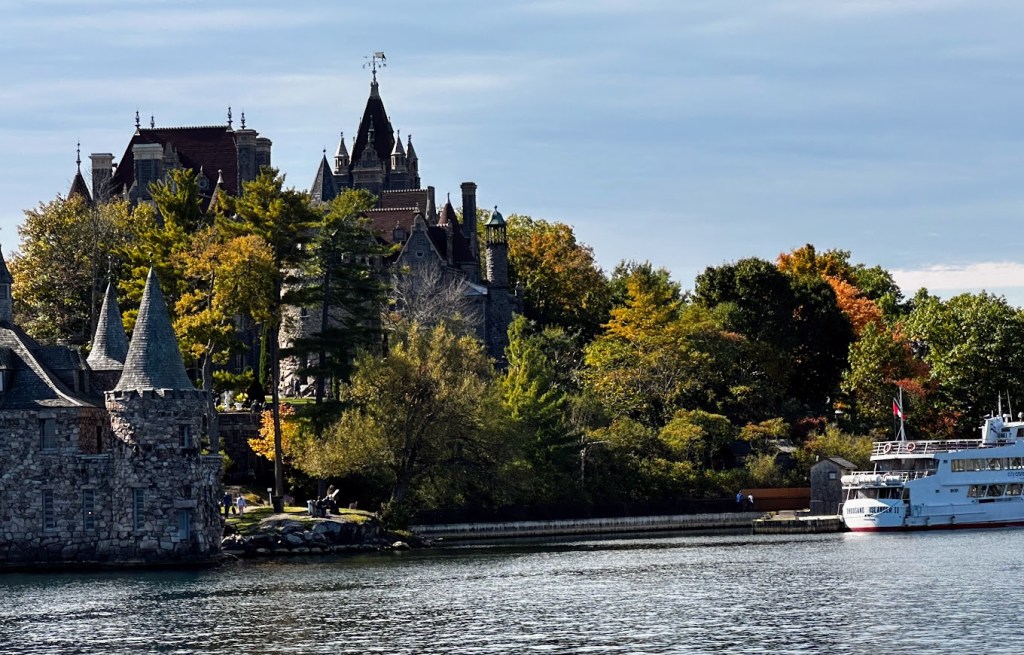
The boat trip to Heart Island takes about half an hour and passes by some extravagant cottages that resemble large houses more than typical summer homes. Upon landing on Heart Island, we went through U.S. border control, which took a while due to the long lineup of visitors. After we cleared the U.S. border, where they took a photo of us without hats and with our glasses off, we had a couple of hours to explore the island and the castle. Then, we returned to the dock for our trip back.

The view from the ferry

As we approached the castle, we saw a wedding on the front lawn and were asked to leave by the organizers. Fortunately, the castle was open, so we explored the large central hall and the enormous dining room before heading upstairs to see the bedrooms. The castle has a total of one hundred and twenty rooms.

The main hall

On the second floor, we watched a short film about the history of George Boldt and the castle. George Boldt emigrated from Prussia to the US at the age of thirteen. He started working in the kitchen of a hotel in Philadelphia and quickly rose through the ranks to manage the hotel at a young age. He became the manager of New York’s Waldorf Hotel and merged it with the Astoria Hotel across the street, becoming the well-known Waldorf Astoria Hotel.

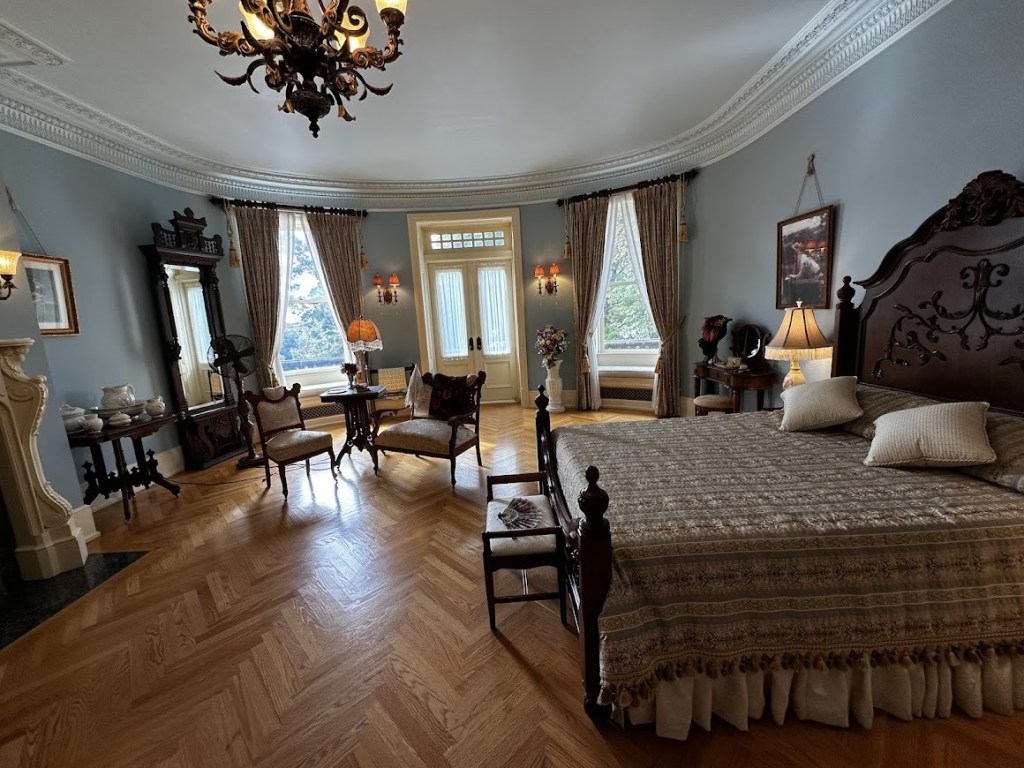
The dining room and a bedroom

As part of his heritage, Boldt is credited with popularizing the “Thousand Island” salad dressing in his hotel. The name originated in the Thousand Islands region of upstate New York, and its original version was made with mayonnaise, ketchup, and pickles. He also created the Waldorf salad, a classic American dish made with diced apples, celery, and mayonnaise.

The Boldt family spent their summers in upstate New York, where George Boldt decided to build a castle on Heart Island for his wife. He was going to give the castle to her on Valentine’s Day. The architecture resembles a Rhineland castle. Construction began at the turn of the century. However, in 1904, tragedy struck when George’s wife passed away unexpectedly. He called off the construction and laid off the three hundred workers who had been building the castle. George never returned to the island, and the castle remained untouched for seventy-three years, falling into a ramshackle state. In 1977, the Thousand Islands Bridge Authority took over the property and invested millions of dollars in its rehabilitation, preserving it for public enjoyment.

Also on the second floor, we saw the rehabilitated bedrooms decorated in period style, belonging to George, his wife, and their children. The floors above have not yet been fully renovated; they currently hold architectural drawings and additional information about the castle.

The garden is also worth visiting, featuring an Italian garden and professionally landscaped grounds with benches. We sat on one of the benches to enjoy our lunch, grateful for a moment of rest after climbing the stairs. It’s important to note that the ceiling heights in the castle are much higher than the typical eight-foot ceilings found in residential homes; climbing four floors felt more like going up six to eight floors in a standard building today.

On the return ferry trip, I bought a cold drink from the bar, which was refreshing and helped me process everything I had seen. If you have visited castles in Europe, this one may not impress you much. However, North America has very few buildings like this one, the Biltmore Estate in Asheville, NC, or Hearst Castle in San Simeon, CA. Visiting this Castle is certainly educational, especially for children. It is also steeped in history and serves as an essential example of the architectural style built during the Gilded Age. I recommend it as a great family outing on a sunny day.

Memories of Chapel Hill: Love, Weddings, and History

April 1, 2025

Chapel Hill. The University of North Carolina. Ah! All the memories came rushing back as we drove around, parked the car, and walked along Franklin Street in Chapel Hill, North Carolina.

I recalled meeting the Dean of City Planning, who welcomed me upon my arrival. He greeted me warmly and instilled confidence in me that I could not fail here. After I met my future wife, we listened to Johnny Cash on the quad, frequented local pubs, and eventually got married!

We initially had a civil ceremony in South Carolina without informing our families; it was one of those spur-of-the-moment decisions. The experience of the civil process, alongside that of four other couples, felt rather mundane. Returning to Chapel Hill, my Peugeot 403 broke down on the road, and we had to hitchhike back.

Returning to our dorms after the ceremony was exhilarating. We had a piece of paper that officially declared us married, and we were embarking on a new life together, forever. I wondered if this was the same experience that pioneers felt when loading their wagons on the journey west.

At that moment, no one knew we were married—not even our school friends.

This exhilarating feeling lasted for a few weeks until we had our church wedding in the Episcopal Chapel of the Cross, which was attended by family and my classmates, with whom I had just graduated. In the lead-up to the wedding, the pastor asked us if our differing religious beliefs would ever cause friction between us. It seemed unlikely: I was a non-practicing Roman Catholic, while Kathy was Episcopalian. Having a church wedding was the traditional way to get married, which both our families accepted.

The memories bubbling up were from over fifty years ago. The Town of Chapel Hill has also aged. We walked along Franklin Street starting from Martin Luther King Jr. Boulevard. There were many more restaurants, coffee shops, and fraternity and sorority houses than we could recall from the past, in addition to newer tourist shops, vaping lounges, and art galleries.

As we crossed Franklin Street, we approached the Chapel of the Cross, where we were married decades ago. I couldn’t remember much about the building except for the circular driveway in front. I remember it well because, after the ceremony, when we tried to drive away in Kathy’s car, my classmates had blocked our tires with rocks. I felt embarrassed as I heard all my friends laughing. I quickly exited the vehicle and moved the stones. However, a loud noise came from the wheels during my next attempt to speed off. I decided to ignore the noise as we drove away, stopping a few blocks later to empty the rocks from the hubcaps.

To my surprise, the Chapel did not evoke any strong emotions within me. I struggled to recall its architecture and viewed the Chapel as if I were seeing it for the first time. However, once we entered the building, the historical information provided in a brochure added to a cultural dimension that was entirely new to me and left a lasting impression.

Mary Ruffin Smith (1814-1885) was an early benefactor of the Chapel, constructed in 1843. Her father, a plantation owner, physician, and congressman, paid $450 for a mulatto slave, a fifteen-year-old girl, for Mary. One of Mary’s brothers took a fancy to the slave girl, Harriet, and stalked and sexually assaulted her. Mary’s other brother, Frank, took exception and pummeled Sidney, ordering him to stay away from Harriet. Sidney stayed away from Harriet after the incident, during which she gave birth to a girl, Cornelia. However, Frank fell in love with the girl and had three daughters with Harriet. Mary cared for Harriet and the four girls, bought them from the plantation, and took them to the Chapel of the Cross every Sunday. All the colored people sat on the balcony of the Chapel, not permitted to sit with the white folks. Mary had all four girls baptized at the Chapel, as well as Harriet.

The story continued with Pauli Murray (1910-1985), the granddaughter of Cornelia, the oldest of Harriet’s daughters. Murray was an author, activist, and writer. In 1938, she attempted to enroll at the University of North Carolina (UNC), but her admission was denied due to her race, despite her close relationship with her great-aunt Mary, who had donated a significant portion of her land to the university. Pauli Murray went on to become a lawyer and practice law. In 1977, she made history as the first African American woman to be ordained as an Episcopal priest in the United States. After her ordination, Rev. Pauli Murray took communion in the Chapel where her enslaved grandmother had been baptized.

This story left a significant impression on me. Perhaps it’s because topics like plantations, slavery, the significance of skin color, and religion are not part of my background. Instead, I could discuss the Iron Curtain, Communism, and the experiences of the Pioneers (the communist equivalent of the Boy Scouts), as I spent my youth in Hungary under Russian domination.

The Evolving Ethnic Character

November 5, 2024

During the late 1950s, I worked alongside Steve as a draftsman at the Buildings and Grounds Department of the University of British Columbia in Vancouver. Although we were recent Hungarian immigrants, we differed in our behavior in the office; he used to bring his breakfast to work unlike me, I ate at home. He spread some grease paper on his drafting table and ate his breakfast of smelly, garlicky sausage with a thick slice of brown bread. The powerful smell permeating the room bothered the rest of us working there, but nobody wanted to tell him to eat his breakfast at home and save us from the unpleasant smells. Eating a smelly breakfast at work was not Canadian, and still is not. I am not sure if that behavior was Hungarian. However, I heard Steve became a successful architect and integrated into Canadian society in a few years.

In contrast to Steve, some individuals never assimilate into the local culture and instead choose to return home. A Hungarian friend’s mother embraced women’s freedom in Canada and entered the workforce. Her husband was not as successful, and he felt he had lost his masculine dominance in the household, so he returned to Hungary, but the wife stayed in Canada with the children.

I do not know how others in Vancouver perceived my ethnicity when I arrived in Canada in the late 1950s, except that they noticed my English language skills and accent. I improved in record time and assimilated into local culture in many other ways.

One strategy I used was always to try to fit in and go with the flow; for example, I acquired a taste for beer when I drank with my classmates while finishing architectural projects at all-night sessions at the UBC School of Architecture.  I was not too fond of beer then, but drinking with my classmates led me to develop a taste for it.

Other opportunities for cultural assimilation arose when I attended concerts with Elvis Presley at the PNE and Dave Brubeck at the old Georgia Auditorium in Vancouver. Later on, I acquired a taste for rock music. My father could not understand why I listened to The Grateful Dead, The Bachman Turner Overdrive, Credence Clearwater Revival, and their ilk; he thought music was only classical.  

I further embraced local culture when we started camping and canoeing after marriage. Later, we traveled widely in a tent trailer across Canada with our children and a dog. After getting tired of hauling a tent trailer, we bought a cottage. And cottaging is a Canadian thing; only a couple of immigrants own cottages out of a hundred neighbors where our cottage is (I realize immigrants may not have the money for a cottage).

While I have been in North America since 1957 and consider myself part of North American culture, I am always intrigued when I hear Hungarian being spoken. My language abilities in Hungarian are equivalent to that of a sixteen-year-old, the age I was when I departed the country. While traveling in France last summer, I heard a group talking in Hungarian in Arles. I introduced myself to them, and we spoke about Hungary today compared to the one I left. I had to search for some words since my fluency in Hungarian was spotty, but it was a satisfying conversation.

A recent event drew me back to my ethnic background. Kathy met a Hungarian woman at a grocery store who recommended that we join the Hungarian Community Center in Ottawa.  I followed up and decided to attend a social event celebrating the anniversary of the Hungarian Revolution of 1956. I hoped to listen to conversations in Hungarian and perhaps meet some people from Sopron from where we fled, so I looked forward to the event. I was somewhat fearful of how I would react to my countrymen and whether I could intelligently converse with them, limited by my sparse vocabulary and lack of practice speaking the language.

Upon entering the building, nobody welcomed us. We found our way to take a couple of seats and looked around. All age groups were there, from children to grey hairs, and they all seemed to know each other. And I heard only Hungarian spoken. There was a celebratory feeling in the air; some people were informally dressed, while others wore pin-striped suits. Nobody showed interest in us.

The MC asked the Hungarian Ambassador to Canada to speak. She spoke in Hungarian, and I whispered to Kathy and explained what was happening.

Although we were in Canada, curiously, there was absolutely no French or English spoken, and there was no acknowledgment of land rights by the Indigenous people of Canada, a custom in all public events now. That made me think that the Hungarians have a thousand-year history occupying the land of Hungary. The Ottomans took over the land at one time and the Germans at another time, but there had never been an acknowledgment of previous land ownership and compensation for taking the land. To my knowledge, the concept of compensation to earlier landowners has no currency in Hungarian thought. That made me think of how people interpret history in different parts of the world.

After the Ambassador’s speech, we enjoyed some poetry and dancing by third-generation Candaian-Hungarians, indicating that some families kept their culture intact. When the Ambassador asked people who came to Canada after the 1956 Revolution to stand up, I counted half a dozen out of fifty, including myself. So, most of these people were second—and third-generation Hungarians who maintained their native culture.

One of the celebration’s highlights was serving “langos,” a Hungarian breakfast food similar to doughnuts, fried dough covered with cheese, cinnamon, and/or garlic. I lined up to get a couple of langos and limited by my language skills, I ended up with two plain ones. There is not much taste to plain ones, so I returned for another one with cheese and garlic to enhance its flavor. I put on too much garlic that burned our mouths, and we took it home, not wanting to throw it away in front of the Hungarian crowd, showing our dislike of it.

Frankly, the event disappointed me because nobody welcomed or showed interest in us while we sat in the audience. Of course, we could have approached people, but they all seemed either to know and talk with each other or to be occupied with moving chairs around and other official matters.

The people were not unfriendly; they seemed to accept and ignore us. For some reason, I felt quite at home, understanding the language, although Kathy felt ignored. I felt as if I was on an island with my old countrymen. When I lined up for our langos at the kitchen, I heard the women working there talking to each other; one kneading the dough and cutting portions to fry, another frying, and the third putting the cheese and/or cinnamon on and serving it. The entire atmosphere felt homey. Based on our strange experience with this celebration, we decided to try again and attend a party next week with dinner, a concert, and dancing. I hope we won’t. be disappointed.