An Evening at the Harvest Ball: Food, Music, and Memories

November 13, 2025

The challenge was figuring out what to wear to the Harvest Ball. I thought I had a sports jacket, but it wasn’t in the closet; then I remembered I’d given it to the charity store years ago. I have collared shirts and some fancy T-shirts, but the only formal wear I have is a black suit I haven’t worn in decades, and I was not sure if it still fits. The question was: What do people wear to a Ball today?

The Ball, organized by the Ottawa Hungarian House, was held at the Hungarian community hall, an informal space in an industrial building. I decided the safest thing to wear was the formal suit. But I could take off the jacket in the beginning, and with no tie and an open shirt, I would match the space’s informality.

We arrived 30 minutes early: the dinner was at 6pm. The hall was almost empty except for the organizers. There were no seating arrangements, so we picked a table on the side, next to a well-dressed woman sitting alone at the table next to us. By way of introduction, she said she was Clara and that she and her husband had come from Hungary in 1967. She spoke in Hungarian. When I said that Kathy does not speak Hungarian, she asked if she spoke English or French. When we settled on English, she said that she and her husband started a fur-making business and moved to Baie-Comeau, Quebec, in the early seventies, where the demand for furs was strong. When the local mining industry died and demand for fur declined, they moved to Ottawa. They continued making furs in their basement factory.

I went to the bar to buy a couple of glasses of wine. When I returned, a  Hungarian couple sat down at our table. His name was Zoltan, and I remarked that it was a good Hungarian name. I did not catch the wife’s name; it was getting noisy. Nokia hired Zoltan when he finished university in Hungary. After a couple of decades, Nokia transferred him to Seattle for two years, and then to Ottawa. They have been in Ottawa for a couple of years and like it here.

Zoltan’s wife was talkative and said that life is much easier here with all the appliances available, than in Hungary. I gathered they would like to stay on after their four-year work visa expires.

A huge bowl arrived at our table, filled with porkolt (pork stew). Although there were only four of us, the bowl could have served twice as many people. We served ourselves in family style. I enjoyed the porkolt, which was liquid and felt more like soup than stew. After tasting the porkolt, Zoltan’s wife thought that no real Hungarian paprika was used and that the porkolt could have been spicier. I agreed, but I enjoyed it with chunks of pork, carrots, and potatoes.
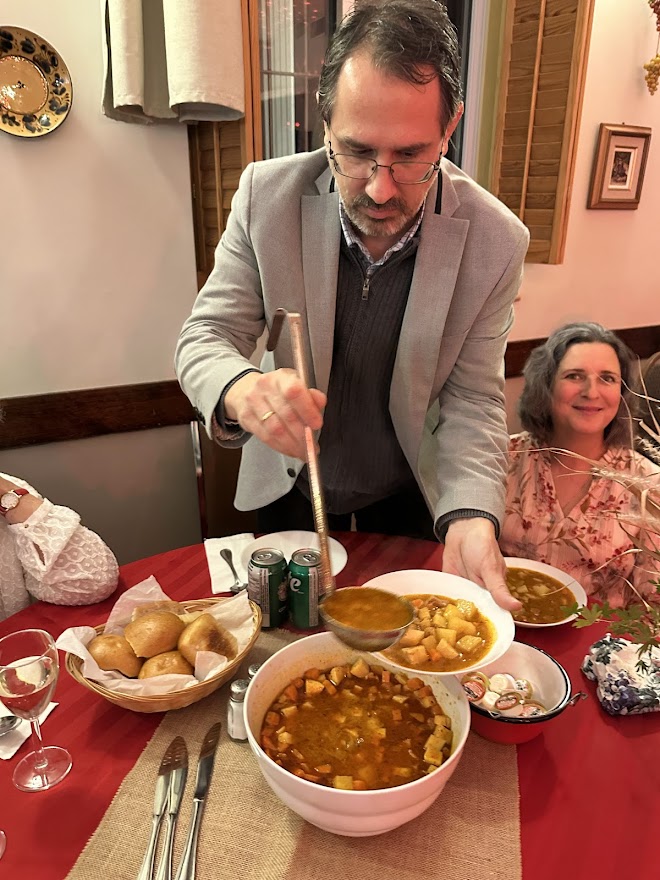
Oue Hungarian table companion serving “porkolt” family style

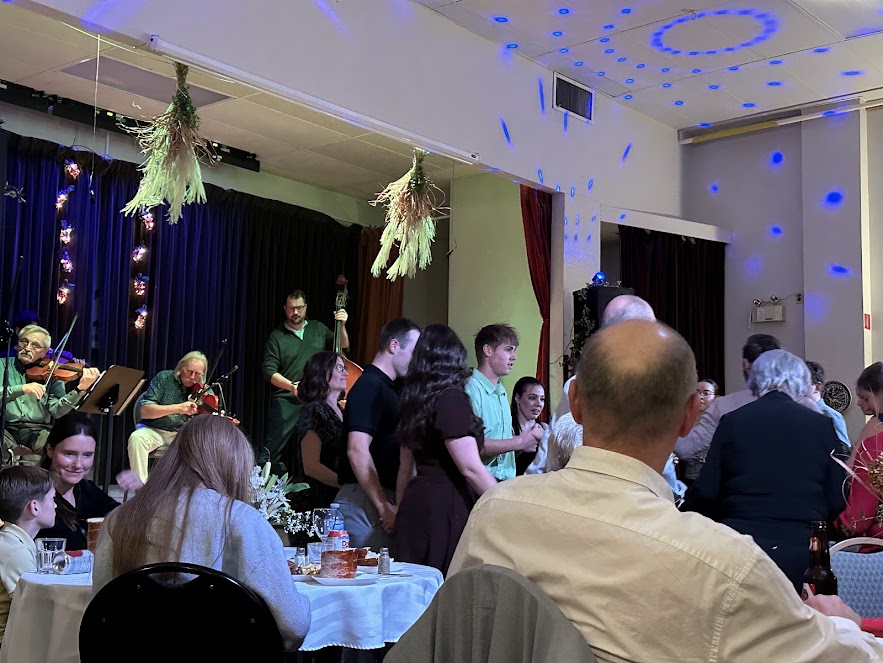
A couple of violinists and a bassist started playing Hungarian folk songs during the meal. The instruments reminded me of the music of Django Reinhardt – gypsy music with a swing – but these musicians played chardas, for Hungarian folk dance. People got up to dance, and soon the dance floor was packed. By now, the community hall had become extremely noisy, with over a hundred people talking, and dancing to the music. It was hard to speak and listen to our table companions.
As I have recently joined the Ottawa Hungarian House, I did not know anyone there. I have never been ethnically oriented. When we came to Canada, we were the type of immigrants who wanted to amalgamate into Canadian society. We did not live the life of the old country. And I married an American girl I met in graduate school at the University of North Carolina. We always spoke English at home, and the children grew up as native Canadians. I came to this event to hear some Hungarian spoken; I may be getting sentimental.

However, I knew some people from my high school in Hungary who studied with me at the University of British Columbia in Vancouver. I heard they came to Ottawa and approached the bartender if he knew any of my old friends, the twins Kalman and Peter Roller.  

He said, “Of course, Pista Roller is sitting back there,” and he took me to him, who was not Kalman or Peter but looked like their spitting image. Pista told me there were four brothers in the family. I was shocked to hear that the twins were dead: one had brain cancer and the other dementia. One was a pharmacist doing research in China and the other worked for the National Institutes of Health in Washington, DC. I wanted to follow up on this information and asked for his phone number to arrange for a get together.

Dessert came when I got back to my table. It was a caramelized pastry in the shape of a tube, four inches in diameter, and eight inches tall. I looked inside, thinking that there was some cream or fruit there. No, there was nothing inside; you ate the tube. The Hungarian couple explained that you tear a piece off with your hand, eat it, then keep tearing it apart and eating it. It is called kurtoskalach (chimney cake) and is a popular Hungarian dessert.

Chimney cake

It was an enjoyable evening of contrasts, combining ethnic foods, music, and dancing with people reading their iPhones and speaking English. The evening brought up memories. I described to our tablemates how we escaped from Hungary during the Hungarian Uprising of 1956. Our table companions who came to Canada two years ago acted like Canadians their age. And the Hungarians who came out decades ago enjoyed reliving the music and food of the time they left Hungary.

The Evolving Ethnic Character

November 5, 2024

During the late 1950s, I worked alongside Steve as a draftsman at the Buildings and Grounds Department of the University of British Columbia in Vancouver. Although we were recent Hungarian immigrants, we differed in our behavior in the office; he used to bring his breakfast to work unlike me, I ate at home. He spread some grease paper on his drafting table and ate his breakfast of smelly, garlicky sausage with a thick slice of brown bread. The powerful smell permeating the room bothered the rest of us working there, but nobody wanted to tell him to eat his breakfast at home and save us from the unpleasant smells. Eating a smelly breakfast at work was not Canadian, and still is not. I am not sure if that behavior was Hungarian. However, I heard Steve became a successful architect and integrated into Canadian society in a few years.

In contrast to Steve, some individuals never assimilate into the local culture and instead choose to return home. A Hungarian friend’s mother embraced women’s freedom in Canada and entered the workforce. Her husband was not as successful, and he felt he had lost his masculine dominance in the household, so he returned to Hungary, but the wife stayed in Canada with the children.

I do not know how others in Vancouver perceived my ethnicity when I arrived in Canada in the late 1950s, except that they noticed my English language skills and accent. I improved in record time and assimilated into local culture in many other ways.

One strategy I used was always to try to fit in and go with the flow; for example, I acquired a taste for beer when I drank with my classmates while finishing architectural projects at all-night sessions at the UBC School of Architecture.  I was not too fond of beer then, but drinking with my classmates led me to develop a taste for it.

Other opportunities for cultural assimilation arose when I attended concerts with Elvis Presley at the PNE and Dave Brubeck at the old Georgia Auditorium in Vancouver. Later on, I acquired a taste for rock music. My father could not understand why I listened to The Grateful Dead, The Bachman Turner Overdrive, Credence Clearwater Revival, and their ilk; he thought music was only classical.  

I further embraced local culture when we started camping and canoeing after marriage. Later, we traveled widely in a tent trailer across Canada with our children and a dog. After getting tired of hauling a tent trailer, we bought a cottage. And cottaging is a Canadian thing; only a couple of immigrants own cottages out of a hundred neighbors where our cottage is (I realize immigrants may not have the money for a cottage).

While I have been in North America since 1957 and consider myself part of North American culture, I am always intrigued when I hear Hungarian being spoken. My language abilities in Hungarian are equivalent to that of a sixteen-year-old, the age I was when I departed the country. While traveling in France last summer, I heard a group talking in Hungarian in Arles. I introduced myself to them, and we spoke about Hungary today compared to the one I left. I had to search for some words since my fluency in Hungarian was spotty, but it was a satisfying conversation.

A recent event drew me back to my ethnic background. Kathy met a Hungarian woman at a grocery store who recommended that we join the Hungarian Community Center in Ottawa.  I followed up and decided to attend a social event celebrating the anniversary of the Hungarian Revolution of 1956. I hoped to listen to conversations in Hungarian and perhaps meet some people from Sopron from where we fled, so I looked forward to the event. I was somewhat fearful of how I would react to my countrymen and whether I could intelligently converse with them, limited by my sparse vocabulary and lack of practice speaking the language.

Upon entering the building, nobody welcomed us. We found our way to take a couple of seats and looked around. All age groups were there, from children to grey hairs, and they all seemed to know each other. And I heard only Hungarian spoken. There was a celebratory feeling in the air; some people were informally dressed, while others wore pin-striped suits. Nobody showed interest in us.

The MC asked the Hungarian Ambassador to Canada to speak. She spoke in Hungarian, and I whispered to Kathy and explained what was happening.

Although we were in Canada, curiously, there was absolutely no French or English spoken, and there was no acknowledgment of land rights by the Indigenous people of Canada, a custom in all public events now. That made me think that the Hungarians have a thousand-year history occupying the land of Hungary. The Ottomans took over the land at one time and the Germans at another time, but there had never been an acknowledgment of previous land ownership and compensation for taking the land. To my knowledge, the concept of compensation to earlier landowners has no currency in Hungarian thought. That made me think of how people interpret history in different parts of the world.

After the Ambassador’s speech, we enjoyed some poetry and dancing by third-generation Candaian-Hungarians, indicating that some families kept their culture intact. When the Ambassador asked people who came to Canada after the 1956 Revolution to stand up, I counted half a dozen out of fifty, including myself. So, most of these people were second—and third-generation Hungarians who maintained their native culture.

One of the celebration’s highlights was serving “langos,” a Hungarian breakfast food similar to doughnuts, fried dough covered with cheese, cinnamon, and/or garlic. I lined up to get a couple of langos and limited by my language skills, I ended up with two plain ones. There is not much taste to plain ones, so I returned for another one with cheese and garlic to enhance its flavor. I put on too much garlic that burned our mouths, and we took it home, not wanting to throw it away in front of the Hungarian crowd, showing our dislike of it.

Frankly, the event disappointed me because nobody welcomed or showed interest in us while we sat in the audience. Of course, we could have approached people, but they all seemed either to know and talk with each other or to be occupied with moving chairs around and other official matters.

The people were not unfriendly; they seemed to accept and ignore us. For some reason, I felt quite at home, understanding the language, although Kathy felt ignored. I felt as if I was on an island with my old countrymen. When I lined up for our langos at the kitchen, I heard the women working there talking to each other; one kneading the dough and cutting portions to fry, another frying, and the third putting the cheese and/or cinnamon on and serving it. The entire atmosphere felt homey. Based on our strange experience with this celebration, we decided to try again and attend a party next week with dinner, a concert, and dancing. I hope we won’t. be disappointed.