Challenging Common Myths in Business and Economics

March 26, 2026

Do you sometimes hear a statement that seems false to you? You think that this cannot be right. Sometimes such statements could be exaggerations; it is the way some people talk. But other times, a statement may be paritally or totally false because you know the subject matter. How do you react in such situations? You may not be able to argue with a statement on live TV or in a large lecture hall. In a small group, though, you might voice your contrary opinion or choose to ignore the statement. At times, it may feel futile or unnecessary to engage, but in other cases, especially when the subject matters to you and you can respond, speaking up might be appropriate.

I recently listened to a university business professor talk about global economic trends. He introduced himself as nonpolitical and explained that the many charts he will present come from reputable sources. In other words, his presentation will be unbiased. He also mentioned that he’ll puncture some “shibboleths” or “urban myths”. So, I looked forward to his lecture.

The professor spoke enthusiastically, and I enjoyed his comments. What stood out most were the remarks that challenged my views—not because I didn’t understand, but because I disagreed. Here are three ideas from his lecture I take issue with.

He began by sharing that he always asks his students what motivates businesspeople and, according to him, the answer is invariably profit: business exists to make money. However, he always counters the students’ view by explaining to them that when he shops for vegetables, he expects the store to sell vegetables; therefore, the store, a business, exists to offer those goods. The owner may have been a gardener initially and decided to sell produce. This made sense, but I also knew that selling continues only if the store makes money. In other words, the owner would not sell vegetables at a loss, would he or she? (In some situations, the business would sell at a loss as when going out of business). The professor had not broken any shibboleths for me with his example; the purpose of the vegetable store is to sell merchandise, but at a profit.

And then a second item came up with which I had trouble agreeing with. The professor said he might be unpopular by suggesting doing away with programs with universal application. For example, he questioned the need for universally free kindergarten, asking why people who can afford it should benefit. He advocated means-testing, in other words. This argument seemed reasonable until I considered Canada’s own universal programs. We provide public schools free for all, and Canadians are proud of their universal healthcare (although not all healthcare services are free). The trend in Western countries is to expand free, universal services, not reduce them. Whether such policies continue depends on political will and affordability, and the direction seems toward greater universality.

A final example that stirred my mind was the professor’s advice about Canada’s resource sector. He argued Canada should sell more natural resources to create jobs and generate revenue, contrary to the traditional view that resources should be developed domestically for added value.

Reflecting on this lecture, I did not think that the professor changed my mind on the three items above. But I must say that his perspectives added to my understanding of the issues. Maybe I have become coopted to the current wisdom on the subjects discussed and have become rigid in my opinions. So it was useful to hear a fresh argument on these three subjects; that business starts with an idea before money is considered, such as selling books on line, the origin of Amazon, that we should not take for granted that universal programs are always the preferred alternative and that Canada could still improve its economy by selling resources to a diversified global market. Unfortunately, I did not have the opportunity to question the professor on these subjects due to his eighty plus slides that he showed, leaving no time for questions.
The Allure of Discovery Trips: Why We Travel to Discover

February 5, 2026

We travel not just for leisure, but for discovery. At a recent lunch, friends talked about the journeys they hope to take before age or health makes such trips impossible. This made me wonder: why does traveling hold such appeal? I am not thinking of holidays or beach escapes, but of trips to countries unknown to us—adventures I call discovery trips.

Discovery trips offer a sense of freedom. Packing minimally—a suitcase and a backpack for daily excursions, I leave behind daily commitments. Far from home, it feels liberating not to worry about bills or routine chores like taking out the garbage. In unfamiliar countries, every day offers discovery: meeting new people, sampling local dishes, observing architecture, and learning to navigate local buses. Conversations with locals often become both enjoyable and necessary as we find our way.

Travel also offers an education. Seeing things with new eyes becomes inevitable. The visible poverty in India, for example, places North America’s general wellness into sharp relief. Comparing Ottawa’s traffic to maneuvering through downtown Dhaka, Bangladesh, showed me how minor our own traffic woes are in comparison.

Before these trips, I research our destination. After returning, I expand on what I’ve learned. I once knew about the Indian caste system in theory, but witnessing it firsthand deepened my understanding of its implications.

The memory of an incident at Kolkata’s airport remains vivid. A well-dressed man suddenly placed his suitcases in front of ours as we waited in a long line for x-ray inspection. My temper flared, and I pushed his suitcase aside, firmly telling him we had arrived much earlier than he had. He made no argument—perhaps because we were foreigners. That experience prompted me to return home and delve into the history and evolution of India’s caste system.

There was also the night our hosts in Dhaka took us to their favorite restaurant. When they ordered goat brains during a period of mad cow disease in England, curiosity mingled with courtesy. We ate. The dish resembled scrambled eggs, though spiced differently.

Each trip required us to set aside our Canadian routines. We engaged all our senses with local culture, cuisine, and people. I took no notes at the time, yet I now realize that relying on memory allowed me to reflect and better recall details that differ from our own way of life.

A Milestone Event: High School Graduation in Baton Rouge, LA

May 21, 2022

It was a hoot. Literally. People were shouting, hollering, and hooting every time the principal shook hands with each graduating student, handing out their diplomas. The noise was at airplane levels, but positive, with commentary encouraging the graduating class to go forward in life. 

The event was my grandson’s graduation from Baton Rouge Magnet High School (BRMHS), which I attended, along with thousands of parents, siblings, and friends, celebrating the graduating students. It took place at the Pete Maravich Assembly Hall, the home of the Louisiana State University basketball team. More than half of the Hall was filled, which has a capacity of 12,000 seats.  

Security was tight. We had to have tickets, and could not carry an object larger than a cell phone or camera with us. Many people were scurrying back to their cars with purses and iPods, and larger objects that were not allowed. 

The atmosphere inside was boisterous, from toddlers to grandpas talking excitedly, enjoying the moment of graduating students embarking on the next stage of their lives. And leaving the family home.  

We could all see the action on the stage on a huge screen hanging from the ceiling like in hockey arenas. There were 369 chairs in the middle of the floor for the graduating class.  

The commencement exercise started with the school orchestra playing “Pomp and Circumstance” while the graduating class walked in two at a time, followed by the next two fifty feet behind. The orchestra played, repeating the music, until all the students took their seats while the crowd stirred in anticipation. 

Invocation and the Pledge of Allegiance followed, and the national anthem sung by the school choir. After the senior class president welcomed the people, the principal of the school gave an overview of the year; this was her twenty-second graduating class.  

Both the salutatorian and valedictorian gave rousing speeches, making fun of some of their experiences as well as the teachers, in good fun, to the wild applause and laughter of their compatriots sitting and clapping in their chairs.  

Then all the graduating students were called up onto the stage, alphabetically, in a stentorian voice. And this is when the noise level intensified. Families and friends of each student broke into a frenzy of hundred-decibel hoots, waving their arms to be recognized by their son/daughter on the stage, who shook hands with the principal handing out their diplomas. This went on for a couple of hours. When all 369 students received their diplomas, they threw their hats into the air in celebration. 

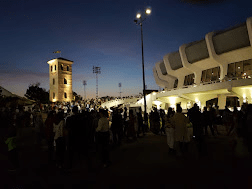
We left the Hall to wait for Alec, our grandson, and stood by “Mike the Tiger’s” cage. Mike the Tiger, a mixed Siberian-Bengal tiger, is the live mascot of the LSU Tigers football team. Mike lives in a multi-million-dollar habitat. The cage with Mike inside used to be pulled around the football field before games with cheerleaders dancing on top, and for Mike’s every growl, the football team was expected to make a touchdown. We waited for Alec by the Italianate campanile, a part of Mike’s habitat (the architecture reflects LSU’s buildings).  

 People were pouring out of the Hall, waiting for their newly minted graduates who were socializing with each other for the last time as students of BRMHS. It took half an hour to loosen Alec away from his friends. 

BRMHS is a magnet school, a category of public schools that emphasizes specific educational themes. The school Alec attended emphasizes academic performance, and interestingly, his class had a great diversity of students to grow up with (31% black, 22% Asian, and 7% Hispanic. And Alec confided in me that 80% of the students were girls, lucky for him). 

I found the entire experience uplifting in providing the young graduates a solid milestone in their lives. Our three children went through high school in Canada where these events were much more sedate and low-key, performed in the gym of the schools. And, of course, I never finished high school. I walked out of Hungary when I was in grade ten and, after arriving in Canada as a refugee, the University of British Columbia in Vancouver admitted me with no high school diploma.  

People pouring out of the Pete Maravich Assembly Hall after graduation, in Baton Rouge, LA, with Campanile on the left, a part of Mike the Tiger’s habitat.