A Culinary Journey on Two Wheels: Cycling and Cuisine

September 30, 2025

These days, we are looking for flat biking routes and prefer to avoid steep, mountainous areas. The rail-to-trail paths are ideal for us, so we decided to cycle along the Petit Train du Nord linear park in Quebec, just north of Montreal.

The recommended ride is from the northern end of the trail at Mont Laurier to St. Jerome, just outside Montreal, because there is a slight slope in that direction. The distance is approximately 200 kilometers, and it can be covered in a few days.

Typically, the cyclist would drive to St. Jerome, leave the car there, and take a bus that goes once a day to transport them to the northern end. However, by the time I called, there was no room on the bus for the day we had planned to go. Instead, we reserved a room at a hotel along the trail, closer to the northern end, to avoid the busier section near Montreal, and planned to cycle in both directions.

That turn of events was fortuitous, as Kathy had pulled a leg muscle while working out at the gym, limiting her ability to cycle for longer distances. Staying at a hotel provided us the opportunity to take shorter rides with rest in between.

Our trip got off to a great start when we drove into Montebello on our way to the trail and discovered a chocolate factory. We couldn’t resist buying some chocolate bars and truffles, completely forgetting about the prices. For lunch, we chose a bistro—after all, it’s Quebec! The French onion soup we had there was delicious.

With tables arranged closely together and the bistro full, the noise level was high, making conversation difficult unless one spoke loudly. However, the proximity to other diners allowed us to engage with our neighbors, which we did. Surprisingly, we ended up discussing politics without any arguments, likely because we shared similar views.

We attempted to use our French, which was more than rusty. Since we rarely have the opportunity to speak French, we struggled to find the right words when communicating with the service people. But it is always satisfying to express oneself in another language when the locals understand you. My feeling was that the locals appreciated our efforts to communicate in French.

In contrast to the bistro, our dinner at the Club du Golf Nominingue hotel restaurant was a more formal affair. While it was also noisy, the dining room was spacious, with tables dressed in white tablecloths and with elegant wine glasses. The service was prompt and attentive to our questions. Although I didn’t find the menu particularly unique to Quebec cuisine, the presentation of the food we ordered was stunning. I felt compelled to take pictures of our plates, which resembled sculptures, even though the food itself was pretty ordinary.

For example, I ordered saucisse artisanale du Québec, which seemed to me to be regular hot dogs, split in two, served with vegetables, and accompanied by French fries, presented in a wire mesh dish. While I wouldn’t consider any of the ingredients unusual, the presentation was truly remarkable.

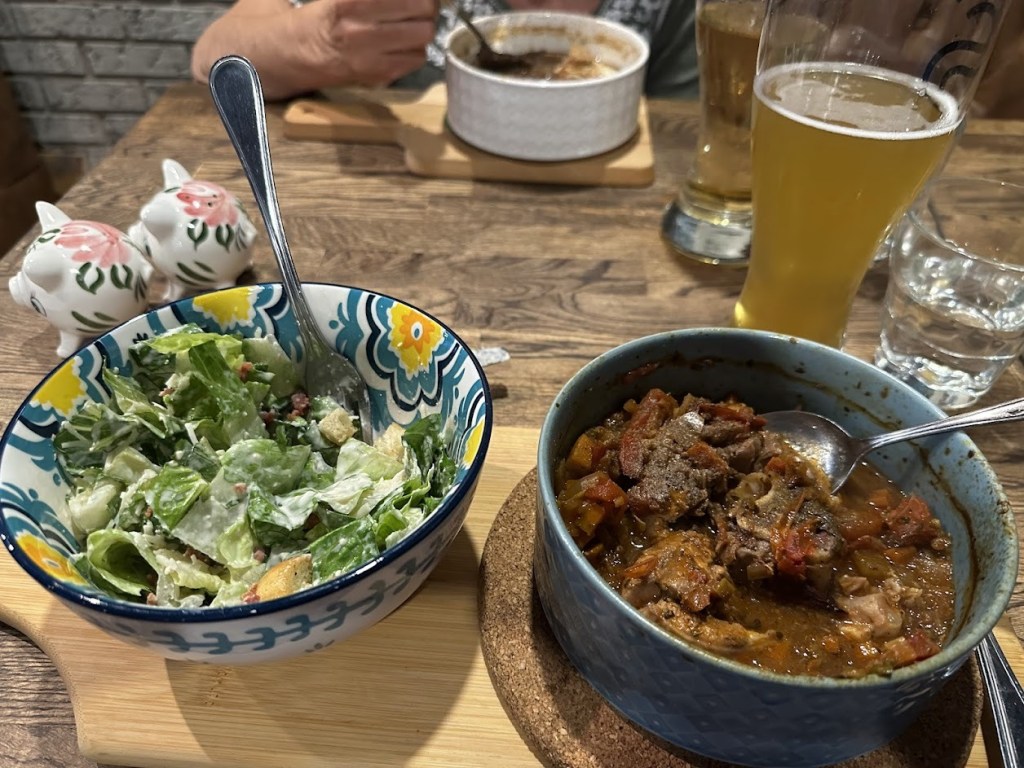
The next day, we discovered a local bistro that was a lot of fun. It was extremely noisy, with people yelling from the bar to the other side of the restaurant, conversing in French, of course. It seemed that all the locals gathered at the bistro in the evening. We enjoyed local beer and cider, and I ordered osso buco, which is pork hocks in English, and it was delicious. For dessert, we had mousse fromage érable, which was delightful.

Beef bourgignon with ceasar salad

With all the food we consumed, we needed to burn off some calories, so we rode the Petit Train du Nord with plenty of energy. Like many trails of this nature, there are long, straight sections that can feel relaxing at times, while at other moments, they may become a bit boring. However, the trail was flat, with a grade that never exceeded four percent.

I was surprised by the number of electric bikes we encountered. Although I knew these bikes were popular, I didn’t expect most of the cyclists we saw to be using them, especially since there was no need for supplemental power on such level terrain. It was also interesting to see how many people were dressed in heavy clothing; I wore just a T-shirt and shorts, while others wore winter jackets. I thought riding an electric bike at higher speeds could feel quite chilly.

Although the speed limit on the trail was 22 kilometers per hour, we maintained a leisurely pace of 10 to 15 kilometers per hour, taking breaks to admire the surrounding landscape.

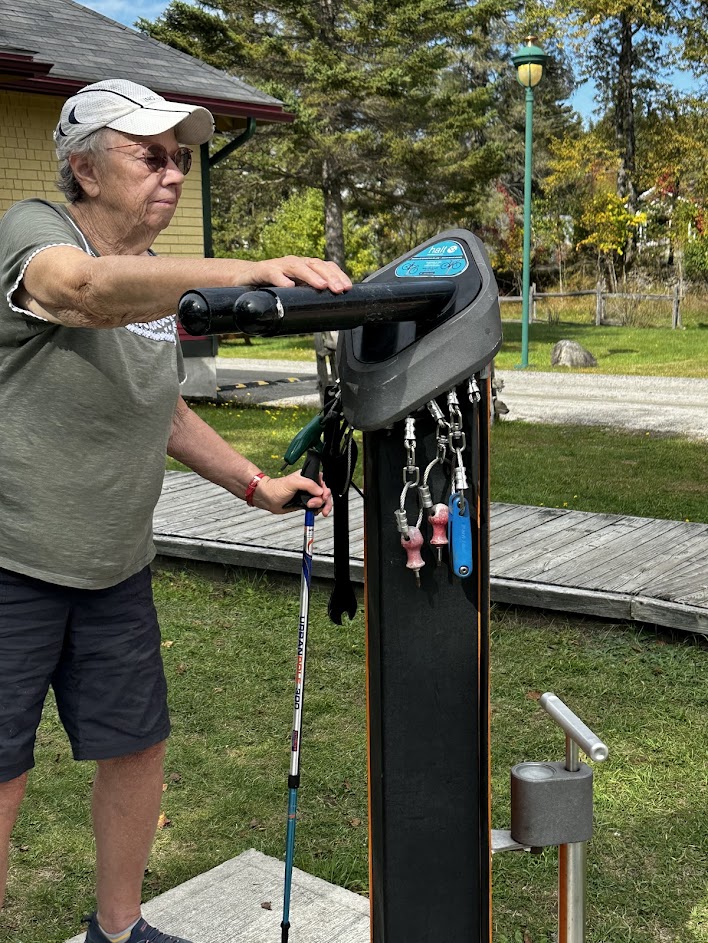
I have to commend the Quebec government for the development and excellent maintenance of this trail. It is entirely paved, and cracks in the pavement are clearly marked with yellow chalk. In areas with a buckling surface, a “danger” sign is placed to alert cyclists. More importantly, there are picnic tables, shelters, water fountains, and even bicycle maintenance pillars equipped with all the necessary tools. This is the most developed trail I have ever experienced. We have cycled on trails in Virginia (the Virginia Creeper), South Carolina (the Spanish Moss Trail), North Carolina (the Tobacco Trail), and many trails in Ontario.

The ambiance at the Le Club et Hotel de Golf Nominingeu, where we stayed, and on the trail, the Quebecois people, the food, and, not least, the cycling trail all contributed to a pleasurable trip. We absolutely have to return for another adventure. We thoroughly enjoyed interacting with the Quebecois people, who, without a doubt, tend to be more expressive, animated, and louder than their English counterparts. One of the highlights of our trip was the opportunity to improve our French language skills. The locals appreciated our efforts, even when our conversations switched to English.

Exploring Beaufort: A Cyclist’s Paradise in South Carolina

March 24,2025


We drove south to leave the winter of Ottawa, even though we enjoy snowshoeing. Escaping springtime offers a welcome reprieve from the winter’s cold and snow. Despite my pollen allergies (managed by Claritin), late March in the Carolinas offers ideal cycling weather.

Driving south towards Beaufort, South Carolina, I sighed in relief at leaving the crowded, monotonous, and speedy Interstate 95 behind. Driving for hours had numbed my feet, so I hoped for less, slower traffic on Route 21 East. Although slower, the traffic picked up closer to Beaufort on a four-lane highway.


The expansion of military bases (Parris Island and Beaufort), resort construction (Hilton Head Island), and a Northern retiree influx have driven development along South Carolina’s east coast.
We learned from a hotel employee at check-in that Beaufort’s population has almost doubled since the pandemic, nearing 15,000. It is not only retirees but also people working remotely who have arrived to take advantage of lower housing and living costs.

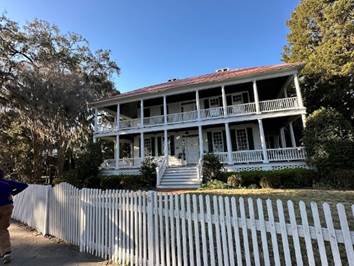
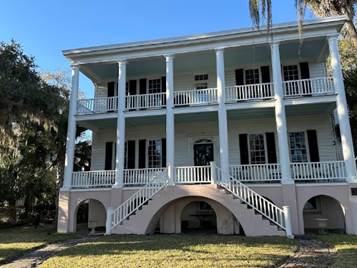
When Kathy stayed here thirty years ago, she stayed in one of the huge antebellum houses on the waterfront, used as a B&B in those days. Today, developers meticulously redeveloped the waterfront, and they restored the antebellum homes along the waterfront to their original designs. The city designated the downtown area a historic district, and we enjoyed a quiet walk admiring the architecture.

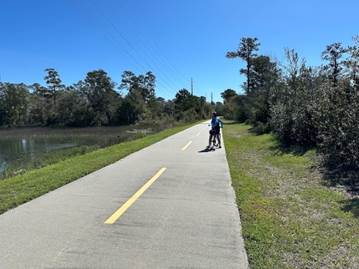
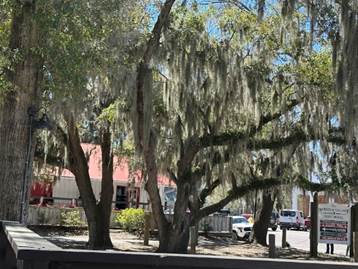
Cycling the Spanish Moss Trail from Beaufort to Port Royal was a smooth ride (it follows the old Magnolia rail line). The paved, twelve-foot-wide trail was flat, crossing marshes with many boardwalks and with the temperature in the mid-twenties (in the seventies in Fahrenheit), was ideal for a bike ride. Much of the Trail crossed areas with oak trees from which Spanish moss hung. I assume the source of the name for the Trail. Although the hanging moss is attractive, avoid touching it because it might contain chiggers.

The paved trail was great for riding, but I knew that falling off the bike would be rough, experiencing injury if going at the maximum allowed speed of 15 mph.

We sped through the twelve-mile trail, pausing to talk with people going in the opposite direction. We avoided talking about politics. We did not know how local people would react to talking to us Canadians, in view of Trump’s desire to annex Canada.

I noticed different organizations took responsibility for maintaining sections of the trail, which included benches at viewing sites, including the military that were in abundance in the area.

In less than a couple of hours, we arrived at Port Royal, at the other end of the trail. We were ready for a cup of coffee and found in the center of Port Royal a home converted to a restaurant with a name Corner Perk that offered fancy coffees. Their muffins were so special we couldn’t resist.

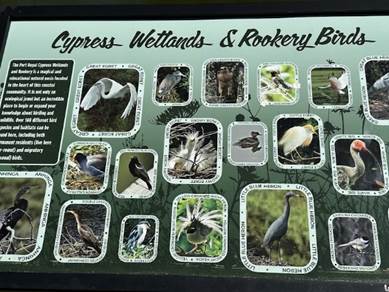
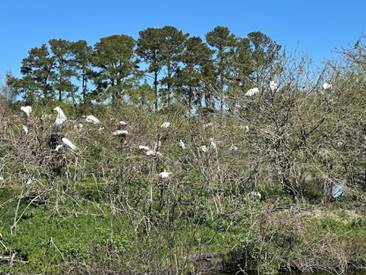
Next, we saw a sign for the Cyprus Wetlands rookery, home to hundreds of local birds (egrets, cormorants, bats, herons, etc.), right by the coffee shop. A boardwalk crosses a lake, going by an island with small trees that provide nesting grounds for birds. We noticed many turtles and alligators also slept on the shore of the island.

Returning to Port Royal, we found a small house converted to a restaurant boasting a sign for Griddle and Grits and the menu included grits with shrimp, with chorizo and grits with different ingredients. I like spicy foods and chose chorizo on grits, which turned out to be excellent. Kathy chose she crab soup, which also turned out to be a good choice.

On the return journey, we paused on a bench and were approached by a man who looked like a bear of an angler, who sat down, smoked a cigarette and started a conversation. He wanted to know all about us and then described his entire life story, including where he was born, where his family members were born and all the ailments they each had. I gathered he has been a floater with jobs in many states before settling in Beaufort. We could not resist listening to him; overall, it was an enjoyable social engagement.

We stopped at a Publix grocery store on the way home to pick up dinner. The Spanish Moss Trail is a nice, paved trail, but it was a bit too tame for us. We like longer and wilder trails with fewer refinements.

What You Learn on a Bike Ride

September 9 2024

I put the bikes on the Thule rack to drive to one of the parking lots along the Ottawa River Parkway. Although we could have cycled from our house to get there, whenever possible I avoid riding on city streets with all the traffic on them.  But when we arrived at the Parkway, we found the two lanes with access to the parking lots closed to car traffic; they were reserved for cyclists on this Saturday. So, we decided to park on a vacant government parking lot nearby, hoping that there would be no monitoring of these lots on a Saturday (by the way, the remote work policy mandates the civil service to work two days per week in the office, so most parking lots for them are nearly empty).

Riding over to the Parkway, we noticed a giant sign indicating the Saturday cycling only sign on the “Kichi Zibi Mekan,” the new name for the Parkway. Let me provide a little history. We used to call this road the “Western Parkway” or the “Ottawa River Parkway”. Both names were geographically suggestive. But in 2012, the government renamed it “Sir John A. MacDonald Parkway” after the first Prime Minister of Canada, a historical name unrelated to geography. We used to call it the “SJAM,” an easy and short name. In 2023, the government renamed it in the Algonquin language, “Kichi Zibi Mekan,” in English: “Great Old River.”

I preferred the Ottawa River Parkway name; it seemed tied to and congruent with the Ottawa River when driving, walking, or riding. Renaming decisions were and are political, in my view. The Conservative government picked Sir John’s name. Sir John was a Conservative politician. When Sir John acquired a bad reputation for his policies towards First Nations, the Canadian public ostracized him. Remember when his monuments were destroyed? This reflects the changing attitudes towards historical figures in Canada.

Instead of returning to the original name, the government, in the spirit of the current ‘reconciliation’ with Indigenous people in Canada, named it in the Algonquin language that few people speak in Ottawa. This ‘reconciliation’ refers to the ongoing efforts to address the historical injustices and promote a better relationship between the Indigenous and non-Indigenous peoples in Canada. The name seems divorced from the Ottawa River for English-speaking people; it is three words in the Algonquin language. It is unintelligible to me. However, it is a step towards recognizing and honoring Ottawa’s Indigenous history and culture.

Our bicycle ride took us across the old railroad bridge from Ottawa to Gatineau. I thought the bridge’s name was the Prince of Wales Bridge. The Quebec, Ontario, Ottawa, and Occidental Railway was built in 1880 and christened with a name that lasted over 124 years, although its function as a rail bridge had stopped years ago. However, the bridge went through a major rehabilitation the past couple of years, into a multi-use pathway spanning the Ottawa River; the Ottawa City Council reopened it as the Chief William Commanda bridge.

My curiosity led me to find out who Chief William Commanda was. Commanda was an Algonquin elder, spiritual leader, and chief of the Ashininabeg First Nation for 19 years. In 2008, he was made an Officer of the Order of Canada, an award for meritorious service in Canada. The rehabilitation of the bridge and its renaming as the Chief William Commanda Bridge not only honors his legacy but also provides a safe and scenic route for cyclists and pedestrians to cross the Ottawa River.

I cannot comment on how well-known Commanda was among the Algonquin people or on his accomplishments since this was the first I had heard of him before the Ottawa City Council announced the name of the rehabilitated bridge. But I wonder why we needed a new name and why the new geographic names in Ottawa appear to be acquiring Algonquin memes.

To understand the local politicians’ emphasis on the Algonquin Nation, it’s important to note that the Algonquins have occupied the Ottawa area for over a thousand years. Today, most of the 8,000 Algonquin people live on the Quebec side of the Ottawa River. Therefore, using Algonquin history in naming local streets, bridges, and venues is attractive from a historical perspective and a way to pay respect to the Indigenous people who have shaped the region’s history.

I am less impressed by the use of the Algonquin language in naming parts of Ottawa, like Kichi Zibi Mikan for the Ottawa River Parkway; the words in English mean “Great River Road.” Why not call it the latter? It is understandable in English and carries the historical Algonquin connotation. Members of the Algonquin nation may understand the name but form a minuscule percentage of the population of Ottawa, where over 36,000 people speak Arabic, 16,000 speak Spanish, and 14,000 speak Chinese, in contrast to the 1000 people who speak any indigenous language, including Algonquin (Ottawa’s population is one million).   Based on this precedent, should we see Ottawa venues named in Arabic, Spanish, and Chinese words?

The growth and diversity of Ottawa’s population make the city an exciting place for bike rides. Reflecting on our experiences during our bike rides, we often like to end our trips with a relaxing coffee. This time, the bike path returning from Gatineau across the William Commanda Bridge led us to the Art-Is-In Bakery close to downtown, where we had lunch. I was pleasantly surprised by the long lineup for service and the bustling crowd inside and on the outside patio, especially the vibrant presence of young people. It felt like a scene from the cafes in Marseille around the inner harbor, a delightful surprise in the heart of Ottawa.

There is no question that Ottawa is becoming a sophisticated metropolitan city, with elaborate bike paths sporting historical names and crowded cafes with outdoor patios. However, I prefer to keep street names and similar venues in their original toponymy and not subject them to political whims.

A Taste of Canada: Getting Tick-ed

August 29, 2023

I contracted Lyme disease and take anti-biotics to get rid of it, doxycycline tablets for twenty-eight day. Not sure when a tick, those nasty tiny little bugs, gorged on my blood but suspect that when I cycled on a rail-to-trail over a month ago and stopped in the tall grass to relieve myself, a tick may have found me. That night my foot began to hurt, swelled up and was hot to touch, and the next day I could not put any weight on it.

The pain went away in a few days when I decided to see a nurse practitioner to find out what it could have been. She examined the foot but came up with no conclusions, so I ignored it. In retrospect, that was a mistake.

A month later, I had the worst shakes of my life, my teeth were chattering. The following days I had become extremely tired, moved like molasses, and lost my appetite to such an extent that I lost six pounds in a few days, symptoms of Lyme disease. On the positive side, if you can call it positive, I had no headache and fever. And then a rash appeared on my belly, another symptom of Lyme disease, that I was not aware of that time.

The symptoms convinced me to go back to my clinic and this time I saw another nurse practitioner who gave me a thorough examination and sent me for blood tests, including Lyme disease. But impatient to wait for the test results which would take numerous days in the labs, I admitted myself to emergency at the local hospital knowing that it could be a long wait, hours, to see an emergency doctor. But I would have the results immediately at the hospital emergency department.

Enterng the emergency room, a large sign welcomed me announcing that the waiting time to see a doctor is five hours, measuring at least four feet by four feet,. OK. Then I looked around and absorbed the cacophony generated by dozens of people in the room when a middle-aged and heavy person in a tennis outfit rolled around a wheelchair with, I think, his wife in it, who moaned loudly about the pain that she could not bear any more and wished to be dead. The scene reminded me of a lunatic asylum. Across from where I sat was a youngish fellow with a neck brace. Some people stood and shifted their feet back and forth; there were not enough chairs. The loudspeaker called my name and nurses triaged me asking about the reason for my presence here. I explained that I thought I had Lyme desease. The nurses took copious notes while measuring my blood pressure and pulse rate. And then I returned to the waiting room.

I observed the people around me and was struck by the diversity, i.e., including all shades of brown to black. Is this the composition of Ottawa today? Or are these the people who have no family doctors and forced to attend the hospital emergency room for health care? But then the loudspeaker called my name again for registration; I had to provide my address and other information, information that the hospital already possessed. During this time a little girl, perhaps three years old, held by her father, was crying constantly, adding to the loud buzz in the emergency room. This whole experience was emotionally taxing on me and imagined that there were people here who have had much more serious problems than I had. But Lyme disease can be very serious in the long run if not treated.

But after five hours, as announced on the large bulletin board entering the emergency room, my name was called again, and I entered a large room with a dozen or so examining rooms around a central area where the emergency doctors and nurses worked and consulted with each other. A nurse directed me to a small waiting room that I shared with a young teenager. He moaned about how hungry he was, having been here for eight hours with no food. I asked him if he would be picked up by his parents, when finished. Or were his parents waiting in the outer room and could get him some food at the food outlet next door? No, he said, his parents were not there, he will take the bus home after his stay at the emergency room experience. That surprised me and felt sorry for him.

It was close to midnight when an examining room had become available, and I was invited to enter it. I did not have to wait long, an emergency doctor came to see me and in ten minutes, prescribed an antibiotic for the blood test that showed a high count of white blood cells and another drug for the rash. And that was it; he said he did not know about Lyme disease.

Leaving after midnight after a seven hour stay tired me out. And I found it emotionally taxing observing all the people in the emergency room suffering from some ailment. But the simple recommendations of the emergency doc soothed me somewhat even though he did not confirm I had Lyme disease or even identify my illness. 

The bombshell came the next week when the the blood test the nurse practitioner ordered showed I had Lyme disease. I had been tick-ed. And I received the typical treatment: twenty-eight days of taking doxycycline.

I learned a few lessons from this experience. A conscientious nurse practitioner may provide excellent service. An emergency doctor treats obvious symptoms and may not search for root causes. And although I find emergency rooms interesting, I prefer to avoid them in the future.  When I go for a walk in the country now, I wear long pants and long-sleeve shirts and tuck my pant legs into my socks to make sure no nasty ticks can access my body for a blood-sucking treat.

Riding the Virginia Creeper

May 20, 2023

Our arrival in Damascus, to ride the Virginia Creeper Trail was exciting. We struggled with the lock on the Vacation Rental by Owner’s (VRBO) door with no success until we turned the knob counterclockwise. With the door open, we faced a large, young woman, staring at us along with two crawling babies on the floor. I am not sure who was more surprised; us or the woman. When we got our breath back, we tried to explain that we had reserved this house and showed the documentation. She was speechless and yelled for her husband who appeared in shorts. He was a huge specimen and we got worried about guns in the house, having read recently people being shot just by driving onto a driveway. The husband explained that he rented this unit for six months and provided us with the name of his contact.  We concluded that we had no choice but to leave and find another place to stay. It was seven o’clock by that time, but fortunately, still light.

My daughter Megan, who had made the reservation through VRBO for a “premier” host called VRBO on the phone to find answers. After an hour and a half, VRBO offered money to rent accommodation in the vicinity because they were unable to find accommodations in Damascus for us; we were also told that the unit we had rented had been sold six months earlier, We drove and called around Damascus, searching for vacant units and found the River Trail Cabins had a couple of vacant units which we immediately occupied. These log cabins were exceptionally well appointed with a small kitchen where we cooked our supper and ate it on the verandah, overlooking the trail and the river. A large hot tub was next to the bed, but it was way too late to fill it up to use it.

We had come to Damascus to meet up with our daughter and husband who were on their way to Blacksburg, Virginia to pick up their youngest son from Virginia Tech where he finished his first year of college, and to ride the Virginia Creeper Trail. The Trail starts in Abington, VA, and stretches to Whitetop Mountain in the Rogers National Recreation Area, close to the North Carolina border. It is thirty-four miles long. Damascus is halfway along the trail, from where it climbs 2000 feet.

The right-of-way for the trail goes back to the 1880s when a railroad line was built to haul iron and coal. When the mines were depleted and it became uneconomic, the line was shut down. In 1977, the Norfolk and Western Railroad Company, owner of the rail line, asked the Interstate Commerce Commission to allow the abandonment of the rail line. Soon after the ICC’s approval, the removal of the tracks began, and the right-of-way was turned into a recreation area by the US National Forest Service and the National Park Service. A caboose at the center of Damascus commemorates, and reminds people of, the original purpose of the trail. The trail now accommodates hikers, cyclists, and equestrians, crosses a National Park and the Appalachian trail, as well as many rebuilt trestle bridges.  

On our first morning, we walked our bikes down the steep embankment on which the log cabins were built, to find the trail, eager to try it out.  We found the trail surface smooth, often with small gravel that was easy to ride. The trail wound its way through Damascus, passing by the SunDog Shuttle service where we inquired about their $25 shuttle service to the end of the line on Whitetop Mountain. We told them we’d be back the next day to experience the 17-mile downhill ride from Whitetop Mountain to Damascus.  In the meantime, we decided to cycle up the trail to experience the ride.

Once we left the town, we rode in a bushy, leafy valley, next to the Laurel River that was maybe fifty feet across, and which looked like whitewater kayaking territory although too shallow for my taste. The river flowed fast over large rocks creating a crashing but relaxing sound. We met some cyclists coming down the trail; it looked like easy riding with the low gradient.

The sun was up creating a dapple effect on the trail that bothered my vision, but also made me sweat although I had only a t-shirt on. We rode for a couple of hours, covered maybe ten miles, and decided to stop and have our lunch on a bench. There was also an outdoor toilet and a parking lot behind us.  We realized that it was possible to drive to several points along the trail, park the car and start riding from there.

Turning back towards Damascus, we cranked the pedal of our bikes a few times and rode for considerable distances, coasting much of the way with a slight downhill gradient; the going was easy and provided an opportunity for observing the forest around us. The return trip was fast, we arrived back at our home in less than an hour.

The next day we drove to SunDog Shuttle service and got on the bus with a dozen other passengers with a trailer behind us loaded with our bikes. The friendly driver related stories of cyclists along the trail; one story was funny in that some wild pigs chased one of the cyclists for a quarter of a mile before going back into the forest. The story did not give us a comfortable feeling, hoping we would not meet a wild pig on our ride down the Creeper Trail.

The driver also said that during the once-a-year Appalachian Trail days, up to a hundred thousand people converge in Damascus. The people attending these days are current and past hikers of the Appalachian Trail. The Appalachian Trail days this year are from May 19 to 21; it was a good thing that we did not come at that time; it would have been overly crowded.

On the forty-minute ride to our starting point on Whitetop Mountain we, of course, conversed with our fellow riders, who came from Michigan, Ohio, and North Carolina. One cyclist shared his experience in doing the Trail this last winter that he described as a somewhat freezy trail with icy spots that he had to navigate.

And we were all white-haired! I expected more young people, but I found our fellow cyclists close to our age, and that made me feel very good; this was a mature, recreational cycling crowd. Many people rented bikes at SunDog indicating that they may not have been serious cyclists but came for the experience.

After the requisite photo at the trailhead, in front of the billboard identifying the Trail and distances along the trail, we jumped on our bikes, and we were flying down the slope that had a gradient of five percent. There were some rocky spots and I had to grab tightly the handlebar that almost jumped out of my hands a few times. The first few miles went fast and after half an hour we stopped for a break to catch our breath.

Eleven miles down the trail we found the Creeper’s Trail Café and enjoyed a morning coffee where we met with a group of cyclists from Tennessee; they were part of a walking club in Knoxville and came for a different experience. I engaged with one of the riders who surprised me by showing me his electric bike. I asked him why he would need an e-bike when this trail was all sloping down, would his bike start rolling down too fast? He agreed that he did not need such a bike but back home he rode on hilly terrain.

Further down we stopped for our lunch sitting on a bench and watched the other cyclists go by, waving to them. When passing a cyclist, the typical protocol was to call out “on your left”, when approaching from behind. Everybody followed this routine. We arrived back at the shuttle place in three hours, a seventeen-mile ride with stops. I was not tired, since we rode downhill almost all the time, but my butt was sore from all the bouncing on some rocky parts, and where we crossed the numerous trestle bridges where their beginning and end was a jump up and then down, with our bikes.

SunDog shuttle service has a well-equipped store for cycle equipment and clothing, and I could not resist buying a t-shirt with the Creeper Trail logo, and with text on the back: “You do not stop riding because you get old, you get old because you stop riding”. That was apropos. Good advice!

I would recommend the Virginia Creeper Trail for cyclists of all kinds with a stay at the River Trail Cabins. And have a chat with the people at the SunDog Shuttle service for local color.