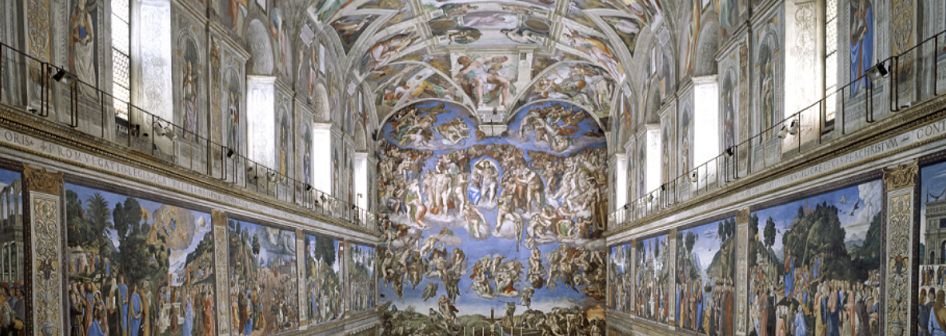
Sistine Chapel Exhibit Review: A Mixed Experience

Janury 27, 2023

Three Views of the Sistine Chapel

I was underwhelmed viewing the Sistine Chapel touring exhibit, produced by Entertainment Events Inc. (EEI) of Hollywood (showing only the ceiling frescoes painted by Michelangelo). The first showing of this exhibition was in Montreal in 2015, after which it toured the world and arrived in Ottawa in December 2022.

 In Ottawa, EEI presented the exhibition at the EY Convention Center, in a large, industrial type of space, like an airplane hangar. It just did not have the aura for showing biblical scenes painted by Michelangelo on the ceiling of the Chapel. What frosted me was the advertising for yoga classes at high prices, taught in front of the paintings. I found the combination of appreciating renaissance paintings with concurrent yoga exercises jarring. But the receptionist told us the yoga classes were fully subscribed; I could not see myself putting my body in yoga poses with great effort and appreciating the artwork simultaneously.

There were no brochures or handouts to describe and explain the paintings, this was Covid times. Instead, you had to bring your cell phone, to which you could download, via a QR code, the explanatory comments. Once we figured out the technical challenges, we found the commentary useful.

Before looking at the pictures, we listened to an introduction to how Michelangelo accepted a commission from Pope Julius II and built a scaffold to paint the ceiling at a height of sixty feet in the Chapel. Michelangelo used vivid and colorful paints on wet gypsum and completed the work between 1508 and 1514. EEI used high-definition photographs to reproduce the paintings in full size.

The full-size biblical scenes were twenty feet above the floor at the EY center, enabling viewers to see the pictures, including brush strokes, in granular detail; that was a major benefit of this show according to EES, compared to seeing the same pictures sixty feet above the ground in the Sistine Chapel.

This exhibition was attractive to art buffs and religious historians, especially those familiar with the Bible; but to me, it does not compete with seeing the real Sistine Chapel in the Vatican, which we visited in 2015. The comparison is like watching a football game on TV versus attending in person. It is hard to describe the excitement of walking through the Sistine Chapel with hundreds of people, all sighing with wonder at the pictures, even though they are sixty feet above you, and seeing not only the ceiling but also the walls, painted by other renaissance artists. But at the touring exhibition, one could take time to study the Michelangelo painted frescoes at a close distance without a crowd.

Although the excitement was tangible within the Sistine Chapel, there were detractions: some people took photos despite being warned not to do so. And the guards kept hushing people to be quiet. As well, when we went, the crowd filled the Chapel wall to wall, and the guards nudged us to move on to let the other visitors come in.

I found the best way to see the Sistine Chapel (if you have internet access and a computer), is to log in to https://www.museivaticani.va/content/museivaticani/en/collezioni/musei/cappella-sistina/tour-virtuale.html This site provides a virtual tour. You can look at all sides, plus the floor and the ceiling of the Chapel. If you want to see more details, you can enlarge the pictures. You may miss the excitement of being in the Chapel, but you do not have to travel to Italy, line up with hundreds of tourists at the entrance and have a limited amount of time to look at the paintings.

Walking through the Sistine Chapel in the Vatican, and looking at stories told by the colorful frescoes, made an everlasting impression on me. I found this quote that reflects my sentiments: “Without having seen the Sistine Chapel, one can form no appreciable idea of what one man is capable of achieving” (Johann Goethe, August 23, 1787).

 Having seen the original work, the touring exhibition was disappointing for me but would be attractive to people where the touring exhibition goes. If your city is not on the touring exhibition schedule and you do not have the time and money to visit the Vatican, the website above provides an excellent way to see the inside of the Sistine Chapel.

2022: from Covid Lockdowns to Travel Freedom

January 1, 2023

When we crossed the border to Canada from the United States, driving north on Interstate 81, I asked the Canadian border guard: “no ArriveCan?”. He just laughed and let us through with a quick look at our passports. A few months ago we had to fill out the ArriveCan forms to cross the border and even with a correctly filled out form, which was a challenge to do, it still took a substantial amount of time to get through. And we had to have proof of vaccination and a negative Covid test taken within a day of arriving in Canada.

We have traveled to the US five times in 2022 and this trip was our sixth, to visit family for Xmas.

We used the ArriveCan form until the Canadian Government abandoned its use, partially because of public opposition to its use, and partially because it was a bureaucratic nightmare to administer it. And the Government also ditched the required vaccinations, and a negative Covid test, reflecting the low rate of Covid infections. Both barriers disappeared by the second half of 2022.

But it was not the ArriveCan and Covid requirements that stuck in my mind as a significant feature of 2022; it was the freedom to travel and the ease with which we could travel in late 2022. Traveling gives you the freedom to see different venues, meet people and, of course, visit family.

When the barriers disappeared, we were free to travel again.

Why is travel such an important and motivating activity for me? I found that if you stay home and follow your daily routine; which includes taking the garbage out, paying bills, and shoveling snow, you lose the excitement of living. Of discovering new ideas, fresh places, and meeting people, which keep your mind alert and body in physical shape.

By March 2022, we got fed up with being isolated in Ottawa and decided on the spur of the moment to visit family in North Carolina. So, we packed a suitcase and drove south. We followed up with a trip to Baton Rouge, Louisiana, in May, where we attended our grandson’s high school graduation. It was a lively experience in the basketball arena at Louisiana State University, with hooting parents celebrating their children’s graduation.

In July, we took our granddaughter back home to Durham, North Carolina, after her soccer camp at the University of Ottawa. End of August we spent a week in Myrtle Beach, South Carolina. with my brother-in-law and his family. And, of course, we spent Thanksgiving and Xmas with family in North Carolina.

Our Honda CRV accumulated enormous mileage this year, compared to 2021, when we filled the car with gas maybe once every two months.

But our travel this year has been much more than seeing family; we did sightseeing and learned about the Moravians’ arrival in North Carolina. and their historical settlement in Salem; hiked in West Virginia. along abandoned rail lines that served coal mining and learned about mining history. Also enjoyed and walked in a gigantic park in Clemmons, North Carolina, donated to the community by the Reynolds family of tobacco fame. A highlight of one of our trips was attending a Baptist church service  – a first for me – in Clemmons. I found these “discovery” trips and experiences stimulating compared to my usual routine at home, which includes taking the garbage out, paying bills, and shoveling snow.

No question in my mind that the trips and the ease with which we took these trips were the highlights of 2022 for me.

US/CANADA Border Crossing Regulations for Covid End Next Week

September 29, 2022

The federal government just announced that Covid-related regulations crossing the border will end next week. It has been a nightmare to cross the border for the past couple of years. The danger of people coming to Canada with Covid infections led the government to introduce the ARRIVECAN system, mandating people to fill out a complicated form on a cell phone before arriving in Canada. The Americans responded in kind, but strangely, traveling by air into the US was allowed with a negative Covid test while traveling by car was not permitted (unless you were an American citizen). 

Resulting from the different border crossing policies, I experienced the most bizarre situation last summer. I could not drive with Kathy to Myrtle Beach, South Carolina (driving from Ottawa, one has to cross the border). Since Kathy is a dual Canadian/American citizen, she drove to Dulles airport near Washington, DC while I flew there the same day. Coming home was different; we drove together and entered the country as Canadian citizens. And, of course, we had to fill out the ARRIVECAN form before crossing the border.

I have been crossing the border for dog ages; early on, when I went to graduate school at the University of North Carolina at Chapel Hill from Vancouver, I drove south to California and then across the US on Route 66. But even before, I remember our drive to Seattle from Vancouver with my father, who informed the American border guard he’ll stay in the US as little as possible. That comment did not sit well with the official who hauled us in for questioning and then had the benefit of trying to decipher my father’s heavy accent before letting us go.

I have always had some innate fear of talking with government officials, especially police and border guards, who brought back memories of the Hungarian secret police and the aura of the heavy hand of government officials. Border crossing was a chore for me those days, not immersed in the philosophy the police and similar organizations serve you, the citizens of Canada.

I was apprehensive when, with a friend of Italian origin, we drove to Seattle with my newly minted citizenship card in the 1960s. My friend warned me that border officials would haul him in and question him because of his Italian name. Surprised to hear that, I wondered if government officials had prejudices against nationalities, including Hungarians. And so it happened; we were subject to thorough questioning, but I escaped detailed scrutiny, and they let us go. Although this incident confirmed my apprehensions, my discomfort with government officials waned in time, especially after I had joined the government in 1973.

It was easy to cross the border into the US in the old days; all you needed was identification like a driver’s license, which, of course, I always carried with me. The reverse, crossing into Canada, was the same. But sometimes you did not even need a solid piece of ID, as when my son’s friend, a recent Russian immigrant to the US, came to visit us in a rented car with neither US citizenship nor a valid driver’s license. He successfully talked his way into Canada at the border and confirmed the ease with which one could enter Canada.

Many of our family border crossings started with camping in New York State. An hour’s drive from us in upper New York State, the pine-treed campgrounds were not only cheaper to stay at than comparable Canadian facilities, but were also less crowded. And, we found wine cheaper down there and the challenge was how to import wine to Canada. Some people suggested I should fill up the water tank of our tent trailer with wine coming home, but I resisted; the water container would have had a taste of having been filled with wine, not the taste of choice of family members. (The limit for importing wine was two bottles per adult). Then we discovered ‘two-buck chuck”, the wine distributed by Trader Joe’s, the retailer in the US.

A case of two-buck-chuck, even paying the customs duties was much cheaper than anything we could buy in Canada. Most of the time, the Canadian customs officials just waved us on when we told them we had a case of wine worth US $24, altho once they told us to go into the office and fill out all the customs papers. This experience cost us ten dollars, but I found it to be a real bother and time-consuming affair as well.

My good luck of never having trouble at the border rossing nto the US ran out when I arrived at the border with my carpentry tools in the car. They immediately sent me inside and took apart my car, checking all the tools. I was going to build a deck for my son’s house, but the border officials were suspicious that I had other intentions. They were afraid that I would take jobs away from Americans. It took over an hour to get on my way; I pointed to my gray hair and said I was retired and had no intention of working and taking a job away from the locals. Further, I explained to them I had lived in the US for years but came home to Canada for my career, which was over.

Complications arose when I mentioned I had an expired draft card with a 5A rating. The younger officials knew nothing about draft cards and I tried to describe the Vietnam war and how Americans were drafted for service. This entire episode came to a hilarious end when an older border guard burst out in a boisterous laugh and explained to the younger officials what had happened in the sixties. The bottom line was that they took away the draft card I cherished and carried with me all the time when I worked in Norfolk, Virginia, in the sixties.

But the border is a two-way street and I never forget the incident when I bought a bottle of liquor at the duty-free shop coming home and the Canadian border guard asked how many ounces were in the bottle (there was a limit on how much one could bring back home). I looked at the bottle for information but could find none. I told the official I bought it at the duty-free store and had to be a size permitted for import to Canada. But he would not budge and I was ready to consume part of the bottle when he suddenly decided to just let us go, looking at the lineup behind us. As soon as we crossed the border, I felt some corrugations on the bottom of the bottle, and lo-and-behold; I found the information I had been looking for.

But next week we will go back to the old days, and a passport will be sufficient to enter Canada. The US is already open with a Canadian passport. Hurrah! Were the heavy-handed regulations preventing the entry of people with Covid useful and worth the cost of losing the tourist business? We’ll not know unless the government undertakes a study of it.

A Canadian Welcome Called ArriveCan, Driving to Canada

July 11, 2022

“You have been picked randomly to take the covid test,” said the Canadian border agency officer, handing David and his two children covid test boxes. They drove from Durham NC crossing to Canada via the Thousand Islands Bridge into Ontario. That was David’s introduction to Canada, after four years of absence.

He and the children travel with Canadian passports, all had three covid vaccine shots, and filled out the ArriveCan document successfully. So what more does the government want? Do they have Covid? The government just did away with random testing at Pearson and other airports in Canada because of the huge delays. If you have a government mandate based on science, as our PM claims, all Covid mandates are based on science, how come you do not enforce it at airports but enforce it at border crossings by car? This is utter nonsense.

The one good thing was that the entire conversation at the border took five minutes, but the agent left them with an ominous warning to take the supervised tests on the first day upon their arrival and submit them in twenty-four hours, or a fine of $5000 may be levied.

To put it in context, my son David and the two children came to visit us for a few days at the cottage that is on an island accessible by boat. And they were told to take the covid tests with a person supervising via an audio/visual internet connection. On this remote island, the internet is sparse and slow, and sometimes non-existent. Have the government policy wonks considered all the potential circumstances where they may have to administer this wretched Covid test?

So David made appointments for all three of them for the next morning; each appointment was scheduled for twenty minutes by the government.

I listened to the conversation the next day when the government officials, three different ones, instructed David and the children, aged nine and twelve; to take out the info sheet from the Covid testing box; fill it out with their birthdates; addresses, etc. and then swab their mouths on two sides for three seconds each and each nostril for fifteen seconds and the government officials counted the time down.

Then they put the labels on the test tubes; put the swabbed sticks back into the tubes in the right direction; etc. and place the test boxes in the fridge (a weird suggestion since the last time we came back to Canada and FedEx picked up our tests. The driver told us the FedEx truck was unrefrigerated). Like you were in kindergarten. And then they were told how to submit the repacked boxes. Two of them said to get FedEx to pick it up (as if FedEx would send a boat to an island), but the third one said Lifelabs and Shoppers Drugmart are places where you can drop off the boxes. Seemed to me the interviewers needed additional training; the instructions provided by the three people should have been identical.

 A couple of interviewers asked David what time it was as the interview was taking place (Canada has three time zones), a strange question; not knowing where in Canada he was and what difference it made, although the information was available. The border guard asked David where the cottage was for his stay in Canada. The IT people developing this program should have provided location info for the interviewers if they were worth their salt (the question showed the interviewers could have been all across Canada and did not know where David was).

This lack of coordination by the agencies delivering ArriveCan and testing reminded me of a similar situation that happened to me when I came back from the US in May. Although the border guard told me I do not have to quarantine, I received a robot call every day for fourteen days upon my return, asking me about my quarantine location. Assuming the border guard punched in the right information, why had the government follow-up program kept calling me? Does the government contract with the lowest cost IT companies that may not have the best track record? Or, perhaps, government officials never test-drive their creations.

Another ridiculous aspect of the experience David went through is that he never received the result of the tests. He stayed less than a week, but by the time FedEx picked up the packages and the lab developed the results, he left the country. He just told me he never received the results and it is a week after arrival. The entire exercise is a total waste of time and a waste of taxpayers’ money.

Yes, vaccinated travelers to Canada may have Covid. But the effort required for, and the inconvenience caused by, testing far outweighs the benefits of finding out how many people entering Canada. Covid is community-spread today in Canada, far more than by people arriving from outside the country.

If the government wants to test arrivals to Canada, it should test all arrivals, including those by airplanes, via highways, and boats, and should make sure that all the agencies administering this process are well-coordinated. Just my opinion.

A New Divide: People Who Work From Home vs. Others. Wonking Out

May, 10, 2022

The pandemic has accelerated the trend in “teleworking”, or what is called today “work from home”. Governments and companies encouraged workers who could work from home to do so to reduce potential infections in the office. But who are these workers and what impacts has this movement had on our daily life?

According to Statistics Canada, over thirty percent of workers worked from home, between April 2020 and June 2021. In 2016, only 4 percent of people did so. A massive change in the work environment, mostly triggered by Covid, I think.

The composition of this home-based workforce is interesting. According to Statistics Canada, seventy percent of people who worked from home were in the “professional, scientific and technical services” industry category.

By income, eight percent of people in the bottom ten percent and over sixty percent of people in the top ten percent of wage earners worked from home.

So better educated and higher-income people seem to have been given a greater opportunity to work from home than others (education and income are usually positively related).

But, there are other consequences resulting from this trend. A recent article by a city planner in Vancouver envisioned that the work-from-home movement could result in larger homes because of the need for a home office. And larger homes need vacant terrain to be subdivided, gobbling up choice agricultural lands around major cities in Canada. The article also envisioned a home with more outdoor space than the norm today, considering people will avoid public spaces and parks for fear of infection.

The article surprised me since current city plans, including Ottawa’s, strongly encourage “densification”, to save on infrastructure and minimize carbon emissions by reducing the daily commute. Perhaps the need to build larger homes for work at home will decrease in time, paralleling the elimination of Covid, if that is possible. Not a likely event in the short term.

I provide all of this context to introduce the nub of a potential issue: people love working from home and the trend toward it may create a new divide. The lucky ones may continue the work-from-home routine while others may never get to enjoy it. Now I have not done a professional survey but have anecdotal evidence from talking with many people who love to work at home and never want to go back to the office.

People I talked with gave me many reasons why working from home is advantageous: you can choose your hours of work; you save time by not having to dress up to go to work; you save money by not buying coffee or lunch and commuting (save on gas, parking or transit costs); and you can take care of daily activities like shopping, taking children to school; or go on a bike ride or run when times are nice.

But, there may be downsides as well. You may miss the watercooler talks catching up on what is going on in the office; miss meetings in person where you may find out more about projects through the body language of others (zoom meetings provide less communication than in-person meetings). You may miss opportunities to show your skills and knowledge to your boss in ad hoc situations that could lead to promotions. Recruits may find it difficult to learn the culture of the organization being away from the office. And some people may find it intrusive that some bosses may call you on a 24/7 basis.

Another unanticipated consequence of working from home may be that office buildings stay empty, taking away the livelihood of many businesses serving office workers. But, of course, companies and governments save money on reduced office space demand.

I remember people blamed the recent convoy in Ottawa for destroying the restaurant industry downtown. But have you considered that the government in Ottawa, ordering employees to work from home for the last two years, may have been a key factor that killed the restaurants downtown?

It may take a few years before we see the light on whether the work-from-home trend will continue. But, to date, this movement has created a divide between those who can avail themselves of this attractive way of working versus others who just cannot do it. And it has created incentives toward low-density urban development conflicting with current city planning objectives to densify to reduce greenhouse gas emissions and save good agricultural lands. Just my opinion.