December 9, 2022
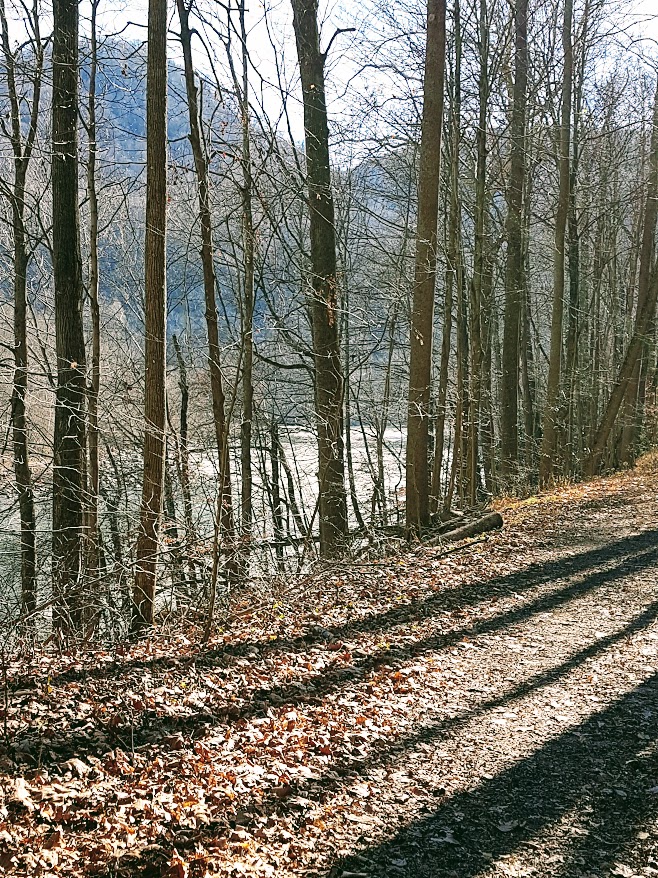
We hiked along the Southside Trail in the New River Gorge National Park near Fayetteville, West Virginia, over Thanksgiving weekend. The trail is wide, and the grade is easy; it follows an abandoned railroad line used by the Chesapeake and Ohio Railroad company in the late 1890s and early 1900s. Those with longer legs and strides went ahead. I strolled after them, enjoying the quiet. There were no people on the trail except one fellow walking a couple of dogs.
It was in November; all the leaves had fallen, making the path soft under the foot and letting the sun’s rays come through the trees. The temperature warmed up from near freezing to t-shirt time and I put my jacket and sweatshirt into my backpack.
Coal mining in this areagoes back to the 1800s. Coal replaced wood to boil brine to make salt needed for the transport of meat with no refrigeration. Small coal mines had sprung up to respond to the need. The demand for coal further expanded when using coal oil for indoor lamps became popular in the mid-1800s; distilled coal is coal oil, made just like moonshine. The increasing demand for coal triggered the construction of railroads.
I passed by well-preserved coke ovens, left over from the time “King coal” was mined and made into coke in the early 20th century. Taking a rest on my walk, I sat down and looked up the story of coal in this part of West Virginia on my cell phone.
I learned the mining industry was a tough one; miners were mostly immigrants and African-Americans, working for low pay under unsafe conditions. To accommodate the workers, the mining companies built housing for them from scratch, overnight; the housing was segregated with whites on one side and blacks on the other side of the coal chute. The companies also provided a store, since there were no other commercial establishments in the vicinity. And the stores sold items for usurious prices to the miners who had no options but to buy at the company store.
Despite their hard condition, the miners’ spirit could not be contained: they played baseball, and the folklore of the ballad of “John Henry” or the alternate “Take the Hammer” song was born. I checked out the ballads sung by most blues and country singers and the one I like the most is by Tennessee Ernie Ford. You can listen to it on YouTube: https://www.youtube.com/watch?v=5Kr6FIXBaZ8
The United Mine Workers of America (UMWA), formed in 1890, came to unionize the workers, to help improve pay and safety, and fought, often violently, for 43 years. Mary “Mother” Jones of national fame, was one of the principal leaders in the West Virginia labor movement until 1921 and led many marches, culminating in armed fights between the miners and the mine owners. The armed miners could not stand up against the National Guard and the Armed Forces called out by the Governor of West Virginia in one case and President Harding in another case. The mine wars culminated when President Roosevelt let the UMWA organize in 1933.
The trail I followed is next to the “New River,” an ironic name for one of the oldest rivers in North America. There are spectacular views of the river along the trail, which has smooth water parts for canoeing and white water for rafting and kayaking. The New River is in a deep gorge, hundreds of feet down from the rim; the sides of the gorge provide some of the best rock climbing in the Eastern United States.
After a couple of hours of walking, I turned back while the rest of the family went on this seven-mile trail. I engaged in a friendly conversation about the history of the coke ovens with the three people from Virginia I encountered on my return trip to the trailhead.
Our home was a Vacation Rental by Owner (VRBO), a half-hour drive from the trailhead, in Fayetteville with a current population of 2800 people. Fayetteville, incorporated in 1872, used to be a mining town, but to me, it was transitioning to become a tourist town in the center of the New River Gorge National Park.
The house was close to a thousand square feet in size, fully renovated, and well-appointed, but I felt technically challenged trying to change the thermometer. Equally challenging was following instructions to make coffee on a machine that combined a carafe coffee maker with a Keurig coffee maker.
Sam, the host, came over to help us figure out how to operate the “nest”thermometer. He demonstrated how your finger moving along the perimeter of a circular control knob changes the temperature.
His wife runs three VRBOs, and he takes care of technical problems when he is home from Alabama, where he now works. Although he was trained as a mining engineer, it was not clear if he was doing mining-related work in Alabama. Perhaps he left town, because there may be no mining jobs left in Fayetteville. The abandoned mines we saw in the area testified to that.
In the afternoon, we walked around the hilly streets of Fayetteville, incorporated in 1872, with small houses like the one we rented. Many of them looked vacant; I wondered if the people owning the vacant units left town for job opportunities elsewhere and converted them to VRBOs.
The downtown area had well-maintained, old commercial buildings. One was a bank. I always recognize the typical small-town banks, stone buildings with Greek columns framing the entrance, and large windows on the sides. This bank was at a street corner, as most of these small-town banks are, with the entrance door located diagonally where the two streets met.
We came to stay in Fayetteville, a convenient location for visiting the New River Gorge National Park. The area was originally established as a National River in 1978, by President Carter and updated into a National Park in 2020 by President Trump. They show a short film on the history of the National Park at the Visitor Center. On leaving the Visitor Center, a South Korean family asked me to take a picture of them, which I was happy to do.
Observing the mostly out-of-state license plates in the parking lot of the visitor center and meeting someone from South Korea made me think the area is successfully transitioning from the declining mining industry to tourism. According to a National Parks report, the New River Gorge National Park attracted 1.8 million visitors in 2021 who spent over $80 million in the region.
(The coal industry grew from mining two million tons of coal in 1880 and employing 3700 people to mining 168,000 tons of coal in 1948 and employing 125,000 people, at its peak. Today, West Virginia coal mines produce 90,000 tons of coal and employ 49,000 people.)
 andrasthehun.ca