Cultural Insights on Icebreaker Introductions

December 18, 2025

Our group of twenty people sat down for our first night’s dinner at our Road Scholar program. Many of us were tired from a long drive or flight to the southwest corner of Florida, to the Everglades. As an icebreaker, our leader asked us to stand and introduce ourselves: our name, where we are from, and what we were looking for in the kayaking program for the coming week.

I looked around with curiosity; what kind of characters indulge in kayaking for hours each day? There were mostly grey hairs, with more women than men. Seniors, although some looked youngish. Later, I discovered that the “youngish” people were 60 or older.  

Although it is useful to know everybody’s name, I could not remember them ten minutes later. But it was interesting to learn about where they came from: many from Florida, but others were from Washington, Wisconsin, Pennsylvania, Indiana, and Maryland. We were the only ones from Canada.

One talkative person at our table gave us a blow-by-blow account of his life without prompting. He described his career from studying microbiology, to serving in the air force, and then using the GI bill to become a Physician’s Assistant. I thought it was useful to have a medical person on hand should anyone get hurt kayaking.

Then this extrovert asked another fellow at our table what he had done before retirement. Surprisingly to me, the answer was “test pilot”. Wow, I thought, that must have been an interesting career. When I talked with the “test pilot” later, I learned that he participated in 16 Road Scholar programs, which was an eye opener for me about its popularity.

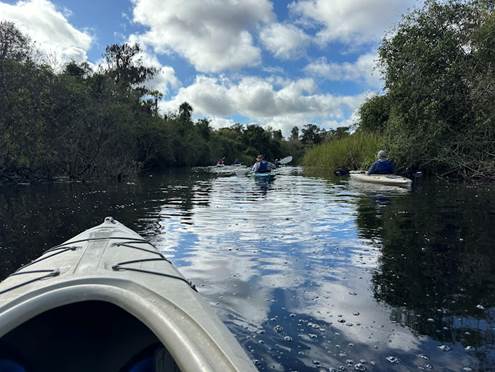
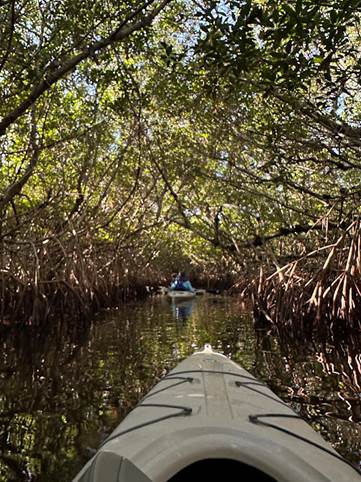
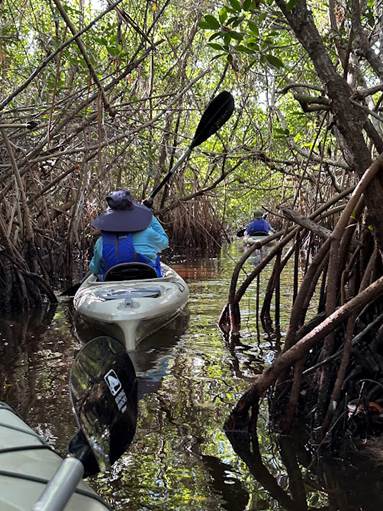
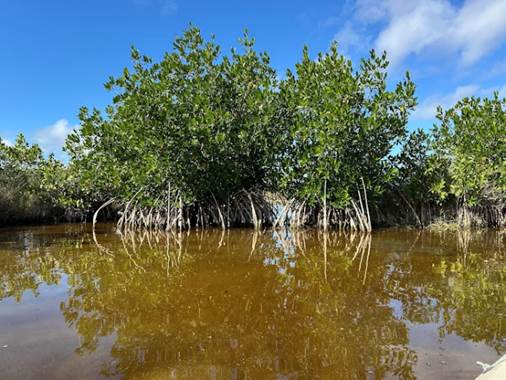
We discussed the Everglades’ fauna and flora during kayaking. For example, we spent time discussing gators, their growth, and the danger they pose to humans: I learned humans are not in their food chain. And we learned about the Brazilian pepper tree, an invasive species that harms mangrove growth but very difficult to contain.

A genuinely fascinating surprise was discovering one participant, who taught maths before, but now was a Road Scholar leader for walking/hiking tours out west. In conversation with him, he mentioned that his icebreaker includes, in addition to the three questions we responded to the first night, the age of the participants, their middle name, and something unique they accomplished or special about them. That made me think how I would have responded if we were asked these questions.

Why would I volunteer to reveal my age to a group of kayakers I just met? What would that add to their impression of me? If they found out how old I am, would they think I would slow them down? And if I appear younger, would they accept me? Would that make any difference? I am already a participant. So, what purpose would it serve to reveal my age?

The other icebreaker, mentioning one’s middle name, was also curious. What do middle names signify? My middle name is my godfather’s first name, and that was the tradition in my family, coming fron a central European culture. Kathy’s middle name is her grandmother’s family name to show family lineage; that is part of Celtic culture. She comes from Wales. Is the goal to offer extra details, possibly about ethnicity? I am not sure that this information is valuable to a kayaking group. And what would happen if someone had no middle name?

 Others may not want to reveal their middle name for religious reasons. For example, my good friend, Zane, used his middle name all the time instead of his first name. I had known him for years, before I discovered that his first name was Mohamed. I think he used his middle name to avoid being stereotyped as a Muslim with all he complications North Americans have today with the religion. I also think asking for middle name is a mild incursion into privacy matters.

In conclusion, icebreakers should be simple; a name, the location where one lives, and perhaps one detail about you, such as your hobby, favorite music, or author. Or the question the leader asked the first night: what do you want to get out of this program. Then let people talk to each other to discover additional information about each other, should they so desire.

Unplanned Adventures: Kayaking the Everglades

December 13, 2025

It was not on our bucket list. We had never thought of visiting it before; in fact, I knew of it by name only. What happened was that I looked for something to do in early December, and a Road Scholar trip fit the bill. So, why did I search for an activity in early December? Let me explain.

In July, we reserved a B&B for a family get-together in December, just before Christmas. Our children live in Durham and Charlotte, NC, and Baton Rouge, LA, and I tried to rent a place central to all three. Just north of Chattanooga, TN, I found a place large enough to accommodate all the family.

Then in November, we told our children we would attend Thanksgiving dinner, assuming one of them would organize it.

The availability of three weeks – the time between Thanksgiving and the family get-together – prompted me to look for something to do during that period; we had no desire to drive from Ottawa south twice, a distance of a thousand miles each way.

I remembered my son’s mother-in-law enjoyed Road Scholar trips and looked up what trips were available in early December. A yoga class in North Carolina sounded interesting, but it was fully booked. Sightseeing trips to New York City and St Augustine did not appeal to us, but a kayaking trip in the Everglades did.

One concern was that the Everglades are another thousand miles further from our children’s homes where we would have our Thanksgiving dinner. But it would take us to a warm place and include a physical activity, kayaking, that we are fond of.

Reviewing the kayaking program, I had another concern: Road Scholar rates this trip hard on a scale they use to alert people of the physical difficulty of their trips. They advise that to participate, one should be able to kayak for 6 miles and walk 2 miles a day. The walking component was not a concern, but paddling six miles was. On balance, we decided we could do it since we kayak every summer, often for hours. So, I reserved the last two spots available.

With Thanksgiving Day approaching, I learned that my older son, Tony, was renovating his kitchen and not ready to prepare for a family dinner, which he has done for many years. Daughter Megan decided to take a job in Williamsburg, VA, and planned her move from Baton Rouge in early December, clearly not ready for entertainment. And David’s children and wife planned to visit family in Beaufort, SC, for Thanksgiving. Well, that was that, and instead of traveling south, we stayed in Ottawa and celebrated US Thanksgiving at home. We left for Everglade City the following Monday, on December 1.

Upon reflection, if we had not planned to have Thanksgiving dinner with family, I would not have reserved the Road Scholar trip because we would have just travelled to Tennessee for the family get-together. So, the real trigger to kayak in the Everglades was our intention to have Thanksgiving dinner with family. Funny how plans can have unintended consequences.

Boldt Castle Visit: History and Architecture Unveiled

October 22, 2025

October 11. We played tourists today. Although we live just an hour and a half’s drive from Boldt Castle, we had never visited it until now. I’ve heard of the castle, of course, but it’s located on Heart Island, in the Thousand Islands region of New York State, on the St. Lawrence River. Visiting from Canada requires a passport, and since we don’t carry our passports with us every day, we never thought about making the trip.

One can visit the castle from Alexandria Bay in New York State or from Canada, with ferries departing from Gananoque and Rockport, Ontario. We decided to go from Rockport to save time, as driving to Alexandria Bay takes longer.

Upon arriving in Rockport, we noticed eight large tour buses. To my surprise, many tourists from China started disembarking. A local who was familiar with the area explained that Chinese workers are often rewarded with tours to Canada, and many of them visit Montreal, or Toronto, making a side trip to Rockport on their way to Niagara Falls. We also encountered other visitors in the parking area, including a couple from Toronto who were making the long drive back home the same day. We met another couple from Pennsylvania, who decided to sightsee in Canada before visiting the castle. I hadn’t realized how popular the castle is as a tourist attraction. A guide told me that five hundred to two thousand people visit the castle each day.

The boat trip to Heart Island takes about half an hour and passes by some extravagant cottages that resemble large houses more than typical summer homes. Upon landing on Heart Island, we went through U.S. border control, which took a while due to the long lineup of visitors. After we cleared the U.S. border, where they took a photo of us without hats and with our glasses off, we had a couple of hours to explore the island and the castle. Then, we returned to the dock for our trip back.

The view from the ferry

As we approached the castle, we saw a wedding on the front lawn and were asked to leave by the organizers. Fortunately, the castle was open, so we explored the large central hall and the enormous dining room before heading upstairs to see the bedrooms. The castle has a total of one hundred and twenty rooms.

The main hall

On the second floor, we watched a short film about the history of George Boldt and the castle. George Boldt emigrated from Prussia to the US at the age of thirteen. He started working in the kitchen of a hotel in Philadelphia and quickly rose through the ranks to manage the hotel at a young age. He became the manager of New York’s Waldorf Hotel and merged it with the Astoria Hotel across the street, becoming the well-known Waldorf Astoria Hotel.

The dining room and a bedroom

As part of his heritage, Boldt is credited with popularizing the “Thousand Island” salad dressing in his hotel. The name originated in the Thousand Islands region of upstate New York, and its original version was made with mayonnaise, ketchup, and pickles. He also created the Waldorf salad, a classic American dish made with diced apples, celery, and mayonnaise.

The Boldt family spent their summers in upstate New York, where George Boldt decided to build a castle on Heart Island for his wife. He was going to give the castle to her on Valentine’s Day. The architecture resembles a Rhineland castle. Construction began at the turn of the century. However, in 1904, tragedy struck when George’s wife passed away unexpectedly. He called off the construction and laid off the three hundred workers who had been building the castle. George never returned to the island, and the castle remained untouched for seventy-three years, falling into a ramshackle state. In 1977, the Thousand Islands Bridge Authority took over the property and invested millions of dollars in its rehabilitation, preserving it for public enjoyment.

Also on the second floor, we saw the rehabilitated bedrooms decorated in period style, belonging to George, his wife, and their children. The floors above have not yet been fully renovated; they currently hold architectural drawings and additional information about the castle.

The garden is also worth visiting, featuring an Italian garden and professionally landscaped grounds with benches. We sat on one of the benches to enjoy our lunch, grateful for a moment of rest after climbing the stairs. It’s important to note that the ceiling heights in the castle are much higher than the typical eight-foot ceilings found in residential homes; climbing four floors felt more like going up six to eight floors in a standard building today.

On the return ferry trip, I bought a cold drink from the bar, which was refreshing and helped me process everything I had seen. If you have visited castles in Europe, this one may not impress you much. However, North America has very few buildings like this one, the Biltmore Estate in Asheville, NC, or Hearst Castle in San Simeon, CA. Visiting this Castle is certainly educational, especially for children. It is also steeped in history and serves as an essential example of the architectural style built during the Gilded Age. I recommend it as a great family outing on a sunny day.

Summer Reflections: Closing the Cottage Experience

October 8, 2025

It is a bittersweet event. This past summer experienced record-high temperatures, resulting in lake conditions suitable for extended periods of comfortable swimming. Family visited, and friends came, to enjoy the water activities. As we near the end of the summer, the forecast indicates colder weather next week. Although we swam with our short wetsuits on this weekend, the water cooled us off, and our stay in the water was brief. But we kayaked every day when the lake was smooth as ice and went for walks in the back.

With the leaves falling, we saw much more sky than during the summer. We have giant maple trees around us. But now with much of the foliage falling, the ground was bathed in sunlight, and the leaves formed a thick, carpet-like cover. And there were no bugs, no mosquitoes, no ticks. Nevertheless, I still wore my tick-proof jacket and long pants for protection from nasty bugs, just in case.

I saw a massive fungus on an old and diseased tree; the fungus must be over a foot in diameter, with a yellowish color and parallel lines across its surface, making it artsy. While walking through the forest after leaf fall, we observed prominent burls, mushrooms, and lichens on the trees, which were readily apparent.  And I recognized the sounds of many birds, such as the black-capped chickadee, Canada geese, American crows, blue jays, and an app on my iPhone identified the yellow-rumped warbler. The loudest, of course, were the loons on the lake.

Crossing the large green pasture, we met three deer, looking at us. They always notice you before you see them. They hear the crunch of the leaves under our feet, while they remain quiet in their movements in the forest, avoiding attention from people passing by. And they always stand sideways with their heads turned, looking at us, waiting to see if we’re going to chase them or feed them. We stopped and took some pictures of them facing us sideways. I know the fellow who lives next to the pasture most of the year and feeds the deer. That is why they are friendly towards people.

Kayaking around the lake is a friendly affair; we always chat with people sitting on their decks. And there are the fishermen who talk about the number of fish caught that day. Yesterday, the surprising social event on the water was meeting three women standing in the water. They proudly announced that that day was a record for them in terms of being in the water this late in the season. I admired them for cheerfully chattering, but surely they were suffering the pain of standing in the cold water

But it was time to close the cottage despite the summer-like weather. All the neighbors were gone except a handful of fishermen on the lake.

Closing the cottage is a process that we have done many times, and it follows a routine. I unhooked the seats in the kayaks and pulled them up onto the shore, storing them upside down along with the windsurfers and canoes. I stored the seats and paddles in the storage hut. Covering the outdoor furniture with tarps was next, while Kathy cleared out the main fridge.

The final closing steps are moving all the stuff we take home to the boat and turning off the hot water tank and pump. My friend Jeff drains the water lines and adds antifreeze to the plumbing for winter.  And a local contractor pulls my floating dock around into quiet waters to protect it from breaking from the harsh winter ice.

The last activity is to place mouse poison around the cottage. Every ten years, there is a mouse invasion. We experienced it once and try to avoid it.

We drove the boat slowly to the marina, feeling the sun on our backs and watching the shore, one final enjoyment on the lake this year. Oh, and we’ll have to let the marina know that our propeller needs straightening; we had the misfortune of hitting a rock a week ago in the extremely shallow water resulting from the hot and dry summer.

Building Friendships at the Cottage: A New Perspective

August 1, 2025

We know our neighbors better on the island where our cottage is, than those where we live. I found that curious and made me think why.

Many people go to their summer homes to relax, to leave the city behind, and to be alone to regenerate their physical and mental health. I thought that cottagers prefer to be left alone. But I found the opposite to be the truth.

Before I go any further, I should explain how we arrived purchasing a cottage that may have relevance to my argument. We camped and tented for our vacations in the beginning until our one-year-old child woke up in an inch of water from a downpour one night. This prompted us to purchase a tent trailer, ensuring we would be above ground in case of a storm.

The tent trailer took us to Florida, the west coast (Vancouver), the east coast (Charlottetown) and many camp grounds in Ontario and New York State. The whole family enjoyed traveling and sightseeing with a tent trailer.

However, as the children grew up, summer camps, sports activities, and jobs made it inconvenient to travel with them, and we sold the tent trailer.

At the time I sold the tent trailer, a friend invited us to visit their cottage, and we canoed to their place on an islad. We had so much fun on the lake that day that we stayed overnight, and I decided I must have a cottage on this island. When I found a cottage for sale, I made a stink bid in the fall, a poor time to sell it. Since the couple owning the property was going through a divorce and the wife wanted her share of the money at once, they agreed to sell it. That property had good “bones”, or structure, but was unfinished and needed a lot of work.

The first task with our newly acquired property was to finish the ceiling with the tiles already stacked in the cottage. When mice dropped from the ceiling onto Kathy while she was sleeping in the bedroom, finishing the ceiling became the number one task. Other projects followed, like building steps going up the hill to the cottage, where there was a dirt path that was slippery when wet.

We also joined the local cottagers’ association, a common group in such communities. The primary function of these groups is to have an annual meeting with a BBQ event, providing the opportunity to meet others. At these AGMs, there are also talks about subjects of interest to all, like water filter systems, and how to avoid mosquitoes and ticks. Once the ice is broken, friendships form. A few years ago, there was an even bridge club on the island.

This weekend’s visit with a few neighbors shaped my views on our cottage community. The next-door neighbor from New Jersey invited us for dinner, and the discussion flowed easily despite our diverse backgrounds and lifestyles. We learned more about the neighbors’ families than we ever knew about our neighbors in town.  

Our neighbors from Michigan invited us to their spacious deck that same weekend. During a discussion about where they met, we learned that the man’s Vietnam experience ended with an injury, resulting from a grenade blowing up next to him, with long-term consequences. This neighbor has done a lot of work on his cottage and has accumulated a wide range of construction equipment. I found one of his tools helpful, a heavy-duty jack that I borrowed to lift up my sinking dock.

We paid a visit to another old friend from Pennsylvania. His grandson was there keeping them company. During our visit, another neighbor dropped in and brought a bag of fresh samosas from Toronto. We all had one and admired the new ceiling completed in their large entertainment room.

Never to miss our Canadian friends from Ottawa, we walked over to their immense deck the next day, where they always relax with a book and a glass of wine in the afternoon.

Although socializing is fun, the weekend was also work; Kathy power washed the outside decks, which are substantial, about one thousand square feet, with a wraparound deck extending into steps leading to the waterfront. I used a weed-eater to clear the front and back yards. I shaved the grass to the ground to make sure no ticks would enjoy my yard, ticks thrive in tall grass, and I had some bad experiences with them just a few weeks ago.

Despite seeing these people only during the summer months, I found that we know more about them than we know about our city neighbors. It could be because in town, most people work. In cottage land, people take their time to hang out, relax, and enjoy seeing others doing the same. Vacationing is a good time to make friends, and cottaging offers such an opportunity.