December 23, 2024
We drove from Munnar to Alleppey in five hours. Our journey through Kerala’s backwaters led us across numerous canals to Alleppey, a city with a population exceeding 300,000. Alleppey district, with over two million inhabitants, boasted a 96% literacy rate and harmonious religious coexistence, according to our guide Dinesh. Hindus comprised half; Christians and Muslims, a quarter each.
Reclaimed lakes around Alleppey formed a backwater area for rice paddies and coconut groves. Manual labor initiated the first reclamation in the late nineteenth century. The second reclamation wave of the early 1900s relied on steam engines, while electric motors powered the final, larger phase of that same century. Reclamation efforts resulted in the canals and rice paddies. Today, the backwater area spans over three hundred square kilometers.
Rice paddies and coconut groves formed the economic foundation of this region. The canals served as transportation routes. Rice barges were the conveyances used to bring the rice to Alleppey; this area is the rice bowl of Kerala. The coconut groves created the coir industry. I was unfamiliar with the word “coir,” but Kathy believed it was identical to sisal, a material her seafaring relatives, including her father, used to craft carpets aboard ships during their downtime. However, sisal comes from a species of flowering plant native to southern Mexico, according to Wikipedia, cultivated and naturalized in many other countries. Like coir, it produces a rigid fiber suitable for rope-making.
In contrast, coir or coconut fiber is a natural fiber extracted from the outer husk of coconut and used in products such as floor mats, doormats, brushes, and mattresses. Coir is the fibrous material found between the hard internal shell and the outer coat of a coconut. Brown coir, derived from mature coconuts, also finds use in upholstery padding, sacking, and horticulture. White coir, harvested from unripe coconuts, makes finer brushes, string, rope, and fishing nets. This material doesn’t sink, so it’s useful in deep water at long lengths without weighing down boats and buoys.
The Alleppey area has always been popular with domestic and international tourists because of its climate. When the rice markets collapsed in the 1960s, rice farmers converted rice barges into houseboats for tourists. There are more than one thousand houseboats now, also called kettuvallams. Coir ropes tied in knots hold the entire boat structure together. This boat uses no nails. Instead, the boat comprises vast planks of Jackwood or Aanjili joined with coir.
Dinesh explained the coir industry has become a significant economic force in the Alleppey area. After giving us all this information, Dinesh took us to the port where we would embark on a Kerala backwater cruise on a kettuvallam. A backwater cruise was our principal attraction when we came to Kerala, and we had grand expectations.
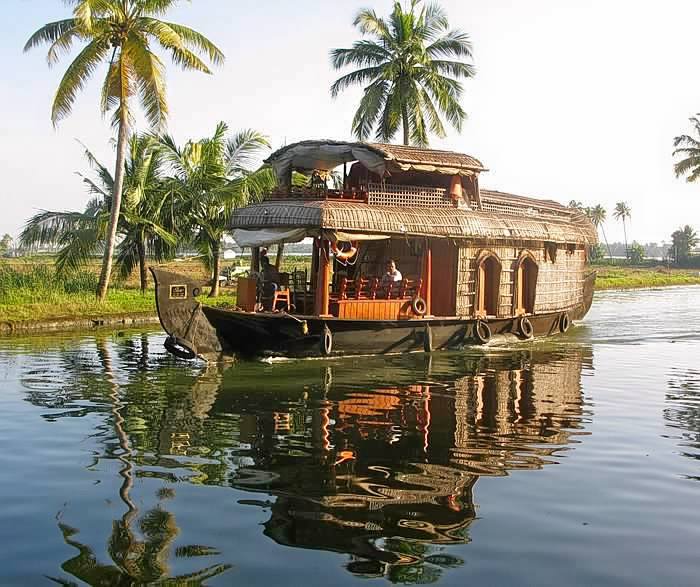
Dinesh left us by the houseboats, docked side-by-side and connected to the port via gangplanks. We started walking toward the kettuvallams, and it was such a major disappointment! At the water’s edge, a dirt path ran alongside the port’s bulkhead. The path extended several hundred meters, with boats moored at the bulkhead and trees bordering the water. Garbage lined the entire pathway. The path was littered with paper boxes, wrappers, and empty soda cans!
I expressed my disgust to Kathy, declaring my intention to leave. Given this awful beginning, what good outcome can we expect from this trip? They advertised Alleppey as notable for its backwater cruises.
But then, a young fellow approached us and asked if we were his passengers. We said that we were waiting for our cruise. We crossed a gangplank to his boat, and the atmosphere suddenly changed. Inside, the boat featured teakwood lounge chairs, a bedroom, and a bathroom, all spotlessly clean. Two boatmates and a chef stayed in the kitchen area.
We departed, gliding along the canal toward a massive lake. Relaxing on this lavish boat allowed me to contemplate the stark difference in condition between the decrepit shoreline and the well-maintained boat. Was it because the coastline and its maintenance are a municipal responsibility, and no money is available to upgrade it? Perhaps boat owners prioritize tourist competition and maintaining boats while lacking resources or desire for approach improvements. I think boat owners should be more keenly interested in a pleasant and attractive approach to their boats.
We were not the only ones getting into the canal system; several houseboats were leaving, and it looked like a busy street with lots of traffic. The blue sky and summer weather were lovely, but many people following the same routine detracted from the trip’s special quality. Despite that, we sat in lounge chairs and enjoyed the scenery. And the entire trip was like that; enjoyment depended on your perspective.
There were minor drawbacks. For example, the boat lacked alcoholic beverages, such as beer, but I could purchase some in the small villages along the way. People complained about the lack of Western channels on the boat’s TV. Television viewing hadn’t crossed my mind. I took a positive approach and enjoyed every moment.
We cruised until we stopped for lunch by the shore, joining other boats in line. But the lunch was ample and delicious, consisting of local fish we enjoyed. We also stopped and bought fresh prawns for our dinner. It was in addition to the full vegetarian meal included with the trip. The cabin crew provided tea and banana fritters for a snack. We had ample food for dinner, including chapati, del curry, aloo gobi, cabbage, a vegetable salad, and vendakka. The chef prepared the food with local spices and heat.
The waterway offered a view into daily life: women in vibrant sarees washing clothes, children returning from school, and people fishing or traveling by small boat. Observing children playing in the water, we guessed the polluted water must have built up their immunity. We also saw commercial barges moving rice. The people along the shore waved at us.
Travelers we spoke with later expressed different views on the boat tours. Some thought an hour would be sufficient. Others found the trip dull. In contrast, we enjoyed the private time we had on the boat. The boat trip offered a relaxing, mosquito-free evening. We observed the morning rush hour in the tiny village where our houseboat docked. Boatloads of children went to school; others were readied for fishing. The chef served us breakfast of idli with sambar and tea. Then, the captain took us back to the dock to disembark, where Dinesh awaited us.
Dinesh took us to the fish market next. I have always liked fish markets, seeing the variety of fresh fish caught in the area, and the Alleppey market was no exception. Photographing the busy fishmongers proved rewarding. Several looked like genuine characters with enormous mustaches and used their long knives to clean fish expertly. Before taking their picture, I asked them if they would mind. Nobody refused.
Having walked around the fish market, Dinesh took us to the Tharavad Homestay, where we would spend the night, leaving us at the door for the evening. He mentioned he could not park overnight in the guesthouse driveway. I suspected hired drivers could not leave their cars in this neighborhood even though we were traveling in an unmarked SUV.
The hosts, Maria and Zac, received us at the homestay, and they were the most hospitable people I had met anywhere. They showed us our bedroom, which was large and spartanly furnished with a bathroom that was not modern but functional. Breakfast was included in our reservation, however, dinner was at our own expense. Although we were the only guests there, Maria provided us with a choice of menus for the night. She was an excellent cook serving local dishes.
During dinner, conversation with our lively and insightful hosts covered all aspects of Alleppey and Indian culture. They were well-traveled, and we discussed politics. The election of a communist government in Kerala surprised everyone, including our hosts, making it one of the first Indian states with such a government. The hosts were involved in the coir industry and had a son in the United States.
The next day, we visited the coir museum and saw lots of coconut remnants used to make the coir in the area. After breakfast, Dinesh picked us up and drove us to Kanyakumari.
 andrasthehun.ca