Mixing of the Races?

August 17, 2022

Viktor Orban, the far-right Hungarian Prime Minister, said “We, Hungarians, are not a mixed race…and we do not want to become a mixed race”, in a speech in Romania, in July 2022. I thought his idea was pathetic nonsense. But wait. Let’s examine what his consequential statement means.

The Huns occupied Hungary over a thousand years ago. Since that time, and also because Hungary is the crossroads between Asia and the west, hordes from the east have invaded and trampled on its land many times. As well, the Germans and Russians occupied it recently. No question that intermarriage has happened, witnessed by the names in Hungary and words borrowed from the Turkish, French, German people, and others. Hungarian people today have a rich ancestry of people from many countries. There are Polish, German, and Hun names in my ancestry, among others, but we called ourselves Hungarian. So what does Orban talk about when he says that Hungarians are not a mixed race?

In the same speech, Orban also said “countries where European and non-Europeans mingle were no longer nations”. Aha! Now you say that Orban is OK with the mixing of European people but not others. Who could these others be? He meant African migrants who came to Europe over the past ten years. And, of course, Africans are Arabs and Blacks and many are Moslems. They have different skin colors and religions. He is against these people coming into Europe: there can be no other interpretation of his comments.

The reaction to his comments was swift both in Hungary and in Europe: he was called racist and his statement was out of the Nazi playbook on racial purity.

We can identify race as humans with similar and distinctive physical characteristics, such as skin color or hair texture. But race has no specific identifiers in the human genome. There is only one race: “homo sapiens”. Altho race is a social construct, it has developed connotations for social exclusion, discrimination, and violence towards certain social groups. We often express it in a social hierarchy with white-skinned people with privilege over darker-skinned people.

Unfortunately for Orban, the trend does not support his thesis: the trend is toward increasing interracial marriages. Partially, it is because of migration patterns, people move from Africa to northern locations. It is also because of increased educational levels; with higher education, there is less prejudice. Sometimes it results from the lack of available partners. For example, many men perish in wars, and the incarceration rate among blacks in the US is high.

In Canada, five percent of marriages were interracial, according to the 2011 census. The rate was ten percent in the city of Vancouver. In the US, over eight percent of marriages are interracial, while ten percent of marriages were interracial in 2015. In Honolulu, forty-two percent of marriages are interracial, while in Las Vegas it is thirty percent and in Santa Barbara, CA, it is thirty percent.

There are many people with mixed-race parentage. Just think of President Obama or our own Governor General Mary Simon. My older brother married a Chinese woman from Hong Kong. Peter and Angela had lived in Hong Kong and Toronto. The family accepted and got along well with Peter’s wife. I enjoyed the diversity Peter brought into the family. You may know some people, in your family or outside, who married someone of another race. So what the hell is Orban talking about? The future is already here; interracial marriage is now.
A Milestone Event: High School Graduation in Baton Rouge, LA

May 21, 2022

It was a hoot. Literally. People were shouting, hollering, and hooting every time the principal shook hands with each graduating student, handing out their diplomas. The noise was at airplane levels, but positive, with commentary encouraging the graduating class to go forward in life. 

The event was my grandson’s graduation from Baton Rouge Magnet High School (BRMHS), which I attended, along with thousands of parents, siblings, and friends, celebrating the graduating students. It took place at the Pete Maravich Assembly Hall, the home of the Louisiana State University basketball team. More than half of the Hall was filled, which has a capacity of 12,000 seats.  

Security was tight. We had to have tickets, and could not carry an object larger than a cell phone or camera with us. Many people were scurrying back to their cars with purses and iPods, and larger objects that were not allowed. 

The atmosphere inside was boisterous, from toddlers to grandpas talking excitedly, enjoying the moment of graduating students embarking on the next stage of their lives. And leaving the family home.  

We could all see the action on the stage on a huge screen hanging from the ceiling like in hockey arenas. There were 369 chairs in the middle of the floor for the graduating class.  

The commencement exercise started with the school orchestra playing “Pomp and Circumstance” while the graduating class walked in two at a time, followed by the next two fifty feet behind. The orchestra played, repeating the music, until all the students took their seats while the crowd stirred in anticipation. 

Invocation and the Pledge of Allegiance followed, and the national anthem sung by the school choir. After the senior class president welcomed the people, the principal of the school gave an overview of the year; this was her twenty-second graduating class.  

Both the salutatorian and valedictorian gave rousing speeches, making fun of some of their experiences as well as the teachers, in good fun, to the wild applause and laughter of their compatriots sitting and clapping in their chairs.  

Then all the graduating students were called up onto the stage, alphabetically, in a stentorian voice. And this is when the noise level intensified. Families and friends of each student broke into a frenzy of hundred-decibel hoots, waving their arms to be recognized by their son/daughter on the stage, who shook hands with the principal handing out their diplomas. This went on for a couple of hours. When all 369 students received their diplomas, they threw their hats into the air in celebration. 

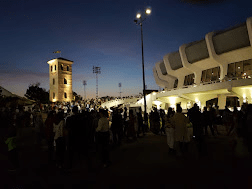
We left the Hall to wait for Alec, our grandson, and stood by “Mike the Tiger’s” cage. Mike the Tiger, a mixed Siberian-Bengal tiger, is the live mascot of the LSU Tigers football team. Mike lives in a multi-million-dollar habitat. The cage with Mike inside used to be pulled around the football field before games with cheerleaders dancing on top, and for Mike’s every growl, the football team was expected to make a touchdown. We waited for Alec by the Italianate campanile, a part of Mike’s habitat (the architecture reflects LSU’s buildings).  

 People were pouring out of the Hall, waiting for their newly minted graduates who were socializing with each other for the last time as students of BRMHS. It took half an hour to loosen Alec away from his friends. 

BRMHS is a magnet school, a category of public schools that emphasizes specific educational themes. The school Alec attended emphasizes academic performance, and interestingly, his class had a great diversity of students to grow up with (31% black, 22% Asian, and 7% Hispanic. And Alec confided in me that 80% of the students were girls, lucky for him). 

I found the entire experience uplifting in providing the young graduates a solid milestone in their lives. Our three children went through high school in Canada where these events were much more sedate and low-key, performed in the gym of the schools. And, of course, I never finished high school. I walked out of Hungary when I was in grade ten and, after arriving in Canada as a refugee, the University of British Columbia in Vancouver admitted me with no high school diploma.  

People pouring out of the Pete Maravich Assembly Hall after graduation, in Baton Rouge, LA, with Campanile on the left, a part of Mike the Tiger’s habitat.