The Death of the Single-Family Home on a Quarter-Acre Lot

February 3. 2023

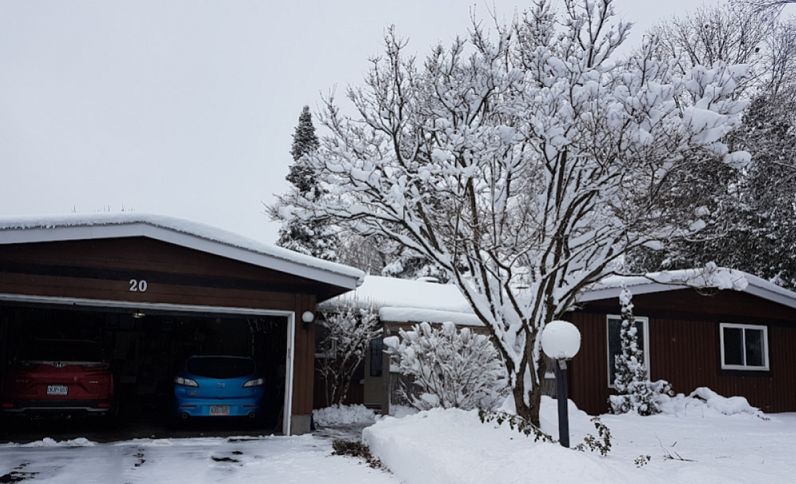
The house on a quarter-acre lot, which has been the Canadian dream, is under vicious attack. The quarter-acre lot in planning terms is the R1 zone, which occupies over half of the land of Canadian cities. In Ottawa, the R1 zone occupies over 50% of the land; in Toronto, Calgary, Edmonton, and Vancouver, it is over 60%, while in Montreal it is 45%.

But the R1 zone is “exclusionary” cry social advocates, citing the shortage and unaffordability of housing, to absorb people arriving in Canada’s cities from the hinterland, and from abroad. R1 is the culprit and therefore, it must be eliminated to permit higher densities, putting two and three dwellings on the quarter-acre lot.

But how can the R1 zone be “exclusionary” when more than half of the land used in cities is zoned R1? To me, the word exclusionary conjures up images of elite golf clubs; high-end tennis clubs, and similar facilities with entrance requirements that a minority of people possess. And by a minority, we usually talk about the “top” five percent or even the top one percent of people.

In 2016, fifty-three percent of dwellings were single-family detached homes in the R1 zone in Canada, and I would not call this metric exclusionary. The rest of the Canadians live in apartments and condominiums.

I realize municipalities could use zoning for excluding certain groups of people by specifying  minimum lot and house sizes, which could make purchasing a house unaffordable for some people. It happened to blacks in parts of the United States (until it became illegal to do so), but I have seen nothing in Canada to illustrate that zoning has been used to exclude a specific group of people from a community.

I studied city planning at the University of North Carolina where Professor Chapin wrote and taught the classic and long-used textbook “Urban Land Use Planning”. According to him, zoning has been a tool to regulate development, generated by employment growth, creating a need for housing, schools, and commercial development.

We have been fortunate in Canada to date, being able to expand the urban boundaries of our metropolitan areas, to provide for growth and reasonably priced housing. Now, suddenly, we find that environmental concerns, greenbelts, and natural boundaries like water and mountains constrict some of our cities concurrent with our radically exploding immigration intake, creating an unprecedented demand for housing.

The government solution to the housing crisis is to densify our communities, and one approach is to permit the doubling or tripling of dwellings that occupy half the land of our cities. And that is the R1 zone. Conclusion: it has to be done away with. Ontario recently introduced legislation to triple the population of the R1 zone by allowing three dwellings on the quarter-acre lot instead of one, starting in the summer of 2023.

I think that by doing so, we’ll destroy some of our attractive and historical districts. Allowing three dwellings where there is one now will lead to a haphazard and unsightly streetscape. Instead of the usual one car per dwelling, we’ll have four of five cars on the same piece of land and lacking parking space on the quarter-acre lot, on the streets. Traffic will increase on roads designed for low-density residential districts. Schools will have to be renovated to serve more children on limited sites.

So, you ask, what is the solution for the burgeoning demand for additional housing? I think that we’ll have to develop some new towns and/or attract our future development into peripheral small towns around our metropolitan areas.

Failing that approach, I suggest that densification in our single-family communities should be allowed gradually in places where the installed infrastructure permits additional development, or until after governments build the required infrastructure.

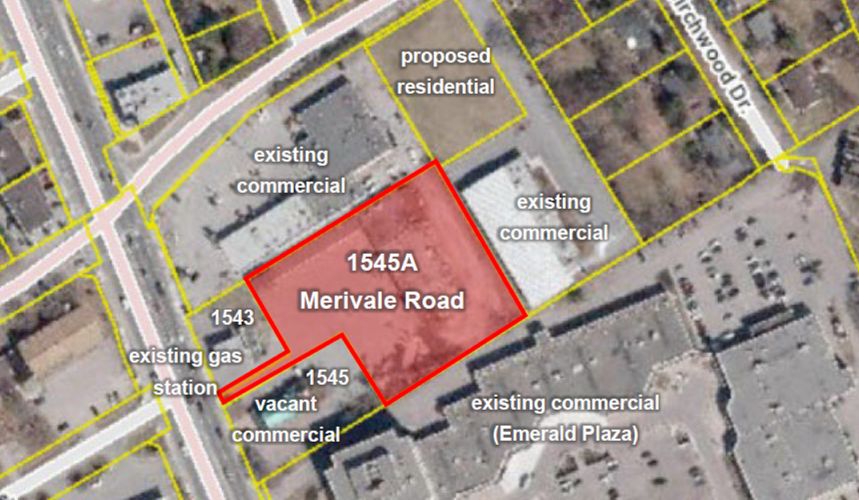
But the demise of the single-family dwelling on a quarter-acre lot has already started. In my community, doubles have replaced single-family units. In one situation, someone purchased two lots, demolished the homes on the land, and constructed three units. These small-scale redevelopments, to date, have bordered our community, but I foresee some enterprising homeowners in the middle of our community replacing their dwellings with a duplex or triplex, creating increased traffic and destroying the family-oriented nature of the community.

Sistine Chapel Exhibit Review: A Mixed Experience

Janury 27, 2023

Three Views of the Sistine Chapel

I was underwhelmed viewing the Sistine Chapel touring exhibit, produced by Entertainment Events Inc. (EEI) of Hollywood (showing only the ceiling frescoes painted by Michelangelo). The first showing of this exhibition was in Montreal in 2015, after which it toured the world and arrived in Ottawa in December 2022.

 In Ottawa, EEI presented the exhibition at the EY Convention Center, in a large, industrial type of space, like an airplane hangar. It just did not have the aura for showing biblical scenes painted by Michelangelo on the ceiling of the Chapel. What frosted me was the advertising for yoga classes at high prices, taught in front of the paintings. I found the combination of appreciating renaissance paintings with concurrent yoga exercises jarring. But the receptionist told us the yoga classes were fully subscribed; I could not see myself putting my body in yoga poses with great effort and appreciating the artwork simultaneously.

There were no brochures or handouts to describe and explain the paintings, this was Covid times. Instead, you had to bring your cell phone, to which you could download, via a QR code, the explanatory comments. Once we figured out the technical challenges, we found the commentary useful.

Before looking at the pictures, we listened to an introduction to how Michelangelo accepted a commission from Pope Julius II and built a scaffold to paint the ceiling at a height of sixty feet in the Chapel. Michelangelo used vivid and colorful paints on wet gypsum and completed the work between 1508 and 1514. EEI used high-definition photographs to reproduce the paintings in full size.

The full-size biblical scenes were twenty feet above the floor at the EY center, enabling viewers to see the pictures, including brush strokes, in granular detail; that was a major benefit of this show according to EES, compared to seeing the same pictures sixty feet above the ground in the Sistine Chapel.

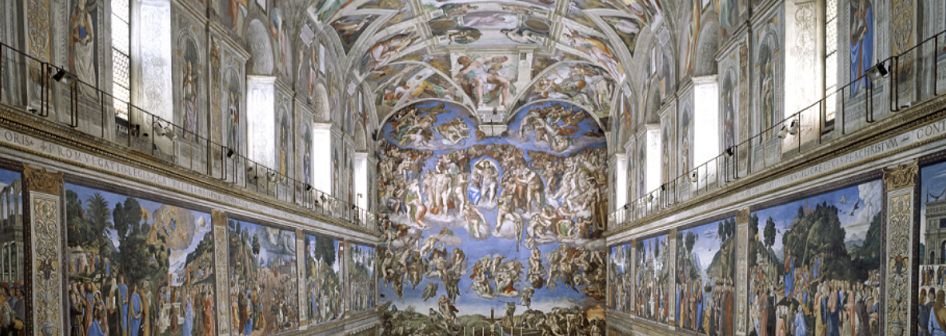
This exhibition was attractive to art buffs and religious historians, especially those familiar with the Bible; but to me, it does not compete with seeing the real Sistine Chapel in the Vatican, which we visited in 2015. The comparison is like watching a football game on TV versus attending in person. It is hard to describe the excitement of walking through the Sistine Chapel with hundreds of people, all sighing with wonder at the pictures, even though they are sixty feet above you, and seeing not only the ceiling but also the walls, painted by other renaissance artists. But at the touring exhibition, one could take time to study the Michelangelo painted frescoes at a close distance without a crowd.

Although the excitement was tangible within the Sistine Chapel, there were detractions: some people took photos despite being warned not to do so. And the guards kept hushing people to be quiet. As well, when we went, the crowd filled the Chapel wall to wall, and the guards nudged us to move on to let the other visitors come in.

I found the best way to see the Sistine Chapel (if you have internet access and a computer), is to log in to https://www.museivaticani.va/content/museivaticani/en/collezioni/musei/cappella-sistina/tour-virtuale.html This site provides a virtual tour. You can look at all sides, plus the floor and the ceiling of the Chapel. If you want to see more details, you can enlarge the pictures. You may miss the excitement of being in the Chapel, but you do not have to travel to Italy, line up with hundreds of tourists at the entrance and have a limited amount of time to look at the paintings.

Walking through the Sistine Chapel in the Vatican, and looking at stories told by the colorful frescoes, made an everlasting impression on me. I found this quote that reflects my sentiments: “Without having seen the Sistine Chapel, one can form no appreciable idea of what one man is capable of achieving” (Johann Goethe, August 23, 1787).

 Having seen the original work, the touring exhibition was disappointing for me but would be attractive to people where the touring exhibition goes. If your city is not on the touring exhibition schedule and you do not have the time and money to visit the Vatican, the website above provides an excellent way to see the inside of the Sistine Chapel.

The Challenge of Tipping at the Taj Mahal and Other UNESCO World Heritage Sites

January 16, 2023

We caught an early Indian Railways train in Delhi to get to the Taj Mahal in Agra. There was a substantial breakfast served by a dapper, uniformed porter on the two-hour train ride. We joined a long line of people waiting for the opening when we arrived at the Taj at 7:00 am. Inside, several official guides competed for our attention.

One guide, a small man with a starched white shirt and tie and formal manner, offered to show me where to take the best photo shots, including where the shots in the James Bond movie Octopussy were taken. Believing he was a government employee on the Taj grounds, I thought his services were free.

He took me on an extensive tour that lasted more than half an hour. He knew the story of the Taj. And he showed me a glorious spot to take a picture of the Taj, from an arcade looking at the front of the Taj, framed by an arch above. It is a novel snapshot that shows the Taj with the minarets at the four corners. It was early in the morning, and the white marble building showed unforgettable translucency in the rising sun.

I thought that even though he was a government employee, I should at least offer him a tip for his tour and offered as much as the entrance fee. He asked me what it was for. I said I wanted to show my appreciation for his time with a tip.

He stared at me in astonishment, then laughed and explained that I did not realize what an expert story he shared with me and that at least ten times what I offered would be a minimum to pay for his expertise. His gall and arrogance astonished me. I was going to negotiate but got my back up at hearing what I thought was an outrageous demand. I told him he had never said that he expected remuneration and that if I had been aware that he would expect so much money, I would have refused his offer for the tour. And I started walking away.

He called after me and negotiated to double my original offer. I chalked up this encounter as an experience in traveling at world-famous tourist sites.

This incident reminded me of an episode we had in Jaresh, Egypt, where we paid for a guided tour. The guide was excellent, and I offered what I thought was a generous tip, which he pooh-poohed and told me to give it to the paperboy and explained in a loud voice that he was worth ten times as much. I finally just started walking away from him, leaving an amount equal to the entrance fee that the guide then threw to the boy selling trinkets at the gate.

From these two experiences, I gathered that, as an initial gambit, the guides ask ten times what you offer, but are happy to accept less than half the suggested tip. I found tipping an unpleasant task with educated and experienced guides.

Traveling in Morocco (Fez) and Egypt (Karnak), the distinguished-looking guides, those with a suit and a tie, had a much more sophisticated approach to earning money. These guides took us on tours that ended up in a gift store, where they expected us to buy artifacts in the store made by local artisans. I noticed that when we left; the guides had a few words with the owners of the stores, and my strong suspicion was that the guides received a kickback, a percentage of the amount we spent in the store.

Some of these guides are professional historians and provide excellent guided tours. But they are also aggressive in securing huge tips by shaming the Westerners, who are often seduced by suave guides with a suit and a tie on, university professors moonlighting as tour leaders.

I found group tours are better, in that they include tips in the price, although the guides always expect additional money.

Regardless of such annoyances, the Taj is a great place to visit. It is a unique building that has an eerie, light feeling in the sun and is surrounded by a well-maintained garden. When leaving, the guards at the gate told us that there are always lots of tourists there.