February 13, 2026
The book All That Man Is by David Szalay has short stories about European men. The stories unfold chronologically from April to December, the first story starting with the youngest man, who is 17, and each subsequent story featuring an older man, culminating in the last story, which features a man who is 73.
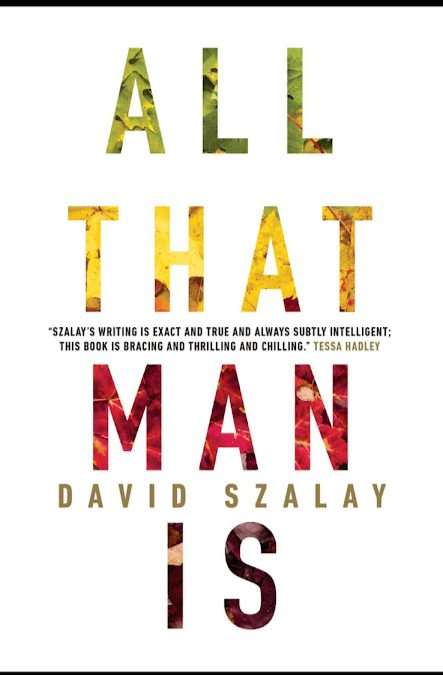
The book has nine stories, starting with two students sightseeing in Berlin and Prague, followed by a young Frenchman vacationing in Cyprus. The subsequent stories are about a university student and his girlfriend driving ftrom Oxford, England to Poland; a bodyguard with his boss and the boss’ wife from Budapest working in London; a Danish journalist digging up dirt on a politician in Amsterdam; an English realtor selling condos in the Swiss Alps; an Englishman living on the Croatian Riviera; a Russian oligarch trying to commit suicide on his yacht on the Mediterranean, and a retired British diplomat living in Italy.
The stories center on white, heterosexual European males traveling or living in a country other than their home in Europe. Does this group of characters represent what it means to be the typical European man today, as the book’s title suggests? I think the author is exploring whether these men collectively illustrate a modern archetype.
I really enjoyed the book. The stories are compelling with well-written plots and fascinating characters whose problems feel real. The smooth language is punctuated by dialogue, balancing longer passages introducing the characters and describing the localities.
Some events are quite funny, as in the story where a married woman in Prague tries to seduce a young, shy boy and ends up sleeping with boy’s friend. Or, when the oversized girl and Bernard put the mattress on the floor in the Cyprus hotel in order to accommodate their lovemaking. However, the author never mocks the inept subjects. Instead, he uses gentle language to describe their frailties and haplessness.
A recurring theme in the stories is the lack of, or search for, meaning in life. This led me to question whether Szalay portrays contemporary European men as lacking purpose, ambition and opportunities, focusing instead on vacations, drinking, and sex. Through these motifs, the book prompts us to ask: Is this what defines the European man today?
An interesting writing craft the author uses is leaving the stories hanging at the end, with no conclusion about what happens next. For example, when the student finds out that his girlfriend is pregnant, he assumes an abortion will solve the problem, while the girlfriend absolutely refuses to do so and wants to keep the baby. The story ends without the reader knowing what happens with the couple. Another example is the Russian oligarch who wants to commit suicide but does not know how to do it. Again, the reader is left with uncertainty about what happens in the end. I found the stories with uncertain conclusions entertaining, leaving the reader to speculate about potential ends.
The stories are realistic; the plots are familiar. The book In Praise of Older Women came to mind while reading the first two stories about young men and older women (Stephen Vizinczey, 1978). The realtor story recalled brochures for ski chalets in Canada, and the story of the Hungarian woman in London reminded me of Central European girls brought to the US for prostitution. The Danish minister’s affair with a married woman is typical of politicians’ scandals. Such familiar situations made the book feel genuine to me.
The short stories also reminded me of Alice Munro’s work, such as Runaway (2004). However, in contrast to the women who suffer in Munro’s stories, the men in Szalay’s stories end up the losers. For example, Murray, retired on the Croatian Riviera, is chasing validation of his masculinity by going after a barmaid, and when losing her to a Dutch friend, he goes after the barmaid’s mother, not upscale choices by any standard.
If Szalay’s stories attempt to define the contemporary European male, I wonder about their lasting relevance. As Europe’s demographics change, will the image of the European man in this book remain accurate or become outdated? The book was short-listed for the Man Booker Prize, and I found it thought-provoking and enjoyable.
 andrasthehun.ca