October 17, 2025
My son reminded me of a time when, after dinner, I lay down on the couch, closed my eyes, and listened to Oscar Peterson as loudly as the family could tolerate. Oscar Peterson has always been my favorite jazz pianist. In my youth, I enjoyed listening to my mother play jazz: she had a perfect ear and could play any song without sheet music, picking out chords as she went along. Perhaps because of her influence, I started playing the piano at an early age and continued until I rebelled in my early teens against the long practice sessions. This background helps explain my passion for jazz piano. In my opinion, as a jazz pianist, Oscar Peterson is unmatched, even when compared to greats like Ramsey Lewis, Ahmad Jamal, or Art Tatum.
Oscar Peterson’s fame is indeed global. He won eight Grammy Awards and collaborated with legends like Ella Fitzgerald, Louis Armstrong, and Nat King Cole. He also received the Order of Canada, among many other accolades. His success is especially inspiring considering he grew up in Little Burgundy, a predominantly Black neighborhood in Montreal, where racism was alive. His father worked as a porter and a sleeping car attendant for Canadian Pacific Railways (CPR). However, he was also a musician who encouraged his children to pursue music.
Oscar displayed his talent for the piano from an early age. He studied under Paul de Marky, a Hungarian classical pianist who had studied with Stephan Thoman, a pupil of Franz Liszt. Although he initially showed an interest in classical piano, Oscar’s musical path evolved significantly early in his life. He played in jazz clubs in Montreal as a teenager and later performed at Carnegie Hall in New York in 1929 when he was twenty-four years old. Over his lifetime, he recorded around two hundred albums before passing away in 2007.
I remember seeing Oscar Peterson perform at Norfolk State College in 1968. He played spirituals to an all-black audience—we were the only white folks at the college. I had a job in Norfolk, VA, but I was mostly ignorant of the racial issues in the United States at the time. When we entered the auditorium and realized we were the only white people there, we felt a bit out of place. However, the audience was enthusiastic, wholly immersed in the music, and ignored us. The auditorium seemed to come alive with people stomping their feet and clapping to the rhythm.
While in Norfolk, I cannot forget the time when I played some Oscar Peterson music at full blast, and a black pastor knocked on my door looking for donations. The first thing he said was that I was listening to some great music. Naturally, I gave him a large donation.
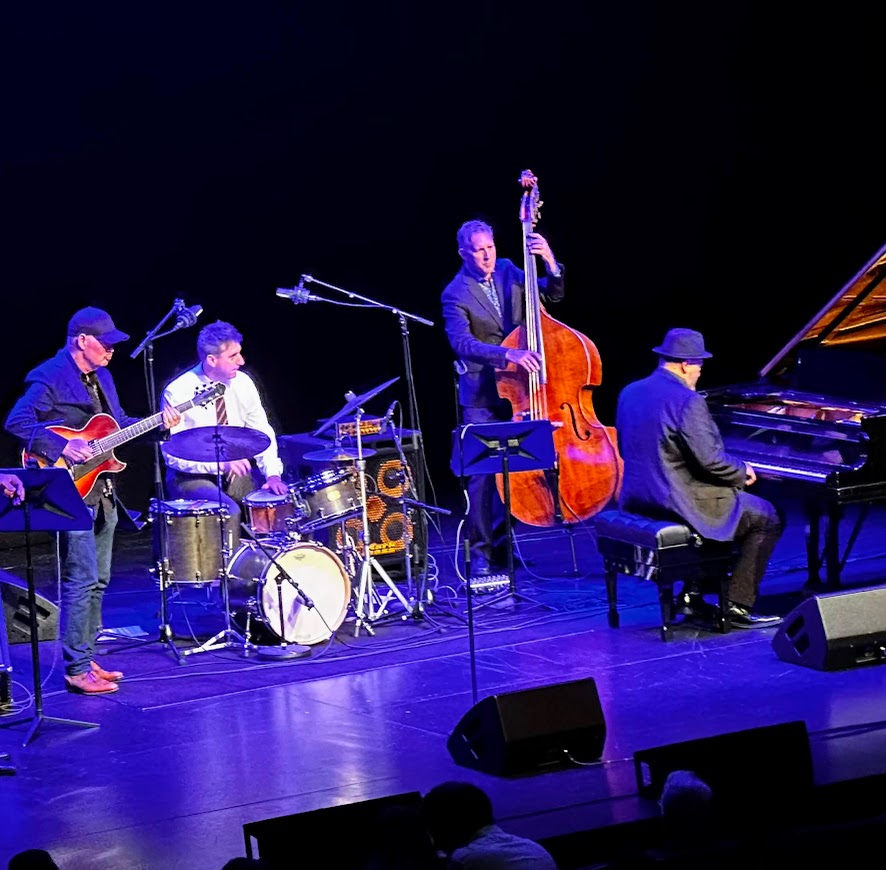
When the announcement was made that the Oscar Peterson Centennial Quartet would be performing at the National Arts Centre in Ottawa, I quickly purchased tickets. I wasn’t familiar with the Quartet, but I assumed they would play Oscar Peterson’s music. I was particularly eager to hear the pianist, even though I knew that no one could match Oscar’s virtuosity.
In honor of Oscar’s 100th birthday, the Centennial Quartet was formed this year. The organizers assembled a group of accomplished musicians for the Quartet. The performance we attended featured Ulf Wakenius on guitar, who had played with Peterson for ten years, from 1997 until Oscar’s passing. On piano was Robi Botos, a former student of Oscar’s in Toronto. The drummer, Tom Doxas, and bassist, Mike Downes, are both well-known figures in the Canadian jazz scene. The Quartet is touring globally, and while the musicians may change depending on the venue, the music remains consistent.
Upon arriving at the theater, we were treated to a multimedia presentation of Oscar’s life on a giant screen above the stage. Then, Celine Peterson, Oscar’s youngest daughter, took the stage to share anecdotes about her father. The concert began with Celine introducing the drummer, who performed a quiet drum solo. The bassist was introduced next and joined the drummer in a soft swing while Celine continued speaking. Following them, the guitarist and pianist joined in, and the Quartet launched into one of Oscar’s compositions, “Night Train,” apparently inspired by the composer’s father’s work as a sleeping car attendant for the CPR.
The Quartet’s interpretations of Peterson’s compositions, including “Hymn to Freedom,” “Cakewalk,” and “Place St. Henry,” were met with enthusiasm and loud applause. In addition to these pieces, the Quartet also performed popular classics like “Sophisticated Lady,” a composition by Duke Ellington, and others. The audience’s warm reception was so overwhelming that after finishing their set, the Quartet had to perform an encore to calm the audience’s applause. I was bobbing my head and stomping my foot to the rhythm throughout the concert. As the smiling crowd exited the auditorium, I stopped at a table in the lobby to browse the CDs for sale by members of the Centennial Quartet. I decided to buy one—the one featuring pianist Roby Botos—hoping to enjoy jazz piano in the style of Oscar Peterson. And as soon as we entered our house, I started playing all of my Peterson’s CDs.
 andrasthehun.ca