Hiking the Chilkoot Trail in Alaska and Yukon

December 24, 2022

I looked in horror to see Kathy sink in the snow, walking twenty feet in front of me. She was down to her waist before she stopped sinking. I lurched forward and flattened myself on the snow-covered field reaching towards her with my outstretched walking pole. With effort by both of us, she crawled out of the snow with a disbelieving smile on her face.

 Deeply etched in my mind, this memory came back to me when reading someone on Quora – a question-and-answer website – that his most memorable adventure, after traveling in eighty countries, was skating on the Rideau Canal in Ottawa: the 3-mile-long canal frozen during the winter months. I have skated on the canal many times without getting excited over it.

In contrast, hiking the Chilkoot Trail stood out in my memory for its physical challenges, natural beauty, and dangers.

As soon as we decided on our hike, our daughter, Megan, and her husband Jerome from Baton Rouge, LA, and son David and his girlfriend Erica, Chapel Hill, NC, decided to join us. Our camping group increased in size when my friend Lloyd also joined us with his son Neil and Neil’s new bride, Alison. Neil offered the trip to Alison as a honeymoon and presented it like a walk in the park. Well, that was not to be, Alison was not in shape for heavy-duty hiking and did not have proper hiking boots.

We hiked the thirty-three miles long (fifty-three kilometers) Chilkoot Trail from Skagway, Alaska, to Bennett Lake in the Yukon in 2001. (The trail is famous for the Klondike gold rush when over a hundred thousand prospectors panned for gold between 1896 and 1899.) It took us five days of hiking and four days of wilderness camping to complete the trail, enjoying unparalleled scenery, from the coastal rain forest to alpine lakes to above the tree line.

At the trailhead, the park rangers gave us a lecture about grizzly bears and how to distinguish between predators and other bears, a fascinating subject to ponder on embarking on the trail; were the park rangers trying to scare us or merely educate us?

Although the rangers advised us not to use hiking poles because of the fragile ground conditions of the north, we brought along one pole each; a useful additional support on uneven terrain.

From the trailhead, we started on a gentle hill with a path not very well marked or visible, but full of roots and rocks. I found the ascent difficult with a heavy backpack on our back carrying our food for five days and camping gear.

Although most of us started to hike early in the mornings after a quick oatmeal breakfast, Lloyd slept in, and Jerome got off early with nary a breakfast and was always the first to arrive at our destination at night; he reserved the best sites at the camp for our group of nine.

We brought along large chunks of cheese for lunch that did not require refrigeration and had trail mix and chocolate bars for snacks. Our “happy” hour was when we arrived at the designated campsite and set up our tents. The freeze-dried food tasted delicious at dinner time after a hard day of hiking.

Since we had to fill up our large water bottles every day, I made a deal with Neil. He did not have a water filter and borrowed mine. In return, after filling up his and Alison’s water bottles, he filled up mine and Kathy’s.

Being in bear country, the rangers advised us to wash our dishes and utensils carefully after dinner. For the night, we packed up all the food and hung it in our backpacks from a rope strung high between two trees, away from our tents, to make sure that bears could not get to it.

On the third day of hiking, we arrived at the famous “stairs.” I thought there would be stairs cut into the rocky ascent. It was not. I read that during the winters, the stampeders cut fifteen hundred stairs in the ice to make it easier to climb up the slopes. We arrived at the “stairs” in September when there was no ice and the “stairs” were huge rocks, some over ten feet high, that we had to climb. We climbed for hours in a fog so we could not see where the top was. We just kept on climbing. When we arrived at the top, we were euphorious about accomplishing what we thought was a real feat.

Descending from the highest point in our trek on a glacier, Kathy suddenly sunk to her waist in the snow-covered mountain side. It seemed surreal to see her sinking, so I hurried over and lay down on the snow to get traction to reach and pull her out. She was soaked, and we hurried up to warm up. Walking over rocky terrain was a unique challenge; there was melting water among the rocks, and we jumped from rock to rock to avoid the water.

On the fourth day of hiking, we heard loud talking and singing behind us. David, Megan, and Erica were trying to make a lot of noise when they got between a mother bear and her two babies. The mother bear false-charged them. Megan and Erica backed away and David flailed his arms to make him look bigger until the bear moved away. Kathy and I hiked with bear bells clanging, and the rest of our party wore them as well after meeting the bears.

We returned to Skagway in the last car of the White Pass and Yukon Railway, free for the smelly hikers, to avoid mixing with the tourists from the luxury cruise liners docked at Skagway. On arrival we went to a pub to have a cold beer. 

The Nuclear Stress Test of the Heart

December 18, 2022

I drove over to the east end of Ottawa to the Cardiovascular Center in a strip mall. It was a bad move on my part to hit the road in rush hour, especially with all the construction going on. It was difficult sometimes to find the lanes toward my destination with all the traffic cones, although this was my second trip there. The first time they injected some dye into the blood flow to track the circulation. This time, they would track the circulation after stressing my heart out.

The Cardiovascular Center is in one of the most inauspicious strip malls. And within the mall, the center is between an optician and a pharmacy. The other small stores in the mall range from dog obedience school and physiotherapy to a Middle Eastern restaurant with Arabic writing on the storefront.

Driving to the Cardiovascular Center made me relax; I usually get nervous going to medical buildings. This place in the middle of a nondescript shopping mall is certainly not like going to a hospital and seeing uniformed nurses and doctors rushing around the hallways with official tags around their necks.

I checked in with the receptionist sitting behind a plastic window and sat down in the waiting room on a seat away from the sun that was shining through the floor-to-ceiling windows, making the room feel like a hot greenhouse.

The people in the room were all older, like me, some required canes for walking. One couple was talking loudly, otherwise, the room was quiet and I read my cell phone to pass the time.

It did not take long for a nurse to call me into a room furnished with a hospital bed, monitoring equipment, and a treadmill. Aha, I thought I will use the latter for the stress test.

Then the nurse asked me to take off my clothes from the waist up and lie down on the hospital bed. She put a blood pressure monitor on my arm while talking to me, then put electrodes on my chest. The last connection was an IV needle.

Finding a good vein to insert an IV is always a challenge for nurses. Although I drank a lot of water that morning to help show veins, and she said that she saw the veins, she could not find one large enough for the needle around my elbow. After poking me twice by my elbow, she put a smaller IV needle into the top of my hand.

In the meantime, we had a great chat about Ottawa that relaxed me and brought down my blood pressure, which is always high when I visit a medical facility, even if it is in a strip mall.

She started my IV drip with saline solution to help the veins; she explained it is used to deliver medications. After the saline solution, some nuclear material dripped into my veins to stimulate the heart. All this time she kept asking whether I felt nauseous, had a headache, was dizzy, or was just lousy. I did not have any of those symptoms but was getting anxious, as I started imagining that perhaps I should have those symptoms if the test were working. But she repeated the same questions in a few minutes, and I assured her again that I was fine and told her if she did not badger me, I could fall asleep on the comfortable bed. The lack of any sickness on my part was a good sign, she said, and that made me feel good.

The nurse also explained that if I felt sick because of the nuclear material, she would give me an “antidote” via the IV. Since I was not feeling bad, I am not sure if she gave me any antidote.

The bottom of my arm, which had the IV in it, was getting painful with pressure building up in it, and told her so. She explained that it is the rush of the liquids coming from the IV needle and because the veins are small in the lower arm, the flow of the liquid puts pressure on the walls of the veins.

The only other impact beyond the pressure in my arm was my pulse rate exploding from its normally low rate in the fifties. Perhaps it was the anxiety of doing the test. While the IV drip was going on, the nurse was in front of a monitor watching my performance.

After a while, she said that it is time to inject some dye into my veins for the “gamma” camera to track the movement of blood in my veins, especially around my heart. I said that was fine with me; she could have put any liquid, even alcohol, into my IV.

When we finished with all the cocktails entering my veins, she told me to go outside into a small waiting room and eat the snacks that they had directed me to bring. But I asked her, “When are we going to do the stressing”? and pointed to the treadmill. She replied that the stressing was already done and explained that the nuclear material injected into me made the heart race and mimic the action of the heart when one is exercising. Ah! So that was it. I did not feel like I exercised at all – I did not sweat – and felt gypped not having the chance to jog on the treadmill for a little exercise, but glad the first phase of the testing was over.

So, I went into a small waiting room and snacked. I was hungry by this time; as I had been told to fast for four hours before the test.

After a half hour in the waiting room, they took me into another room with a dentist-type chair. On the left side of the chair, there was the gamma camera, a huge L-shaped machine that covered my chest, and the left side. She moved the camera over my chest and told me to sit on the left side of the chair so that the other side of the L was next to my left side, where the heart is. The camera buzzed for four minutes and then after a break, we did it over again, for four minutes. Then I was done.

I felt quite relaxed coming out of the Cardiovascular Center. It was not only because the staff were pleasant but also because of the venue. We were in a strip mall, and I thought this visit was more like going for coffee at Starbucks than getting a medical exam. Maybe we should have all medical clinics in shopping centers instead of medical buildings. Now I just must wait for the results, which may come in a few weeks.

From Railroads to Coal Mines to National Park

December 9, 2022

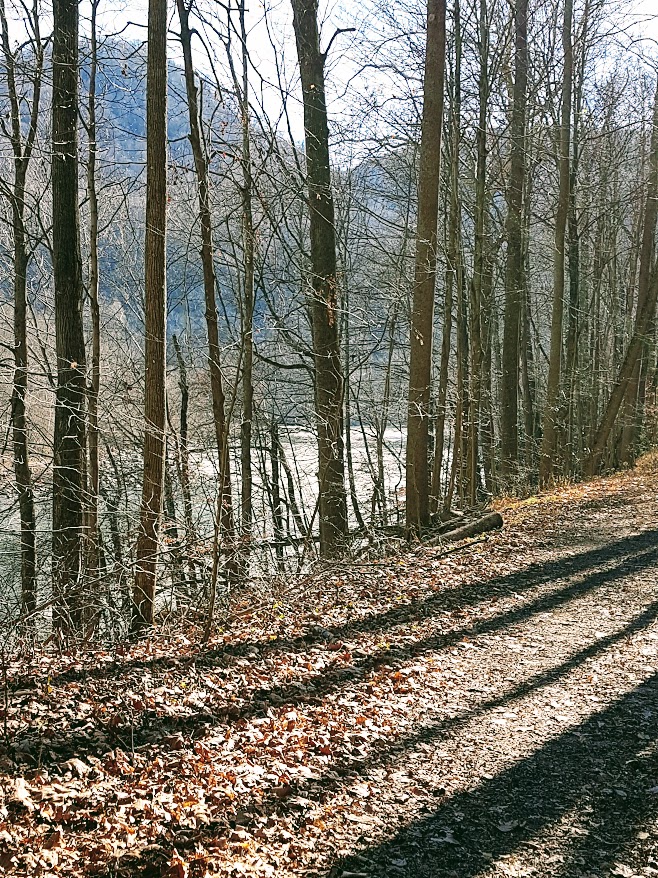
We hiked along the Southside Trail in the New River Gorge National Park near Fayetteville, West Virginia, over Thanksgiving weekend. The trail is wide, and the grade is easy; it follows an abandoned railroad line used by the Chesapeake and Ohio Railroad company in the late 1890s and early 1900s. Those with longer legs and strides went ahead. I strolled after them, enjoying the quiet. There were no people on the trail except one fellow walking a couple of dogs.

It was in November; all the leaves had fallen, making the path soft under the foot and letting the sun’s rays come through the trees. The temperature warmed up from near freezing to t-shirt time and I put my jacket and sweatshirt into my backpack.

the Southside Trail

Coal mining in this areagoes back to the 1800s. Coal replaced wood to boil brine to make salt needed for the transport of meat with no refrigeration. Small coal mines had sprung up to respond to the need. The demand for coal further expanded when using coal oil for indoor lamps became popular in the mid-1800s; distilled coal is coal oil, made just like moonshine. The increasing demand for coal triggered the construction of railroads.

I passed by well-preserved coke ovens, left over from the time “King coal” was mined and made into coke in the early 20th century. Taking a rest on my walk, I sat down and looked up the story of coal in this part of West Virginia on my cell phone.

I learned the mining industry was a tough one; miners were mostly immigrants and African-Americans, working for low pay under unsafe conditions. To accommodate the workers, the mining companies built housing for them from scratch, overnight; the housing was segregated with whites on one side and blacks on the other side of the coal chute. The companies also provided a store, since there were no other commercial establishments in the vicinity. And the stores sold items for usurious prices to the miners who had no options but to buy at the company store.

Despite their hard condition, the miners’ spirit could not be contained: they played baseball, and the folklore of the ballad of “John Henry” or the alternate “Take the Hammer” song was born. I checked out the ballads sung by most blues and country singers and the one I like the most is by Tennessee Ernie Ford. You can listen to it on YouTube: https://www.youtube.com/watch?v=5Kr6FIXBaZ8

The United Mine Workers of America (UMWA), formed in 1890, came to unionize the workers, to help improve pay and safety, and fought, often violently, for 43 years. Mary “Mother” Jones of national fame, was one of the principal leaders in the West Virginia labor movement until 1921 and led many marches, culminating in armed fights between the miners and the mine owners. The armed miners could not stand up against the National Guard and the Armed Forces called out by the Governor of West Virginia in one case and President Harding in another case. The mine wars culminated when President Roosevelt let the UMWA organize in 1933.

The trail I followed is next to the “New River,” an ironic name for one of the oldest rivers in North America. There are spectacular views of the river along the trail, which has smooth water parts for canoeing and white water for rafting and kayaking. The New River is in a deep gorge, hundreds of feet down from the rim; the sides of the gorge provide some of the best rock climbing in the Eastern United States.

After a couple of hours of walking, I turned back while the rest of the family went on this seven-mile trail. I engaged in a friendly conversation about the history of the coke ovens with the three people from Virginia I encountered on my return trip to the trailhead.

Our home was a Vacation Rental by Owner (VRBO), a half-hour drive from the trailhead, in Fayetteville with a current population of 2800 people. Fayetteville, incorporated in 1872, used to be a mining town, but to me, it was transitioning to become a tourist town in the center of the New River Gorge National Park.

 The house was close to a thousand square feet in size, fully renovated, and well-appointed, but I felt technically challenged trying to change the thermometer. Equally challenging was following instructions to make coffee on a machine that combined a carafe coffee maker with a Keurig coffee maker.

Sam, the host, came over to help us figure out how to operate the “nest”thermometer. He demonstrated how your finger moving along the perimeter of a circular control knob changes the temperature. 

His wife runs three VRBOs, and he takes care of technical problems when he is home from Alabama, where he now works. Although he was trained as a mining engineer, it was not clear if he was doing mining-related work in Alabama. Perhaps he left town, because there may be no mining jobs left in Fayetteville. The abandoned mines we saw in the area testified to that.

In the afternoon, we walked around the hilly streets of Fayetteville, incorporated in 1872, with small houses like the one we rented. Many of them looked vacant; I wondered if the people owning the vacant units left town for job opportunities elsewhere and converted them to VRBOs.

The downtown area had well-maintained, old commercial buildings. One was a bank. I always recognize the typical small-town banks, stone buildings with Greek columns framing the entrance, and large windows on the sides. This bank was at a street corner, as most of these small-town banks are, with the entrance door located diagonally where the two streets met. 

We came to stay in Fayetteville, a convenient location for visiting the New River Gorge National Park. The area was originally established as a National River in 1978, by President Carter and updated into a National Park in 2020 by President Trump. They show a short film on the history of the National Park at the Visitor Center. On leaving the Visitor Center, a South Korean family asked me to take a picture of them, which I was happy to do.

Observing the mostly out-of-state license plates in the parking lot of the visitor center and meeting someone from South Korea made me think the area is successfully transitioning from the declining mining industry to tourism. According to a National Parks report, the New River Gorge National Park attracted 1.8 million visitors in 2021 who spent over $80 million in the region.

(The coal industry grew from mining two million tons of coal in 1880 and employing 3700 people to mining 168,000 tons of coal in 1948 and employing 125,000 people, at its peak. Today, West Virginia coal mines produce 90,000 tons of coal and employ 49,000 people.)

The Advent Worship in Clemmons, North Carolina

December 4, 2022

St. Judas Thaddeus Church in Sopron, Hungary

I have never been a church-going person except in my youth when my father, who went to a Jesuit school, made us go to church on holy days like Xmas and Easter.

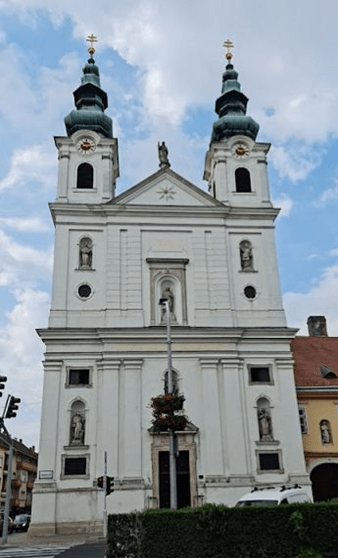
My memory of going to the old baroque church in Sopron, Hungary – St. Judas Thaddeus, built by the Dominicans in 1715 – is not pleasant (see picture on left). The huge nave of the church was a forbidding, gloomy space for a small kid. It was cold inside with a stone floor.

Nobody received us at the entrance lobby; nobody led us inside. I stood for the service at the back of the church, listening to the sermon; that gave me a quick getaway if I got too cold or bored by the service.

The sermon and the entire mass were in Latin, which I could not understand. (The Catholic Church required that Mass be carried out in Latin until the Second Vatican Council of 1962–1965, which permitted the use of the vernacular.)

And the priest dressed in ecclesiastical clothing for delivering the sermon, giving him – and it was always a “him” – a formal appearance, talking down to us from the pulpit ten feet above us.

And, of course, we had the confessionals in little cubicles on the side of the nave of the church, where it was dark and I had to kneel in front of a wire screen behind which was the priest listening to your sins which were related to disobeying your parents and swearing using religious imagery.

 The salvation for my “mortal” sins, prescribed by the priest, was always saying a prayer fifty times or more, depending on the gravity and length of the list of my sins. I always thought the confessional was a good bargain to repent your “mortal” sins; it never took longer than a half hour to get back on the good side of the Lord.

Once I repented my sins, I lined up for communion wafers, the “sacramental bread”, that tasted good. Then we were free to leave the church.

Clemmons First Baptist Church, Clemmons, North Carolina

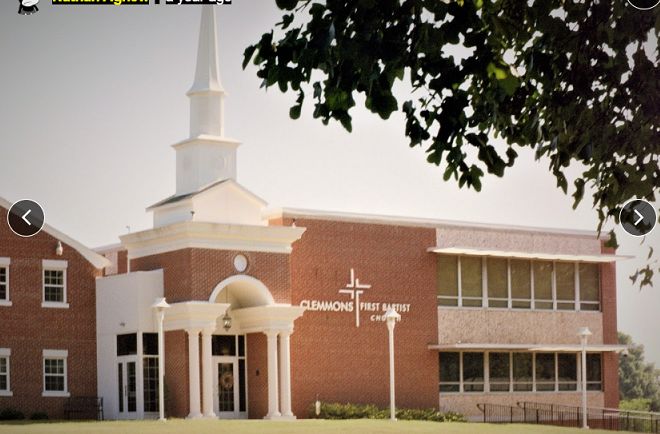
I encountered a huge contrast to my experience with my baroque church when we visited our family at the end of November in Winston-Salem NC, and joined them for Sunday service at Clemmons First Baptist Church (see picture on left), on the last Sunday of the month, the beginning of Advent.

We entered the modern building with a red-brick façade, where smiling people welcomed us into the well-lighted and comfortable lobby and ushered us into the nave of the church to padded pews.

I felt like I was in a large living room entering the lobby and once we sat down, lively conversation filled the church until the service started. The Pastor welcomed the attending children, and the organist played hymns with the text shown on two gigantic video screens over the stage so that we did not have to pick up the hymn books to follow the songs.

All the people were informally dressed. The Pastor showed up in slacks and a sweater and gave a sermon from notes, speaking freely most of the time.

The Pastor addressed the meaning of Advent by asking us to look at our state in life to make sure we are ready for the second coming of Jesus. He illustrated his point by talking about himself getting old, although he said he is 44 years old; to me, he is a young man. But he said he feels his age when getting up “from a toilet seat”, eliciting laughter from the audience. He added that now one can install higher toilet seats to help with that. This type of informal sermonizing made me feel quite comfortable.

Then the Pastor, in a more serious vein, talked about embracing silence, meditation, and the healing power of nature. I felt quite at home by now: we just came from the New River National Park in West Virginia, where we spent a few days hiking and enjoying nature in silence.

He said there is no need to push yourself to get ready for the second coming by reading the scriptures. Instead, he said, wait until the desire to do so comes from within yourself. I liked his low-key approach to religion; embrace religion when you are ready for it. I was ready to join the church!

At the end of the worship, we followed the Pastor, who walked into the lobby to welcome the audience. I told him how much I enjoyed his sermon, shaking hands with him.

I noticed a board in the lobby with pictures of a dozen deacons (members of the church); I learned that all the families frequenting this church have a deacon who follows their well-being and provides help when needed. For example, should someone get sick and not be able to cook, the deacon would organize members of the church to bring over food. My brother-in-law is a deacon here. I thought the deacons performed an important and valuable role.

If we had had churches like the Clemmons First Baptist Church when I was growing up, I may have been a lifelong churchgoer.

The Minister of Immigration’s Foggy Response to my Questions on Inreased Immigration to Canada

December 2, 2022

I wrote to the Minister asking if he considered the impact of his bumped-up immigration targets on the Canadian housing market (where there is a severe shortage) and on Canadian healthcare (which is bursting at the seams).

Although it is desirable to have more immigrants to grow our economy, can we provide housing and healthcare to them when Canadians are experiencing a housing shortage, and millions are without a family doctor?

I received an automatic acknowledgment, promising a response in six weeks if my questions are worthy of a response:

“Thank you for your email addressed to the Honourable Sean Fraser, Minister of Immigration, Refugees, and Citizenship. Please note that all comments and questions are taken seriously, and although Immigration, Refugees and Citizenship Canada (IRCC) cannot provide a personalized response to every message, we will review and consider all comments received.”

“…the service standard for a response to correspondence addressed to the Minister is six weeks if it is determined that a reply is warranted. “

A couple of weeks later, I received a form-letter providing officious government bumph but no response to my questions.

“The Government of Canada is committed to an immigration system that contributes to economic growth, supports diversity, and helps build vibrant, dynamic and inclusive communities. The 2023-2025 Immigration Levels Plan, tabled in Parliament on November 1, 2022, projects continued growth in permanent resident admissions with targets of 465,000 in 2023; 485,000 in 2024; and 500,000 in 2025.”

“The Levels Plan sets out a path for responsible increases in immigration targets to support economic growth and address labour market shortages. Over half of all planned admissions are dedicated to the economic class.”

“In 2022, Canada is on track to welcome 431,645 new permanent residents, and the 2023-2025 Levels Plan builds on this momentum. Increasing immigration will help cement Canada’s place among the world’s top destinations for talent, while reuniting family members with their loved ones and fulfilling Canada’s humanitarian commitments, including on Afghanistan resettlement”.

“For further information, I invite you to read the 2022 Annual Report to Parliament on Immigration.

Ok. There is no mention of the availability of housing for immigrants, or the ability of our current healthcare system to provide healthcare to immigrants.

But wait, I thought there may be more information in the 2202 Annual Report to Parliament on Immigration. So I read the entire report and found the only remotely relevant text under “settlement and integration services”:

“IRCC supports the successful integration of immigrants to Canada through a suite of settlement and integration services. In 2021–22, IRCC funded more than 550 service provider organizations and provided settlement services to more than 428,000 clients. Services include pre-arrival and post-arrival orientation and information services, needs and assets assessment and referrals, language training, employment-related services including mentorship and apprenticeship programming, and services that help newcomers connect and contribute to their communities.” 

Again, nothing on housing and healthcare for immigrants.

Canada’s population of 38 million occupies 16 million housing units, with an average occupancy of 2.3 people per household. Applying this number to the 500,000 immigrants to be welcomed annually in a few years, we would need over 200,000 housing units annually, just for immigrants. But that is the number of units that Canada builds in a typical year. Even if we assume immigrant families double up, the housing shortage would get worse, resulting in even more unaffordable housing prices than we have today. Has the Minister not thought about the availability of housing for immigrants at affordable prices?

What about healthcare? Canada has 2.7 physicians per 1,000 population (in 2021) compared to the Organization for Economic Co-operation and Development (OECD) average of 3.5 (2017 or the nearest year). We do not compare well to OECD countries relative to the number of doctors per 1,000 population.

Applying the ratio of 2.7 physicians per 1,000 population, the half a million immigrants the Minister wants to bring to Canada each year would require 1,350 additional physicians. Would Canadian healthcare deteriorate further due to increased immigration? Would the 2.7 ratio be reduced?

Half a million immigrants annually would require thousands of housing units and doctors if they wanted to live the life that Canadians are used to. The Minister has not responded to my questions on how he would house the immigrants given the already shortage of, and high price of, housing in Canada. And he has not responded how our already overburdened healthcare system would grapple with an annual inflow of half a million of immigrants. Were these subjects an oversight by the Minister? Are we muddling ahead without an analysis of the consequences of our actions?