March 11, 2023
It felt like, rightly or wrongly, we should take a trip. Everyone we know was going somewhere. It is winter vacation time for many of our friends as they “get away” from winter.
The winter travelers made me think: what type of past trips have we enjoyed the most, anytime? And the one that stood out was walking the Camino de Santiago in the Fall of 2012. We walked from Leon to Santiago, Spain, a distance of 320 kilometers, in 16 days, following the centuries-old pilgrimage route to the shrine of the apostle St. James in Santiago de Compostela. Thousands of people from all over the world walk it every year.
Although the Camino is often described as a religious experience, we thought more of doing the Camino for exercise, for its physical challenge, and as a cultural experience. Most people we talked with had similar goals, except for a few doing the Camino for reflection, or a pause in life, figuring out their next career move.
To me, the best feature of the walk, which made it so relaxing, was that we lived day to day with no thought of the future, with no thought of doing daily chores such as taking the garbage out, paying bills, and washing the car. We just got up in the morning, packed our stuff, and hit the road, with or without breakfast. Then we walked and walked, and stopped whenever we wanted to rest, eat, see the surroundings, or engage in a chat with locals or other pilgrims, called “peregrinos” locally. There was no past, no future, just the present.
Living in the present is wonderful. After a long day of walking, our challenge was to find a nice albergue, or hostel in English, where we took a hot shower, relaxed our tired bodies for a while, and then enjoyed the “peregrino’s” dinner. After dinner, we sat by the fireplace and socialized with other pilgrims, solving world problems. It was a glorious life!
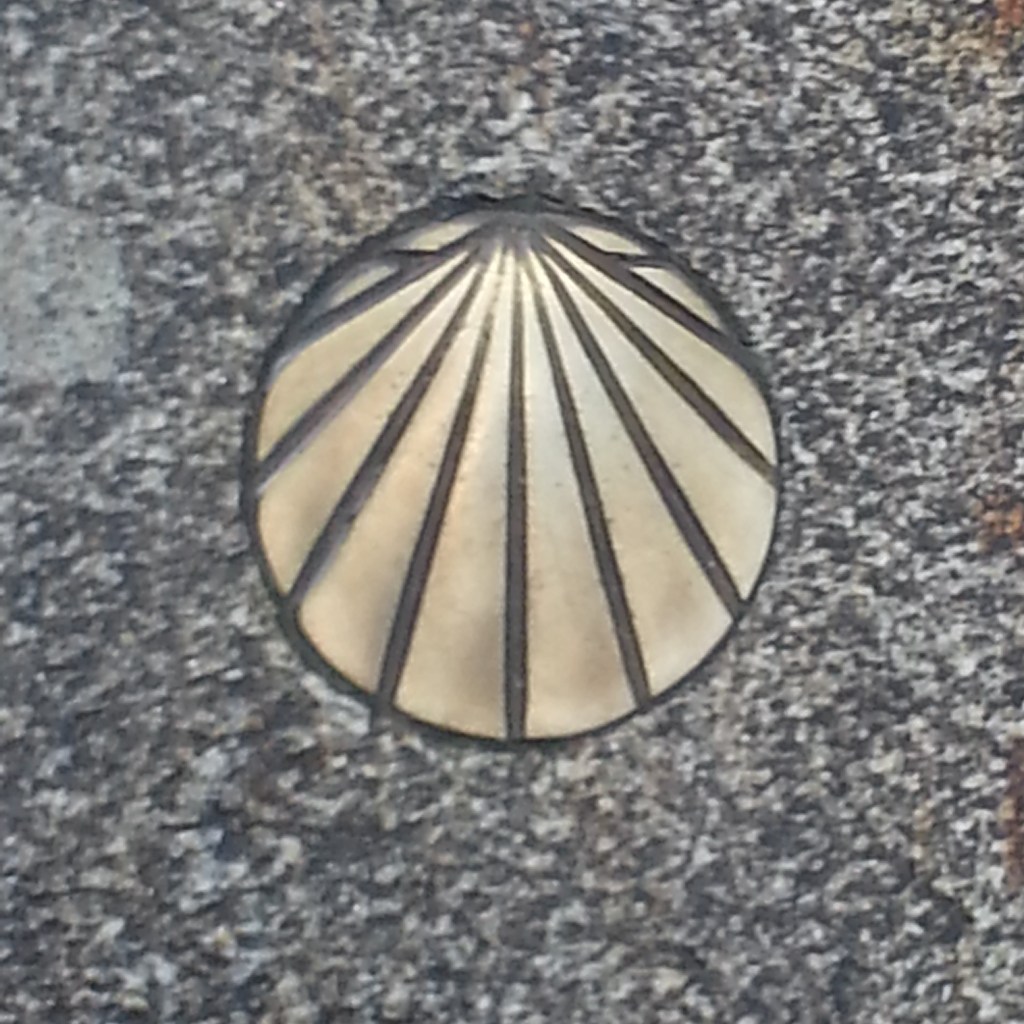
The walk is well-marked by the scallop symbol because the pilgrimage routes lead to the Galician coast, where scallops are abundant, and pilgrims would often collect these shells as souvenirs
I am not saying it was all fun. When we started in Leon, it was raining hard and we thought of delaying our start, but, who knows, the next day may be the same, so we started with our rain gear on. The first challenge was to find the scallop sign to start the walk, and talking with a local on the street, he suggested we take a bus to get to the outskirts of Leon, where the trail is marked clearly and we could start walking in the country avoiding the industrial parts of the town. We followed his advice and got on a bus with our backpacks; we did not know where to purchase a bus ticket, so we just got on and asked the driver for advice who waved us on to sit down, recognizing foreign pilgrims.
The driver beckoned us where to get off, and we followed the other pilgrims on the road. The road was wet and full of puddles and we got thoroughly soaked that day, but we found a friendly “hospedalier”, or hostel host, in an albergue in the afternoon, where we rented a private room at a slightly more expensive rate than staying in the dormitory. After changing into dry clothes, we put our wet clothes in front of a roaring fire in the living room. Once we took a shower and changed into our dry clothes, we joined other pilgrims for a “fixed dinner” at the albergue. After dinner, we sat with the other pilgrims and exchanged views on the Camino experience and whatever was happening elsewhere.
Talking with other pilgrims was entertaining, interesting, and comforting. We learned that no matter what part of the world you come from, we all have similar wishes, ambitions, frustrations, and experiences. We met someone from the UK who just went thru a divorce and came to walk the Camino to rethink his life. Another pilgrim from the US was between jobs, assessing his options; he did not want to work in his father’s company. A young woman from Brazil came to see the culture of Spain.
We walked with a Danish woman for a few days on the Canino; we walked at the same speed and spent many hours talking about the social network in Denmark. She was a teacher but got bored with teaching and just took a few months off to travel. She was not concerned at all with getting another job when she returned home and explained that she would always have a job, no matter how often she quit. During one of her breaks in her career, she learned to become a yoga instructor, and she gave us a morning yoga class, a good warm-up, before our walks.
With all fellow pilgrims, we had direct, honest, and meaningful discussions; we all realized the chances of ever meeting again were close to nil and therefore we could open up and talk from the heart. I seldom, if ever, had this type of deep-felt interaction before. Being older than most pilgrims, we felt a bit like the confessional priest as they poured out their stories.
Some people were introverted and did not stop socializing, preferring to be alone with their thoughts. That was all right as well; there was no shortage of people on the road to say hello to. We saw people behind or ahead of us all the time. A few came to experience and find religion. But most people we met and talked with came for the exercise and to soak up the local culture and enjoyed engaging with other pilgrims on the day’s journey.
Of course, we needed preparations for our trip. One was by walking longer and longer distances at home, which helped me to get used to the daily walks on the Camino, which averaged six hours. We stopped walking in the early afternoon to make sure we had a nice auberge to stay overnight.
In the light backpacks that we purchased, we carried a change of quick-dry clothing, toiletries, rain gear, and digital equipment. We minimized the amount of clothing we took with us to reduce the weight of our backpacks. One of the best recommendations received was to have hiking boots that are well-worn and comfortable, and we had those.
We put the winter clothing that we needed to travel from Ottawa to Leon, Spain, in a suitcase, and sent it on the train from Leon to Santiago, where they held them fro us at the station storage area.
We also carried silk liners that we purchased in Vietnam; we used them at the albergueswhere they provided beds and covers. By using silk liners, we tried to protect ourselves from bedbugs. One in our walking group acquired such an acute case of bedbugs that she visited a doctor and delayed her trip by a week to get over the itching.
For information on the Camino, I found the slim book by John Brierley the best. Using his book, we identified rest stops where we would look for albergues for overnight stays.
When we were tired of bunk beds provided in the albergues and wanted some comfort, we went upscale to a hotel with a private bathroom. Another reason for taking a hotel room was that although the albergues gave some sort of breakfast, it was minimal and we had to leave by 7 a.m., a not-always-pleasant early departure. In one albergue, they shut the lights off at nine p.m., and locked the entrance door, which I found strange and scary; I looked for an exit in case of fire that I could not find. Locking the door for safety made sense to me, but we should have been able to open the door from the inside. That was not the case in this situation.
But most of the time, we found the albergues clean and hospitable, offering excellent dinners at a reasonable price, and providing the opportunity to meet and socialize with pilgrims from all over the world.
Our lunches included cheese, bread, and fruit, which we purchased the evening before. We learned early to buy our food supplies at the first available store; many of the small villages we crossed had no stores. Many of these villages looked abandoned or occupied by few people, perhaps because of urbanization that drew people to the cities for jobs, like what has been happening in North America.
We bought the fixed menu “peregrino’s” dinner offered in most towns, or at the albergue, frequently accompanied by other peregrinos we had met that day. These dinners were terrific, often freshly caught fish, always served with a bottle of wine on the table that was refilled when emptied, and dessert.
In Galicia, we enjoyed the locally famous “pulpo” meal of octopus, freshly boiled in front of us and served on a wooden platter cut into small disks, with a jug of wine and bread. It tasted a bit like chicken. We went back twice; the octopus was so good!
But the Camino is more than great food, genuine hospitality at the albergues, and meeting people on the Camino: it was a walk across various and attractive landscapes, from flat to hilly terrain, that was occasionally challenging.
Along the way, we visited unique architectural works that I found interesting being an architect. For example, the Santiago de Compostela Cathedral is a Romanesque-style cathedral, which was our destination. It is one of the most important pilgrimage sites in the world and is believed to be the burial place of Saint James the Great. The cathedral’s crypt is beneath the high altar and is believed to be the burial place of Saint James. A striking memory of the Cathedral is the way it is lit up at night when we can see all the rich sculptural details of the building.
The Cathedral in Santiago made an impression on me in another way as well. I am Catholic and my memories of Catholic churches in Hungary as a child did not compare with what I experienced in Santiago. We attended a service that was in Latin and performed by three priests. Right after, they burned incense in a large basket hanging from the ceiling, forty meters above the transept, halfway down from the ceiling. The basket swung back and forth, and the burning incense generated a cloud that enveloped the upper part of the church. I found that the sun coming through the windows from the sides of the transept created a mysterious effect, burning through the incense. Some people in the audience cried. I was so taken by the experience that we came back a couple of more times to relive this supernatural feeling.
In Astorga, we encountered the unique neo-gothic “Palacio Episcopal”, or the Bishop’s Palace, designed by Antonio Gaudi. every bit as fascinating as the works by him we had seen in Barcelona, characterized by curvy, flowing lines.
It was an educational experience to stay overnight at a monastery, converted to an albergue, where we slept in a cell with bunk beds designed for monks previously.We had one enormous bathroom per floor, like some college dormitories at home, and a common kitchen where all the pilgrims fixed their dinners. It was an opportunity to socialize again.
In Rabanal, we visited the 12th-century chapel, where a choir of Benedictine monks performed Gregorian chants in Latin, a unique experience in an appropriate historical building. The Knights Templar built the 12th-century Romanesque chapel and protected the pilgrims as they traveled the Camino. The chapel could not seat more than a few dozen people and smelled musty. It was dark inside, but the sound of the choir created a mysterious atmosphere, making us feel as if we were back in the 12th century.
Walking through a part of Galicia, we came across Celtic Crosses – like what we see in Wales and Ireland and learned that the Galicians were also Celts; in fact, they have their language and to this day many in the country do not speak Spanish.
While going on a cruise or spending time in warm climate resorts has appeal,there is no comparison in my mind to the satisfaction that I get from a walking tour such as the Camino, which combines physical challenges with cultural experiences; truly, to me, a very satisfying way to spend a few weeks. We walked the second half of the Camino, although we met one couple who had walked from Germany. Others divided it up into several blocks to enable them to finish the whole trail.
.
 andrasthehun.ca