March 6, 2025
While driving through the Thar Desert, the temperature soared into the upper 40s Celsius. Despite the heat during our travels in Rajasthan, our trip was filled with unique experiences, including an Ayurvedic massage, a camel ride in the desert, and accommodation in a Maharaja’s palace.
Many Maharajas lost their wealth and status after India gained independence, forcing them to find new ways to make a living. Many were left with nothing but their palaces, which they transformed into hotels. Our room in one of these palaces had an authentic atmosphere characterized by heavy curtains to keep the heat and noise out, aging period furniture, and a slightly musty smell. It was huge by North American standards. The luxurious palace made us feel important while we stayed there.
We had arranged for an Ayurvedic massage, advertised in the palace’s lobby, to be performed in our hotel room. Ayurveda, a practice that has been around for over five thousand years, focuses on balancing the body and mind. Practitioners use hot oils to promote healing and restore imbalances, and we were eager to experience it.
Two young therapists arrived—one woman and one man. Their English was limited, but they instructed me to lie on one bed and undress to my shorts, while Kathy undressed to her bra and shorts on the other bed. The therapists, dressed in business attire, covered our faces with towels before opening massive suitcases filled with various oils.
The room was quiet, and the warm oils, infused with fragrant herbs, helped us relax. I remembered a massage I experienced in Thailand, which ended with painful toe pulls. In contrast, the Ayurvedic massage was incredibly soothing.
The therapists advised to remain on the bed after the massage to allow the oils to seep into our skin until they dried and removed toxins. We had no trouble relaxing further; we were half-asleep by that point. After an hour of blissful peace, we got up to explore Jaisalmer (population 65,000 in 2011, 90% Hindu).
Walking around the city was challenging due to the narrow streets and roaming cows. At one point, a group of cows blocked Kathy as she tried to navigate her way. Many towns in India have laws against cows wandering freely, but Jaisalmer is an exception, marking our first encounter with numerous cows meandering about. (Cows are considered sacred by Hindus).
It was hard not to feel sorry for the cows, many of whom appeared half-starved and abandoned. I learned that volunteer veterinarian groups from overseas come to India to trim the cows’ hooves, allowing them to walk more comfortably. We often saw people feeding the cows before having their meals in the mornings. In the evenings, the cows usually rested or slept at the edges of the streets, having nowhere else to go.
On our way back to the hotel, we met an Indian man from Britain who expressed great disappointment in visiting his hometown. Contrary to his childhood experience, he found Jaisalmer to be backward and dirty. While we accepted what we saw as the norm, he wished the local government had done a better job in the city.
Our overnight camel safari in the desert began the following day. Due to the camels’ unique characteristics, we were advised to wear long pants to prevent irritation from their swaying and straw-like hair. Sunglasses and face coverings were also recommended in case of a sandstorm.
The safari started with a challenge: how do you get on a camel? We learned that when the camel is seated on all fours, one should climb up onto the saddle attached to its hump and lean back to avoid falling forward when the camel stands up, starting on its hind legs.
We began our camel trip on the outskirts of Jaisalmer, where we felt strange riding a camel. The roads were busy with motorcycles, trucks, bicycles, and two-wheeled camel carts with used airplane tires. People used camels as work animals. I initially thought I needed to control the camel in the traffic, but I quickly learned that this was not the case—camels listen only to their masters. In addition, our camels seemed to know exactly where to go.
Our leader walked beside his camel until we left the town and entered the desert. My camel followed the guide, a Raika tribesman. Kathy rode behind me, followed by two tribesmen and three additional camels carrying our gear.
The desert gradually enveloped us, and we continued riding in the heat until the leader suddenly stopped and unfolded a small prayer rug for himself to kneel and pray on. We also dismounted and stretched our legs to relieve any stiffness. Resuming the trip, we knew how to mount the camels.
At our camp, a couple of tribesmen set up an open-front tent equipped with cots and a small toilet tent for us. They also erected a collapsible table with chairs while the cook prepared our meals a short distance from our camp.
The temperature dropped significantly after sunset. The cook prepared mouth-watering curries for us, and we finished our meal with hot chai tea infused with cloves, cinnamon, and cardamom. A spectacular view of millions of stars in the sky appeared when darkness had fully descended.
Suddenly, out of nowhere, a Gypsy family appeared with musical instruments. They began to play music next to our campfire, which was fueled by camel dung. The young girls started dancing in flowing, gold-braided dresses while their parents played unique musical instruments I had never seen before. The entire Gypsy family was dressed in colorful embroidered shirts and skirts, with the father wearing a turban on his head.
After the performance, we relaxed on our cots, gazing at the countless stars outside our open tent. I found myself wondering if the Gypsies were simply nomadic people who happened to see us in the desert or if, more likely, the organizers of our tour had arranged for them to perform for us.
Before drifting off to sleep, I thought about how majestic the camels were, with their slow, ambling gait. I also reflected on the Raikas, a local tribe in Rajasthan, who are actively working to protect the diminishing number of camels. Thanks to their advocacy, the government declared the camel the state animal of Rajasthan in 2014.
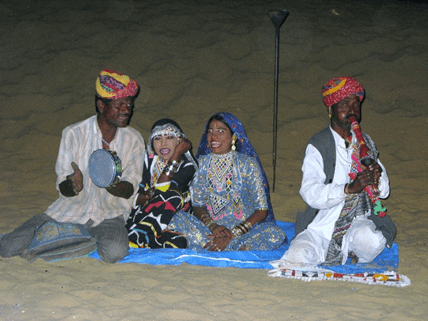
Entertainment at night in the desert.
 andrasthehun.ca